Manduka PRO vs Gaiam Dry-Grip: Which One Should You Buy?
Gaiam's Performance Dry-Grip sits at the top of the most visible budget brand in yoga, and the Manduka PRO is the mat people buy when they decide they're done buying mats. Both are PVC with a closed surface, so this is not a grip rivalry. It's a question of how much mat, and how many years of mat, you want to pay for.
As an Amazon Associate, we earn from qualifying purchases made through links on this page. How this works
The quick answer
These two settle into a clear order. The PRO is 7.5 pounds of dense closed-cell PVC that took first place in GearLab's 19-mat test, supports you like a firm floor, and routinely stays in service for a decade, backed by a lifetime guarantee. The Dry-Grip is a softer, lighter 5 mm mat that GearLab found comfortable for slow, unheated practice, but its wet grip placed near the bottom of the same test and its long-term durability was flagged as a weak point. Both share PVC's core weakness: sweat sits on the surface, and wet palms slide.
If yoga is a habit you expect to keep, the PRO costs less per year than its price tag suggests and is much better to practice on. If your practice is gentle, dry, and occasional, the Dry-Grip is a comfortable mat for about half the money.
Get the PRO if...
- You practice often enough that a decade-long mat makes sense
- You want dense, planted support under balance work
- You're willing to break in a slick surface for a few weeks
- You want the guarantee with real fine print behind it
Get the Dry-Grip if...
- You'd rather keep about $74
- You want a lighter mat to carry (4.25 pounds vs 7.5)
- Your practice is unheated and your palms stay dry
- You want a softer, more forgiving surface for slow practice
Side by side
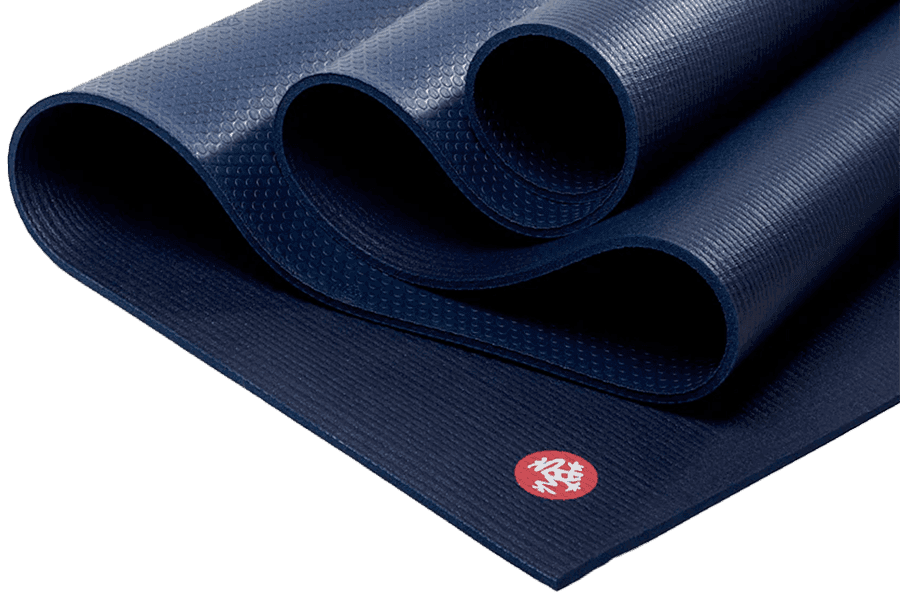
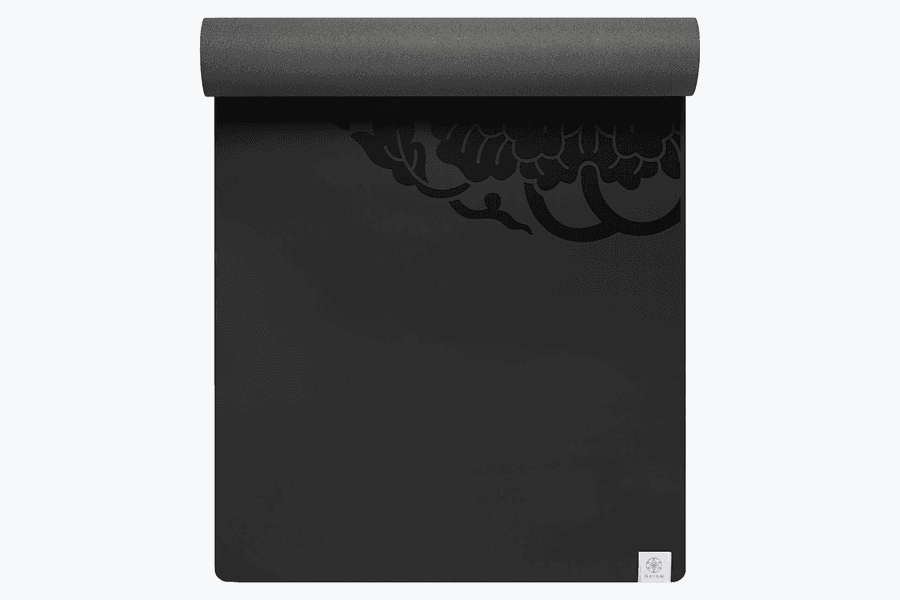
Price
The Dry-Grip lists for about $74 less.
$144
List price · check price at Amazon
$69.98
List price · check price at Amazon
Thickness
The PRO is 20% thicker.
6 mm0.24″
5 mm0.2″
Weight
The Dry-Grip is 3.3 lbs lighter.
7.5 lbs3.4 kg
4.25 lbs1.9 kg
Size
The PRO is 3″ longer; the PRO is 2″ wider.
Same on both
- PVC with a closed surface, so sweat stays on top
- Latex-free, safe for latex allergies
- Lifetime guarantee on paper (defects, not wear)
- Wrong mat for hot yoga without a towel
Full specs
Dimensions
Materials & build
Buying
Two PVC mats built to very different standards
This pairing comes up whenever someone outgrows a starter mat and starts pricing the next one. The Gaiam Performance Dry-Grip is the step-up mat from the brand you see at Target: 5 mm of PVC with a smooth topcoat, $69.98. The Manduka PRO is the mat at the other end of the aisle and the other end of the decade: 6 mm of dense German-made PVC at $144, famous for refusing to wear out.
Because both are closed-surface PVC, they share a personality trait that surprises people: neither is a sweat mat. What separates them is density, lifespan, and what each feels like to actually practice on, so that’s where we’ll spend most of this page.
Cushion and stability: dense beats soft for most practices
The spec sheet says 6 mm versus 5 mm, which sounds like a wash. It isn’t, because the two mats put very different material in those millimeters. The PRO’s closed-cell PVC is compressed into a slab that supports you like a firm floor: your hand sinks a millimeter and stops, which is exactly what you want under a standing balance or a loaded wrist. GearLab ranked the PRO first of 19 mats in its test, and that planted feel is a big part of why.
The Dry-Grip is softer and more forgiving, and GearLab’s testers genuinely liked its comfort for slower practice; knees and hips get a kinder landing than the PRO gives them. The cost of that softness is wobble under one-legged work and less feedback from the floor. For restorative and stretch-heavy practice the Gaiam’s cushion is the nicer place to be. For everything more dynamic, the PRO’s firmness wins.
Grip: a break-in problem vs a sweat problem
Each mat has one well-documented grip flaw, and they’re different flaws. The PRO’s is temporary: the closed-cell surface ships slick and needs a few weeks of regular practice before traction arrives. Manduka used to suggest a salt scrub to hurry this along and has since retired that advice; the current position is that the slickness resolves with use, and broken-in PROs grip respectably with dry hands.
The Dry-Grip’s flaw is permanent and lives in its name. GearLab rated its wet grip near the bottom of the same 19-mat test, found traction fell apart in sweaty sessions, and steers the mat toward stretch practice and slower flows. With dry palms it’s perfectly secure; the topcoat handles light moisture at best. Neither mat is the right tool for hot yoga, but the Gaiam is the one whose marketing most oversells that point.
Weight: the PRO stays home
The PRO weighs 7.5 pounds; the Dry-Grip weighs 4.25. That gap decides more purchases than any spec on this page. A PRO rolled into its dense cylinder is a real carry over any distance, and most owners treat it as furniture: it lives where you practice. The Dry-Grip goes over a shoulder without complaint and suits a mat that commutes to a studio a few times a week.
The PRO is also the bigger surface: 71″ × 26″ against the Gaiam’s 68″ × 24″. If you’re much over five foot eight, those three extra inches matter more than they sound.
Durability: this is what the $74 buys
The PRO’s reputation rests here. Dense closed-cell PVC barely wears, decade-old PROs are common, and Manduka backs the mat with a lifetime guarantee whose fine print defines lifetime as roughly 10 years of regular use, one replacement, proof of purchase from an authorized seller. It’s the rare mat where the guarantee mostly goes unused.
The Dry-Grip also carries a lifetime guarantee, which is genuinely unusual at $69.98, but GearLab flagged its long-term durability as a weak point: the topcoat and the surface dye are the vulnerable parts, and guarantees at every price cover manufacturing defects rather than the normal wear that actually retires mats. On paper the coverage matches; in practice one of these mats is built to need it and one isn’t.
Materials, allergies, and the new-mat rituals
Both mats are latex-free PVC, which makes either one a safe pick for a latex allergy, something neither natural rubber nor polyurethane-over-rubber mats can claim. The PRO adds an OEKO-TEX Standard 100 certification and German manufacturing; the Dry-Grip is marketed as free of six common phthalates, with no certification and no stated country of origin.
Both need an airing-out when new, and the Gaiam needs one extra step: GearLab’s testers found its surface dye transferred onto clothing at first, so buff it with a towel before class, and follow Gaiam’s own advice to let it air for two to three days. Care afterward is identical: damp cloth, mild soap, no machine washing. PVC tolerates careless storage far better than rubber, so neither mat minds a sunny room or a car trunk the way a Jade would.
Sizes and colors
The PRO comes in a full family: the standard 71″ mat plus Long, Long & Wide, and the enormous Squared for two-person or off-mat practice, in black plus 13 more colorways at last count. The Dry-Grip comes in one size and three colorways at last count: black, purple, and blue. If fit is part of your decision, only one of these brands gives you options.
Price and where to buy
List prices are $144 for the PRO and $69.98 for the Dry-Grip, and street pricing treats them differently: the Gaiam sells through Amazon and big-box stores where prices drift below list, while the PRO holds its price almost everywhere. Check the current price of the PRO at Amazon and the Dry-Grip at Amazon. One warranty note if you go the Amazon route for the PRO: Manduka’s guarantee applies only when the mat is sold and shipped by Amazon itself.
The long-term arithmetic favors the PRO for regular practitioners: one $144 mat that runs a decade beats replacing a $69.98 mat every few years. For an occasional practice, that math never gets a chance to work, and the Gaiam’s lower entry price is the sensible call.
Bottom line
Get the PRO if you practice regularly and want to stop thinking about mats. It’s firmer, bigger, dramatically more durable, and better to practice on once broken in; you just have to accept the weight and the slick first month. Get the Dry-Grip if your practice is gentle, dry, and unheated, or if you’re not yet sure how committed you are; it’s a comfortable mat at a fair price with a limit its own name obscures.
If the PRO’s price is right but you sweat, that’s a different comparison entirely; start with our PRO vs Jade Harmony page. And if the Dry-Grip’s price is right but you want to see Gaiam’s cheaper option, we’ve compared the PRO against the Gaiam Premium too.
Manduka PRO
List price $144
Frequently Asked Questions
- Is the Gaiam Dry-Grip a cheaper alternative to the Manduka PRO?
- Only loosely. Both are closed-surface PVC mats, so they fail the same way when your palms sweat, but they're built to different standards. The PRO is a dense 6 mm slab that GearLab ranked first of 19 mats and that owners keep for a decade; the Dry-Grip is a lighter 5 mm mat GearLab recommends for stretch practice and slower flows, with durability flagged as a weak point. Think of the Gaiam as a comfortable mid-range mat, not a discounted PRO.
- Which is better for hot yoga?
- Neither, and we mean that. Sweat sits on top of both surfaces, and wet palms slide. GearLab rated the Dry-Grip's wet grip near the bottom of its 19-mat test despite the name, and a new PRO is slick even before sweat gets involved, though a broken-in PRO does better. If heated or heavily sweaty classes are your normal, look at an absorbent polyurethane top or natural rubber instead, or plan on a towel over either of these.
- Is the PRO really worth $74 more?
- If you practice regularly, the arithmetic favors it: one $144 mat that runs a decade costs less per year than replacing a $70 mat every few years, and it's a firmer, more stable surface the whole time. If you practice a few times a month, the Dry-Grip's comfort is perfectly adequate and the PRO's density is overkill you'd be paying to store.
- Does the Manduka PRO really need a break-in period?
- Yes, and it's the most common complaint about the mat. The closed-cell surface ships slick and needs a few weeks of regular practice before the grip comes in. Manduka used to recommend a salt scrub to speed this up but has retired that advice; its current position is that the slickness resolves with use. The Dry-Grip has no break-in period, just an airing-out.
- What should I know about the Dry-Grip when it's new?
- Two things. GearLab's testers found the surface dye transferred onto clothing when the mat was new and suggested buffing it with a towel before first use. And Gaiam's own care instructions say to unroll the mat and air it out for two to three days to release the new-mat smell. Both issues fade; they're just worth knowing before your first class in light-colored leggings.
- How do the lifetime guarantees compare?
- Both brands say lifetime, and both mean defects rather than normal wear. Manduka's fine print defines lifetime as roughly 10 years of regular use, with one replacement and proof of purchase from an authorized seller; on Amazon that means sold and shipped by Amazon. Gaiam's guarantee is unusual to see at $69.98, but GearLab's durability concerns about the coating are about wear, which guarantees don't cover. The PRO is the mat that makes its guarantee mostly unnecessary.
Related comparisons
- Manduka X vs Gaiam Performance Dry-Grip 5mm
- JadeYoga Level One vs Gaiam Performance Dry-Grip 5mm
- Manduka PRO vs b, halfmoon B Mat Strong 6mm
- Gaiam Performance Dry-Grip 5mm vs IUGA Eco Friendly Non Slip PU
- Manduka PRO vs Alo Warrior
- Manduka PRO vs Yoloha Unity Pro Cork
- Manduka Begin vs Gaiam Performance Dry-Grip 5mm
- Manduka PRO vs JadeYoga Harmony XW
- Gaiam Performance Dry-Grip 5mm vs Hugger Mugger Earth Elements 5mm