Manduka PRO vs PROlite: Which One Should You Buy?
Manduka makes both of these mats in the same German factory, from the same dense PVC, and backs both with a lifetime guarantee. What actually separates them is thickness, width, and about 3 pounds. We'll walk through where each of those differences matters and which mat makes sense for how you practice.
As an Amazon Associate, we earn from qualifying purchases made through links on this page. How this works
The quick answer
The PRO and PROlite are basically the same mat at two different weights. The PRO is thicker and a little wider, but it's also 3 pounds heavier and costs $32 more. The PROlite gives up a bit of cushion and keeps everything else.
If the mat is going to live at home or stay at the studio, get the PRO. If you carry it to class a few times a week, get the PROlite.
Get the PRO if...
- Your mat mostly stays in one place
- You want the deepest, firmest cushion of the two for knees and wrists
- You want the extra 2 inches of width
- The extra heft helps it lie flat and stay put
Get the PROlite if...
- You carry your mat to class, on transit, or on trips
- 4.6 lbs is a lot easier to live with than 7.5
- You'll trade a little cushion for a much easier carry
- You'd rather keep the $32
Side by side
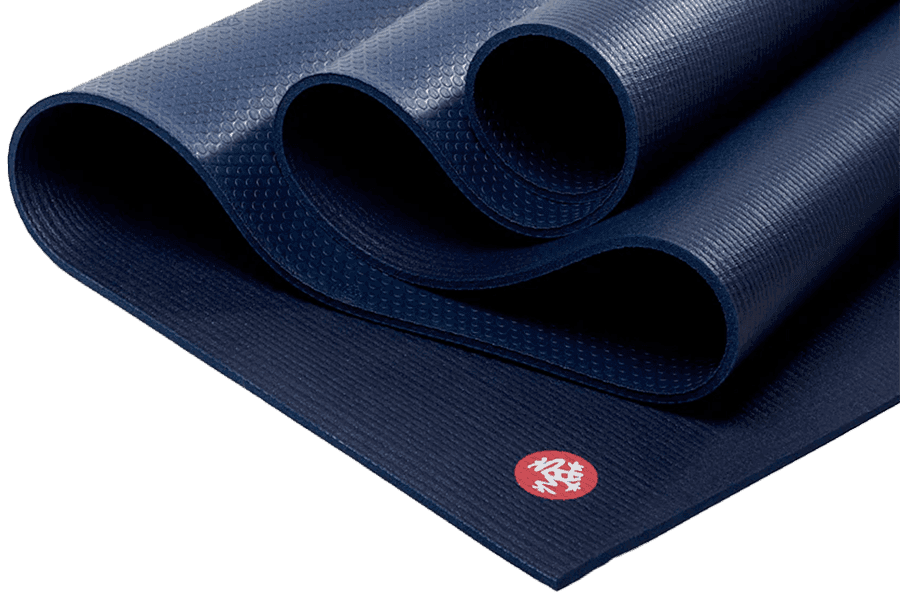
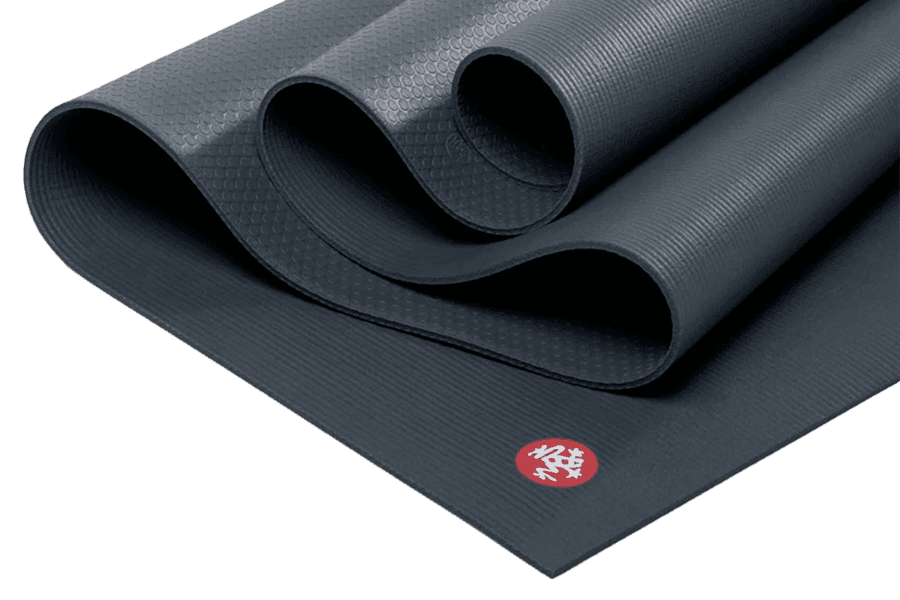
Price
The PROlite lists for $32 less.
$144
List price · check price at Amazon
$112
List price · check price at Amazon
Thickness
The PRO is 28% thicker.
6 mm0.24″
4.7 mm0.19″
Weight
The PROlite is 2.9 lbs lighter.
7.5 lbs3.4 kg
4.6 lbs2.1 kg
Size
Same length; the PRO is 2″ wider.
Same on both
- Closed-cell PVC
- Fabric-like top surface
- Made in Germany
- Lifetime guarantee
- OEKO-TEX certified
- Latex free
- Needs a break-in period
Full specs
Dimensions
Materials & build
Buying
- Short68" × 26"
- Long85" × 26"
- Long & Wide79" × 52"
- Squared78" × 78"
- Short68" × 24"
- Long79" × 24"
- Long & Wide79" × 30"
Two versions of the same mat
Manduka sells a lot of mats, but the PRO and the PROlite are the two it built its reputation on, and they follow the same recipe. Dense PVC. A fabric-like top that feels closer to denim than to foam. A closed-cell surface that sweat sits on instead of soaking into. Both are made in Germany and both carry a lifetime guarantee.
So this is not a good mat versus a bad mat. The PRO is simply more of the same thing: 1.3 mm thicker, 2 inches wider, and about 3 pounds heavier. Almost every question about these two comes down to how much of that extra material you actually want.
Cushioning: firm, and firmer than you expect
The PRO is 6 mm thick and the PROlite is 4.7 mm. That reads like a small gap, but the first thing to understand is that neither mat is soft. Manduka’s PVC is extremely dense. Reviewers who come to these mats from squishy foam consistently describe the feel as firm, almost hard, and that’s the point. You get support without sinking.
The thickness difference shows up where bone meets floor. Kneeling poses, low lunges, anything that parks your knees or hips on the ground for a while. On a hard floor, the PRO’s extra 1.3 mm of dense material takes the edge off in a way owners genuinely notice. It’s a big part of why OutdoorGearLab ranked the PRO first out of 19 mats it tested, with a perfect score for comfort and support. The PROlite is still comfortable, but people practicing on concrete or tile tend to feel the floor through it sooner.
For standing and balance work, the firmness works in favor of both mats. Nothing wobbles under a single-leg pose the way a soft 8 mm foam mat does. If your practice is mostly flowing and standing, the PROlite gives up very little.
Weight is the real decision
The PRO weighs 7.5 pounds and the PROlite weighs 4.6, and honestly, this number should drive the whole decision. If you haven’t carried a 7.5 pound mat before, it’s about the same as a gallon of milk slung over your shoulder.
At home, that weight is irrelevant. It might even be a plus, because the PRO’s heft keeps it perfectly flat and planted on the floor. The problem starts when the mat has to travel. Walk fifteen minutes to a studio, add a bike or a bus, and the PRO starts to feel like a chore. Yoga forums are full of the same story: someone loves their PRO but it stays home because they got tired of hauling it.
That’s the problem the PROlite was made for. Four and a half pounds is normal mat weight. You put it over a shoulder or in a tote and forget about it, so it’s the one that actually makes it to class.
Grip, and the break-in period nobody warns you about
Both mats share the most common complaint in their reviews: they’re slippery when new. The surface starts out slick, and until it breaks in, your hands will slide in downward dog. It’s temporary, but it surprises people who just spent over a hundred dollars on a mat.
For years the standard advice, printed on Manduka’s own packaging, was a salt scrub: spread coarse sea salt across the mat, leave it for 24 hours, brush it off, wipe it down. Manduka has since walked that back. Their current position is that the slickness isn’t a residue you can scrub away, it’s the nature of the surface itself, and it resolves on its own with consistent use. Having read a lot of owner reports on both sides, we’d skip the salt and just practice. A few weeks of regular use breaks the surface in, and from then on the grip keeps improving. These mats have a reputation for getting better with age, which you can’t say about many.
A couple of smaller things worth knowing. New mats have a noticeable smell that typically airs out within a few weeks. And once broken in, the top surface grips well without ever feeling tacky, which some people love and others find too smooth compared to a rubber mat.
The other thing to know: closed-cell PVC does not absorb sweat. With dry hands, the broken-in surface grips well. With wet hands, it slides. If you run hot or take heated classes, plan on laying a towel over either mat. This is identical on both, so it shouldn’t move you toward one or the other. It might move you toward a different mat entirely, like an open-cell rubber mat that drinks up moisture.
Durability and the lifetime guarantee
This is why people pay Manduka prices. Dense closed-cell PVC is about the most durable mat material there is, and these two mats are famous for refusing to die. GearLab’s testers noted instructors’ PRO mats five to twenty years old that were still in near-mint condition, with no compression. Studios keep them in rotation for years. Manduka leans into this with a lifetime guarantee on both mats: if one wears out under normal use, they replace it.
Read the guarantee’s fine print before you count on it, though. Manduka defines a mat’s lifetime as roughly ten years of regular use, covers wear that affects performance but not cosmetic wear, allows one replacement per purchase, and requires proof of purchase from an authorized seller. Buying from Amazon qualifies when the mat is sold and shipped by Amazon itself.
Either way, the coverage is identical on both mats, and so is the material, so don’t let durability push you toward the heavier one. The PROlite is not the flimsy version. It’s the same slab, cut thinner.
One honest caveat about the whole product line: PVC lasts forever partly because it’s plastic through and through, and it isn’t recyclable in any practical way. Both mats are OEKO-TEX certified, which covers manufacturing emissions and harmful substances, but if you want a natural material, look at something like the Manduka eKO or a natural rubber mat instead. Buying one mat that lasts twenty years is its own kind of eco argument, but it’s fair to want neither.
Sizes, width, and colors
The standard PRO is 71″ × 26″. The standard PROlite is 71″ × 24″. Two inches of width doesn’t sound like much, but lie down with your arms at your sides and it’s the difference between your hands resting on the mat or on the floor. Broader-shouldered practitioners tend to appreciate the PRO for this alone.
Both models come in other cuts. There’s a 68″ short version of each, and if you’re tall, the PRO comes in an 85″ long version while the PROlite comes in a 79″ long and a 79″ × 30″ long and wide version. A useful rule: if you’re six feet or taller, the standard 71″ length will feel short in reclining poses, and the long versions are worth the upcharge.
Colors rotate seasonally on both. As we write this, each mat comes in around a dozen colorways, though black remains the classic look for either. If you care about a specific color, check both the Amazon listing and manduka.com, because the selections don’t fully overlap.
Price and value
List prices are $144 for the PRO and $112 for the PROlite. Actual prices move around, especially on Amazon, where colorways are often discounted at different amounts. It’s worth checking the current price on both the PRO and the PROlite before deciding, because a sale can erase the gap entirely.
Either way, this is premium mat money, and the value argument is the lifespan. A $30 mat that flakes apart every couple of years costs more per decade than one PRO or PROlite that never needs replacing. That math only works if you practice consistently. If you’re brand new to yoga and not sure it will stick, buy something cheap first and come back when you’ve worn it out.
Between the two, the PROlite is the better pure value. Same material, same guarantee, thirty-two dollars less at list.
Bottom line
Buy the PRO if the mat will live where you practice. Home studio, a corner of the bedroom, or a studio that lets you store it. You get the most cushion and width Manduka offers in this line, and since the mat never has to go anywhere, the weight stops mattering.
Buy the PROlite if your mat commutes. It keeps nearly everything that makes the PRO great, weighs about 3 pounds less, and costs less. For most people who carry their own mat to class, it’s the smarter buy, and the one we’d point a friend to first.
Manduka PRO
List price $144
Manduka PROlite
List price $112
Frequently Asked Questions
- Is the Manduka PRO worth $32 more than the PROlite?
- Only if you'll use what the extra money buys: 1.3 mm more cushion and 2 more inches of width. At list price the PRO is $144 and the PROlite is $112, and both are built from the same material with the same lifetime guarantee, so you aren't paying for extra durability. If you carry your mat regularly, the cheaper PROlite is actually the better mat for you.
- Are the Manduka PRO and PROlite good for hot yoga?
- Not on their own. Both mats are closed-cell PVC, which means sweat sits on the surface instead of soaking in. Once your hands get wet, grip drops off fast. Most people who take either mat to heated classes lay a yoga towel over it. The upside of closed-cell is hygiene: the mat wipes clean and doesn't absorb anything.
- Why is my new Manduka mat slippery?
- That's normal, and it's the most common complaint about both mats. The closed-cell surface is slick when new and breaks in with use. For years the standard advice was Manduka's salt scrub (coarse sea salt, sit 24 hours, wipe off), but Manduka has since walked that back and now says the slickness isn't a residue you can scrub away; it simply resolves with consistent practice. Expect a few weeks of regular use before the surface hits its stride.
- How much thicker is the PRO than the PROlite?
- The PRO is 6 mm thick and the PROlite is 4.7 mm, so the PRO carries about 28% more cushion. Both are high-density mats that feel firm rather than soft, so the difference shows up as more support under your knees and hips, not a softer surface.
- Do both mats have a lifetime warranty?
- Yes, and it's identical coverage, so the warranty shouldn't drive your decision between them. Read the fine print though: Manduka defines the lifetime of a mat as roughly 10 years of regular use, covers performance-affecting wear but not cosmetic wear, allows one replacement per purchase, and requires proof of purchase from an authorized seller. Amazon counts when the mat is sold and shipped by Amazon.
- What sizes do the PRO and PROlite come in?
- The standard PRO is 71" × 26", with a 68" short version, an 85" long version, plus oversized spin-offs (79" × 52" Long & Wide and the 78" × 78" PRO Squared). The standard PROlite is 71" × 24", with a 68" short version, a 79" long version, and a 79" × 30" long-and-wide version. If you're around six feet or taller, the long versions are worth the upcharge.
Related comparisons
- Manduka PROlite vs JadeYoga Harmony 74"
- Manduka PROlite vs Lululemon The Mat 5mm
- Manduka PROlite vs JadeYoga Harmony 68"
- Manduka PRO vs b, halfmoon B Mat Strong 6mm
- Manduka PROlite vs b, halfmoon B Mat Everyday 4mm
- Manduka PRO vs Alo Warrior
- Manduka PRO vs Yoloha Unity Pro Cork
- Manduka PROlite vs Suga SugaMat
- Manduka PROlite vs Yoga Design Lab Combo 3.5mm