Manduka PRO vs Jade Harmony: Which One Should You Buy?
The Manduka PRO is a dense PVC slab that feels slick for the first few weeks and then lasts for decades. The Jade Harmony is natural rubber that grips from your very first class but wears faster and needs more care. We'll walk through where each one wins and which fits how you actually practice.
As an Amazon Associate, we earn from qualifying purchases made through links on this page. How this works
The quick answer
The PRO is the buy-it-once mat. It's thicker, wider, backed by a lifetime guarantee, and famous for outliving everything around it, but it starts out slippery and weighs 7.5 pounds. The Harmony is the opposite: tacky natural rubber grip on day one, almost 3 pounds lighter, about $44 cheaper, and it wears faster, hates sunlight, and carries a 1 year warranty.
If you want one mat for the next decade and can wait out the break-in, get the PRO. If grip is your priority, or you want a natural material at a lower price, get the Harmony.
Get the PRO if...
- You want a mat that lasts decades, with the guarantee to match
- You want the thickest, firmest cushion of the two
- You want the extra 3 inches of length and 2 inches of width
- You don't mind a few weeks of break-in for a lifetime of grip
Get the Harmony if...
- You want real grip on day one, no break-in period
- Your palms sweat a little and you'd rather skip the towel
- A natural, renewable material matters to you
- You'd rather keep about $44
Side by side
Price
The Harmony lists for about $44 less.
$144
List price · check price at Amazon
$99.95
List price · check price at Amazon
Thickness
The PRO is 25% thicker.
6 mm0.24″
4.8 mm0.19″
Weight
The Harmony is 3.2 lbs lighter.
8 lbs3.6 kg
4.8 lbs2.2 kg
Size
The PRO is 3″ longer; the PRO is 2″ wider.
Same on both
- Firm, dense cushion
- Lies flat without curling
- Longer sizes available
- Decades-old studio favorite
- Wipe-down cleaning only
Full specs
Dimensions
Materials & build
Buying
- Short68" × 26"
- Long85" × 26"
- Long & Wide79" × 52"
- Squared78" × 78"
- Long74" × 24"
- Harmony XW80" × 28"
Two opposite answers to the same question
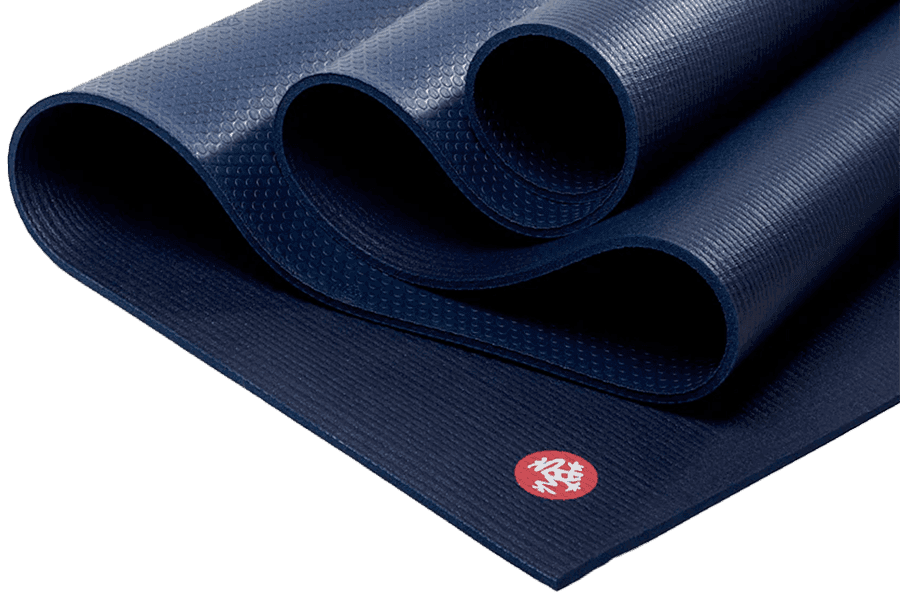
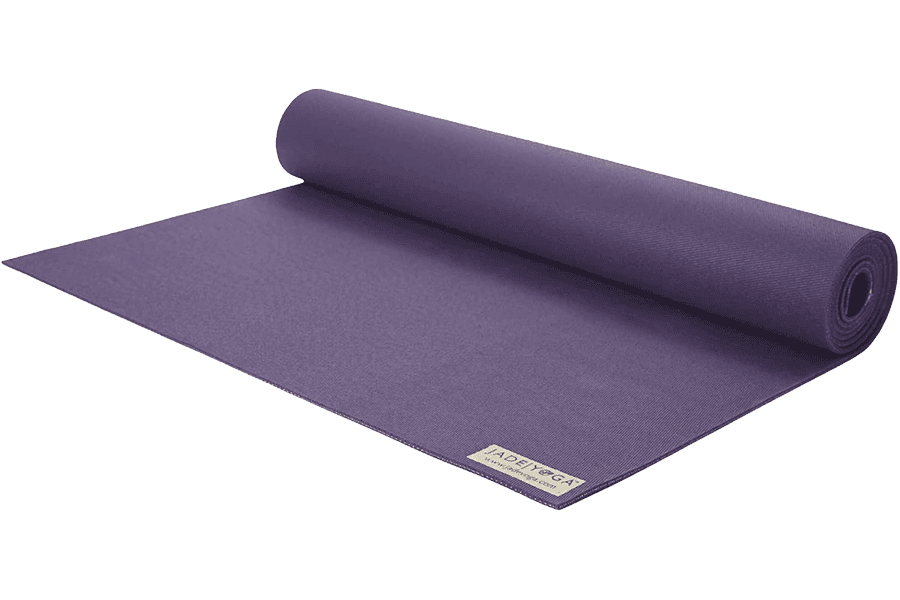
Most premium mat matchups are two versions of the same idea. This one isn’t. The Manduka PRO is a dense slab of PVC, made in Germany, that treats a yoga mat like a piece of studio equipment. The Jade Harmony is open-cell natural rubber, made in the USA, that grips hard from the first class and wears like the natural material it is.
That one difference in material drives almost everything else: how they grip, how long they last, how you clean them, and what they cost. When we compared the PRO against its own lighter sibling, weight was the whole decision. Here it comes down to whether you care more about grip out of the box or about how the mat holds up years down the road.
Grip: the Harmony wins the first month
Unroll both mats and the difference shows up on the first down dog. The Harmony is tacky the moment it comes out of the box. Jade advertises a Yoga Journal best-grip award right on the product page, and owner reviews back the reputation: with dry or slightly damp hands, the rubber surface just holds. There is no break-in period to get through.
The PRO is the opposite story. New PRO mats are slick, and it’s the most common complaint about them. The surface needs a few weeks of regular practice before the grip comes in, and until then your hands will slide. Once broken in, the PRO grips well and keeps improving with age, but you have to get there first, and plenty of frustrated PRO reviews come from people who gave up in week one.
Sweat separates them further. The Harmony’s open-cell rubber actually absorbs moisture. Jade compares the surface to a sponge, and Wirecutter credits exactly that quality for keeping traction in sweaty sessions. The PRO’s closed-cell surface absorbs nothing, so sweat pools on top and wet hands slide. If your palms sweat a little, the Harmony handles it on its own where the PRO wants a towel.
Two caveats before we call the grip contest a blowout. If you sweat enough to drip, even open-cell rubber gets slippery, and you’ll want a towel over either mat in a heated class. And the Harmony’s tackiness cuts both ways: some people find it grabby when sliding a foot forward between poses, and the rubber picks up lint, dust, and pet hair like velcro.
Cushioning and feel
On paper this is a clear PRO win: 6 mm of cushion against the Harmony’s 3/16 of an inch, which works out to about 4.8 mm. In practice both mats sit at the firm end of the spectrum, just with different personalities. The PRO’s dense PVC feels almost hard, in a supportive way, with no sink at all. The Harmony’s rubber has a touch more spring to it, a slightly softer landing that still stays stable under standing poses.
Where the PRO’s extra thickness earns its keep is bone-on-floor work on hard surfaces. Kneeling lunges, low hip openers, anything that parks your knees on the ground for a while. It’s a big part of why OutdoorGearLab ranked the PRO first out of 19 mats it tested, with a perfect score for comfort. The Harmony is comfortable for most practices, but on concrete or tile, sensitive knees will notice the difference.
If your practice is mostly flowing and standing work, either mat is more than enough, and neither wobbles under a balance pose the way soft foam mats do.
Weight and carrying
The PRO weighs 7.5 pounds. The Harmony is listed at 4.8, and Jade’s own copy rounds that to about five. Nearly 3 pounds of difference, and you feel it every time the mat leaves the house.
At home, the PRO’s heft is a feature. It lies dead flat and stays planted through the sweatiest flow. On a shoulder strap across town it becomes a chore, and plenty of PRO owners admit theirs stopped leaving the house for exactly that reason. The Harmony sits at normal mat weight. It’s no featherweight, there are 2 pound travel mats if that’s the goal, but it goes over a shoulder or into a tote without a second thought.
Durability and care: where they really split
This is the PRO’s whole argument. Dense closed-cell PVC barely wears. GearLab’s testers came across instructors’ PRO mats five to twenty years old and still in near-mint shape, and Manduka backs the mat with a lifetime guarantee. A PRO is plausibly the last mat you buy.
The Harmony wears like what it is, a natural material. With heavy daily practice the surface slowly softens and sheds, sweat speeds that up, and hard-practicing owners tend to replace theirs every few years. Treated gently it can go much longer. CNN Underscored puts the ceiling around ten years if you keep it out of the sun, and some longtime owners on Jade’s own site report exactly that.
The care rules are stricter too. Sunlight hardens natural rubber and ruins the surface, so the Harmony can’t live in your car or come along for park sessions, and Jade specifically excludes sun damage from its warranty. Cleaning means a damp cloth or a diluted vinegar wipe. No alcohol, no harsh cleaners, no concentrated essential oils. The PRO shrugs at most of this. You wipe it down and move on.
The warranties sum up the gap. Manduka guarantees the PRO for life, which its fine print defines as roughly ten years of regular use, with one replacement per purchase and proof of purchase from an authorized seller. Jade covers the Harmony for one year against defects and premature wear. That difference tells you what each company expects from its own material.
The eco question
If the environmental side matters to you, the Harmony has the cleaner story. The rubber is tapped from trees, a renewable source, and Jade says there’s no PVC or synthetic rubber anywhere in the mat. The company also plants a tree for every mat sold and says it has passed two million so far.
The PRO is PVC through and through, and PVC isn’t recyclable in any practical way. Manduka’s counterargument is longevity: one mat that lasts twenty years can beat a string of rubber mats that each lasted five. The PRO is also OEKO-TEX certified, which covers harmful substances in manufacturing. Both arguments hold up, honestly. It depends on whether you measure impact by the material or by how often you replace it.
One health note: Jade says its mats are 99% latex free but can carry trace amounts of latex proteins, so if you have a latex allergy, the PRO is the safe choice here.
Sizes, width, and colors
The standard PRO is 71″ × 26″ and the standard Harmony is 68″ × 24″, so the PRO gives you 3 more inches of length and 2 more of width. The extra width is genuinely nice if you have broad shoulders. If you’re under about five foot eight, the Harmony’s 68″ length is plenty. Taller than that, look at the 74″ Harmony for $10 more, or the PRO’s 85″ long version. Jade also makes the oversized Harmony XW at 80″ × 28″ if you want room in every direction.
Colors are a wash. We counted a dozen Harmony colorways and around fourteen for the PRO, though both rotate through the year and stock varies by size. If a specific color matters, check both the Amazon listing and the brand’s own site, because the selections don’t fully overlap.
Price and value
List prices are $144 for the PRO and $99.95 for the Harmony, so the Harmony saves you about $44 up front. Street prices move around on Amazon, especially by colorway, so it’s worth checking the current price on both the PRO and the Harmony before you decide.
The value math depends on your horizon. Per year of ownership the PRO is probably the cheaper mat, because it refuses to wear out and the guarantee backs that up. If you’re not sure how long you’ll stick with a mat, or you like changing gear every few years anyway, the Harmony gets you a premium mat for meaningfully less money today.
Bottom line
Buy the PRO if you’re settling in for the long haul. It costs more, weighs more, and starts out slippery, but once it breaks in it holds up longer than anything else in its class, and the guarantee means that claim has teeth. It’s the better mat to own in year five.
Buy the Harmony if you want the mat to just work on day one. The grip is immediate, the natural rubber feels great under your hands, and the price is friendlier. You’ll baby it a little and probably replace it sooner, and lots of people happily make that trade. For a first premium mat, especially if the PRO’s break-in period sounds annoying, the Harmony is the easier mat to recommend.
Manduka PRO
List price $144
Jade Harmony
List price $99.95
Frequently Asked Questions
- Which is better for hot yoga, the Manduka PRO or the Jade Harmony?
- The Harmony handles sweat better. Its open-cell rubber absorbs moisture, and Wirecutter specifically credits that surface for keeping traction in sweaty sessions. The PRO is closed-cell PVC, so sweat pools on top and grip drops off fast once your hands are wet. That said, heavy sweaters end up laying a towel over either mat, and constant heavy sweat also breaks down natural rubber faster, so for serious hot yoga a purpose-built mat plus towel beats both.
- Which lasts longer, the Manduka PRO or the Jade Harmony?
- The PRO, and it isn't close. Dense closed-cell PVC is about the most durable mat material there is, and PRO mats routinely stay in service for a decade or more. Open-cell natural rubber is a softer, more delicate material that wears with heavy use and breaks down if it sees sunlight. The warranties reflect that: Manduka backs the PRO for life (roughly 10 years of regular use in the fine print), while Jade covers the Harmony for 1 year.
- Is the Jade Harmony safe if I have a latex allergy?
- No. Jade says its mats are 99% latex free but may contain trace amounts of latex proteins, and doesn't recommend them for people with latex allergies. The Manduka PRO is PVC and latex free, so it's the safer pick of these two if latex is a concern.
- Does the Jade Harmony smell like rubber?
- Yes, when it's new. A natural rubber smell out of the box is the most common complaint in Harmony reviews. For most people it fades over the first few weeks of airing out and regular use, though a few owners say a faint rubber scent never completely disappears. The PRO has a milder new-mat smell that airs out on a similar timeline.
- Can I leave the Jade Harmony in my car or practice outside on it?
- You shouldn't. Jade is explicit that the Harmony is not intended for outdoor use and shouldn't be exposed to direct sunlight, which hardens the rubber and ruins the surface. Sun damage and improper storage (like a hot car) are specifically excluded from the warranty. If your mat lives in your trunk between classes, the PVC-based PRO will forgive that routine far better.
- What's the difference between the Jade Harmony and the Harmony 2.0?
- This comparison covers the original Harmony, which is made in the USA and lists at $99.95 for the 68" size. The newer Harmony 2.0 is a separate mat: it's made in Spain, costs about $10 more, and adds FSC and OEKO-TEX certifications. Reviews and awards for one don't automatically apply to the other, so check which version a review is actually talking about.
Related comparisons
- JadeYoga Harmony 68" vs Suga SugaMat
- JadeYoga Harmony 68" vs Manduka PRO Lite Terra 4.7mm
- JadeYoga Harmony 68" vs Manduka eKO Lite
- Manduka PROlite vs JadeYoga Harmony 68"
- Manduka PRO vs Alo Warrior
- JadeYoga Harmony 68" vs Manduka GRP Adapt 1.0
- JadeYoga Harmony 68" vs Manduka eKO Lite Long
- Manduka PRO vs b, halfmoon B Mat Strong 6mm
- Manduka PRO vs Yoloha Unity Pro Cork