Manduka eKO vs IUGA PU Mat: Which One Should You Buy?
Both of these get recommended as the sensible alternative to a cheap PVC mat, and both did well in OutdoorGearLab's 19-mat test: the eKO second overall, the IUGA eighth with a Best Value Upgrade award. They are not the same kind of mat. The eKO is 7 pounds of natural tree rubber that grips beautifully in a dry room and gets slippery when wet. The IUGA is a 2.1 pound polyurethane-topped mat that costs $47 less and keeps its grip when soaked.
As an Amazon Associate, we earn from qualifying purchases made through links on this page. How this works
The quick answer
The eKO is the better-made mat. GearLab scored it 87 of 100, behind only the Manduka PRO, liked the tiger-stripe traction lines for arm balances and inversions, and spoke to practitioners who got three to six years of vigorous daily use out of one. Its listed drawbacks are the ones you'd expect: heavier, creases easily, more slippery when wet. The IUGA gives up material quality and long-term durability, and in exchange it's longer, wider, grippy wet or dry, light enough to forget you're carrying it, and comes with a strap in the box.
If you practice at home in a dry room and want the nicer material under you, get the eKO. If you sweat, carry your mat to class, or would rather spend half as much, get the IUGA.
Get the eKO if...
- You practice in a dry room and want the stronger dry grip
- You want natural tree rubber rather than a polyurethane top
- Your mat mostly stays home, so 7 pounds costs you nothing
- You want the mat regulars report using for three to six years
Get the IUGA if...
- You sweat, or practice heated, and need grip when wet
- You carry your mat: 2.1 pounds, with a carry strap included
- You want an extra inch of length at the same 26 inch width
- You'd rather spend about $47 less
Side by side
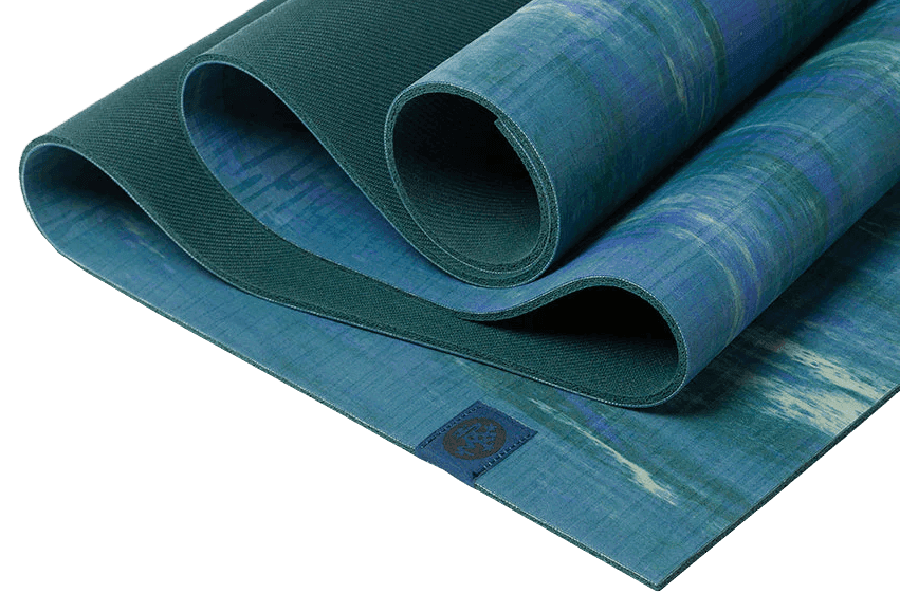
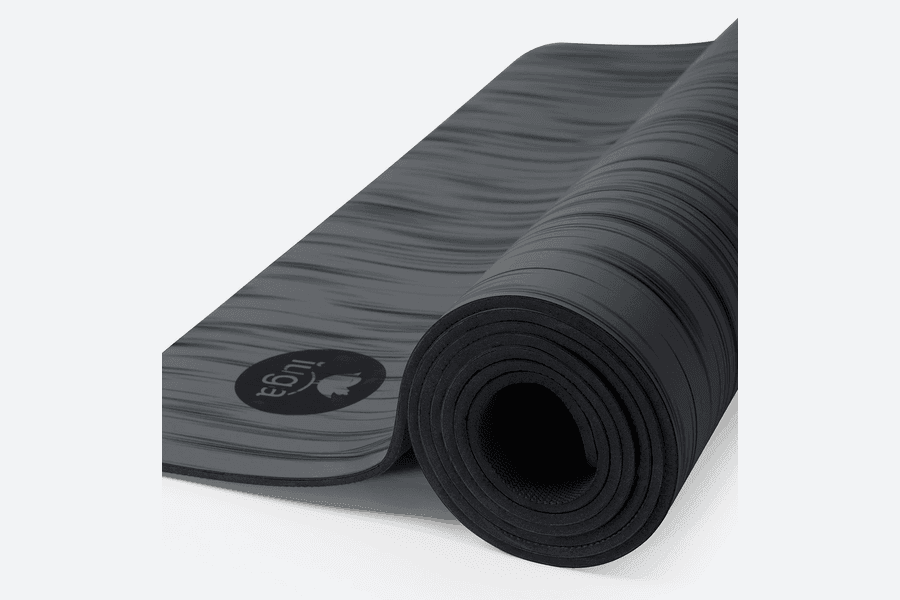
Price
The IUGA lists for about $47 less.
$114
List price · check price at Amazon
$66.99
List price · check price at Amazon
Thickness
Identical thickness.
5 mm0.2″
5 mm0.2″
Weight
The IUGA is 4.9 lbs lighter.
7 lbs3.2 kg
2.1 lbs0.95 kg
Size
The IUGA is 1″ longer; same width.
Same on both
- Both are 5 mm thick
- Both sit on natural rubber, so trace latex is a caution
- Neither carries a warranty past its return window
- Both need a few days of airing before the smell settles
- Keep both out of direct sun and hot cars
Full specs
Dimensions
Materials & build
Buying
Two answers to the same question
Shoppers who don’t want a PVC mat tend to land on one of these. The Manduka eKO is the brand’s natural rubber mat, $114, made in Taiwan with over 30% recycled content, and the mat Manduka points you to when the PRO is the wrong material for you. The IUGA is the budget version of a premium idea: a polyurethane top over a natural rubber base, the same construction Liforme and Lululemon use, at $66.99.
Both did well in OutdoorGearLab’s 19-mat test, the eKO second overall at 87 of 100 and the IUGA eighth at 75 with a Best Value Upgrade award. They still suit different people, and the dividing line is simple: how much you sweat, and how far you carry the mat.
Grip: dry belongs to the eKO, wet belongs to the IUGA
In a dry room the eKO is excellent. GearLab singled out the tiger-stripe traction lines on its surface, finding they gave good friction for arm balances and inversion practice, and the mat scored 9 of 10 for grip on that basis. Rubber feels warmer and more organic underhand than any coated surface, and there’s no break-in to wait through.
Add sweat and it turns over. The eKO is closed-cell, so moisture sits on the surface; Manduka’s own listing describes its traction as reliable in dry conditions, and GearLab lists slipperiness when wet among its main downsides. The IUGA’s absorbent polyurethane top does the job premium sweat mats do: GearLab soaked it and found hands and feet could still get an excellent grip on the wet surface.
So if your palms stay dry, the eKO is the nicer mat to practice on. If they don’t, the cheaper mat wins the only category that matters once you’re sliding.
Cushion: same 5 mm, different feel
Both are 5 mm, and neither is soft. The eKO’s rubber has what GearLab called a resilient spring, a little livelier than the PRO’s dead-firm feel, and Manduka describes the same thing as cushioning that gently rebounds. It’s the more pleasant of the two to spend an hour on.
The IUGA is firmer and thinner-feeling, and that’s not a criticism. GearLab found the cushion thick enough to protect knees on hard floors and firm enough to hold steady in single-leg balance poses, which is exactly what you want from a light mat. Its one physical drawback follows from the weight: at 2.1 pounds it can shift or wrinkle slightly mid-practice, where the 7 pound eKO stays exactly where you put it.
Size and weight: not close
Footprint is close to a tie. The IUGA is 72″ × 26″ and the eKO is 71″ × 26″, so you gain an inch of length and nothing in width. Both are generous next to the 68″ × 24″ standard cut most budget mats use, which is what GearLab was praising when it called the IUGA’s dimensions wide.
Weight is where they part company. GearLab put the IUGA at 2 pounds 1 ounce, among the lightest mats in the test, with an adjustable shoulder strap in the box; its testers carried it to class and flew with it repeatedly without it being a burden.
The eKO is 7 pounds by Manduka’s spec, and GearLab measured 6.3. Either number is a real load on a walk to the studio, and heavier mats are the ones owners quietly stop carrying. If you need more length, Manduka sells the 79″ eKO Long at $124; IUGA has no bigger size.
Durability: neither one is a decade mat
GearLab spoke with practitioners who used the eKO for vigorous daily practice for three to six years before retiring it, which is a reasonable life for tree rubber and clearly less than the PRO manages. Manduka made that trade deliberately when it built the mat from biodegradable rubber. The classic rubber wear pattern shows up eventually: track lines where hands and feet rub parallel rails into the surface. The eKO also creases easily, so store it rolled rather than folded.
The IUGA wears faster at the top. GearLab flagged durability concerns after a few years of hard use, with flaking and wear marks appearing on the polyurethane, and noted it degrades quicker if you practice on abrasive surfaces like pavement or dirt. Its open-cell top also takes a long time to dry out fully after a sweaty class, which is the maintenance cost of the grip you bought it for.
Paperwork won’t rescue either mat. Manduka gives the eKO a 30 day return window and no warranty, since the lifetime guarantee belongs to the PRO series, and IUGA offers 45 days to send it back. Buy either one expecting a few good years.
Materials, latex, and cleaning
The eKO has the better material story. It’s tapped tree rubber with over 30% recycled content and a closed-cell surface Manduka points out is easy to keep clean, since nothing soaks in. The IUGA is polyurethane over rubber, marketed as eco-friendly and SGS-certified without a certification we can independently verify, so treat that as marketing rather than a credential.
Both sit on natural rubber, which rules them out for a genuine latex allergy; trace latex proteins come with the material. Both also arrive smelling like what they’re made of. GearLab’s testers noted a strong initial smell on the IUGA despite the odorless claim on the box, and a few days unrolled in a ventilated room clears it. Care is the same for both: damp cloth, mild soap, no machine washing, and never leave either one in a hot car or in direct sun.
Price and where to buy
List prices are $114 for the eKO and $66.99 for the IUGA, and street prices move on both, so check the current price of the eKO at Amazon and the IUGA at Amazon before you commit.
The $47 gap buys a nicer material and a longer life, not better performance in a sweaty room. If you like the IUGA’s absorbent surface and want the premium version of it, our Lululemon The Mat vs IUGA page covers that upgrade, and Jade Harmony vs eKO covers the rubber mat that grips through sweat better than this one does.
Bottom line
Get the eKO if your practice is dry and your mat mostly stays home. It’s the better-built of the two, the dry grip is excellent, the cushion has a spring the IUGA can’t match, and the recycled rubber is a real point in its favor. You’re paying $114 for material quality and a three-to-six-year life, with no warranty backing either.
Get the IUGA if you sweat, if you carry your mat, or if the price difference matters. It grips wet, it’s bigger, it weighs a third as much, it comes with a strap, and independent testing rates it a legitimate value pick rather than a compromise. Its top layer will wear out first, which at $66.99 is easier to accept.
Manduka eKO
List price $114
Frequently Asked Questions
- Which grips better when you sweat?
- The IUGA, clearly. GearLab saturated it with water and found hands and feet could still get an excellent grip on the surface, which is why the mat gets recommended for hot yoga at its price. The eKO is closed-cell, so sweat stays on top of the surface instead of soaking in; Manduka's own listing describes its traction as reliable in dry conditions, and GearLab lists slipperiness when wet among its main downsides. Dry, the eKO is the grippier of the two.
- Is the eKO worth $47 more?
- It depends on whether you sweat and where the mat lives. The eKO's rubber cushion has a springier, more resilient feel, its dry traction is excellent, and GearLab ranked it second of 19 mats overall. But it's nearly 5 pounds heavier, it's the weaker mat once your palms are damp, and Manduka gives it no warranty beyond a 30 day return window. For a dry home practice the eKO earns the gap; for a sweaty or commuting practice the IUGA is both cheaper and better suited.
- How long does each mat last?
- Neither is a decade mat. GearLab heard from practitioners who used the eKO for vigorous daily practice for three to six years before retiring it, and notes that rubber mats wear by developing track lines where hands and feet rub the same rails into the surface. The IUGA's weak point is its absorbent top: GearLab flagged durability concerns after a few years of hard use, with flaking and wear marks, and notes it degrades faster if you practice on abrasive surfaces like pavement. If you want five years or more of daily use, both brands sell longer-lived mats.
- Which is better if you're tall?
- Neither by much. The IUGA is 72 by 26 inches and the eKO is 71 by 26, so you gain an inch of length and no width. Both are roomier than the 68 by 24 cut most budget mats use, which is the comparison GearLab was making when it praised the IUGA's dimensions. If you need real length, Manduka sells the eKO Long at 79 inches for $124, and that is the only way either brand goes bigger.
- Do these mats smell when they arrive?
- The IUGA does. GearLab's testers noted a strong smell out of the package despite the odorless marketing, and owners report the same; a few days unrolled in a ventilated room clears it. Natural rubber has its own scent that fades over the first few weeks. Neither smell is a defect, and neither is a reason to return a mat in week one.
- Is either mat safe with a latex allergy?
- No. The eKO is natural tree rubber and the IUGA is built on a natural rubber base, and natural rubber can carry trace latex proteins. Anyone with a genuine latex allergy should be shopping PVC or TPE mats instead, which is one of the few arguments for a mat like the Manduka PRO or a Gaiam PVC mat over either of these.
Related comparisons
- Manduka Begin vs IUGA Eco Friendly Non Slip PU
- Manduka X vs IUGA Eco Friendly Non Slip PU
- Manduka eKO vs Lululemon The (Big) Mat 5mm
- Lululemon The Mat 5mm vs Manduka eKO
- Gaiam Performance Dry-Grip 5mm vs IUGA Eco Friendly Non Slip PU
- JadeYoga Harmony 74" vs Manduka eKO
- IUGA Eco Friendly Non Slip PU vs Hugger Mugger Earth Elements 5mm
- JadeYoga Level One vs IUGA Eco Friendly Non Slip PU
- IUGA Eco Friendly Non Slip PU vs Gaiam Performance Dry-Grip Long & Wide