Manduka X vs IUGA Eco Friendly PU: Which One Should You Buy?
There are five dollars between these two mats and almost no overlap in what they're for. The Manduka X is closed-cell TPE, textured on both sides, built to take cross-training and get hosed off. The IUGA is a polyurethane-topped rubber mat that soaks sweat down away from your hands, weighs barely two pounds, and picked up GearLab's Best Value Upgrade award at 75 of 100.
As an Amazon Associate, we earn from qualifying purchases made through links on this page. How this works
The quick answer
The IUGA is the better yoga mat and the better hot yoga mat. GearLab rated its grip 8 of 10 dry and 7 wet, gave it 8 of 10 for comfort and support, and put it 8th of 19 overall, ahead of mats at twice the price. It also weighs 2.1 pounds and comes with a carry strap. The X is the better mat for everything that is not yoga: dense TPE that shrugs off weights and pavement, a surface that wipes or hoses clean, and no absorbent layer to hold odor. Owner reviews on the X's grip diverge sharply once you sweat on it.
For a yoga practice, especially a warm one, buy the IUGA. For a mat that has to survive a garage, a driveway, and a set of kettlebells, buy the X.
Get the Manduka X if...
- Your mat sees strength work, cardio, and stretching as much as yoga
- You want a closed-cell surface that never absorbs sweat
- You'll take it outside and want to hose it down after
- You want double-sided texture so it doesn't matter which way it lands
Get the IUGA if...
- You practice hot yoga or sweat a lot and need grip that survives it
- You want the lighter mat by a mile, 2.1 pounds against 3.4
- You want the wider surface, 26 inches against 24
- You want a mat GearLab rated 75 of 100 with a Best Value Upgrade award
Side by side
Price
The IUGA lists for about $5 less.
$72
List price · check price at Amazon
$66.99
List price · check price at Amazon
Thickness
Identical thickness.
5 mm0.2″
5 mm0.2″
Weight
The IUGA is 1.3 lbs lighter.
3.4 lbs1.5 kg
2.1 lbs0.95 kg
Size
The IUGA is 1″ longer; the IUGA is 2″ wider.
Same on both
- Roughly the same price, within about $5
- 5 mm thick
- No warranty beyond a return window
- Light enough to carry to class without thinking about it
Full specs
Dimensions
Materials & build
Buying
Five dollars apart and built for different rooms
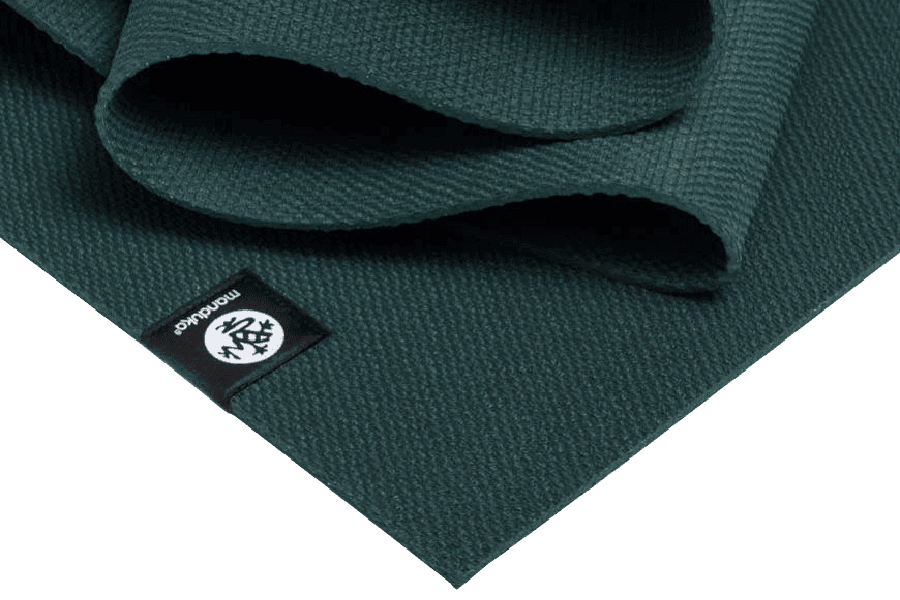
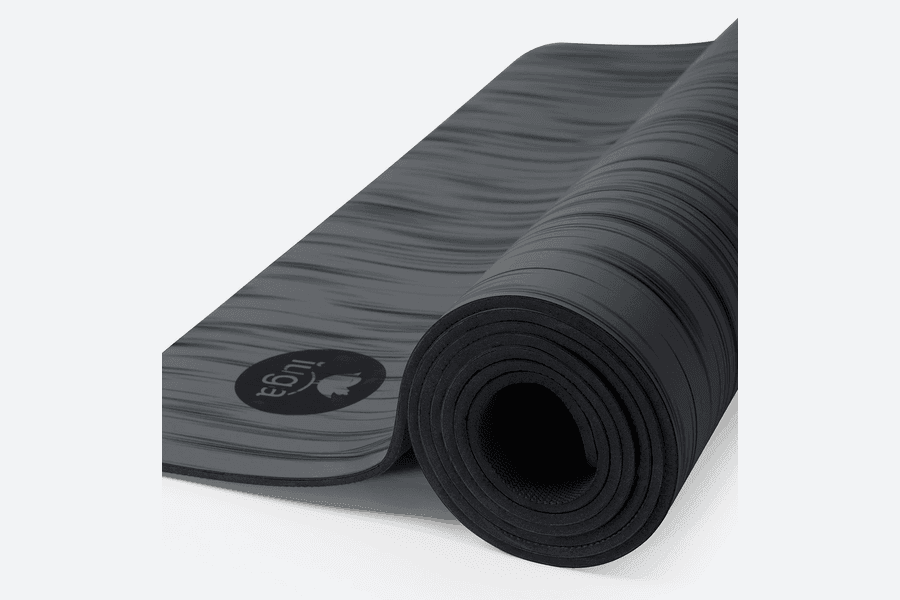
The Manduka X lists at $72 and the IUGA at $66.99, so price is not going to settle this. Both are 5 mm. Everything else diverges. The X is closed-cell TPE with a crosshatch texture on both sides, sold by Manduka as a hybrid fitness mat. The IUGA is a polyurethane top over a natural rubber base, sold explicitly for hot yoga, and at 2.1 pounds it is one of the lightest full-thickness mats made.
One of these was in OutdoorGearLab’s 19 mat test and did well. The other was not, and its record comes from owners.
Grip: the IUGA has the numbers
GearLab rated the IUGA 8 of 10 for dry grip and 7 for wet, gave it their Best Value Upgrade award, and placed it 8th of 19 overall at 75 of 100, ahead of several mats costing twice as much. The polyurethane top absorbs sweat down away from your hands, which is what keeps the wet number where it is.
The X grips well dry and that is not in dispute. Sweat is. Owner reviews split about as cleanly as they can: some say it holds while they are dripping, others say it became very slippery in a heated class and they had to add a towel. Closed-cell TPE is the reason. Sweat cannot go anywhere, so it stays on the surface. If you practice warm, the IUGA is the safer buy and it is not a close call.
The gap shows up in a specific way during a long class. On the X, a wet patch stays where it lands until you wipe it, so the slick spot ends up being exactly where your hands keep going. The IUGA pulls that moisture down out of the contact area, so the surface under your palms on the tenth chaturanga is close to what it was on the first. That is the practical value of an absorbent top, and it is bigger than the one point separating their dry grip scores.
Cushion and support
GearLab scored the IUGA 8 of 10 for comfort and support, which is strong for a 5 mm mat and better than several thicker ones in the same test. It sits on a natural rubber base that gives without collapsing.
The X is firmer. Manduka builds it on high-density TPE and rates it for impact absorption, which is a different goal: it is tuned for a knee landing on it rather than a knee resting on it. On a hard floor that firmness reads as supportive rather than comfortable. Neither mat bottoms out; the IUGA is the more pleasant one to spend an hour on and the X is the one you would rather jump on.
Worth flagging for anyone comparing on paper: both mats are 5 mm, and GearLab scored several 6 mm mats lower for comfort than the IUGA. Thickness on its own predicts very little. Density and what the material does under a concentrated load predict a lot, which is why these two feel different despite identical numbers on the spec sheet.
Weight and carrying
The IUGA weighs 2.1 pounds, and GearLab measured exactly that on their own scale, which does not always happen. It ships with an adjustable strap. Carrying it is not something you plan around.
The X is 3.4 pounds, still light by mat standards and well under half a Manduka PRO, but the 1.3 pound gap is noticeable on a long walk. Neither is heavy. If commuting to a studio every day is the routine, the IUGA is the one that disappears on your shoulder.
Size, and the two inches that matter
The X is 71 by 24 inches. The IUGA is 72 by 26. The length difference is a rounding error, but the width is not: 24 inches against 26 is the difference between a foot landing on the mat in a wide-legged stance and landing on the floor.
That 24 inch width is the X’s clearest compromise, and it comes from being designed as a training mat where a narrower footprint is fine. If you are broad-shouldered or you like a wide stance, it is worth taking seriously before you buy.
Cleaning, odor, and drying time
This is the X’s clearest win. Closed-cell TPE keeps sweat and dirt on the surface, so a wipe finishes the job and a hose handles anything worse. Nothing sits inside the mat, so nothing develops a smell, and it can be rolled up immediately after a session without consequence.
The IUGA absorbs by design, so it needs real drying time before it gets rolled, and absorbent mats that get put away damp are how odor problems start. GearLab still scored its care and cleaning 8 of 10, so this is a habit rather than a headache, but it is a habit the X does not ask for.
Durability and coverage
The X should last longer. It is built on a woven scrim Manduka rates for HIIT and outdoor use, and owners report months of five-day-a-week training with minimal visible wear. TPE gives up slowly, by compressing, rather than by the surface failing.
The IUGA’s polyurethane top is the same material that wears and stains on mats costing three times as much, and surface wear is its common complaint rather than the mat coming apart. Coverage is thin either way: 30 days from Manduka, 45 from IUGA, and no warranty from either. Manduka’s lifetime guarantee applies to the PRO line, not to the X.
Price and where to buy
About $5 separates the list prices, and both mats discount on Amazon by colorway often enough that the gap can invert on any given week. Check the current Manduka X price at Amazon and the current IUGA price at Amazon rather than assuming list. Manduka has also been running one X colorway well below the rest on its own site.
On value, the IUGA is the more surprising mat: a budget brand that scored 8th of 19 in a field including mats at $165, with a strap in the box. The X earns its price differently, by being the mat you can misuse.
Colorways and what comes in the box
The IUGA ships with an adjustable carry strap, which at $66.99 is a genuine extra rather than a token one, and it comes in five colorways at last count. IUGA sells it directly and through Amazon, and its return window runs 45 days, longer than most brands at any price.
The X comes in seven solid colorways and nothing else in the box. There is no long version, no wide version, and no travel version; what you see is the entire line. Manduka has also been running one colorway well below the others on its own site, so it is worth checking whether the color you want is the discounted one before you order.
Bottom line
Buy the IUGA if the mat is for yoga, especially warm yoga. Better wet grip, more width, two pounds lighter, a strap included, and a test result that puts it above much more expensive mats. Its weakness is the polyurethane surface, which will look used before the X does.
Buy the X if the mat has other work to do. Weights, intervals, a garage floor, a driveway, a hose. It is the tougher mat and the easier one to look after, and for an unheated practice its grip is fine. If you want the absorbent surface with more mat under you, our Manduka X vs Liforme comparison covers the premium end of the same choice.
Manduka X
List price $72
Frequently Asked Questions
- Which is better for hot yoga?
- The IUGA, without much argument. Its polyurethane top pulls sweat off the surface, which is why GearLab rated its wet grip 7 of 10, and IUGA sells it explicitly as a hot yoga mat. The Manduka X is closed-cell, so sweat pools on top, and owner reviews split: some say it holds even while they're dripping, others describe it as very slippery in a heated class and say they bought a towel to use with it. If your practice is heated, that split is a reason to skip it.
- Which is more durable?
- The X. Manduka builds it on a woven scrim and rates it for HIIT and outdoor use, and owners report five-day-a-week use over months with minimal wear. The IUGA's top layer is polyurethane, the same material that wears and stains on much more expensive mats, and its usual complaint is surface wear rather than the mat coming apart. Neither brand offers a real warranty: Manduka gives 30 days, IUGA 45.
- How much does the weight difference matter?
- More than the 1.3 pound gap sounds. At 2.1 pounds the IUGA is one of the lightest full-thickness mats made, light enough that carrying it is a non-event, and it ships with an adjustable strap. The X at 3.4 pounds is still light by mat standards, well under half a Manduka PRO, but you notice it on a long walk. GearLab measured the IUGA at exactly the 2.1 pounds IUGA claims.
- Which one is easier to clean?
- The X, and it's not close. Closed-cell TPE keeps everything on the surface, so a wipe or a hose is the whole routine. The IUGA absorbs by design, so it needs a proper dry before it gets rolled, and mats like it develop odor if they're put away damp. GearLab still scored the IUGA 8 of 10 for care and cleaning, so this is a difference of degree rather than a warning.
- Is the Manduka name worth anything here?
- Some, but less than usual. The X isn't part of Manduka's PRO or eKO lines and carries no lifetime guarantee, just 30 day returns, and it wasn't included in GearLab's test lineup. It's a good, tough training mat with a well-known label on it. The IUGA is a budget brand that happened to build a mat testers rated 8th of 19 overall, which is the more surprising result of the two.
- Which is better for a beginner?
- The IUGA, if the plan is yoga. It's wider, grippier, lighter, comes with a strap, and it scored 8 of 10 for comfort in GearLab's testing. The X makes more sense for someone whose routine already includes weights or interval work and who wants one mat for all of it, or who wants a mat that can go outside.
Related comparisons
- Manduka X vs Gaiam Performance Dry-Grip 5mm
- Manduka Begin vs IUGA Eco Friendly Non Slip PU
- Manduka X vs Gaiam Performance Dry-Grip Long & Wide
- Gaiam Performance Dry-Grip 5mm vs IUGA Eco Friendly Non Slip PU
- Manduka X vs Hugger Mugger Earth Elements 5mm
- IUGA Eco Friendly Non Slip PU vs Hugger Mugger Earth Elements 5mm
- Manduka X vs JadeYoga Level One
- JadeYoga Level One vs IUGA Eco Friendly Non Slip PU
- IUGA Eco Friendly Non Slip PU vs Gaiam Performance Dry-Grip Long & Wide