Manduka PRO vs eKO: Which One Should You Buy?
The PRO and eKO are both Manduka mats in the same 71" × 26" size, built from opposite materials. The PRO is dense PVC: slick at first, essentially immortal, and guaranteed for life. The eKO is natural rubber: grippy from the first practice, made in Taiwan with over 30% recycled content, $30 cheaper, and backed by no warranty at all. The choice comes down to the material, not the size.
As an Amazon Associate, we earn from qualifying purchases made through links on this page. How this works
The quick answer
The PRO is thicker (6 mm vs 5), half a pound heavier, $30 more, and starts out slippery, but it lasts decades and Manduka guarantees it for life. The eKO grips well from day one, feels warmer and more natural under the hands, and is the more sustainable choice, but natural rubber wears faster and Manduka's lifetime guarantee doesn't cover it, only a 30 day return window.
The PRO is the better long-term buy and the mat we'd point most people to. Get the eKO if the break-in period is a dealbreaker, or if a natural material matters more to you than the guarantee.
Get the PRO if...
- You want a mat that lasts decades, with the guarantee to match
- You want the thicker, firmer 6 mm cushion
- You want zero care rules: no sun worries, wipe and go
- You're fine breaking in the surface for a few weeks
Get the eKO if...
- You want real traction on day one, no break-in
- You prefer the warmer, grippier feel of natural rubber
- A renewable material with recycled content matters to you
- You'd rather keep the $30
Side by side
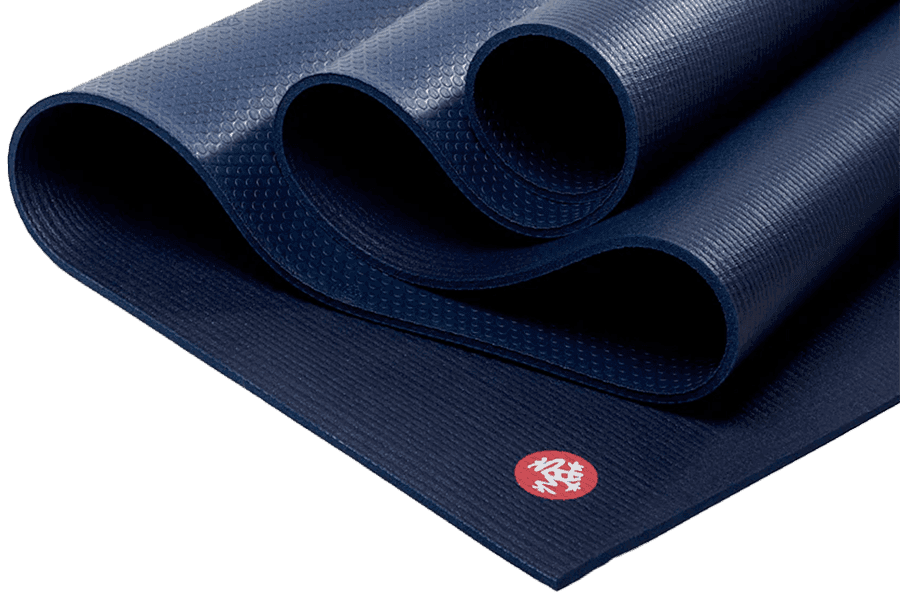
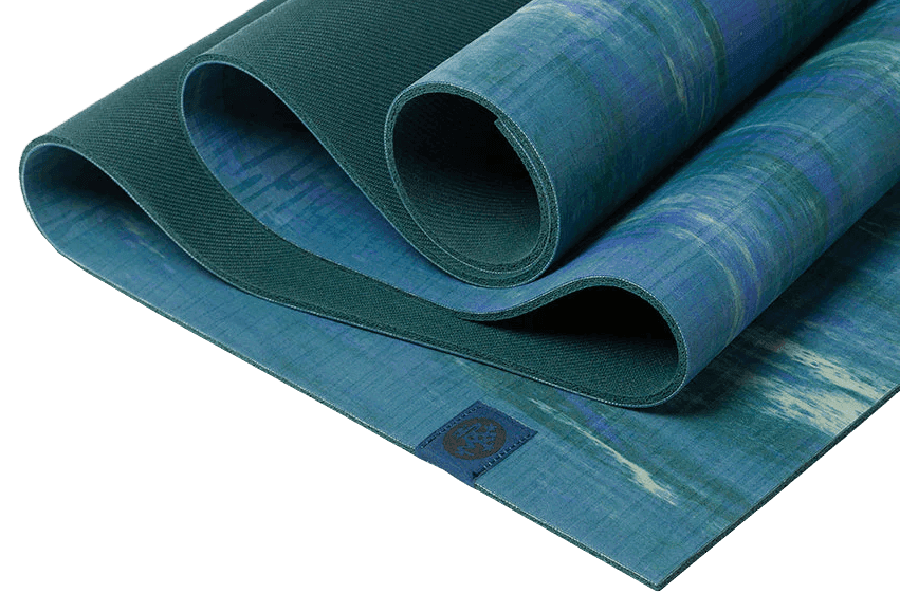
Price
The eKO lists for $30 less.
$144
List price · check price at Amazon
$114
List price · check price at Amazon
Thickness
The PRO is 20% thicker.
6 mm0.24″
5 mm0.2″
Weight
The eKO is 0.5 lbs lighter.
7.5 lbs3.4 kg
7 lbs3.2 kg
Size
Same length; same width.
Same on both
- Same 71" × 26" footprint
- Made by Manduka
- Closed-cell surface (sweat can't soak in)
- Heavy, stay-at-home weight class
- Lies flat without curling
Full specs
Dimensions
Materials & build
Buying
Manduka arguing with itself
Most PVC-versus-rubber comparisons pit Manduka against Jade. This one stays in the family. The PRO is Manduka’s case for PVC: German-made, dense to the point of feeling bulletproof, and guaranteed for life. The eKO is Manduka’s case for natural rubber: made in Taiwan with over 30% recycled content, grippy without a break-in, and $30 cheaper at $114 to the PRO’s $144.
The footprint is identical, 71″ × 26″, and both are closed-cell mats around 7 pounds, so a lot of the usual comparison noise drops away. What’s left is the real question: the material. One of these mats Manduka will replace if it wears out in the next decade. The other it won’t, and that asymmetry from the company that makes both is worth listening to.
Grip: the eKO skips the hazing
The eKO’s textured natural rubber surface grips from the first practice. There’s no waiting period and nothing to learn, and the rubber has a warmer, softer feel under the hands than the PRO’s fabric-like finish. For a lot of people that first-day experience is the whole reason to pick it.
The PRO ships slick. It’s the most common complaint about the mat, and the surface needs a few weeks of consistent practice before the grip arrives; Manduka has retired its old salt-scrub advice and now says the slickness simply resolves with use. Once broken in, the PRO grips well and keeps improving for years.
Neither wins a sweat contest. Both are closed-cell surfaces, so moisture stays on top rather than soaking in, and Manduka itself hedges the eKO’s grip as reliable in dry conditions. A little glow is fine on either mat; a dripping hot yoga class wants a towel over both. If absorbent sweat grip is the priority, that’s Jade Harmony territory, and our PRO vs Harmony comparison covers it.
Cushioning: 6 mm vs 5, both firm
The PRO carries 6 mm of dense PVC; the eKO carries 5 mm of natural rubber foam that Manduka describes as soft cushioning with a gentle rebound. In practice both are firm, stable mats, with the PRO reading harder and the eKO slightly springier. The PRO’s extra millimeter and density matter most for kneeling work on concrete or tile, part of why OutdoorGearLab ranked it first of 19 mats with a perfect comfort score. On forgiving floors the two feel closer than the spec sheet suggests.
Weight: a half-pound wash
Seven pounds for the eKO, seven and a half for the PRO. Neither number will make your commute to class pleasant, and both mats lie dead flat and stay planted once unrolled, which is the upside of all that mass. If weight is what you’re actually shopping on, the answer isn’t either of these; it’s Manduka’s 4.6 pound PROlite or the 2 pound eKO Superlite travel mat.
Durability and the warranty Manduka won’t give
Here’s the gap that should anchor your decision. The PRO lasts decades; GearLab’s testers found instructors’ PRO mats five to twenty years old still in service, and Manduka’s lifetime guarantee, roughly 10 years of regular use in the fine print with one replacement, makes it official.
The eKO gets no such promise. Manduka’s guarantee page covers the PRO series only, which leaves the eKO with the standard 30 day return window and nothing after it. That’s not an oversight. Natural rubber is a shorter-lived material: heavy use wears the surface, owners report flaking after a few years of hard practice, and sunlight degrades it outright. Manduka knows exactly how long each of its materials lasts, and it priced the warranties accordingly.
Care follows the same split. The PRO tolerates neglect, hot cars included. The eKO wants shade, no harsh cleaners, and a little respect for the fact that it’s a plant product.
The eco question
The eKO exists because the PRO’s one honest weakness is its material. PVC isn’t recyclable in any practical way, and no amount of longevity changes what it’s made of. The eKO answers with rubber tapped from trees and a build that Manduka says uses over 30% recycled content.
The counterargument is the one Manduka itself makes for the PRO: a mat that lasts twenty years may beat a rotation of shorter-lived rubber mats on total footprint. Both framings are fair, and which wins depends on whether you measure impact by the material or by the replacement cycle. If you want the greener mat and plan to care for it, the eKO is the honest choice within the Manduka lineup.
Sizes, colors, and versions
Both standard mats are 71″ × 26″. The eKO comes in one other size, a 79″ × 26″ Long at $124, plus lighter eKO Lite and Superlite spin-offs we cover separately. The PRO’s bench is deeper: short, an 85″ Long, and two oversized home-studio cuts. Colors run around 14 for the PRO and 5 for the eKO at last count.
One version note: Manduka re-engineered the eKO line a few years back, and some retailers still label the current mat eKO 2.0. Today’s version is the one made with over 30% recycled content. Older reviews may describe the previous generation, so check the date on anything you read.
Price and value
List prices are $144 for the PRO and $114 for the eKO. Street prices move around by colorway, so check the current price on both the PRO and the eKO before you decide.
The value math is lopsided once you stretch it over years. The $30 you save on the eKO buys a mat with maybe a third of the PRO’s working life and no coverage when it wears. Unless the rubber matters to you for its own sake, the PRO is the cheaper mat per year by a wide margin. If the rubber does matter, price the eKO against the Jade Harmony too; at $99.95 it undercuts the eKO and its open-cell surface handles sweat better.
Bottom line
Buy the PRO for the same reason most people do: it’s the last mat you’ll need to think about. The break-in weeks are annoying and real, and everything after them is a decade of not caring. Within Manduka’s lineup it remains the default for a reason.
Buy the eKO if the PRO’s two genuine flaws, the slick start and the PVC, are the two things you can’t live with. It fixes both for $30 less, and it feels great from the first practice. Just go in clear-eyed: you’re trading the guarantee and years of lifespan for that day-one grip and the cleaner material story.
Manduka PRO
List price $144
Manduka eKO
List price $114
Frequently Asked Questions
- Does the Manduka eKO have the same lifetime guarantee as the PRO?
- No, and this is the biggest gap between them. Manduka's lifetime guarantee covers the PRO series only (PRO, PROlite, and PRO Travel). The eKO has no stated warranty; you're covered by Manduka's standard 30 day return window and nothing beyond it. If the guarantee is part of why you're buying Manduka, only the PRO delivers it.
- Which grips better, the Manduka PRO or the eKO?
- Out of the box, the eKO. Its textured natural rubber surface has reliable traction from the first practice, while a new PRO is famously slick and needs a few weeks of regular use to break in. Once broken in the PRO grips well and keeps improving. Both are closed-cell, so neither absorbs sweat, and heavy sweaters will want a towel on either one.
- Which lasts longer, the PRO or the eKO?
- The PRO. Dense PVC barely wears, and PRO mats routinely serve a decade or more. The eKO's natural rubber is tougher than open-cell rubber mats, but owners report surface wear and flaking after a few years of heavy use, sunlight degrades it, and Manduka doesn't warranty it. Manduka's own warranty coverage suggests which material it expects to last longer.
- Is the Manduka eKO good for hot yoga?
- Middling. Unlike Jade's open-cell mats, the eKO is closed-cell, so sweat sits on the surface rather than soaking in, and Manduka itself describes the grip as reliable in dry conditions. Light sweat is fine; a dripping hot yoga class will have your hands sliding, so plan on a towel. The upside of closed-cell is hygiene: the mat wipes clean and doesn't hold moisture or smell.
- How thick and heavy are the PRO and the eKO?
- The PRO is 6 mm thick at 7.5 pounds; the eKO is 5 mm at 7 pounds, in the same 71" × 26" footprint. Both feel dense and supportive rather than soft, and neither is fun to carry across town. The eKO also comes in a 79" × 26" Long version at $124, and the PRO's Long is 85" at $164.
- Is the current eKO the same mat as older eKO reviews describe?
- Not quite. Manduka re-engineered the eKO line a few years back, and some retailers still label the current version eKO 2.0. Today's eKO is made in Taiwan from natural rubber with over 30% recycled content. The broad strokes of older reviews still apply, but specifics like weight, feel, and durability may describe the previous generation, so check which version a review covers.
Related comparisons
- Manduka eKO vs Lululemon The (Big) Mat 5mm
- Lululemon The Mat 5mm vs Manduka eKO
- Manduka PRO vs b, halfmoon B Mat Strong 6mm
- JadeYoga Harmony 74" vs Manduka eKO
- Manduka PRO vs Alo Warrior
- Manduka PRO vs Yoloha Unity Pro Cork
- Manduka PRO vs JadeYoga Harmony XW
- Manduka eKO vs Suga SugaMat
- Manduka PRO vs Lululemon The (Big) Mat 5mm