Jade Harmony vs Manduka eKO: Which One Should You Buy?
These are the two natural rubber mats most people cross-shop, and they read as near twins on a spec sheet: tree rubber, around 5 mm, premium pricing. The split that matters is invisible in photos. The Harmony is open-cell rubber that absorbs sweat into the surface; the eKO is closed-cell rubber that keeps everything on top. That one construction choice decides how each mat handles a sweaty palm, how big and heavy it is, and how it ages.
As an Amazon Associate, we earn from qualifying purchases made through links on this page. How this works
The quick answer
The Harmony is the sweat handler. Its open-cell surface soaks up moisture and keeps traction when your palms are damp, it weighs a manageable 4.8 pounds, and it costs about $14 less. The eKO answers with size and structure: a 71" x 26" footprint that gives you 3 more inches of length and 2 of width, a sealed surface that never absorbs a sweaty class, and 7 pounds of mat to carry for it.
If your hands ever get damp mid-practice, or the mat rides to class on your shoulder, get the Harmony. If you want the bigger footprint and a rubber mat that stays home, get the eKO.
Get the Harmony if...
- Your palms get damp and you'd rather not manage a towel
- You carry your mat to class and feel every pound
- You want the 1 year warranty the eKO doesn't offer
- You'd rather keep about $14
Get the eKO if...
- You want the bigger 71" x 26" footprint
- You'd rather sweat stayed on the surface you can wipe
- Recycled content matters: the eKO is built with over 30%
- The mat mostly lives where you practice
Side by side
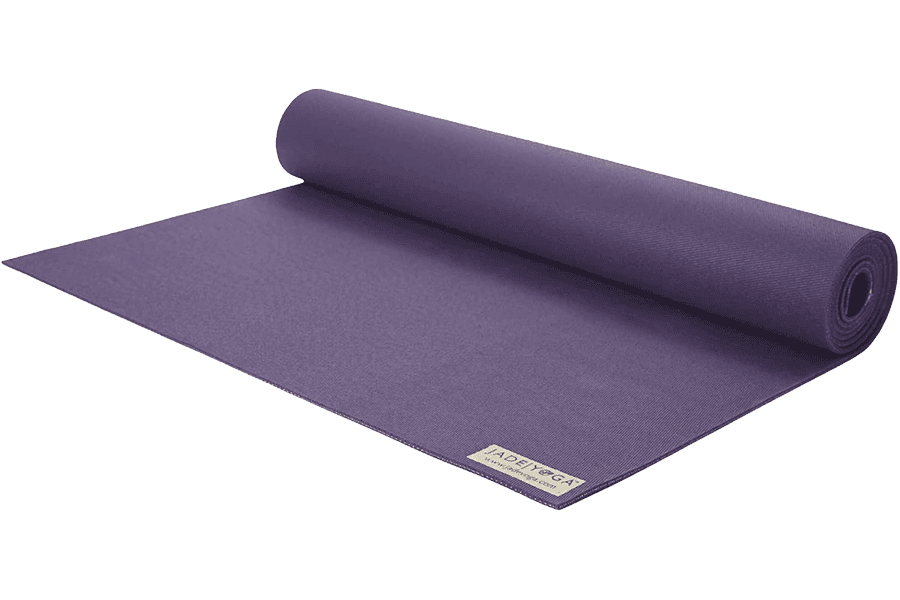
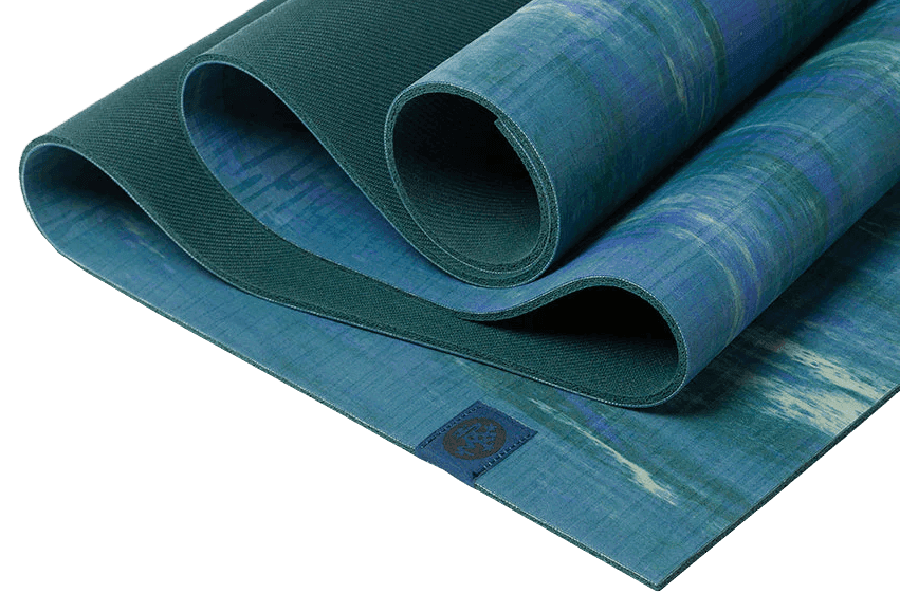
Price
The Harmony lists for about $14 less.
$99.95
List price · check price at Amazon
$114
List price · check price at Amazon
Thickness
The eKO is 4% thicker.
4.8 mm0.19″
5 mm0.2″
Weight
The Harmony is 2.2 lbs lighter.
4.8 lbs2.2 kg
7 lbs3.2 kg
Size
The eKO is 3″ longer; the eKO is 2″ wider.
Same on both
- Natural rubber, tapped from trees
- Grip from the first practice, no break-in
- Rubber smell out of the box
- Must stay out of direct sun
- Longer sizes available
Full specs
Dimensions
Materials & build
Buying
Two rubber mats, one hidden difference
If you’ve decided you want natural rubber instead of PVC, these are the two mats you end up choosing between. The Jade Harmony has been the American-made studio standard for over twenty years. The Manduka eKO is Manduka’s rubber mat, made in Taiwan with over 30% recycled content, and the one the brand points you to when you don’t want the PVC of its famous PRO.
The spec sheets read like near twins, so the decision hides in one word: cell structure. The Harmony is open-cell rubber, a surface that drinks in moisture. The eKO is closed-cell, a sealed surface that keeps everything on top. That single manufacturing choice drives how each mat grips a sweaty palm, how much mat you get, and what it weighs, which is most of what follows.
Grip: even until your palms get damp
Dry hands can’t separate these two. Both surfaces are tacky from the first practice with no break-in period, and both feel warmer and more organic underhand than any synthetic mat. Jade advertises a Yoga Journal best-grip award; the eKO’s rippled texture holds just as confidently in a dry room.
Add sweat and they separate fast. The Harmony’s open-cell surface absorbs light moisture, the quality Wirecutter credits for its traction in sweaty sessions, so a damp palm keeps its hold. The eKO’s sealed surface absorbs nothing. Sweat beads and sits, and Manduka itself hedges by describing the eKO’s grip as reliable in dry conditions. That’s an accurate description, and it’s also the eKO conceding this round.
The usual caveat applies to both: a dripping hot-yoga class overwhelms open-cell rubber too, and heavy sweaters end up laying a towel over either mat. But in the wide middle ground of a normal practice with occasionally damp hands, the Harmony simply needs less managing.
Cushioning: a fifth of a millimeter
The eKO is 5 mm thick; the Harmony is 3/16 of an inch, which works out to about 4.8 mm. Nobody can feel a fifth of a millimeter, and in practice both mats land in the same place: firm, springy, stable under standing poses, with the gentle rebound natural rubber is loved for. Manduka describes the eKO’s cushion as soft with a gentle rebound, and Harmony owners would recognize the description.
Neither is a knee-pillow. If kneeling work on tile or concrete is what hurts, both brands sell the fix one shelf up, the 8 mm Jade Fusion being the obvious one. Between these two, thickness is a wash.
Size and weight: the eKO is more mat, everywhere
Here’s the eKO’s best argument. It measures 71″ × 26″ to the Harmony’s 68″ × 24″, which means 3 more inches of length and 2 more of width. The width in particular is a quiet luxury: broad shoulders fit, and hands stay on rubber in wide-legged poses. If you’re around five foot ten or taller, the Harmony’s 68″ starts to feel short in a full-length savasana, while the eKO still fits.
The bill for all that mat comes due on the walk to class. The eKO weighs 7 pounds, the Harmony 4.8, and that 2-pound-plus gap is the difference between a mat you sling over a shoulder without thinking and one that owners quietly stop carrying. Tall Jade buyers have an out: the 74″ Harmony adds length for $10 and stays lighter than the eKO.
Durability: rubber wears, and both makers know it
Natural rubber is a shorter-lived material than PVC, and neither mat escapes that. Harmony surfaces soften and shed with heavy practice, and hard-practicing owners tend to replace theirs every few years, though CNN Underscored puts the gentle-care ceiling around ten. eKO owners tell a similar story with different symptoms: the sealed surface holds up well early, then flakes with wear, a recurring report after a few years of daily practice.
The paperwork is more different than the materials. Jade covers the Harmony for 1 year against defects and premature wear. Manduka covers the eKO with nothing at all beyond a 30 day return window, because its lifetime guarantee is reserved for the PRO series. A 1 year warranty isn’t much, but it beats none, on the more expensive mat, from the company that also makes a mat it will guarantee for a decade.
Care rules are identical and strict, because tree rubber has non-negotiables: no direct sun, no hot cars, no harsh cleaners. A damp cloth or diluted vinegar wipe is the routine for both. Sun damage is specifically excluded from Jade’s warranty, and it will harden either mat’s surface just the same.
The eco stories, both decent
Both mats exist partly as the answer to PVC, and both back it up. The Harmony is tapped tree rubber made in the USA, and Jade plants a tree for every mat sold, past two million by its own count. The eKO’s angle is circularity: tree rubber built with over 30% recycled content. There’s no loser here, just two flavors of the same good intention. Pick whichever resonates, or let the other sections decide.
One shared health note: this is tree rubber, which means latex. Jade says its mats are 99% latex free but may carry trace latex proteins and doesn’t recommend them for latex allergies, and the eKO is built on the same base material. Anyone with a latex allergy should be looking at PVC or TPE mats instead of either of these.
Sizes, colors, and versions
Jade wins the catalog. The Harmony comes in around 12 colorways at last count against the eKO’s 5, and in three sizes: the standard 68″, the 74″, and the oversized 80″ × 28″ Harmony XW. The eKO offers the standard 71″ and a 79″ × 26″ Long at $124, plus the lighter eKO Lite and Superlite spin-offs we cover separately.
One version note on each. Manduka re-engineered the eKO line a few years back, and some retailers still label the current mat eKO 2.0; today’s version is the one with over 30% recycled content. On the Jade side, the Harmony 2.0 is a genuinely different mat, made in Spain with different certifications, so make sure any review you’re reading covers the original USA-made Harmony this page is about.
Price and value
List prices are $99.95 for the Harmony and $114 for the eKO, a gap of about $14. Street prices drift by colorway, so check the current price on both the Harmony and the eKO before you buy.
Fourteen dollars won’t decide this, but what it buys should: the eKO’s extra size is real, and so is the Harmony’s warranty and sweat grip. Since both mats wear on a similar clock, there’s no long-game calculation to run the way there is against a Manduka PRO. You’re paying for the features you’ll use this year.
Bottom line
Get the Harmony if your hands ever get damp mid-practice or your mat commutes with you. It grips through sweat the eKO can’t handle, it’s over 2 pounds lighter, it costs a little less, and it carries the only warranty in this matchup. It’s the better rubber mat for most people, which is roughly what it’s been for twenty years.
Get the eKO if you want the bigger mat and practice somewhere dry. The 71″ × 26″ footprint is genuinely roomier than the Harmony’s, the recycled content is a real point in its favor, and at home the 7 pounds just means it lies flat and stays put. Buy it knowing what it is: the homebody of the two, happiest when it never has to travel and nobody sweats on it much.
Jade Harmony
List price $99.95
Manduka eKO
List price $114
Frequently Asked Questions
- Which is better for hot yoga, the Jade Harmony or the Manduka eKO?
- The Harmony. Its open-cell rubber absorbs light sweat into the surface, which is the quality Wirecutter credits for its traction in sweaty sessions. The eKO is closed-cell, so sweat stays on top, and Manduka itself describes the eKO's grip as reliable in dry conditions. If you drip rather than glow, though, both mats want a towel, and constant heavy sweat shortens the life of any natural rubber surface.
- Which lasts longer, the Jade Harmony or the Manduka eKO?
- Neither is a decades mat; natural rubber wears with use on both. Harmony owners who practice hard tend to replace theirs every few years, though CNN Underscored puts the ceiling around ten years with gentle care. eKO owners report surface flaking after a few years of heavy practice. The coverage tells you what the makers expect: Jade gives the Harmony a 1 year warranty, while Manduka gives the eKO no warranty at all, just a 30 day return window.
- Is either mat safe for a latex allergy?
- No. Both are natural tree rubber. Jade says its mats are 99% latex free but may carry trace latex proteins and doesn't recommend them for latex allergies, and the eKO is the same base material. If latex is a concern, a PVC mat like the Manduka PRO is the safer direction.
- How much bigger is the Manduka eKO than the Jade Harmony?
- The eKO is 71" x 26" against the Harmony's 68" x 24", so you get 3 more inches of length and 2 more of width. If you're around five foot ten or taller, or you like extra side room in wide-legged poses, that's a real difference. Jade's answer is the 74" Harmony for $10 more, or the oversized Harmony XW at 80" x 28".
- Why is the Manduka eKO so much heavier?
- Density and size together. The eKO packs closed-cell rubber into a bigger footprint and comes out at 7 pounds, while the open-cell Harmony is 4.8. The eKO's weight buys a planted, dead-flat feel at home; the Harmony is the one you can carry across town without noticing.
- Do the Jade Harmony and Manduka eKO smell when new?
- Yes, both. A rubber smell out of the box is the most common early complaint about each mat, and it's simply what fresh tree rubber smells like. It fades over the first few weeks of airing out and use on both, though a faint trace can linger on any natural rubber mat.
Related comparisons
- JadeYoga Harmony 68" vs Suga SugaMat
- JadeYoga Harmony 68" vs Manduka eKO Lite
- Manduka PROlite vs JadeYoga Harmony 68"
- Manduka eKO vs Lululemon The (Big) Mat 5mm
- JadeYoga Harmony 68" vs Manduka GRP Adapt 1.0
- Lululemon The Mat 5mm vs Manduka eKO
- JadeYoga Harmony 68" vs Manduka eKO Lite Long
- JadeYoga Harmony 74" vs Manduka eKO
- JadeYoga Harmony 68" vs Lululemon The Mat 5mm