Manduka PRO vs Gaiam Premium Reversible: Which One Should You Buy?
The Gaiam Premium Reversible is the mat plenty of people meet first: forty dollars, a different print on each side, and more than 15,000 Amazon ratings behind it. The Manduka PRO is the mat people move to when the first one packs down. Both are 6 mm of PVC and that is where the family resemblance stops. One thing worth knowing before you compare them: in OutdoorGearLab's 19-mat test the Reversible finished 15th, below Gaiam's own plain Premium, which costs $10 less.
As an Amazon Associate, we earn from qualifying purchases made through links on this page. How this works
The quick answer
GearLab scored the PRO 91 of 100 and ranked it first overall, with a perfect 10 for comfort and support, and one of its testers has been practicing on the same PRO for 20 years. The Reversible scored 54 and landed 15th of 19, a notch under the plain Gaiam Premium 6mm at 62. Both Gaiams are soft PVC foam that compresses with use and turns slick as moisture builds; the reversible version's extra $10 buys a second printed face, not better performance.
If you practice more than a couple of times a week, the PRO is a much better mat to be on and will still be here in ten years. If you're new, practice occasionally, or mostly want something for stretching and floor work, the Reversible is a fair $40 and the best-looking of the cheap options.
Get the PRO if...
- You practice several times a week and want a mat that lasts a decade or more
- You want firm footing in balance poses instead of foam that sinks
- You want the larger 71 by 26 inch surface (the Gaiam is 68 by 24)
- You want a guarantee with real terms behind the price
Get the Gaiam Reversible if...
- You're starting out and don't want to spend $144 on an unproven habit
- You want a printed mat with a different design on each side
- You want something light at about 3.3 pounds
- You'd rather keep about $104
Side by side
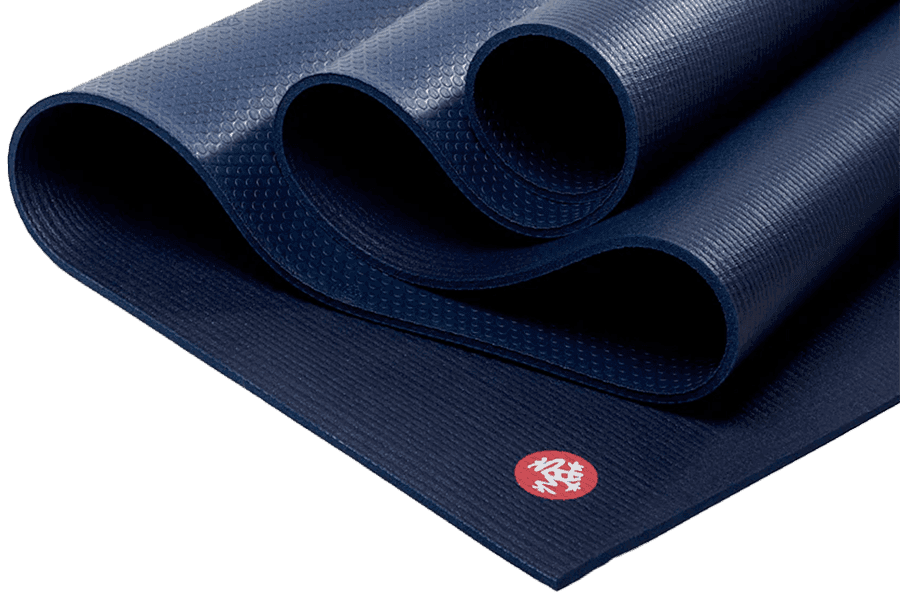
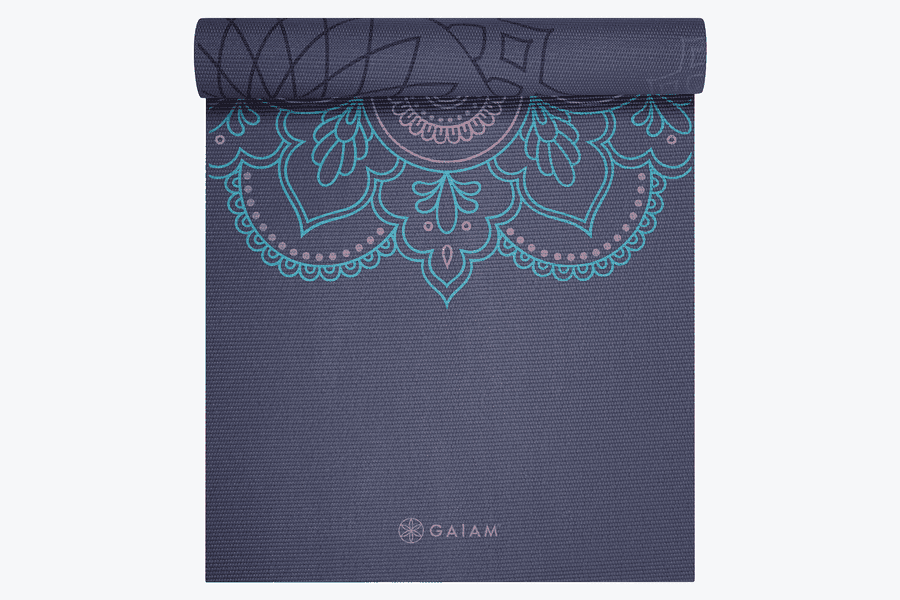
Price
The Gaiam Reversible lists for about $104 less.
$144
List price · check price at Amazon
$39.98
List price · check price at Amazon
Thickness
Identical thickness.
6 mm0.24″
6 mm0.24″
Weight
The Gaiam Reversible is 4.2 lbs lighter.
7.5 lbs3.4 kg
3.3 lbs1.5 kg
Size
The PRO is 3″ longer; the PRO is 2″ wider.
Same on both
- Both are 6 mm thick
- Latex-free PVC
- Wet palms slide on either surface
- Both are sold with a lifetime guarantee against defects
- Damp cloth cleaning only, no machine washing
Full specs
Dimensions
Materials & build
Buying
A $40 print mat against a $144 slab
The Gaiam Premium Reversible is one of the most bought yoga mats there is: $39.98, ten printed designs at last count, a different pattern on each face, and better than 15,000 ratings on Amazon averaging 4.6 stars. The Manduka PRO is what people buy second, usually after the first mat flattens out. On paper the two line up: same thickness, same base material, latex-free, with a lifetime guarantee printed on both boxes.
The difference is what the 6 mm is made of. The PRO packs its height with dense, compressed PVC and weighs 7.5 pounds. The Gaiam fills the same height with soft foam and weighs 3.3. That gap decides how each mat feels underfoot, how it behaves in a balance pose, and how many years it survives before it stops doing its job.
What “reversible” actually buys you
Worth clearing up first, because it’s the reason this mat exists. Both faces of the Gaiam are finished practice surfaces with the same texture, so flipping it changes which design is showing, not how the mat feels. Some reversible mats pair two genuinely different surfaces, one grippier and one softer. This isn’t one of those. Owners describe it as two mats in one, which is fair as long as you mean two looks.
It also isn’t free. Gaiam’s plain Premium 6mm is $29.98 and shares the construction, the 68″ × 24″ footprint, the weight, and the guarantee. In OutdoorGearLab’s 19-mat test the plain version scored 62 of 100 and the Reversible 54, finishing 15th. So the extra $10 is buying the print rather than a better mat. That’s a fine reason to spend it, as long as you know that’s the trade.
Support: the Gaiam gives, the PRO doesn’t
Soft foam is lovely for kneeling and awkward on one leg. Testing the plain Premium, which is this mat’s construction under a different print, GearLab praised the 6 mm cushion for stretch classes, slower flows, and long kneeling sequences, then found the same softness went squishy and sacrificed stability in balance poses like tree and in headstands. The Reversible rates a shade lower again for comfort and support, 6.0 against the plain Premium’s 6.5, with poor cushion listed among its drawbacks.
The PRO does the opposite. It reads as a firm floor with a little give, which is why GearLab handed it a perfect 10 for comfort and support and ranked it first of the 19 mats it tested. A yoga therapist on its testing team said they use it with cancer patients because it holds them in place and protects already-stressed joints. If your practice includes standing sequences, inversions, or anything where you load one limb, this section is most of the comparison.
Grip: sweat beats both of them
Neither mat absorbs a drop. Both are closed-surface PVC, so moisture sits on top and waits for you to slip in it. One GearLab tester put the Gaiam’s limit plainly: the foam surface became slippery as moisture built up, enough to lose confidence in a wide-legged forward fold or even warrior two. Its wet grip rated 4 out of 10 against a test average of 5.7, and GearLab scored the Reversible 4 of 10 for grip overall, the lowest of the three Gaiams in the lineup. Dry hands are fine on the textured sticky finish, and that’s the practice it’s built for.
The PRO starts worse and improves for years. A new one is slick, and it takes a few weeks of regular practice before it grips properly. Manduka has dropped the salt-scrub ritual it used to recommend, and its current position is that the slickness resolves with use, which matches what long-term owners report. Even broken in, though, it’s a dry-hands mat. For heated classes, a rubber surface like the Jade Harmony or an absorbent-top mat solves a problem neither of these can.
Size and weight
The PRO gives you more room: 71″ × 26″ against the Gaiam’s 68″ × 24″. Two extra inches of width is the part people notice, since it keeps hands on the mat in wide-legged poses, and the extra length matters if you’re over about five foot eight.
Carrying reverses it completely. GearLab measured the Reversible at 3.2 pounds; the PRO is 7.5. A light mat goes into a tote without thinking about it, which is why the Gaiam ends up in car trunks, dorm rooms, and guest closets. Plenty of PRO owners eventually stop taking theirs anywhere, and that’s a real cost if your mat is supposed to commute.
Durability: a couple of years against a couple of decades
Foam packs down. Testing the plain Premium, GearLab found the areas where hands and feet land already showed slight indentations, and listed cushion compression and moderate durability among the line’s weaknesses. The printed surface adds one of its own: GearLab’s drawbacks for the Reversible include staining clothing, so give a new one a towel buff before you practice in pale leggings. Under daily practice, expect the cushion to be noticeably thinner within a couple of years. Practice once or twice a week and it lasts much longer.
Dense PVC barely changes. GearLab has a tester still using the same PRO after 20 years, and mats a decade old turning up in studios is unremarkable. Manduka’s lifetime guarantee is real but narrower than it sounds: roughly ten years of regular use, one replacement, proof of purchase from an authorized seller, with Amazon qualifying when the mat is sold and shipped by Amazon. Gaiam’s lifetime guarantee is genuinely unusual at $40, though guarantees at any price cover manufacturing defects rather than foam that softened from being used correctly.
One care note on the Gaiam side: unroll it and let it air for two to three days before the first practice, which is Gaiam’s own instruction for clearing the new-mat smell. The PRO’s care routine is a damp cloth and nothing else.
Who each one is for
The Reversible is a first mat, and it’s good at that job. It’s the right buy when you’re not sure yoga will stick, when class is a weekly experiment, when the mat is mostly for stretching or a home workout video, or when you want something that looks nice unrolled in a living room. GearLab’s Best First Yoga Mat pick went to the plain Premium 6mm, and this is that mat with a print on it.
The PRO is for a practice that already exists. Several sessions a week, standing work, maybe some arm balances, and a mat that lives unrolled in the corner. If you’re somewhere between those two descriptions, Manduka’s middle tier is worth a look: Begin and X both give firmer footing than starter foam without the PRO’s price or weight.
Price and where to buy
List prices are $144 and $39.98. Both sell through Amazon, and both drift below list depending on colorway and season, so check the current price on the PRO at Amazon and the Gaiam Reversible at Amazon before deciding. Gaiam also stocks big-box shelves, so you can put hands on one first.
Run it over time and the answer follows your calendar. Practicing daily, one $144 mat that goes a decade costs less than replacing a compressed foam mat every couple of years, and it’s better to be on the whole time. Practicing twice a month, the Gaiam may never wear out, and everything the PRO does well would sit unused.
Bottom line
Buy the Gaiam Premium Reversible if you’re starting out, practice casually, or want a good-looking mat for floor work at a price that doesn’t need justifying. Buy it for the print, since that’s what separates it from the $29.98 version. Just know its limits going in: it wobbles under one-legged poses, it slides once your palms are damp, and it will pack down under heavy use.
Buy the PRO if yoga is already in your week. It’s firmer, bigger, and built on a completely different timescale, and its real competition isn’t a $40 mat. If you’ve reached the point of weighing premium mats against each other, our PRO vs Liforme comparison picks up where this one ends.
Manduka PRO
List price $144
Gaiam Premium Reversible 6mm
List price $39.98
Frequently Asked Questions
- Is the Reversible worth $10 more than the standard Gaiam Premium?
- Only for the look. The two mats share the same 6 mm PVC construction, the same 68 by 24 inch footprint, roughly the same 3.3 pounds, and the same lifetime guarantee. In GearLab's testing the plain Premium scored 62 of 100 and the Reversible 54, so the extra money isn't buying performance. Buy the Reversible because you want the print on both faces, and buy the plain Premium if you'd rather keep the ten dollars.
- Can you really practice on both sides of the Reversible?
- Yes. Both faces are finished practice surfaces with the same texture, so flipping it changes which design is showing rather than how the mat feels. Some reversible mats pair two genuinely different surfaces, one grippier and one softer; this isn't one of those. Amazon owners call it two mats in one, which is fair as long as you mean two looks.
- Why does the Manduka PRO cost almost four times as much?
- Density and lifespan. The PRO's PVC is compressed into a 7.5 pound closed-cell slab that supports you like a firm floor and barely wears; GearLab's testers have PROs still going strong after 20 years. It's made in Germany, certified to OEKO-TEX Standard 100, and covered by Manduka's lifetime guarantee, which in the fine print means about ten years of regular use, one replacement, and proof of purchase from an authorized seller (Amazon counts when the mat is sold and shipped by Amazon). Whether that's worth $104 depends entirely on how often you'll be on it.
- Which one is better for hot yoga?
- Neither, honestly. Both are closed-surface PVC, so sweat sits on top instead of soaking in. GearLab's tester said the Gaiam foam becomes slippery as moisture builds, enough to lose confidence in wide-legged poses, and a new PRO is slick before sweat is even involved. For heated classes, look at natural rubber or an absorbent-top mat, or plan on a towel over either of these.
- How long will the Gaiam Reversible last?
- Plan on a couple of years of daily practice, longer if you're on it once or twice a week. GearLab lists compression over time and durability among the Premium line's main weaknesses, and the printed surface shows wear first where hands and feet land. Gaiam's lifetime guarantee is unusual at this price, but guarantees at every price tier cover manufacturing defects rather than foam that has softened from normal use.
- Does the Manduka PRO need breaking in?
- Yes, and it's the single most common complaint about it. A new PRO is slick, and it takes a few weeks of regular practice before the surface grips properly. Manduka has retired the salt-scrub ritual it used to recommend; the current position is that the slickness resolves with use. After that the grip keeps improving for years, which is the opposite of how a foam mat ages.
Related comparisons
- Manduka PRO vs b, halfmoon B Mat Strong 6mm
- Gaiam Premium Reversible 6mm vs Gruper TPE 6mm
- Manduka PRO vs Alo Warrior
- Manduka PRO vs Yoloha Unity Pro Cork
- Amazon Basics 1/4 Inch Thick TPE vs Gaiam Premium Reversible 6mm
- Gaiam Premium Reversible 6mm vs YogaAccessories Extra Thick Deluxe 1/4"
- Manduka PRO vs JadeYoga Harmony XW
- Manduka PRO vs Lululemon The (Big) Mat 5mm
- Manduka Begin vs Gaiam Premium Reversible 6mm