Manduka PRO vs Gaiam Essentials: Which One Should You Buy?
The spec sheets nearly match: 6 mm of PVC on both, roughly the same length, lifetime guarantees on both. Then there's the price, $144 against about $22, and the 4 pound weight difference that explains it. This is the decision between buying a mat for the next decade and buying one to find out whether you'll keep going.
As an Amazon Associate, we earn from qualifying purchases made through links on this page. How this works
The quick answer
The PRO is dense enough to feel like a firm floor and durable enough that GearLab found testers still using the same mat after 20 years. It took first place among the 19 mats GearLab tested in 2026, scoring a perfect 10 for comfort and support. The Gaiam Essentials is the cheapest mat Gaiam makes: soft PVC foam, 3.5 pounds, a carry strap in the box, and roughly 15,000 Amazon ratings averaging 4.6 stars.
If yoga is already in your week, the PRO is the better mat by every measure that matters and the price works out fine over ten years. If you're starting out, or you need a mat for occasional stretching, spend the $22 and put the other $122 somewhere useful. You can always upgrade once you know what you want.
Get the Manduka PRO if...
- You practice several times a week and want one mat for the long run
- You want firm, stable footing rather than squishy foam
- You want the extra 2 inches of width for wider stances
- You would rather buy once than replace a compressed mat every couple of years
Get the Gaiam Essentials if...
- You're new to yoga and don't want to spend $144 to try it
- You want a light mat at 3.5 pounds with a carry sling included
- You mostly stretch, do floor work, or practice a few times a month
- You would rather keep about $122
Side by side
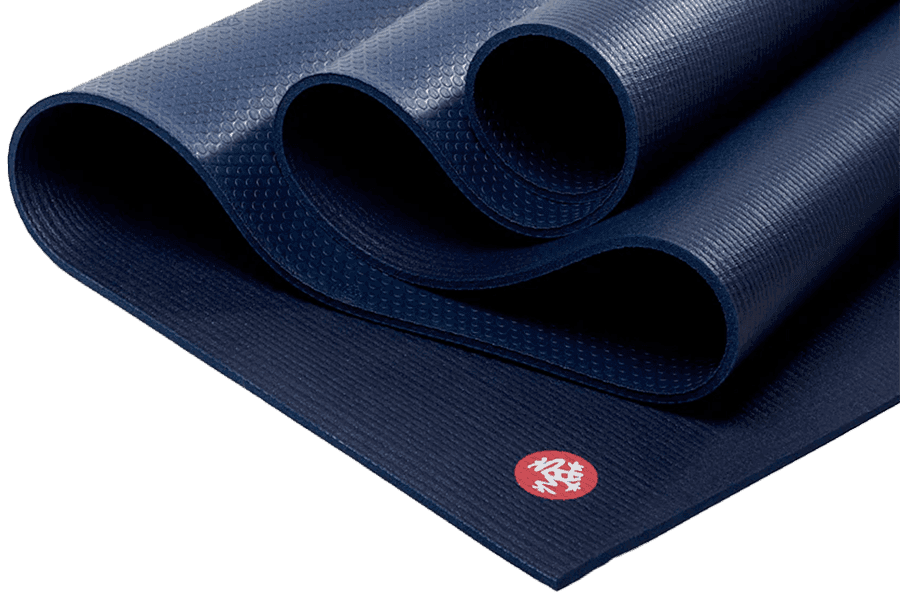
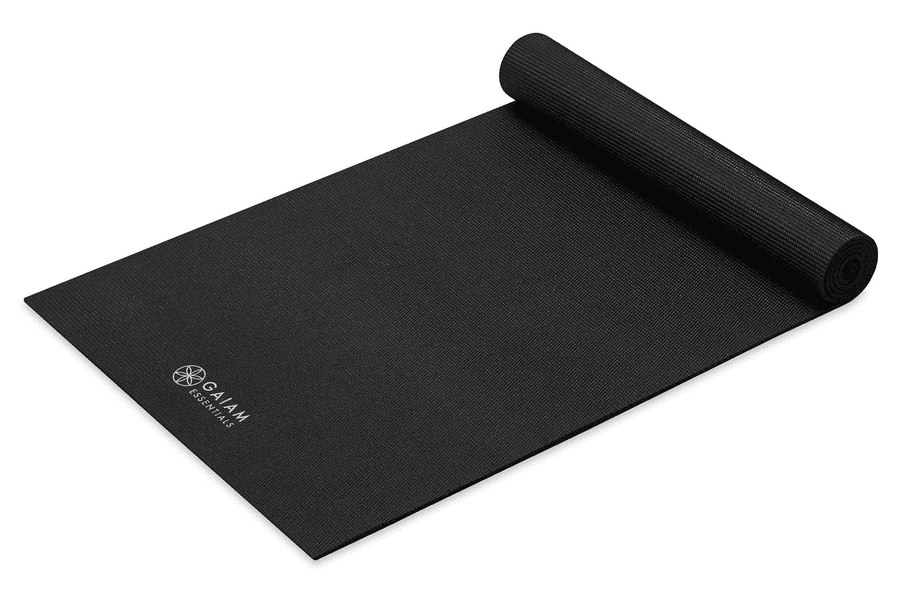
Price
The Gaiam Essentials lists for about $122 less.
$144
List price · check price at Amazon
$22.13
List price · check price at Amazon
Thickness
Identical thickness.
6 mm0.24″
6 mm0.24″
Weight
The Gaiam Essentials is 4.5 lbs lighter.
8 lbs3.6 kg
3.5 lbs1.59 kg
Size
The Gaiam Essentials is 1″ longer; the PRO is 2″ wider.
Same on both
- 6 mm thick
- PVC, latex-free
- Slippery once your palms get sweaty
- Lifetime guarantees on paper
Full specs
Dimensions
Materials & build
Buying
Six times the price for the same 6 mm
Line up the listings and the numbers look close. Both mats are 6 mm thick, both are PVC, both are latex-free, and both carry lifetime guarantees. The Gaiam is even fractionally longer, at 72 inches against the PRO’s 71. Then you get to $144 against about $22.13.
The 4 pound weight difference explains most of it. Manduka compresses the PRO’s PVC into a dense slab that weighs 7.5 pounds; Gaiam fills the same 6 mm with light foam at 3.5. Density is what you are paying for, and it changes how the mat holds you, how it behaves under a standing leg, and how many years it survives.
Feel: firm floor against soft foam
The PRO feels close to hard underfoot, and regulars come to like that. Nothing sinks, nothing tips, and knees and wrists land on something that supports rather than swallows them. GearLab gave it a perfect 10 for comfort and support and ranked it first of the 19 mats it tested in 2026.
The Essentials is soft, which reads as comfortable in a shop and behaves differently in practice. Soft foam is kind in seated and floor work and unhelpful the moment you stand on one leg, because the surface compresses unevenly under your foot. GearLab has not tested the Essentials, but it did test Gaiam’s Premium 6mm, a near-identical mat from the same line, and found the foam compresses under a hand and holds the print for a moment. That is the family trait.
Grip: neither one loves sweat
Both are closed-surface PVC, so nothing absorbs and wet palms slide. The Essentials has the textured sticky finish Gaiam puts on all its mats, which works fine in a dry room and gives up once your hands are damp. Gaiam’s listing claims it suits heated practice; we would not buy it on that basis, and GearLab rated the closest equivalent it has tested at 4 out of 10 for wet grip.
The PRO starts worse and finishes better. A new one is genuinely slippery for the first few weeks, which Manduka now says resolves with regular use rather than a salt scrub. Once broken in it grips well and improves for years, though GearLab still lists slickness when really wet as its main drawback. For hot yoga, neither is the right tool. Look at natural rubber or an absorbent top instead.
Size: longer against wider
The Essentials is 72″ × 24″ and the PRO is 71″ × 26″, so the cheap mat is the longer one by an inch. Width is where the PRO wins, and width is the dimension people actually notice: 2 extra inches shows up in wide-legged stances and any pose where your hands land outside your shoulders.
One caution on the Gaiam. Its Amazon listing is 72 inches, but Gaiam sells a 68 inch Essentials on its own site, so check the dimensions on whichever listing you order from. If you want more length than either, Manduka makes the PRO Long at 85 inches.
Weight: the Gaiam wins the walk to class
At 3.5 pounds the Essentials goes over a shoulder or into a tote without any thought, and it ships with a cinch carry sling in the box, which Manduka charges extra for.
The PRO’s 7.5 pounds is a genuine commitment. GearLab lists heft as one of its two downsides, and a lot of owners end up leaving theirs permanently in one room. If you want Manduka density in something carryable, the PROlite is the mat for that.
Durability: a decade against a couple of years
Dense PVC barely wears. GearLab has a tester still using the same PRO after 20 years, and Manduka’s lifetime guarantee sits behind it, with fine print that works out to roughly ten years of regular use, one replacement, and proof of purchase from an authorized seller. Amazon purchases qualify only when sold and shipped by Amazon itself.
Soft foam packs down. Gaiam covers the Essentials with a lifetime guarantee too, which is remarkable at this price, but a guarantee of this kind covers defects rather than foam gradually flattening under normal use. GearLab found visible compression on the Premium from the same line and rated it 6 out of 10 on materials. Practice daily on an Essentials and expect a couple of years; practice a few times a month and it can go much longer.
Care and the new-mat smell
Gaiam asks you to unroll the mat and air it out for two to three days before the first session, because PVC mats release a strong odor when first unwrapped. The company publishes a guide about getting rid of it, which tells you how common the complaint is. It also warns that extended sun exposure makes the mat brittle.
The PRO arrives with a milder version of the same smell and then asks very little: wipe it down, keep it out of the sun, and it carries on. Nothing soaks into a closed-cell mat, so deep cleaning never comes up.
Two lifetime guarantees that mean different things
Both listings say lifetime, and the phrase is doing very different work in each case. Manduka’s covers the mat against defects and wear for what its fine print describes as roughly ten years of regular use, with one replacement, and it requires proof of purchase from an authorized seller. People do claim on it, and the mat is built to a standard where the company can afford to offer it.
Gaiam’s lifetime guarantee is genuinely unusual on a $22 mat, and it covers manufacturing defects rather than the gradual flattening of foam. That distinction matters because flattening is what actually ends the life of a mat in this class. Treat it as insurance against a bad unit rather than a promise that the mat will still be good in five years.
Who each one is actually for
The Essentials is a starter mat and a perfectly good one. It is what you buy when you are not sure yoga will stick, when you need a spare for guests, or when the mat mostly supports stretching and floor work in front of a screen. Roughly 15,000 Amazon ratings average 4.6 stars, which is about right for what it is.
The PRO is for a practice that already exists. Several sessions a week is where its stability, width and lifespan start paying for themselves. If you are somewhere between the two, Manduka’s own Begin and X sit in the middle of the price range with firmer footing than starter foam.
Price and value
List prices are $144 and $22.13, and the Gaiam’s street price moves around by colorway, so check the current price on the PRO at Amazon and the Essentials at Amazon before you decide.
For a daily practitioner, one $144 mat that runs a decade beats replacing a flattened foam mat every year or two. For someone on the mat twice a month, the Essentials may never wear out and the PRO’s advantages would mostly go unused. Neither purchase is wrong if it matches how often you will actually practice.
Bottom line
Buy the Gaiam Essentials if you are starting out, practicing casually, or want a light, cheap mat for floor work. It cushions well, comes with a strap, and has real limits: unstable under balance poses, slippery once you sweat, and destined to compress.
Buy the Manduka PRO if yoga is already part of your week. It is firmer, wider, and built on a completely different timescale, and its real competition is other premium mats rather than this one. Our PRO vs B Mat Strong comparison covers that end of the ladder.
Manduka PRO
List price $144
Gaiam Essentials 6mm
List price $22.13
Frequently Asked Questions
- Is the Gaiam Essentials actually any good?
- For the money, yes. It is a plain 6 mm PVC mat with a textured sticky surface, a carry sling in the box, and Gaiam's lifetime guarantee, and it holds a 4.6 star average across roughly 15,000 Amazon ratings. It is soft foam, so it compresses under regular use and gets slippery when your hands sweat. As a first mat, a guest mat, or a stretching mat, it does the job. As a daily driver for a serious practice, it will not hold up.
- Why does the Manduka PRO cost six times as much?
- Density and lifespan. The PRO's PVC is compressed into a closed-cell slab that weighs 7.5 pounds, supports you like a firm floor, and barely wears; GearLab's testers found PROs still in service after decades. It is made in Germany, OEKO-TEX certified, and covered by a lifetime guarantee that means roughly ten years of regular use and one replacement in the fine print. The Essentials is light foam built to a $22 price. Whether the gap is worth it depends entirely on how often you will be on the mat.
- Which is bigger?
- They trade places. The Essentials listing we link runs 72 inches long against the PRO's 71, so it is fractionally longer. The PRO is 26 inches wide against the Essentials' 24, and those 2 inches are the ones you notice, in wide-legged poses and anything where your hands land outside your shoulders. Gaiam also sells a shorter 68 inch Essentials on its own site, so check the length on whichever listing you buy from.
- Is either mat good for hot yoga?
- Not really. Both are closed-surface PVC, so sweat sits on top and wet palms slide. GearLab lists slickness when wet as the main drawback of the PRO, and rated the closest Gaiam mat it has tested, the Premium 6mm, at 4 out of 10 for wet grip. If heated classes are your normal, you want an absorbent-top mat or a natural rubber surface, or a towel over whichever of these you buy.
- Does the Gaiam Essentials smell?
- Yes, out of the wrapper. Gaiam's own instructions say to unroll the mat and air it out for two to three days before the first session to release the new-mat smell, and the odor is strong enough that they publish a guide about it. The PRO arrives with a milder version of the same thing. Both fade with airing and use.
- What sits between a $22 mat and a $144 one?
- Quite a lot. Manduka's own Begin and X mats land in the middle of the range with firmer footing than starter foam. Gaiam's Performance Dry-Grip is a step up within the same brand. Jade's natural rubber mats and Lululemon's The Mat sit around $100 to $120 with far better grip than either mat here. If the Essentials feels flimsy but $144 is too much, that middle tier is where to look.
Related comparisons
- YogaAccessories Extra Thick Deluxe 1/4" vs Gaiam Essentials 6mm
- Gruper TPE 6mm vs Gaiam Essentials 6mm
- Amazon Basics 1/4 Inch Thick TPE vs Gaiam Essentials 6mm
- Manduka PRO vs Alo Warrior
- Manduka PRO vs b, halfmoon B Mat Strong 6mm
- Manduka PRO vs Yoloha Unity Pro Cork
- Manduka PRO vs JadeYoga Harmony XW
- Manduka PRO vs Lululemon The (Big) Mat 5mm
- Manduka PRO vs JadeYoga Fusion 68"