Manduka PRO vs Gaiam Classic Print: Which One Should You Buy?
This is the widest price gap we cover from these two brands: $144 for the Manduka PRO, the dense studio classic that OutdoorGearLab scored highest in its current 19-mat test, against $24.98 for the Gaiam Classic Print, the archetypal printed sticky mat. Nobody cross-shops these as equals. The real question is whether you're at the start of a practice or somewhere in the middle of one, and the answer to that decides the page.
As an Amazon Associate, we earn from qualifying purchases made through links on this page. How this works
The quick answer
As products they aren't close. The PRO scored 91 of 100 with the Editors' Choice award for a daily practice: a perfect comfort-and-support score, top marks for materials, 7.5 pounds of PVC that studios keep for a decade, and a lifetime guarantee. The Classic Print is 4 mm and 2.1 pounds of thin sticky PVC that grips fine with dry hands, turns slick under sweat, and flattens under daily use; its virtue is costing about as much as two studio classes.
That virtue is real. Buy the Classic Print to find out whether yoga sticks, or for a light mat that mostly supports stretching. Buy the PRO when practice is already a habit; spread over the decade it lasts, it is the cheaper mat of the two.
Get the Manduka PRO if...
- You already practice regularly and are done replacing starter mats
- You want the firm, planted platform that topped the current test
- A lifetime guarantee on a decade-class mat appeals to you
- You want the bigger 71″ × 26″ footprint
Get the Classic Print if...
- You're new and $24.98 is the right level of commitment
- You want the lightest possible carry, 2.1 pounds against 7.5
- The mat mostly hosts stretching and home videos
- A print you like is what gets you on the floor
Side by side
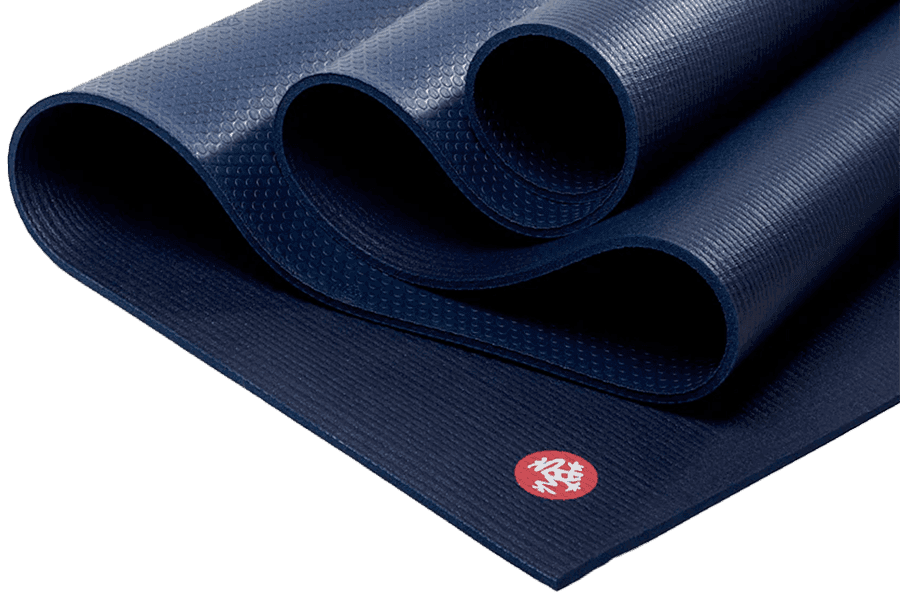
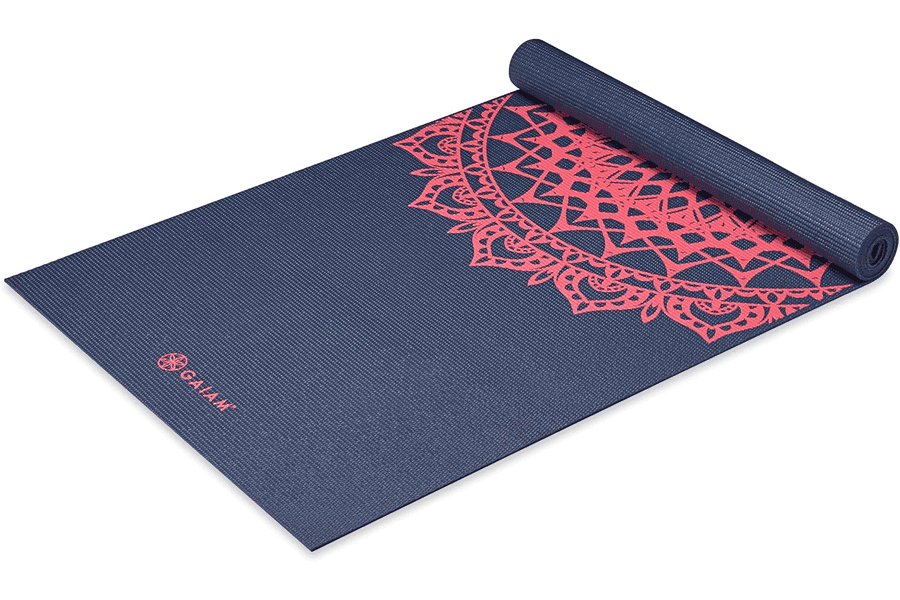
Price
The Classic Print lists for about $119 less.
$144
List price · check price at Amazon
$24.98
List price · check price at Amazon
Thickness
The PRO is 50% thicker.
6 mm0.24″
4 mm0.16″
Weight
The Classic Print is 5.9 lbs lighter.
8 lbs3.6 kg
2.1 lbs0.95 kg
Size
The PRO is 3″ longer; the PRO is 2″ wider.
Same on both
- Latex-free PVC, safe for latex allergies
- Lifetime guarantees against manufacturing defects on both
- Closed surfaces that need a towel once palms sweat
- Easy damp-cloth cleaning
Full specs
Dimensions
Materials & build
Buying
One PRO costs six Classic Prints
Nobody weighs these two as equals, and we won’t pretend to. The Manduka PRO is the $144 studio classic that topped OutdoorGearLab’s current 19-mat test at 91 of 100. The Gaiam Classic Print is the $24.98 printed sticky mat you see in every big-box store, 4 mm thin and 2.1 pounds light. People land on this page because they are deciding between starting cheap and buying once, and that is a genuinely good question with a knowable answer.
The answer depends on exactly one thing: whether a regular practice already exists. Everything below is that sentence with evidence.
What each mat actually is
The PRO is 6 mm of dense German-made PVC with a fabric-like finish, 8 pounds, 71″ × 26″. Its test record is the best in the category: a perfect 10 for comfort and support, top marks for materials with an OEKO-TEX cert, and the Editors’ Choice award for a daily practice. Its known flaws are the famous break-in slickness, the weight, and a closed surface that needs a towel in sweaty rooms.
The Classic Print is the archetypal starter mat: latex-free sticky PVC, 68″ × 24″, in a rotating set of printed designs. It grips fine with dry hands, turns slick under sweat, and its thin foam finds the floor quickly under a kneeling knee. Its virtue is honest and enormous: it costs about as much as two studio classes.
Cushion and stability: density is the difference
Both mats are firm rather than squishy, but the PRO’s firmness comes from 6 mm of dense material that protects a knee while staying planted under a standing leg, which is precisely what its perfect comfort score measured. The Classic Print’s 4 mm is thin enough that sensitive joints want a folded blanket for kneeling work on hard floors.
If cushion is your main worry but the PRO’s price isn’t happening, know that Gaiam’s own Premium 6mm adds half again as much foam for $5 more than the Classic Print, and it’s the version GearLab named Best First Yoga Mat.
The break-in warning for first-time PRO buyers
A brand-new PRO is more slippery than a brand-new $25 Gaiam, which surprises people every year. The PRO’s surface arrives slick and earns its traction over weeks of practice as the top layer wears in; Manduka used to suggest a salt scrub and now says plainly that the slickness resolves with use. The Classic Print grips from its first day, dry hands assumed.
Neither mat handles sweat. Both are closed-surface PVC, so damp palms mean a towel on either, and a genuinely sweaty practice deserves a different construction entirely, like the absorbent-top mats covered in our PRO vs IUGA comparison.
Longevity: where the money argument lives
Under daily practice, a Classic Print compresses and wears smooth within a couple of years; that is soft PVC doing what it does, and its lifetime guarantee covers defects, not this. The PRO’s dense PVC runs a decade or more, and one $144 mat that lasts ten years costs less than replacing a $24.98 mat every year or two while performing better the whole time.
Practice twice a month and the argument reverses completely: the Gaiam may never wear out, and the PRO’s decade would be spent mostly rolled in a corner. Longevity only pays when there is a practice to spend it on.
Small print on the small purchase
Two Classic Print notes worth knowing at checkout. Gaiam itself warns that printed mats arrive with a strong odor and need two or three days of airing out before practice. And fresh printed surfaces can transfer a little dye to light clothing, so give a new mat a damp-towel wipe and skip the pale leggings for the first sessions.
The PRO’s equivalent small print is its guarantee: the lifetime coverage works out to roughly ten years of regular use and one replacement, and it requires purchase from an authorized seller, which on Amazon means sold and shipped by Amazon itself.
Price and where to buy
Check current prices on the PRO and the Classic Print at Amazon. The Gaiam’s street price drifts with the print design, and big-box stores stock it if you want a mat this afternoon. The PRO comes in Black plus 13 more colorways at last count and rarely discounts far.
Bottom line
Get the Classic Print if you are starting out or your mat mostly supports stretching at home. At $24.98 the risk of being wrong is close to nothing, and if practice sticks, you’ll upgrade with actual knowledge of what you want. That is the correct way to spend $25.
Get the PRO when the habit is real and you are done cycling through starter mats. It is the best-scored mat in the current test, it will outlast every Gaiam you would have bought instead, and its firm platform is what a standing practice eventually asks for. Between the two sits the rest of the market, and our PRO vs Gaiam Premium page covers this same decision one shelf up.
Manduka PRO
List price $144
Gaiam Classic Print 4mm
List price $24.98
Frequently Asked Questions
- Is the Manduka PRO really worth six Gaiams?
- If you practice regularly, the arithmetic says yes. A Classic Print under daily use compresses and wears smooth within a couple of years; the PRO's dense PVC runs a decade or more behind a lifetime guarantee, and one $144 mat that lasts ten years beats replacing a $25 mat every year or two, while performing better the whole time. If you practice occasionally, the arithmetic flips completely: the Gaiam may never wear out, and everything the PRO does well would go unused.
- What does the $119 actually buy?
- Density, mostly, and everything that follows from it. The PRO's 6 mm of dense PVC earned a perfect comfort-and-support score by cushioning joints while staying firm under standing balances, where the Gaiam's thin foam finds the floor quickly under a knee. It also buys 2 inches of width, top-of-test materials marks, and the longevity above. It does not buy sweat performance; both mats are closed-surface PVC that gets slippery under damp palms.
- Does the PRO have a break-in period?
- Famously, yes. The PRO arrives slick and builds traction over weeks as its top layer wears in; Manduka used to suggest a salt-scrub break-in and now simply says the slickness resolves with use. The Classic Print grips from day one with dry hands. A beginner buying the PRO first should know this, because a brand-new PRO is genuinely more slippery than a brand-new $25 Gaiam.
- Which is better for a beginner?
- Usually the Gaiam, and not because beginners deserve less. A first mat's job is to make starting easy and cheap while you find out what your practice needs, and the Classic Print does that for $24.98. The exception is the beginner who already knows the habit will stick; skipping the starter-mat stage and buying the PRO once is a defensible move, break-in and all. GearLab's Best First Yoga Mat pick, the thicker Gaiam Premium, splits the difference at $29.98.
- What are the Classic Print's known quirks?
- Gaiam itself warns that printed mats arrive with a strong odor and need two or three days of airing out, and new printed surfaces can transfer a little dye onto light clothing, so give a fresh one a damp-towel wipe. Beyond that, its limits are honest budget-mat limits: thin cushion, slickness under sweat, and foam that compresses where hands and feet land under heavy use.
- Is either mat good for hot yoga?
- No. Both are closed-surface PVC, so sweat pools on top; the Gaiam turns slick, and even the broken-in PRO usually gets a towel laid over it in heated rooms. If sweaty practice is the plan, the money at either end of this comparison is better aimed at an absorbent-top mat: the $67 IUGA at the budget end, or Manduka's GRP Adapt 2.0 at the premium end.
Related comparisons
- Manduka PRO vs Alo Warrior
- Manduka PRO vs b, halfmoon B Mat Strong 6mm
- Manduka PRO vs Yoloha Unity Pro Cork
- Amazon Basics 1/4 Inch Thick TPE vs Gaiam Classic Print 4mm
- Gruper TPE 6mm vs Gaiam Classic Print 4mm
- Manduka PRO vs JadeYoga Harmony XW
- Manduka PRO vs Lululemon The (Big) Mat 5mm
- YogaAccessories Extra Thick Deluxe 1/4" vs Gaiam Classic Print 4mm
- Manduka Begin vs Gaiam Classic Print 4mm