Manduka PRO vs Gruper TPE 6mm: Which One Should You Buy?
On paper these two look closer than almost any other pair we compare. Both are 6 mm thick, both run about 72 inches long, and both are latex-free. Then one weighs 7.5 pounds and costs $144, and the other weighs 2.6 pounds and costs about $28. Nearly all of that difference is density.
As an Amazon Associate, we earn from qualifying purchases made through links on this page. How this works
The quick answer
The PRO is compressed PVC that behaves like a firm floor, made in Germany, OEKO-TEX certified, and first of 19 mats in GearLab's 2026 test at 91 out of 100. The Gruper is a two-layer TPE mat with a different non-slip texture on each face, a strap and a storage bag in the box, and a 4.4 star average from roughly 10,500 Amazon ratings.
If you practice regularly, the PRO is the better mat in every way except weight and price, and it will still be here in ten years. If you are new to yoga, practice at home a couple of times a week, or want something light to carry, the Gruper does the job for less than a class pass and you will not have wasted much if you upgrade later.
Get the Manduka PRO if...
- You practice several times a week and want one mat for years
- You want firm support rather than soft foam underfoot
- You want 26 inches of width instead of 24
- You want a warranty that a company will actually honor
Get the Gruper TPE if...
- You're starting out and don't want to spend $144 to find out
- You want 2.6 pounds to carry instead of 7.5
- You want a carry strap and storage bag included
- You'd rather keep about $116
Side by side
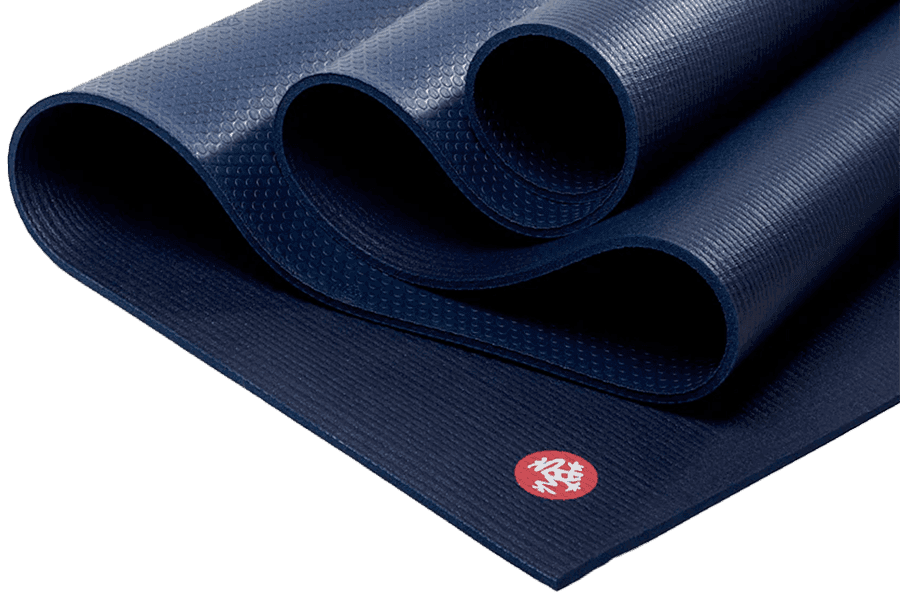
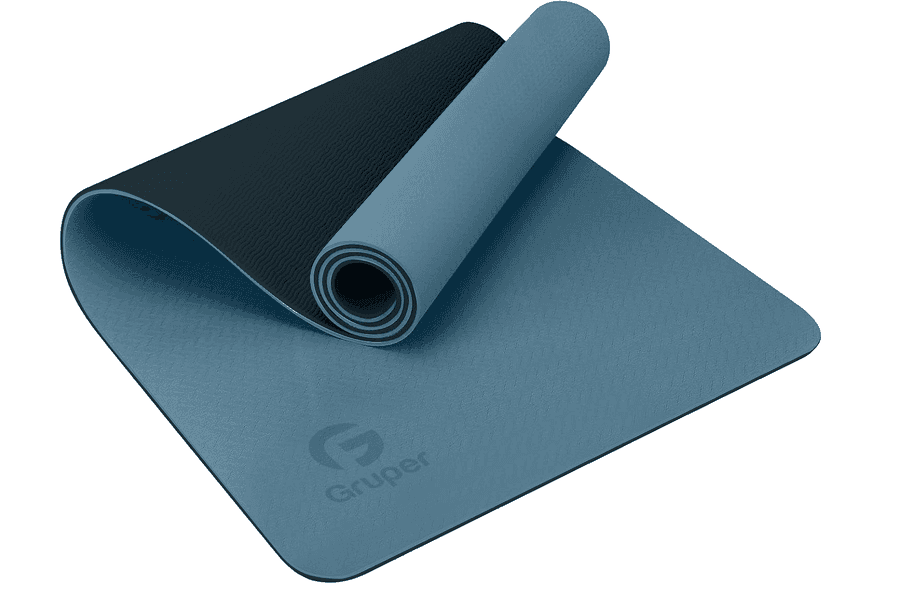
Price
The Gruper lists for about $116 less.
$144
List price · check price at Amazon
$27.99
List price · check price at Amazon
Thickness
Identical thickness.
6 mm0.24″
6 mm0.24″
Weight
The Gruper is 5.4 lbs lighter.
8 lbs3.6 kg
2.6 lbs1.18 kg
Size
The Gruper is 1″ longer; the PRO is 2″ wider.
Same on both
- 6 mm thick
- Latex-free
- Around 72 inches long
- Non-absorbent surfaces, so sweat sits on top
Full specs
Dimensions
Materials & build
Buying
Same 6 mm, and a $116 gap
Both of these are 6 mm thick, both run around 72 inches long, both are latex-free. Then the PRO weighs 8 pounds and costs $144, and the Gruper weighs 2.6 and costs about $27.99. Almost all of that difference is density, and density is most of what a mat actually does.
The Gruper is a popular first mat for good reason: it is cheap, light, comes with a strap and a storage bag, and holds a 4.4 star average across roughly 10,500 Amazon ratings. The PRO is what a lot of those people buy two or three years later.
TPE and PVC are not the same trade
Thermoplastic elastomer sits between plastic and rubber. It is lighter than PVC, softer underfoot, contains no PVC or latex, and is easier to recycle in principle if anyone actually takes it. Gruper builds this mat in two bonded layers with a fine S-pattern texture on top and a corrugated grip underneath, which is a sensible design at the price.
The catch is wear. TPE compresses and tears sooner than dense PVC or natural rubber, particularly where your hands and feet keep landing. Manduka’s PVC is the opposite: heavy, unrecyclable, and close to indestructible. GearLab scored the PRO a perfect 10 for materials and has testers still using theirs after 20 years.
Feel: the millimetres match, the surfaces do not
Under a kneecap the Gruper is the softer and more comfortable of the two. Under a standing foot it compresses unevenly, so your ankle works to stabilise the mat as well as you. The PRO does not move at all, which is why GearLab gave it a perfect 10 for comfort and support and put it first of 19 mats overall.
Nobody should read 6 mm on two spec sheets and expect the same experience. Thickness tells you how much material is between you and the floor; it says nothing about what that material does when you put weight on it.
Grip: fine dry, unreliable wet, on both
The Gruper’s textured faces do real work with dry hands, and the corrugated underside keeps the mat on the floor rather than travelling with you. Once your palms are damp, the surface gets slick, which is the standard budget-mat story and has nothing to do with Gruper specifically.
The PRO is better but not immune: GearLab scored it 9 dry and 7 wet and lists slickness when really wet as one of its two drawbacks. It is also genuinely slippery for the first few weeks, and Manduka now says regular use resolves that rather than a salt scrub. For hot classes, look at the GRP Adapt 2.0 or a natural rubber mat.
Weight: 2.6 pounds against 7.5
This is the Gruper’s clearest win. At 2.6 pounds with a strap and a bag in the box, it goes to a class or into a car without any thought. The PRO’s 8 pounds is a genuine commitment, and GearLab lists heft as one of the two things it holds against the mat.
If you want Manduka construction in something carryable, the PROlite is 4.6 pounds at 4.7 mm, and it is the mat most people who commute to a studio should be looking at instead of the PRO.
Length, width and the other thickness
The Gruper is 72″ × 24″, so it is an inch longer than the PRO’s 71″ and two inches narrower than its 26″. Width is the dimension people notice, in wide-legged stances and anywhere hands land outside the shoulders.
Gruper also sells the same mat at 8 mm and 3.1 pounds if you want more cushion, with the same caveat that softer costs you stability. The PRO comes in a 68″ Short, an 85″ Long, and extra-wide and squared versions for home studios.
One of these has a warranty
Manduka’s lifetime guarantee amounts in the fine print to roughly ten years of regular use, one replacement, and proof of purchase from an authorized seller. Amazon purchases qualify only when the mat is sold and shipped by Amazon itself, which is worth checking on the listing before you order.
Gruper publishes no warranty at all. Your protection is Amazon’s return window, and after that the mat is yours however it behaves. At $28 that is not unreasonable; it just means you should not treat it as a long-term purchase.
Price and value
List prices are $144 and $27.99, and the Gruper’s street price moves by colorway, so check the current price on the PRO and the Gruper at Amazon before you decide.
One $144 mat that runs a decade costs less than replacing a $27.99 mat every eighteen months over the same stretch, and it is a nicer surface throughout. But buying cheap first, finding out whether yoga sticks, and upgrading with a clearer idea of what you want is a perfectly sound plan. Most people who own a PRO did exactly that.
Bottom line
Buy the Gruper if you are new, if the mat needs to be light, or if you want something adequate for under $30 with the strap and bag thrown in. It is a fine mat for home practice a couple of times a week and it will not survive daily studio use.
Buy the Manduka PRO if yoga is already part of your week. It won GearLab’s 2026 test at 91 out of 100, it is firmer and wider, and it is built on a timescale nothing at $28 can approach. For a middle option, our PRO vs Begin comparison covers Manduka’s entry-level mat.
Manduka PRO
List price $144
Gruper TPE 6mm
List price $27.99
Frequently Asked Questions
- What is TPE and how does it compare to PVC?
- Thermoplastic elastomer, a foam that sits between plastic and rubber. It is lighter than PVC, softer underfoot, free of PVC and latex, and easier to recycle in theory. The catch is durability: TPE compresses and tears sooner than dense PVC or natural rubber, especially where your hands and feet land, so a TPE mat in daily use tends to show wear within a year or two. The PRO's PVC is the opposite trade, heavy but nearly indestructible.
- Is the Gruper slippery?
- It is fine dry and unreliable wet, which is normal for the material. Gruper puts a fine S-pattern texture on the top face and a corrugated grip on the bottom, and the texture does real work with dry hands. Once your palms are damp the surface gets slick, the same complaint that follows most budget mats. The PRO is not immune either: GearLab rated it 7 out of 10 wet, and a new one is genuinely slippery for the first few weeks.
- Both are 6 mm. Why does the PRO feel so different?
- Density. Manduka compresses the PRO's PVC until 6 mm weighs 7.5 pounds; Gruper fills the same 6 mm with light foam at 2.6. Under a standing leg the PRO does not compress and the Gruper does, which is why GearLab gave the PRO a perfect 10 for comfort and support. Thickness tells you how much material is there, not how it behaves.
- Does the Gruper come in other sizes?
- There is an 8 mm version of the same mat at 3.1 pounds, in the same 72 by 24 footprint. If you want more cushion, that is the one to look at, with the same caveat about softness costing you stability. The PRO comes in a 68 inch Short, an 85 inch Long, and squared and extra-wide versions.
- Which is better value?
- It depends on how long you practice. One $144 mat that runs a decade costs less than replacing a $28 mat every eighteen months over the same period, and the PRO is more pleasant to use throughout. But that only holds if you keep practicing. Buying the Gruper first and upgrading in a year, once you know what you want, is a perfectly reasonable plan and a lot of people do exactly that.
- Does either come with a warranty?
- Manduka's lifetime guarantee covers the PRO for what the fine print describes as roughly ten years of regular use, with one replacement and proof of purchase from an authorized seller; Amazon counts only when the mat is sold and shipped by Amazon itself. Gruper publishes no warranty, so you are relying on Amazon's return window. That is worth knowing before the mat starts flaking.
Related comparisons
- Amazon Basics 1/4 Inch Thick TPE vs Gruper TPE 6mm
- Gaiam Premium 6mm vs Gruper TPE 6mm
- Gruper TPE 6mm vs Gaiam Essentials 6mm
- Manduka PRO vs Alo Warrior
- YogaAccessories Extra Thick Deluxe 1/4" vs Gruper TPE 6mm
- Gaiam Premium Reversible 6mm vs Gruper TPE 6mm
- Manduka PRO vs b, halfmoon B Mat Strong 6mm
- Manduka PRO vs Yoloha Unity Pro Cork
- Gruper TPE 6mm vs Gaiam Classic Print 4mm