Manduka PRO vs Amazon Basics 1 Inch: Which One Should You Buy?
On paper this looks lopsided in the cheap mat's favor: the Amazon Basics gives you a full inch of foam, four times the Manduka PRO's 6 mm, for about a quarter of the price. But a mat this soft can't hold a standing yoga pose at all, and that one fact separates these two products. The PRO is a firm platform for practicing yoga on. The Amazon Basics is a plush pad for lying, kneeling, and stretching on. Decide which of those you need and the price difference stops mattering.
As an Amazon Associate, we earn from qualifying purchases made through links on this page. How this works
The quick answer
The PRO is a yoga mat: 6 mm of dense PVC that stays stable under standing poses, grips once broken in, and lasts decades under a lifetime guarantee. The Amazon Basics is a padded exercise mat: a full inch of soft NBR foam that feels wonderful under knees, elbows, and backs, ships with a carry strap, and costs about $38, but it sinks and wobbles under any pose where you bear weight on your feet or hands, and owners report mixed durability, with some mats ripping or turning slippery.
Nobody should buy the 1 inch mat for a standing yoga practice, at any price. Buy the PRO for yoga. Buy the Amazon Basics for floor exercise, physical therapy work, and stretching on hard floors, where its softness is the whole point.
Get the PRO if...
- You practice standing yoga and need a stable surface
- You kneel a lot and want dense support that won't bottom out
- You want a mat that lasts decades, with the guarantee to match
- You're building a long-term practice
Get the Amazon Basics if...
- Your routine is floor exercise, PT movements, or stretching
- You want maximum padding on a hard floor for about $38
- Comfort lying down matters more than stability standing up
- You want something light with a carry strap included
Side by side
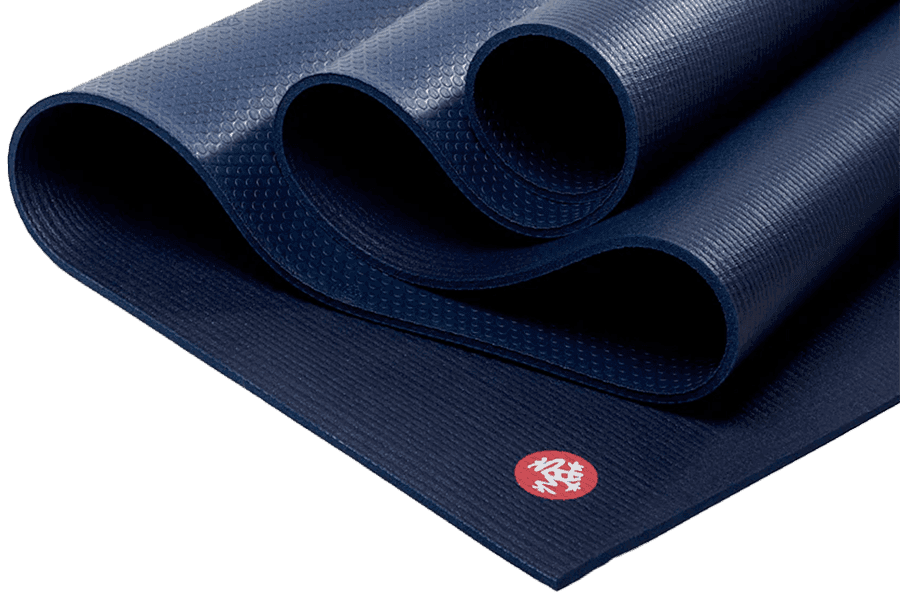
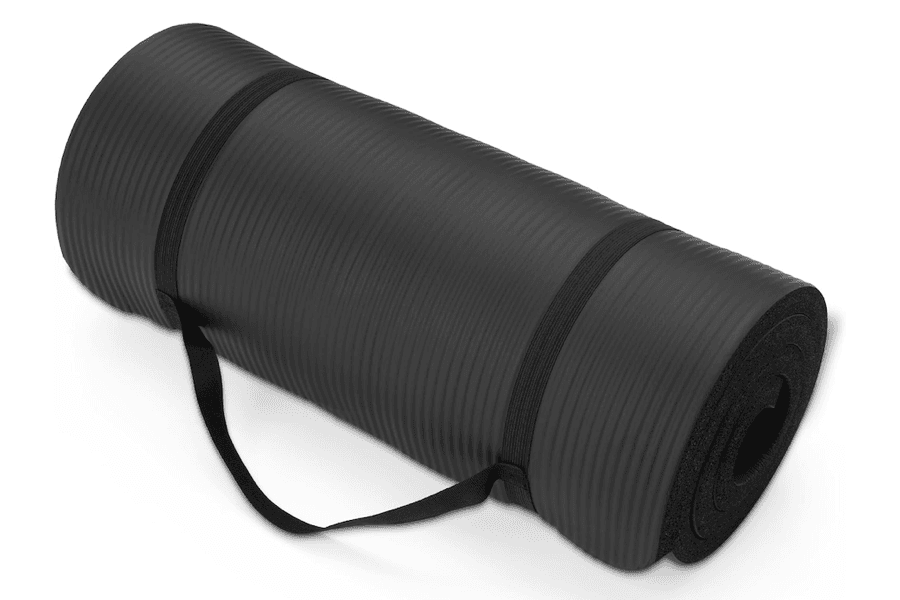
Price
The Amazon Basics lists for about $106 less.
$144
List price · check price at Amazon
$38.40
List price · check price at Amazon
Thickness
The Amazon Basics is 323% thicker.
6 mm0.24″
25.4 mm1″
Weight
The Amazon Basics is 2.9 lbs lighter.
7.5 lbs3.4 kg
4.6 lbs2.1 kg
Size
The Amazon Basics is 3″ longer; the PRO is 2″ wider.
Same on both
- Textured surfaces that wipe clean
- Neither suits sweaty hot yoga
Full specs
Dimensions
Materials & build
Buying
The thickest mat on Amazon vs the firmest mat in yoga
This comparison exists because the spec sheet tells a seductive story: about $38 buys you a full inch of cushioning, four times what Manduka gives you for $144. If thickness were the product, the PRO would be a scam.
Thickness is not the product. The PRO is a yoga mat, a firm platform your feet and hands can trust through a standing practice. The Amazon Basics is an inch of soft NBR foam, an exercise pad whose entire pitch is plushness. Once you see them as different tools, the decision usually takes a minute: what will you actually be doing on it?
An inch of soft beats 6 mm of dense exactly once
The once: lying down. Stretched out on your back on the Amazon Basics, the foam cradles you in a way no yoga mat will, and owners doing physical therapy exercises, ab work, and long floor sessions on hard floors love it for exactly that. Several reviewers report buying it purely as a comfort surface, and a surprising number end up donating it to the family dog.
Everywhere else, density wins. Soft foam compresses under concentrated weight, so a kneeling knee or a planted palm sinks through the plush until it finds something like floor. The PRO’s 6 mm of dense PVC barely compresses at all, which is why it protects joints better at a quarter of the thickness and why OutdoorGearLab scored its comfort and support perfect. Deep and soft is a mattress; thin and dense is a foundation.
You cannot balance on a pillow
An inch of soft foam moves under your feet. Every standing pose becomes an ankle workout, every lunge lands on a surface that shifts as you load it, and balance poses are simply not happening. GearLab’s testers said of a comparable 1 inch foam mat that its extreme cushioning doesn’t provide a stable surface for balancing, and that matches the physics: the taller the soft stack, the more it wobbles.
The PRO is the opposite tool, dense enough that studios have defaulted to it for decades. If your practice includes standing sequences, there’s no version of this comparison where the foam mat works, at this thickness least of all. If your practice is entirely seated and supine, keep reading, because then the foam’s case gets real.
Grip, smell, and daily life
Neither surface is a grip champion. The Basics has a lightly textured foam top that holds for slow movement; a recurring owner note is that it turns slippery, with some recommending grip socks. The PRO ships famously slick and needs a few weeks of practice to break in, then grips well dry for years. Sweat defeats both, so hot yoga is off the table either way.
One quirk the PRO doesn’t share: new-mat smell. Amazon’s own listing recommends airing the mat out for 48 hours to let the new-product odor dissipate, which is unusually honest packaging copy. Owner reports vary, and plenty notice nothing, but plan to unroll it in a ventilated room for a couple of days. On the practical side the Basics is the easier companion: about 4.6 pounds to the PRO’s 7.5, carry strap included, 74″ long to the PRO’s 71″, though 2 inches narrower at 24″.
Durability: owners disagree, the warranty doesn’t
Amazon’s review summary for the Basics line is candid: opinions on durability are mixed, with some owners reporting mats that hold up and others reporting rips and slippery surfaces. Soft foam also compresses over time regardless of luck; a mat whose entire value is loft loses value as the loft goes. The 1 year warranty prices those expectations about right.
The PRO sits at the other end of the category. GearLab found instructors’ PROs still serving after five to twenty years, and Manduka’s lifetime guarantee, roughly ten years of regular use with one replacement in the fine print, exists because the company can afford to offer it. You’re not paying six times more for the same lifespan; you’re paying for a different unit of time.
The elephant on the listing: the 1/2 inch version
The same Amazon listing sells this mat in a 1/2 inch thickness, and that version, not this one, is the mat outlets like Forbes and CNN Underscored actually tested and liked as a budget comfort pick. Going from half an inch to a full inch buys more plushness and more wobble, and it makes the roll fatter and the foam’s flaws larger. If a foam pad is genuinely what you need, we’d point most people at the thinner version first; our PRO vs Amazon Basics 1/2 Inch comparison covers it. The full inch earns its keep mainly for bony joints on very hard floors, physical therapy routines, and maximum lying-down comfort.
Price and value
List prices are $144 for the PRO and about $38 for the Amazon Basics, and Amazon pricing drifts, so check the current price on the PRO and the Amazon Basics 1 inch mat before deciding.
Judged inside their own categories, both are fair deals. The Basics is a lot of comfortable foam for the money, even with the durability lottery. The PRO is expensive up front and cheap per year. The only bad purchase here is the crossover: buying an inch of foam to do standing yoga on, or paying $144 for a mat you’ll only ever lie on.
Bottom line
For yoga, buy the PRO, and if the price stings, buy a firmer budget mat like Amazon’s own 6 mm TPE mat rather than more foam. Standing practice needs a floor, not a pillow.
For stretching, physical therapy, core work, or turning a patch of hard floor into somewhere pleasant to be, the Amazon Basics does the job better than the PRO and at about a quarter of the price. Air it out for two days, don’t ask it to hold a Warrior III, and it’s a perfectly good buy.
Manduka PRO
List price $144
Amazon Basics 1 Inch Extra Thick
List price $38.40
Frequently Asked Questions
- Is the Amazon Basics 1 inch mat good for yoga?
- Not for most of it. A full inch of soft NBR foam sinks under concentrated weight, so standing and balance poses wobble from the ground up; OutdoorGearLab said of a comparable 1 inch foam mat that its extreme cushioning simply doesn't provide a stable surface for balancing. For gentle seated, supine, or restorative practice it's fine, and genuinely comfortable. For anything involving Warrior poses, buy a firm mat instead.
- Isn't a 1 inch mat better for bad knees than a 6 mm one?
- It depends what your knees are doing. Kneeling or lying, the thick soft foam feels lovely, and owners with joint pain and physical therapy routines praise it for exactly that. Bearing weight in a pose, soft foam compresses until your joint approaches the floor anyway, while the PRO's dense 6 mm barely compresses at all. The foam is more comfortable to rest on, but the dense mat gives more actual support in weight-bearing poses.
- What's the difference between the Amazon Basics 1 inch and 1/2 inch mats?
- Same NBR foam, double the thickness, sold as thickness options on the same Amazon listing. The 1/2 inch version is the one outlets like Forbes and CNN Underscored actually reviewed and liked as a budget comfort mat, and it's a bit more manageable to roll and carry. The 1 inch version is plusher and even less stable. If you're set on a foam pad, we'd take the 1/2 inch for most uses.
- How durable is the Amazon Basics 1 inch mat?
- Mixed, by the owners' own account. Amazon's review summary notes opinions split between mats that hold up fine and mats that rip or turn slippery, and soft foam compresses and thins with regular use regardless. There's a 1 year warranty behind it, which is a fair statement of expectations. The PRO is in a different category entirely: decades of service with a lifetime guarantee.
- Does the Amazon Basics mat smell out of the box?
- Enough that Amazon says so itself: the listing recommends airing the mat out for 48 hours to let the new-product smell dissipate. Owner experiences vary, and several reviewers report little to no odor, but plan on unrolling it somewhere ventilated for a couple of days. The PRO's PVC is OEKO-TEX certified and has no meaningful odor reputation.
- Which is easier to carry to a class or gym?
- The Amazon Basics, easily. It weighs about 4.6 pounds to the PRO's 7.5 and includes a carrying strap, though it rolls into a fat bundle because of the thickness. Just know that carrying it to a yoga class somewhat misses the point, since it can't hold standing poses once you unroll it. For a stretching or floor-work session at the gym, it carries fine.
Related comparisons
- Amazon Basics 1 Inch Extra Thick vs Retrospec Solana 1"
- Manduka PRO vs b, halfmoon B Mat Strong 6mm
- Manduka PRO vs Alo Warrior
- Manduka PRO vs Yoloha Unity Pro Cork
- Manduka PRO vs JadeYoga Harmony XW
- Manduka PRO vs Lululemon The (Big) Mat 5mm
- Manduka PRO vs Lululemon The Mat 5mm
- Manduka PRO vs Liforme Classic
- Manduka PRO vs JadeYoga Fusion 68"