Manduka eKO vs Manduka X: Which One Should You Buy?
These two share a Manduka logo, a 71 inch length, 5 mm of thickness, and almost nothing else. The eKO is a premium natural rubber yoga mat: 7 pounds, 26 inches wide, warm and grippy underhand. The X is formally the X Hybrid Fitness Mat, a $72 TPE all-rounder at less than half the eKO's weight, built to also survive shoes, dumbbells, and circuit day. The $42 gap buys material and width; whether that's worth it depends on what your floor time actually looks like.
As an Amazon Associate, we earn from qualifying purchases made through links on this page. How this works
The quick answer
For a pure yoga practice, the eKO is simply the nicer mat: real rubber texture, a denser and more planted feel, and 2 extra inches of width. For everything else, the X is the smarter buy. It's $42 cheaper, half the weight to carry, tolerates cross-training the eKO's rubber surface can't, and gives up surprisingly little as a yoga surface. Neither carries a warranty, and neither grips well once palms are properly wet.
If the mat exists for yoga and you value how it feels, get the eKO. If the budget matters, the mat travels, or it doubles for workouts, get the X.
Get the eKO if...
- You want natural rubber underhand, not TPE
- You want the full 26 inch width
- The mat stays home, where 7 pounds lies flat and planted
- Recycled content matters: over 30% of the build
Get the X if...
- You'd rather keep $42
- You carry your mat: 3.4 pounds against 7
- Your mat also sees workouts, shoes, or sliders
- You have a latex allergy (TPE has none; rubber does)
Side by side
Price
The X lists for $42 less.
$114
List price · check price at Amazon
$72
List price · check price at Amazon
Thickness
Identical thickness.
5 mm0.2″
5 mm0.2″
Weight
The X is 3.3 lbs lighter.
7 lbs3.2 kg
3.7 lbs1.7 kg
Size
Same length; the eKO is 2″ wider.
Same on both
- 71 inches long, 5 mm thick
- Closed-cell: sweat stays on top
- Grippy dry from the first session
- Made in Taiwan
- No warranty beyond 30 day returns
Full specs
Dimensions
Materials & build
Buying
A yoga mat and a gym floor, from the same brand
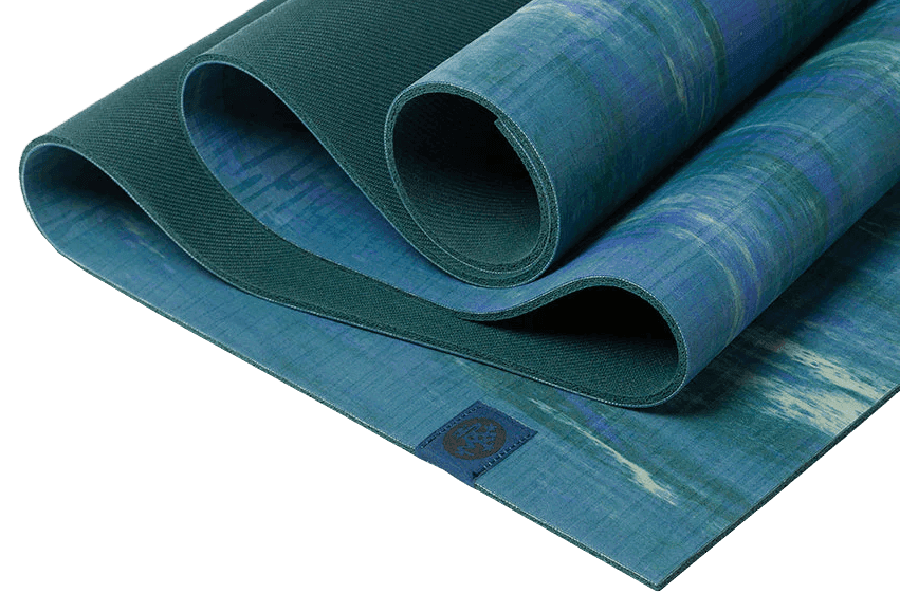
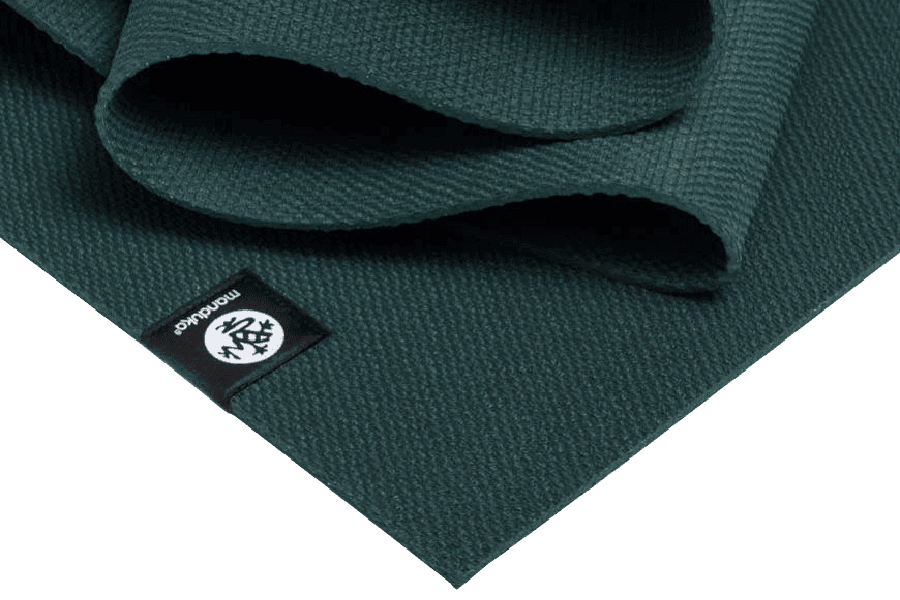
Manduka names these two honestly. The eKO is a yoga mat, full stop: 71″ × 26″ of natural rubber built around barefoot practice. The X is formally the X Hybrid Fitness Mat, a TPE all-rounder that Manduka expects to host dumbbells, sliders, and shoes along with the occasional sun salutation. One costs $114, weighs 7 pounds, and feels premium. The other costs $72, weighs 3.4, and feels practical.
They overlap more than those descriptions suggest, both 71 inches long, both 5 mm thick, both closed-cell surfaces that grip dry hands from day one. So the useful way to read this page is as a $42 question: what exactly does the eKO’s extra money buy, and does your practice collect on any of it?
Grip and feel: rubber wins on charm
Neither mat needs a break-in. The X’s double-sided textured TPE grips dry hands reliably from the first session, and the eKO’s rippled rubber does the same with more personality: warmer, softer, the surface people mean when they say a mat feels expensive. On pure dry traction we’d call them even. On how they feel while you use them, the eKO wins clearly, and if that sounds trivial, it’s the main thing you’re paying the $42 for.
Sweat levels the field again, downward. Both are closed-cell, so moisture pools on top, and Manduka frames the eKO’s grip as reliable in dry conditions; the X behaves no better. A towel covers either for the occasional heated class. If sweat is a weekly fact of your practice, neither is the right tool, and our Harmony vs eKO page covers the absorbent alternative.
Cushioning: equal thickness, different springs
Both carry 5 mm, and both cushion a kneeling pose adequately on a normal floor. The difference is density: the eKO’s rubber is heavier and more planted, compressing with a firm, supportive rebound, while the X’s lighter TPE feels springier and a touch hollower under load. Balance poses are stable on either. On hard tile or concrete the denser eKO protects a little better at the bottom of the compression, though neither is a thick mat, and neither pretends to be.
Size and weight: width versus portability
Same length, different everything else. The eKO’s 26 inch width is a genuine luxury, 2 inches most mats don’t give you, and it earns them with 7 pounds that lie dead flat at home and grind on a shoulder strap. The X is a standard 24 inches wide and 3.4 pounds, less than half the eKO’s weight, and it commutes the way the eKO simply doesn’t. There’s no compromise position between them in Manduka’s rubber line except the 5 pound eKO Lite, which splits this exact difference.
Durability: both few-year mats, differently abused
Neither of these is the Manduka that lasts decades; that’s the PRO series, and Manduka underlines the point by giving its lifetime guarantee to the PROs and leaving both of these mats with a 30 day return window and nothing after.
Their aging just takes different shapes. The eKO’s rubber wears at the surface, and owners report flaking after a few years of hard daily practice; sunlight and harsh cleaners accelerate it, and shoes or dragged equipment would wreck it quickly, which is why it should stay a barefoot mat. The X’s TPE compresses and loses cushion over a similar few years, but it takes shoes, sliders, and circuit workouts as designed use along the way. If your mat’s week includes anything besides yoga, the X isn’t just the cheaper option, it’s the only one of the two that survives the job.
Materials: the latex question
The eKO’s material story is the richer one, natural tree rubber with over 30% recycled content, renewable at the source and free of PVC. The X’s TPE is a synthetic, pitched mainly as a lighter-footprint alternative to PVC rather than a green credential in itself.
But the X holds one card the eKO can’t match: TPE contains no latex. Natural rubber does, and Manduka’s rubber mats aren’t the place for a latex allergy. If that’s your constraint, the X is one of the few affordable Manduka answers, alongside the Begin and the PVC PRO line.
Sizes, colors, and versions
The eKO gives tall practitioners a 79″ × 26″ Long at $124; the X comes in its single 71″ × 24″ size, in around 7 colorways to the eKO’s 5. One catalog note on the eKO: Manduka re-engineered the line a few years back and some retailers still label current stock eKO 2.0, so date-check any older review you lean on. The X has had no such reshuffle.
Price and value
List prices are $114 for the eKO and $72 for the X, and Manduka runs colorway sales on both, so check current prices on the eKO and the X at Amazon before deciding.
Since both wear out on a similar clock and neither carries a warranty, the eKO’s $42 premium buys features, not longevity: the rubber feel, the 26 inch width, the recycled content. Those are real, daily-use upgrades for a committed barefoot practice. They’re also exactly the things a casual or mixed-use practitioner never notices, which is why the X exists at all.
Bottom line
Get the eKO if yoga is the whole job and the mat mostly lives at home. The rubber surface is genuinely nicer under your hands every single practice, the extra width changes how wide stances feel, and at home its 7 pounds works for you. Buy it barefoot-only and keep it out of the sun.
Get the X if you want one mat for a varied week, a lighter carry, a latex-free material, or just the $42. It gives up the eKO’s charm, not its competence: the yoga fundamentals are all there, and it shrugs off treatment that would ruin the rubber mat. For most people this far down Manduka’s price list, the X is the more rational buy, and the eKO is the one you get because you know exactly what you’re paying extra for.
Manduka eKO
List price $114
Manduka X
List price $72
Frequently Asked Questions
- Is the Manduka X good for yoga, or just workouts?
- It's a competent yoga mat. It grips dry hands from the first session with no break-in, its 5 mm TPE cushions adequately, and it holds steady under balance poses. What you give up against the eKO is feel and width: TPE is springy but characterless next to natural rubber, and the X's 24 inches against the eKO's 26 is a real difference in wide stances. For yoga-only use the eKO is nicer; the X is rarely a regret at $42 less.
- Which is better for hot yoga, the eKO or the X?
- Neither. Both are closed-cell surfaces, so sweat pools on top instead of absorbing, and Manduka frames the eKO's grip as reliable in dry conditions; the X behaves the same way. A towel fixes either for occasional heated classes. For regular hot practice, an absorbent surface like an open-cell rubber mat or a polyurethane-topped mat is the right category.
- Can I do cross-training or wear shoes on the Manduka eKO?
- You shouldn't. Natural rubber wears at the surface, and shoes, sliders, and dragged weights speed that up dramatically; owners already report surface flaking after a few years of just hard barefoot practice. The X is the one designed for that workload, with a firmer double-sided TPE surface that treats shoes and equipment as intended use.
- How big is the weight difference between the eKO and the X?
- Large: the eKO is 7 pounds, the X is 3.4. The eKO is one of the heaviest standard-size mats sold and tends to become a stay-at-home mat. The X carries like a light mat because it is one. If the mat commutes, that alone can decide this comparison.
- Which lasts longer, the eKO or the X?
- Both are few-year mats under regular use, worn by different mechanisms: the eKO's rubber surface flakes with hard practice, while the X's TPE slowly compresses and loses its cushion. Neither has a warranty, since Manduka's lifetime guarantee covers the PRO series only. If you want a Manduka that lasts a decade, that's the PRO or PROlite conversation.
- Is the Manduka X safe for a latex allergy?
- Yes. TPE contains no latex, which makes the X one of the few mats in Manduka's premium-adjacent range that's safe for latex allergies. The eKO is natural tree rubber and isn't. If latex is your constraint, the X, the Begin, or a PVC mat like the PRO are the Manduka options.
Related comparisons
- Manduka X vs Gaiam Performance Dry-Grip 5mm
- Manduka X vs Gaiam Performance Dry-Grip Long & Wide
- Manduka eKO vs Lululemon The (Big) Mat 5mm
- Lululemon The Mat 5mm vs Manduka eKO
- Manduka X vs IUGA Eco Friendly Non Slip PU
- Manduka eKO vs Hugger Mugger Para Rubber 5mm
- JadeYoga Harmony 74" vs Manduka eKO
- Manduka X vs JadeYoga Level One
- Manduka eKO vs Yoga Design Lab Infinity 5mm