Manduka eKO vs eKO Superlite: Which One Should You Buy?
These two share a name, a textured natural rubber surface, and almost nothing else that matters to your knees. The eKO is a full daily mat: 5 mm thick, 71" x 26", 7 pounds of rubber that lies flat and cushions kneeling work. The Superlite takes the same surface and shaves it to 1.5 mm and 2.2 pounds, a mat that folds like a towel and packs in a carry-on. The $60 price gap is real, but this is a category decision before it's a budget one.
As an Amazon Associate, we earn from qualifying purchases made through links on this page. How this works
The quick answer
The eKO is a mat you practice on every day; the Superlite is a mat you take somewhere. At 5 mm the eKO cushions knees and tailbones on hard floors and its 7 pounds keeps it planted. At 1.5 mm the Superlite puts your joints essentially on the floor, and testers consistently decline to recommend ultra-thin travel mats as anyone's only mat. What the Superlite does brilliantly is fold into luggage, layer over questionable rental mats, and cover carpet or grass sessions for $54.
If you're buying one mat for regular practice on hard floors, get the eKO. Get the Superlite as the travel and second mat it was designed to be, and it will not disappoint you.
Get the eKO if...
- This will be your primary mat on wood, tile, or concrete
- Kneeling and seated work need real cushion under them
- You want the wider 26" surface
- The mat mostly stays where you practice
Get the Superlite if...
- You travel and want a mat that packs like clothing
- You're layering it over studio rental mats
- You practice on carpet or grass that does the cushioning
- You'd rather keep $60
Side by side
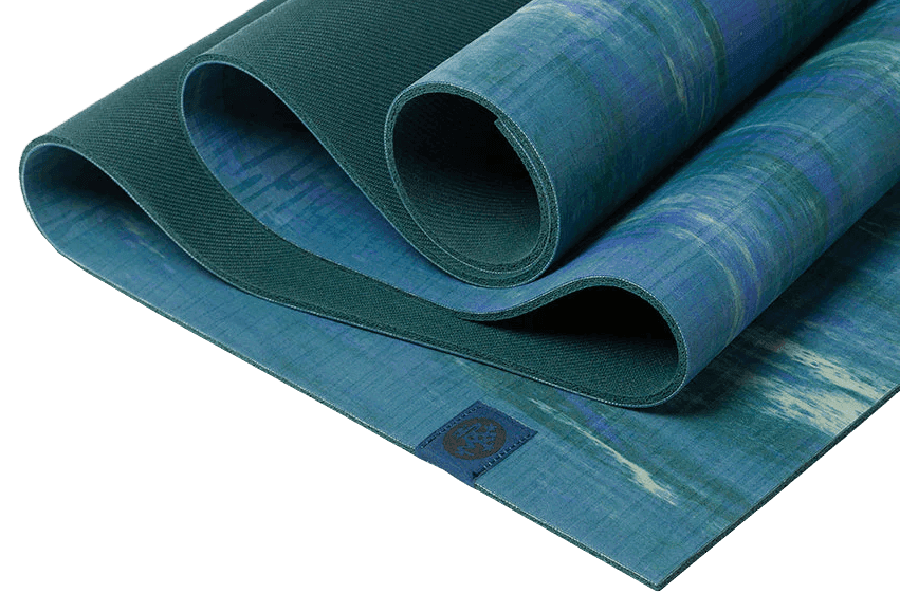
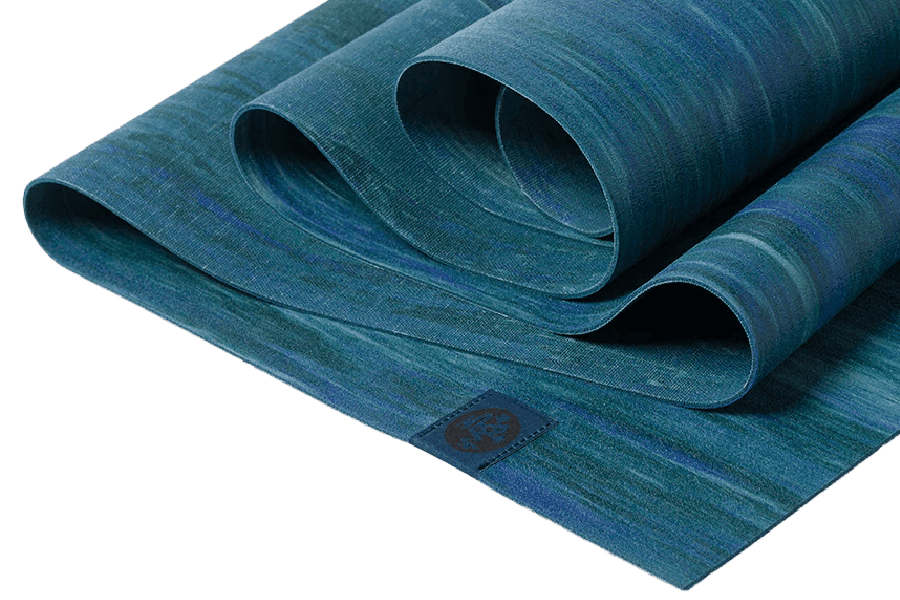
Price
The Superlite lists for $60 less.
$114
List price · check price at Amazon
$54
List price · check price at Amazon
Thickness
The eKO is 233% thicker.
5 mm0.2″
1.5 mm0.06″
Weight
The Superlite is 4.8 lbs lighter.
7 lbs3.2 kg
2.2 lbs1 kg
Size
Same length; the eKO is 2″ wider.
Same on both
- Same textured natural rubber surface and grip character
- Closed-cell: sweat stays on top
- Grip from the first practice, no break-in
- No warranty beyond 30 day returns
- Not for latex allergies
- 79" Long versions available
Full specs
Dimensions
Materials & build
Same name on the label, different objects in the bag
The shared name is doing a lot of selling here, so let’s be precise about what it covers. Both mats use Manduka’s textured, closed-cell natural rubber, so they grip the same, smell the same out of the box, and follow the same care rules. Everything else diverges. The eKO is a full daily mat: 5 mm thick, 71″ × 26″, 7 pounds. The Superlite is 1.5 mm, 71″ × 24″, 2.2 pounds, and folds flat like a beach towel.
That makes this less a comparison than a sorting exercise. The $60 you’d save buying the Superlite is only a saving if a travel mat is what you actually need, and the thickness number is where that question gets settled.
Cushioning: 5 mm practices, 1.5 mm reports the floor
The eKO’s 5 mm of dense rubber is proper cushioning: firm, stable in balance work, kind enough to knees and tailbones on hardwood and tile. It’s the same thickness Manduka sells on mats twice the price, and for most bodies it’s the sweet spot between comfort and connection to the floor.
The Superlite’s 1.5 mm is a grip layer, not a cushion. Kneel on it over hardwood and your kneecap is effectively meeting the wood with a rubber film in between; OutdoorGearLab’s testers found the ultra-thin travel class grippy but without protection for your bones, and declined to recommend any of them as a daily solo mat. Over carpet, grass, or a rental mat the equation flips, because the ground underneath does the cushioning and the Superlite just supplies traction and hygiene. Know which floor you own before you pick a side of this page.
Portability: no contest, by design
The Superlite folds to roughly laptop size, weighs 2.2 pounds, and vanishes into a carry-on, a backpack, or a tote with no straps and no roll to manage. It’s among the best answers the travel niche has produced, and frequent flyers and retreat-goers buy it on that trait alone.
The eKO is a 7 pound roll, and even the walk to a neighborhood class gets old with it on your shoulder. It isn’t a flaw, it’s what 5 mm of dense rubber weighs at this size, but nobody should buy an eKO imagining it commuting. If you want one mat that both cushions and carries, the middle of this family, the 5 pound eKO Lite, is the compromise Manduka built for exactly that.
Grip: same skin, different physics
Surface to surface, these grip identically: the same rippled rubber, tacky from the first practice with no break-in. But a mat grips in two directions, your hands to it and it to the floor, and mass matters for the second one. The eKO’s 7 pounds pins it flat anywhere. The Superlite is light enough to shift or wrinkle on smooth floors mid-flow, a behavior GearLab’s testers flagged on slick surfaces, though over carpet or layered on another mat it stays obediently put.
Both are closed-cell, so sweat pools on top rather than soaking in, and Manduka frames the whole line’s grip as reliable in dry conditions. Heated classes mean a towel on either mat; if hot yoga is the actual mission, an absorbent-top mat like the GRP Adapt 2.0 beats anything wearing the eKO name.
Durability and care: identical rules, one shared gap
One care sheet serves both: damp cloth cleaning, no harsh products, no direct sun, no hot cars. Both will announce themselves with a rubber smell for the first weeks, and both are 99% latex free, which is Manduka’s way of saying not latex free, so neither suits a latex allergy.
On lifespan, the eKO carries the known caveat of its surface flaking after a few years of heavy daily practice. The Superlite’s single dense layer has no foam to crush and holds up better than 1.5 mm suggests, though rough floors abrade it and vigorous daily use wears any rubber surface. Neither has a warranty behind it, just Manduka’s 30 day return window; the lifetime guarantee belongs to the PRO family, a fact worth remembering when a $114 rubber mat and a $144 guaranteed PVC one sit one shelf apart.
Sizes and colors: the Superlite has the bigger closet
The eKO is 71″ × 26″ with a 79″ Long version at $124 and around 5 colorways at last count. The Superlite gives up 2 inches of width at 71″ × 24″, offers its own 79″ Long for $58, and comes in around 19 colorways at last count, the widest palette in Manduka’s entire lineup. Travel mats apparently get to have fun.
When the answer is both
Because they don’t overlap, this pair combines unusually well. An eKO at home and a Superlite in the suitcase runs $168 at list, less than plenty of single premium mats, and covers home practice, hotel floors, retreats, and the rental mats you’d rather not touch bare-handed. Superlite owners also fold it over a studio mat as a hygiene layer, which for frequent class-droppers may be the most valuable thing it does. We resist recommending two purchases where one would do; here, the two genuinely do different jobs.
Price and value
List prices are $114 for the eKO and $54 for the Superlite. Colorway pricing drifts, so check the current price on the eKO and the eKO Superlite at Amazon before you buy.
The trap in this comparison is reading the Superlite as the budget eKO. It isn’t; it’s a different product wearing the same rubber. $54 for a travel mat you’ll use for years is money well spent, while $54 for a daily mat that leaves your knees on the tile buys a mistake you’ll feel every practice. If $54 is the actual budget for a primary mat, a thicker entry-level mat like the Manduka Begin or X serves better than any travel mat can.
Bottom line
Buying one mat for regular practice on hard floors: get the eKO. It’s the one with actual cushioning, the wider surface, and the planted, flat-lying weight, and it’s the mat this family’s reputation rests on.
Get the Superlite for what it was built for: flying, retreats, hotel rooms, layering over rentals, or carpet-floor practice at home. In that role it’s excellent, cheap for what it does, and more colorful than anything else Manduka sells. Just don’t ask 1.5 mm to be your knees’ only defense against a tile floor, because it won’t be.
Manduka eKO
List price $114
Frequently Asked Questions
- Can the eKO Superlite be my only yoga mat?
- On hard floors, we'd say no. At 1.5 mm it offers essentially no cushioning, and your knees, tailbone, and spine feel the floor through it; OutdoorGearLab's testers found ultra-thin travel mats grippy but without protection for your bones. On thick carpet it works fine as a daily mat, because the carpet does the cushioning. If your floor is wood, tile, or concrete, buy the eKO or another 4 to 5 mm mat as your primary.
- Do the eKO and eKO Superlite grip the same?
- The surface does; the mat doesn't. Both use the same textured closed-cell rubber, tacky from the first practice. But at 2.2 pounds the Superlite doesn't have the mass to anchor itself, and it can shift or wrinkle on smooth floors during dynamic flows, a behavior GearLab's testers flagged on slick surfaces. Over carpet or another mat it stays put. The 7 pound eKO plants itself anywhere.
- How small does the eKO Superlite pack?
- Small enough for a carry-on with room to spare. At 1.5 mm it folds flat to roughly laptop size rather than rolling, weighs 2.2 pounds, and slips into a backpack or tote. That's the whole reason it exists: hotel rooms, retreats, and studios whose rental mats you'd rather not touch bare-handed.
- Is either mat good for hot yoga?
- Neither is ideal. Both are closed-cell rubber, so sweat stays on the surface, and Manduka frames the eKO line's grip as reliable in dry conditions. Light sweat is manageable; a heated class means a towel on either. If hot yoga is your routine, an absorbent-top mat like Manduka's GRP Adapt 2.0 is the better tool than anything in the eKO family.
- What's the actual size difference between the two?
- The eKO is 71" x 26"; the Superlite is 71" x 24", so you give up 2 inches of width along with the thickness. Both come in 79" Long versions, the eKO Long at $124 and the Superlite Long at $58. Colors run the other way: the Superlite comes in around 19 colorways at last count, the widest range in Manduka's lineup, against the eKO's 5.
- Do these mats smell when new?
- Yes, both arrive with a rubber smell, since both are natural tree rubber. Owners report it fading over the first weeks of airing out and use. It's the price of the material rather than a difference between the two, though the Superlite's thinner build tends to air out a bit faster.
Related comparisons
- Manduka eKO Superlite vs JadeYoga Voyager
- Manduka eKO vs Lululemon The (Big) Mat 5mm
- Lululemon The Mat 5mm vs Manduka eKO
- JadeYoga Harmony 74" vs Manduka eKO
- Manduka eKO vs JadeYoga Harmony 2.0 68"
- Manduka eKO vs Suga SugaMat
- JadeYoga Harmony 68" vs Manduka eKO
- Manduka eKO vs Yoga Design Lab Combo 3.5mm
- Manduka eKO vs b, halfmoon B Mat Everyday 4mm