Manduka eKO vs eKO Lite: Which One Should You Buy?
These two mats are the same recipe poured in different amounts. Both are Manduka's closed-cell natural rubber with over 30% recycled content, made in Taiwan, 71 inches long, gripping identically from the first practice. The eKO gives you 5 mm of it, 26 inches wide, at 7 pounds. The eKO Lite trims to 4 mm and 24 inches and comes out at 5 pounds and $18 less. You're choosing between cushion and width on one side, carry weight and price on the other.
As an Amazon Associate, we earn from qualifying purchases made through links on this page. How this works
The quick answer
The eKO is the stay-home version: an extra millimeter of rubber that matters on hard floors, 2 extra inches of width, and 7 pounds that plant it on the floor and make it a chore on a shoulder. The eKO Lite is the same mat built to commute, at 5 pounds and a slimmer roll, giving up cushion and width to get there.
If the mat travels to class, get the Lite; it's the version designed for that life. If it stays on your floor, get the standard eKO, because at home its weight costs nothing and its cushion and width pay off daily.
Get the eKO if...
- Your mat stays where you practice
- You want 5 mm between your knees and a hard floor
- You want the full 26 inch width
- You're around five foot ten or taller and use the whole mat
Get the eKO Lite if...
- You carry your mat to class regularly
- Two pounds and a slimmer roll matter to you
- Your floors are wood or carpeted, not tile or concrete
- You'd rather keep $18
Side by side
Price
The eKO Lite lists for $18 less.
$114
List price · check price at Amazon
$96
List price · check price at Amazon
Thickness
The eKO is 25% thicker.
5 mm0.2″
4 mm0.16″
Weight
The eKO Lite is 2 lbs lighter.
7 lbs3.2 kg
5 lbs2.2 kg
Size
Same length; the eKO is 2″ wider.
Same on both
- Same closed-cell natural rubber, over 30% recycled content
- Same grip, tacky from day one
- 71 inches long
- Made in Taiwan
- No warranty beyond 30 day returns
- Same care rules: no sun, no harsh cleaners
Full specs
Dimensions
Materials & build
The same mat, cut for two different lives
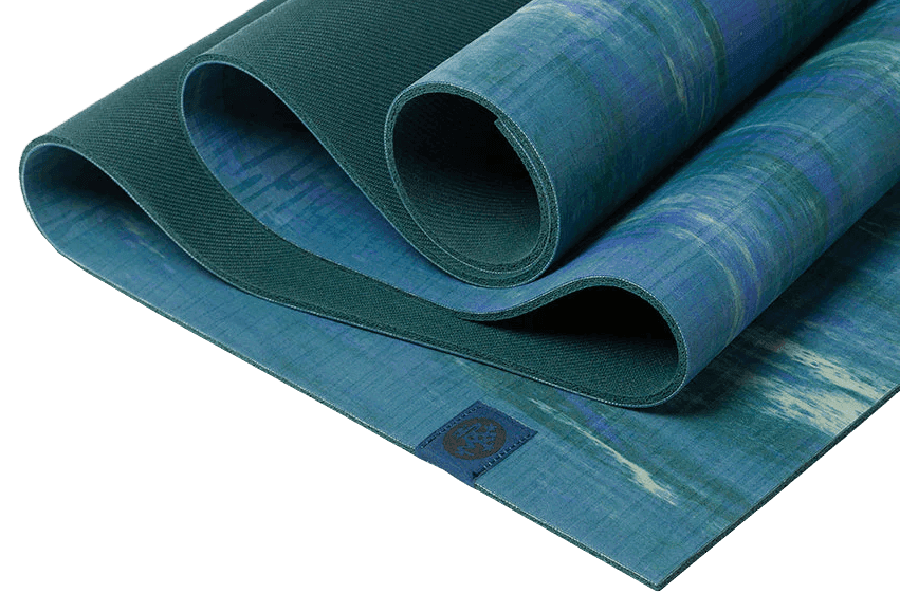
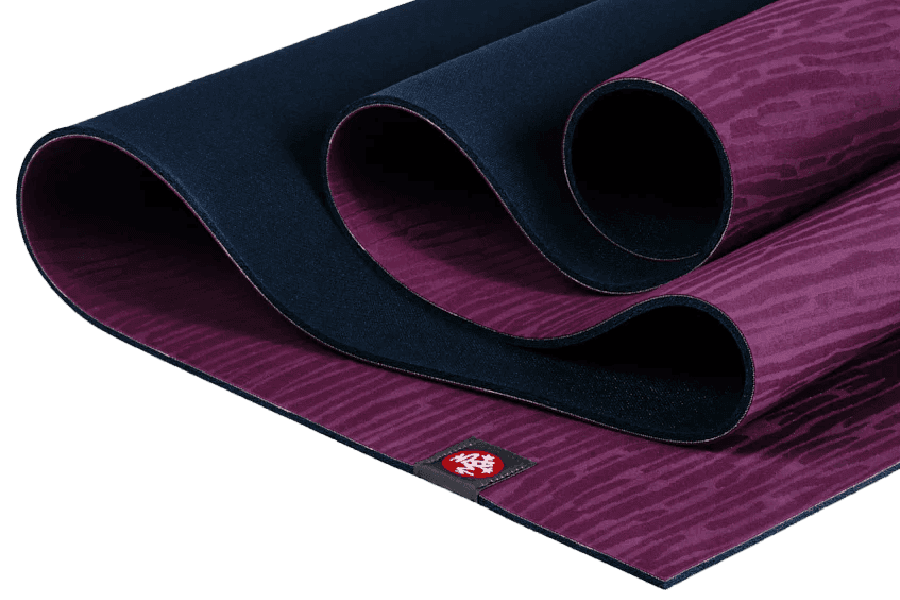
Manduka sells its natural rubber recipe in two main cuts, and this page is the choice between them. Both the eKO and the eKO Lite are closed-cell tree rubber with over 30% recycled content, made in Taiwan, 71 inches long, with the same rippled surface and the same day-one grip. Unroll them side by side and the family resemblance is total.
The differences are three numbers. The eKO is 5 mm thick, 26 inches wide, and 7 pounds. The eKO Lite is 4 mm, 24 inches, and 5 pounds, for $18 less. Everything worth saying about this matchup comes down to what those numbers mean on your floor and on your shoulder.
Grip: identical, caveat included
There’s no grip decision to make. Both mats wear the same textured rubber surface that holds from the first practice, no break-in, with the warm, slightly soft feel that makes people choose rubber over PVC in the first place.
They also share the same limitation. Closed-cell rubber keeps sweat on the surface, and Manduka itself describes the eKO line’s grip as reliable in dry conditions. Damp palms are fine; wet ones slide, and a heated class means a towel on either mat. If absorbent sweat grip is what you’re shopping for, that’s open-cell territory, and our Harmony vs eKO comparison covers exactly that tradeoff.
Cushioning: the millimeter you can feel
On paper, 5 mm versus 4 looks like rounding error. Under a knee it isn’t, because rubber compresses when you load it, and the mat that starts with 25% more material keeps meaningfully more between bone and floor at the bottom of the compression. On a carpeted or sprung wood floor, both mats are comfortable. On tile or concrete, kneeling poses find the Lite’s floor noticeably sooner.
Our rule of thumb: match the mat to your hardest floor, not your usual one. If any regular part of your practice happens on a hard surface, the standard eKO’s extra millimeter is the cheapest joint protection you can buy. If you need real cushioning beyond that, neither of these is the answer; that’s thick-mat territory like the 8 mm Jade Fusion.
Width: 26 inches is the sleeper feature
The quieter spec gap is width. The eKO’s 26 inches gives you 2 more than the Lite’s standard 24, and owners who have practiced on both tend to miss the width more than the thickness. Broad shoulders stay on the mat in savasana, hands stay on rubber in wide-legged folds, and the whole mat feels less like a balance beam. The Lite isn’t cramped; 24 inches is what almost every mat measures. But the eKO’s extra room is the kind of upgrade you stop noticing only because you got used to it.
Weight and carry: the Lite earns its name
Seven pounds against five, and the eKO’s extra width rolls into a fatter cylinder besides. The Lite goes over a shoulder and across town like a normal mat; the full eKO is a commitment to carry, and like other 7-pound mats it has a way of quietly becoming furniture. If your practice is at a studio and you walk, bike, or take transit, that alone should decide this page in the Lite’s favor. If the mat lives on your floor, weight is a non-issue and the eKO’s heft just makes it lie flatter.
Durability: same rubber, less runway
Both mats age the same way, because they’re the same material. Closed-cell rubber holds up well early, then wears at the surface, and daily practitioners commonly report visible wear within a few years on the eKO line. The Lite starts that process with a fifth less material, so under equal use, expect it to reach retirement first. Neither carries a warranty: Manduka’s lifetime guarantee covers the PRO series only, leaving both eKOs with a 30 day return window. Care rules are the standard rubber set, no direct sun, no hot cars, no harsh cleaners, damp cloth to clean.
One version note: Manduka re-engineered this line a few years back, and some retailers still label current stock eKO 2.0. Today’s mats are the ones built with over 30% recycled content; older reviews may describe the previous generation.
Sizes, colors, and the rest of the line
Both cuts come in a 79 inch Long: the eKO Long at $124 keeps the 26 inch width, and the eKO Lite Long at $104 keeps 24. Tall practitioners should solve length with those rather than hoping 71 inches stretches. Colors currently favor the Lite, around 8 colorways at last count against the eKO’s 5. Below both sits the 1.5 mm eKO Superlite, a foldable travel mat that’s a different tool entirely.
Price and value
List prices are $114 for the eKO and $96 for the eKO Lite. Street prices move by colorway, so check both the eKO and the eKO Lite at Amazon before you buy; the gap sometimes widens past the $18 list difference.
For $18 the standard eKO adds a millimeter of cushion and 2 inches of width, which is a lot of mat per dollar if you’ll use it. The Lite’s discount isn’t really the point of the Lite; the 2 pounds are. Buy on your commute and your floor, and let the price difference be a tiebreaker at most.
Bottom line
Get the standard eKO if the mat stays where you practice. At home its 7 pounds costs you nothing, and the extra cushion and width are upgrades you’ll feel in every session on a hard floor. It’s the better mat when weight doesn’t matter, and at home it doesn’t.
Get the eKO Lite if the mat travels. You give up nothing in rubber, grip, or length, just cushion and width, and you get a weight you’ll actually carry. A mat that comes with you beats a slightly nicer one that stays home. Just be honest about your floors: if home practice on tile is part of the week, spend the $18 and haul the extra pounds.
Manduka eKO
List price $114
Frequently Asked Questions
- What's actually different between the Manduka eKO and eKO Lite?
- Three numbers: thickness (5 mm vs 4 mm), width (26" vs 24"), and weight (7 lbs vs 5 lbs). The surface, grip, rubber, and 71 inch length are the same. The eKO costs $114 and the eKO Lite $96 at list.
- Is the eKO Lite's 4 mm enough cushion?
- On a wood studio floor, yes, for most people. On tile or concrete, the missing millimeter shows up in kneeling poses, because rubber compresses under weight and 4 mm doesn't leave much between bone and floor. If your knees already complain, or your floor is hard, the standard eKO's 5 mm is the safer buy, and chronically sore knees may want thicker still.
- Does the 26 inch width of the eKO really matter?
- If you have broad shoulders or like your hands and feet inside the mat in wide stances, yes; 2 inches is more than it sounds. The 24 inch eKO Lite matches the standard width of most mats, so it isn't cramped, it's just normal. Side-by-side, the eKO's extra width is one of the nicest things about it.
- Are the eKO and eKO Lite good for hot yoga?
- Neither is the tool for serious heat. Both are closed-cell, so sweat stays on the surface, and Manduka frames their grip as reliable in dry conditions. A little glow is fine; a heated class means a towel on either mat. If absorbent sweat grip is the priority, an open-cell mat like the Jade Harmony fits better.
- Which wears out first, the eKO or the eKO Lite?
- Expect the Lite to go first under equal use, simply because 4 mm gives the same wearing surface less material to work through, and daily practitioners commonly report visible wear on eKO-line mats within a few years. Neither has a warranty; Manduka's lifetime guarantee is a PRO-series benefit, and the eKO line gets a 30 day return window.
- Do the eKO and eKO Lite come in longer sizes?
- Yes, both offer a 79 inch Long version: the eKO Long at $124 and the eKO Lite Long at $104, each keeping its standard width. Tall practitioners should note the Longs before sizing up in thickness, since length is usually the dimension that actually runs out.
Related comparisons
- JadeYoga Harmony 68" vs Manduka eKO Lite
- Manduka eKO Lite vs Suga SugaMat
- Manduka eKO vs Lululemon The (Big) Mat 5mm
- Lululemon The Mat 5mm vs Manduka eKO
- Manduka eKO vs Hugger Mugger Para Rubber 5mm
- JadeYoga Harmony 74" vs Manduka eKO
- Manduka eKO Lite vs Lululemon The Mat 3mm
- Manduka eKO vs Yoga Design Lab Infinity 5mm
- Manduka eKO vs JadeYoga Harmony 2.0 68"