Manduka eKO vs Liforme: Which One Should You Buy?
Two premium mats built on natural rubber, two different ideas of what the rubber is for. The eKO is all rubber: a dense, textured 7-pound slab that feels planted and grips reliably with dry hands. The Liforme wraps its rubber in a polyurethane top that grips harder as your palms get damp, and etches alignment lines into it. The $51 between them buys specific things, so it's worth being precise about what.
As an Amazon Associate, we earn from qualifying purchases made through links on this page. How this works
The quick answer
The eKO is the homebody: 71 by 26 inches of closed-cell rubber, textured grip that works from day one in dry conditions, and a planted 7-pound feel, at $114. The Liforme is the performance pick: GearLab rated its wet grip among the best it tested, its etched alignment lines took GearLab's top pick for fine-tuning placement, and its 72.8 by 26.8 inch platform is bigger while weighing a pound and a half less. Both wear like the natural materials they are, and neither carries a warranty beyond a 30 day window.
If you sweat, or you'd use the alignment lines, the Liforme is worth the extra $51. If your palms stay dry and you want the biggest, most planted rubber mat for the money, the eKO is the better buy.
Get the eKO if...
- You'd rather keep $51
- Your palms stay mostly dry in practice
- You want a dense, planted 7-pound feel
- You prefer textured rubber to a smooth top
Get the Liforme if...
- You sweat; its top layer grips best when damp
- You'd actually use the etched alignment lines
- You want the bigger 72.8″ × 26.8″ platform
- You want the lighter carry (5.5 pounds vs 7)
Side by side
Price
The eKO lists for $51 less.
$114
List price · check price at Amazon
$165
List price · check price at Amazon
Thickness
The eKO is 19% thicker.
5 mm0.2″
4.2 mm0.17″
Weight
The Liforme is 1.5 lbs lighter.
7 lbs3.2 kg
5.5 lbs2.5 kg
Size
The Liforme is 1.8″ longer; the Liforme is 0.8″ wider.
Same on both
- Natural rubber base, so not for latex allergies
- Bigger than standard mats in every direction
- No real warranty (30 day windows on both)
- Rubber care rules: no sun, gentle cleaners
Full specs
Dimensions
Materials & build
Buying
Two takes on the premium rubber mat
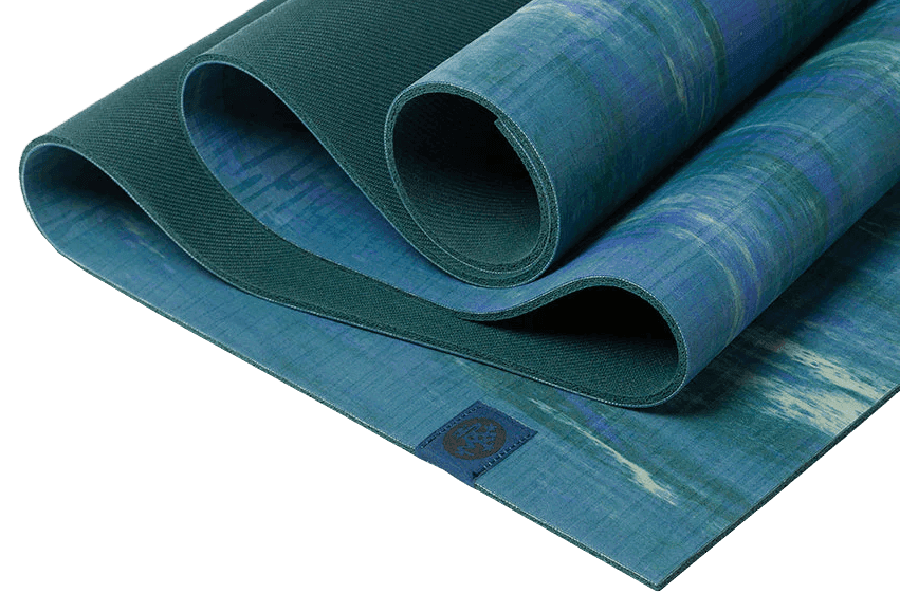
Strip away the branding and both of these are natural rubber mats aimed at practitioners who’ve outgrown starter foam. The eKO leaves the rubber exposed: 7 pounds of dense, closed-cell material with a woven texture on top, at $114. The Liforme covers its rubber with a smooth polyurethane layer that absorbs sweat and carries etched alignment lines, at $165.
That surface decision drives almost everything else: how each grips, when each grips, how each wears, and which one deserves your extra $51. We’ll take those in order.
Grip: dry-weather rubber vs wet-weather polyurethane
The eKO’s textured rubber grips well from the first practice, no break-in required, and Manduka describes that traction as reliable in dry conditions. The qualifier matters: the surface is closed-cell, so sweat doesn’t soak in, it pools, and a genuinely sweaty class means sliding palms and a towel.
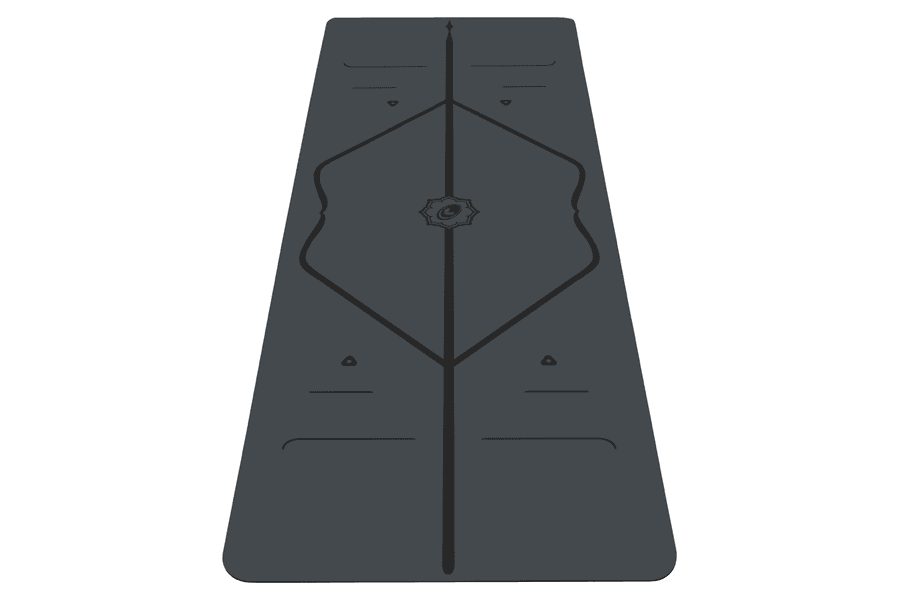
The Liforme runs the other way. Its polyurethane top absorbs moisture as it lands and grips harder as your hands warm up, with a waterproof middle layer keeping sweat out of the rubber core. GearLab rated that wet grip among the best it tested, describing the surface as gecko-like. With bone-dry hands the two are closer than the scores suggest; add any moisture and the Liforme pulls away decisively.
The sorting question is the one we ask on every grip page: what do your palms actually do in a hard class? Dry, the eKO is fine. Damp or worse, this section alone is worth the $51.
The alignment lines
The Liforme’s second argument is etched into its surface. The AlignForMe markers give consistent reference points for hand and foot placement, spacing, and centering, and GearLab named the Liforme its best mat for fine-tuning alignment. They’re most valuable to home practitioners working without a teacher’s eye and to teachers demonstrating placement; experienced practitioners with a settled practice may stop seeing them within a month.
The eKO’s surface is plain, and there’s no aftermarket version of this feature. If the lines appeal, only one mat here has them; if they don’t, ignore this section and the Liforme’s case rests entirely on grip and size.
Feel and stability: planted vs precise
The eKO is the more substantial object: 5 mm thick and 7 pounds, dense enough to lie dead flat and feel anchored under fast transitions, with the slightly warm, textured hand-feel that rubber people love. The Liforme is thinner at 4.2 mm and firmer than that number reads, a deliberately stable platform for balance work, at a more manageable 5.5 pounds.
Footprints favor the Liforme slightly: 72.8″ × 26.8″ against the eKO’s 71″ × 26″, both generously bigger than standard. Tall practitioners have a further option on the Manduka side, the 79″ eKO Long at $124; the Liforme Classic comes in one size.
Durability: neither is the decade mat
Here the two agree, unfortunately. eKO owners report surface flaking after a few years of heavy practice; the Liforme’s polyurethane top wears down under hard daily use, and Liforme says openly that its materials are designed to biodegrade and lifespan depends on how you practice. Sunlight degrades both. Neither brand backs its mat beyond 30 days: a return window from Manduka, a money-back guarantee from Liforme.
If a decade of service is the actual priority, neither of these is the right buy; that’s the Manduka PRO’s territory, covered in our PRO vs eKO and PRO vs Liforme pages. Between these two, plan on similar multi-year lifespans and price the difference accordingly.
Materials, eco claims, and allergies
Both wear their sustainability up front. The current eKO is made in Taiwan from natural rubber with over 30% recycled content; the Liforme pairs its rubber base with materials designed to break down at end of life. Neither carries a third-party certification, so both claims live on trust in the brand.
The shared rubber base also means a shared caution: natural rubber can carry trace latex proteins, so neither mat suits a genuine latex allergy. Care is identical too, gentle cleaners and no sun, and both ship with a natural rubber smell that fades over the first weeks.
Sizes and colors
The eKO comes in the standard 71″ mat and the 79″ Long, in around 5 colorways at last count. The Liforme Classic comes in one size with a wider palette, gray, blue, purple, and several more colorways at last count, and ships with a carry bag in the box. Neither line offers an extra-wide cut; if width is the constraint, Jade’s Harmony XW and Manduka’s PRO family are where to look instead.
Price and where to buy
List prices are $114 and $165, and the eKO discounts more often. Check the current price of the eKO at Amazon and the Liforme at Amazon. Since neither carries a meaningful warranty, buy wherever the price is best; there’s no authorized-seller fine print to protect here, unlike with Manduka’s PRO line.
Bottom line
Get the Liforme if you sweat or you’d use the lines. Those are its two real features, both are excellent, and no amount of eKO is a substitute for either. Get the eKO if your practice is dry and you want the most planted, most textured rubber mat $114 buys, with a Long size the Liforme can’t match.
And if you’re torn because you want wet grip at a lower price than $165, that exact middle exists: the IUGA runs the Liforme’s construction at a third of the price, and our Liforme vs IUGA page covers what you give up in the trade.
Manduka eKO
List price $114
Liforme Classic
List price $165
Frequently Asked Questions
- Which is better for hot yoga, the Manduka eKO or the Liforme?
- The Liforme, clearly. Its polyurethane top absorbs and wicks sweat, a waterproof middle layer keeps moisture out of the rubber core, and GearLab rated its wet grip among the best it tested. The eKO is closed-cell, so sweat sits on the surface, and Manduka itself describes the grip as reliable in dry conditions. Light dampness is fine on the eKO; a dripping class means a towel.
- Which lasts longer?
- Call it a rough draw, with different wear patterns. eKO owners report surface flaking after a few years of heavy practice, and sunlight degrades the rubber. The Liforme's polyurethane top wears down with hard daily use, and Liforme is explicit that its materials are designed to biodegrade. Neither brand stands behind its mat for long: the eKO gets Manduka's 30 day return window, the Liforme a 30-day money-back guarantee. Budget for eventual replacement with either.
- Are the Liforme's alignment lines worth it for experienced practitioners?
- They're most valuable to home practitioners and teachers, less so to anyone with a settled practice. The etched markers give consistent reference points for placement and centering, and GearLab named the Liforme its best mat for fine-tuning alignment. If you know you'd stop noticing them, the eKO's plain textured surface costs you nothing, and neither does its price.
- How different do they feel in use?
- Quite different, despite the shared rubber base. The eKO is 5 mm of dense closed-cell rubber with a grippy woven texture; it feels firm, planted, and slightly warm, and its 7 pounds keep it dead flat. The Liforme is thinner at 4.2 mm and smooth-topped, firmer underfoot than the number suggests, with a grip that feels almost suction-like once your hands warm up. Texture people tend to prefer the eKO; smooth-surface people the Liforme.
- Is either mat okay for a latex allergy?
- No. Both are built on natural tree rubber, which can carry trace latex proteins. If latex is a genuine concern, a PVC mat like the Manduka PRO is the safer direction, and it happens to be the mat Manduka actually warranties.
- Is the current eKO the same mat older reviews describe?
- Not quite. Manduka re-engineered the eKO line a few years back, and some retailers still label the current version eKO 2.0. Today's eKO is made in Taiwan from natural rubber with over 30% recycled content. Older reviews get the broad strokes right, but weight, feel, and durability specifics may describe the previous generation. The Liforme has had one design throughout, so its reviews age better.
Related comparisons
- Manduka eKO vs Lululemon The (Big) Mat 5mm
- Lululemon The Mat 5mm vs Manduka eKO
- JadeYoga Harmony 74" vs Manduka eKO
- Manduka eKO vs JadeYoga Harmony 2.0 68"
- Manduka eKO vs Suga SugaMat
- JadeYoga Harmony XW vs Liforme Classic
- JadeYoga Harmony 68" vs Manduka eKO
- Manduka eKO vs Yoga Design Lab Combo 3.5mm
- Manduka eKO vs b, halfmoon B Mat Everyday 4mm