Manduka eKO vs Gaiam Essentials: Which One Should You Buy?
GearLab scored the Manduka eKO 87 out of 100 and placed it second of 19 mats, behind only the Manduka PRO. The Gaiam Essentials is the mat millions of people already own because it costs about $22. The question is narrow: what does $114 buy that $22 does not? Grip, width and years. Not cushion, not carrying weight, and not length, all of which go the cheap mat's way.
As an Amazon Associate, we earn from qualifying purchases made through links on this page. How this works
The quick answer
The eKO took a perfect 10 out of 10 for dry grip, tied for best in the field, and 7 out of 10 wet. GearLab's testers liked its tiger-stripe traction lines for arm balances and inversions, scored its cushion 9 out of 10 at 5 mm, and spoke to practitioners who used one for vigorous daily practice for three to six years before retiring it. It is also two inches wider than the Gaiam.
The Essentials is an inch longer, exactly half the weight at 3.5 pounds, comes with a cinch sling, and carries a lifetime guarantee where Manduka offers nothing but 30 day returns. Buy the eKO if you practice regularly. Buy the Essentials if you do not, or if you carry your mat.
Get the Manduka eKO if...
- You want the best dry grip in a 19 mat test
- You want 26 inches of width instead of 24
- You want a mat owners get three to six years out of
- You want natural rubber with over 30 percent recycled content
Get the Gaiam Essentials if...
- You practice occasionally or are just starting
- You want more padding under your knees
- You carry your mat and would rather not haul 7 pounds
- You need a latex-free mat
Side by side
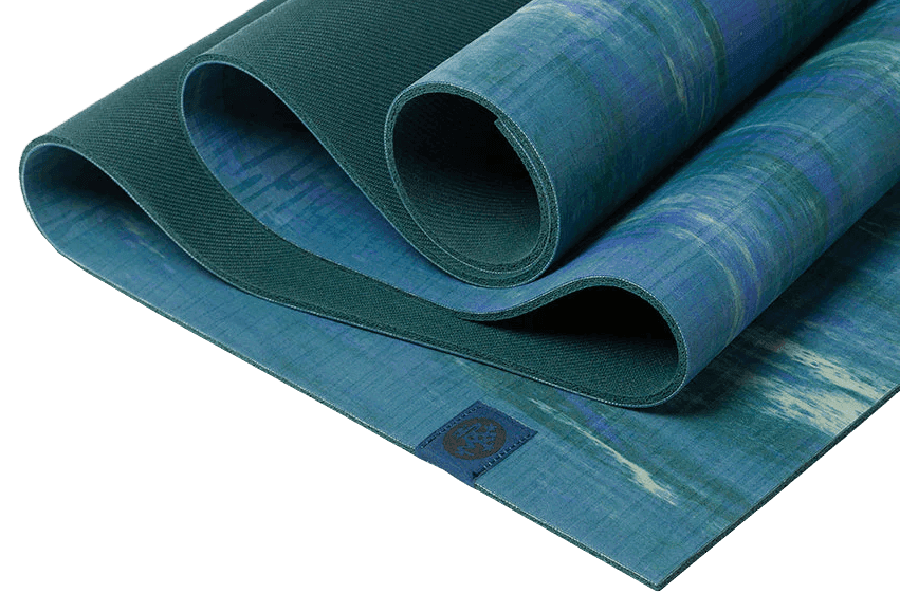
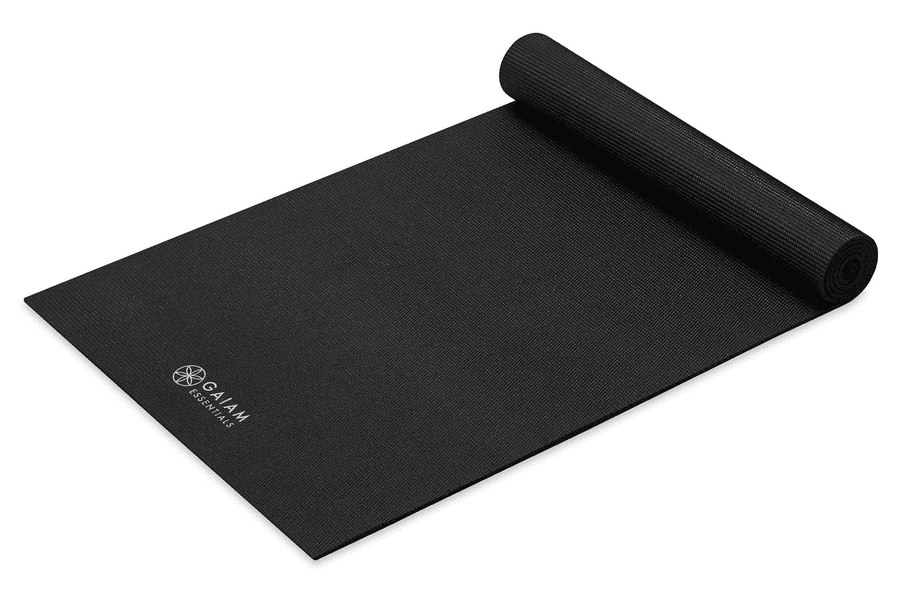
Price
The Gaiam Essentials lists for about $92 less.
$114
List price · check price at Amazon
$22.13
List price · check price at Amazon
Thickness
The Gaiam Essentials is 20% thicker.
5 mm0.2″
6 mm0.24″
Weight
The Gaiam Essentials is 3.5 lbs lighter.
7 lbs3.2 kg
3.5 lbs1.59 kg
Size
The Gaiam Essentials is 1″ longer; the eKO is 2″ wider.
Same on both
- Closed surface, so nothing soaks in
- Strong smell for the first week or two
- Neither belongs in direct sunlight
- Both need a towel in a heated room
Full specs
Dimensions
Materials & build
Buying
The second best mat tested against the default cheap one
GearLab scored the eKO 87 out of 100 and placed it second of 19 mats, behind only the Manduka PRO. The Gaiam Essentials is the mat millions of people already own because it costs about $22.13. This page is really one question: what does $114 buy that twenty two dollars does not?
Grip, width and years. Not cushion, not carrying weight, and not length, all of which go the cheap mat’s way. Whether that trade works depends almost entirely on how often you are on the mat.
A perfect ten for dry grip
The eKO took 10 out of 10 for dry grip in GearLab’s testing, tied for the best result in the field, and 7 out of 10 wet. Its testers liked the tiger-stripe traction lines across the surface for arm balances and inversions, and listed the eKO among the mats with notable grip on the floor underneath, so it stays where you put it on hardwood.
The Essentials relies on a printed sticky texture over soft foam. GearLab tested Gaiam’s Premium 6mm, which uses the same surface, and scored it 6 dry and 4 wet, naming poor wet grip among its three downsides. One tester described the foam turning slippery as moisture built and losing confidence in a wide-legged forward fold. That is the single biggest difference between these two mats.
Worth one caveat on the eKO: it is closed cell, so sweat sits on the surface rather than soaking in, and Manduka scopes its own claim to dry conditions. It is very good in a normal room and not a hot yoga specialist.
Comfort scores that do not match the thickness
The eKO scored 9 out of 10 for comfort and support at 5 mm. The Gaiam is 6 mm, a millimeter thicker, and its sibling scored 6.5. GearLab described the eKO as walking the line between comfort and support just right for many people, with a little more spring in its cushion than the PRO.
The difference is density. Rubber compresses and pushes back; soft PVC compresses and stays down for a beat, which GearLab noted by pointing out the handprint it leaves. On a knee, the Gaiam is the more forgiving mat. Under a standing foot it is the less certain one, and the eKO is the reason people describe rubber as feeling like a floor.
Wider mat, longer mat
The eKO is 71″ × 26″ and the Essentials listing we link is 72″ × 24″. So the Gaiam is an inch longer and the eKO is two inches wider, and width is the one you feel: 24 inches puts your hands near the edge in a wide down dog.
If length is what you need, Manduka sells an eKO Long at 79″ × 26″. Gaiam also sells a 68″ × 24″ Essentials on its own site for $19.98 without the sling, so check dimensions before you order from anywhere but the listing we link.
Exactly double the carrying weight
Manduka lists the eKO at 7 pounds and GearLab measured 6.3. The Essentials is 3.5 and comes with a cinch sling; the eKO includes nothing. That is roughly twice the mat to carry, and no strap to carry it with.
If you walk or cycle to a studio, this matters more than any score on this page. Manduka’s own answer within its range is the 4 mm eKO Lite at 5 pounds, which keeps the rubber and drops the bulk.
Three to six years against a couple
This is the strongest number on the page. GearLab spoke to practitioners who used the eKO for vigorous daily practice for three to six years before retiring it. It is also direct that rubber mats break down faster than PVC, with a classic wear pattern of parallel track lines where hands and feet rub the surface, so the eKO thins rather than lasting forever.
The Essentials compresses instead, taking a permanent set under your hands, knees and hips within a couple of years of regular use. GearLab found the same foam in Gaiam’s Premium showing compression, scuffs and wear. Three eKO years is worth roughly five Essentials at these prices, which is the closest thing to a fair cost comparison here.
The guarantee belongs to the cheap mat
Gaiam covers the Essentials with a lifetime guarantee. Manduka offers nothing on the eKO beyond 30 day returns, and that is a deliberate choice: its lifetime guarantee covers the PVC mats like the PRO, and it leaves the eKO out because the rubber is biodegradable.
Read the Gaiam clause for what it is, though. It addresses manufacturing defects rather than foam that has quietly gone flat, which is what actually ends a mat in this class. The unwarrantied mat is still the one that lasts longer.
Materials, latex and the smell
The eKO is natural rubber made in Taiwan with over 30 percent recycled content, which earned it 8 out of 10 on materials. It is not safe with a latex allergy and it carries a strong rubber smell for the first week or two. Keep it out of direct sun and clean it with water or a heavily diluted mild cleaner, never alcohol or oils.
The Essentials is PVC, latex free and free of the six worst phthalates, and it tolerates any mild cleaner. It has its own odor problem, and Gaiam is upfront: unroll and air the mat for two to three days before your first session, and it publishes a guide on getting rid of the smell.
Price and where to buy
The eKO lists at $114 and sells on Amazon and manduka.com, where individual colorways drift and often sit under list. The Essentials is about $22.13 on Amazon, also drifting by color.
Five Essentials cost about one eKO. If the cheap mat is doing what you need, replacing it every couple of years is a perfectly rational plan. The eKO earns its money when grip or width is the thing limiting your practice, or when you simply want to stop shopping for mats.
Bottom line
Buy the eKO if you practice regularly. It finished second of 19 in independent testing, took a perfect ten for dry grip, is two inches wider, and owners get three to six years of hard use out of one. You are carrying twice the weight with no strap and no warranty.
Buy the Gaiam Essentials if you practice occasionally, want padding under your knees, or are not yet sure how much you will use it. It is longer, half the weight, and a fifth of the price. If you want the eKO’s rubber without the seven pounds, our eKO vs eKO Lite comparison covers the lighter version.
Manduka eKO
List price $114
Gaiam Essentials 6mm
List price $22.13
Frequently Asked Questions
- How much better is the eKO grip?
- A lot, dry. GearLab rated it 10 out of 10 for dry grip, tied for the best result in a 19 mat test, and 7 out of 10 wet. It scored Gaiam's Premium 6mm, which shares the Essentials textured surface, at 6 and 4, listing poor wet grip among its three downsides. One tester described the foam turning slippery as moisture built and losing confidence in a wide-legged forward fold.
- Is the eKO good for hot yoga?
- It is good rather than specialist. It rated 7 out of 10 wet, which is strong, but the mat is closed cell so sweat sits on the surface rather than soaking in, and Manduka scopes its claim to dry conditions deliberately. For heated classes the Manduka GRP Adapt 2.0 scored 8.5 wet in the same test and is built specifically for it.
- Which one is more comfortable?
- It depends what you mean. GearLab scored the eKO 9 out of 10 for comfort and support at 5 mm, against 6.5 for the Gaiam surface at 6 mm, because density matters more than thickness: rubber compresses and pushes back where soft PVC compresses and stays down. On a knee the Gaiam is more forgiving. Under a standing foot the eKO is far steadier.
- How long does each one last?
- GearLab spoke to practitioners who used the eKO for vigorous daily practice for three to six years before retiring it, and is direct that rubber breaks down faster than PVC, with a classic wear pattern of parallel track lines where hands and feet rub. The Essentials compresses instead, taking a permanent set within a couple of years of regular use. Five Essentials cost about one eKO, which is roughly the fair comparison.
- Why does the cheap mat have the better guarantee?
- Because Manduka leaves the eKO out of its lifetime guarantee on purpose: that clause covers its PVC mats like the PRO, and the eKO is made from biodegradable natural rubber. You get 30 day returns and nothing after. Gaiam covers the Essentials for life, which addresses manufacturing defects rather than foam that has gone flat. The unwarrantied mat is still the one that lasts longer.
- How much heavier is the eKO?
- Exactly double. Manduka lists 7 pounds and GearLab measured 6.3, against 3.5 for the Essentials, which also includes a cinch sling where the eKO includes nothing. If you walk or cycle to a studio this outweighs any score on the page, and Manduka's own answer is the 4 mm eKO Lite at 5 pounds.
Related comparisons
- YogaAccessories Extra Thick Deluxe 1/4" vs Gaiam Essentials 6mm
- Gruper TPE 6mm vs Gaiam Essentials 6mm
- Amazon Basics 1/4 Inch Thick TPE vs Gaiam Essentials 6mm
- Manduka eKO vs Lululemon The (Big) Mat 5mm
- Lululemon The Mat 5mm vs Manduka eKO
- JadeYoga Harmony 74" vs Manduka eKO
- Manduka eKO vs JadeYoga Harmony 2.0 68"
- Manduka eKO vs Suga SugaMat
- JadeYoga Harmony 68" vs Manduka eKO