Manduka Begin vs B Mat Strong 6mm: Which One Should You Buy?
The Begin is where a lot of people start: light, soft, latex free, with a centre stripe to help you line up, at $62. The B Mat Strong is where a lot of people end up: 6 mm of dense rubber, 26 inches wide, certified to OEKO-TEX Standard 100, and about as grippy as a mat surface gets, at $144. The $82 between them buys traction and size.
As an Amazon Associate, we earn from qualifying purchases made through links on this page. How this works
The quick answer
If you practice regularly, the B Mat Strong is the better mat and the gap shows up first in your hands. Its rubber holds wet or dry with no break-in, 6 mm is enough to kneel on without wobbling in a balance, and 26 inches is the modern width. It weighs twice what the Begin does and it contains latex.
The Begin earns its place as a starter mat. It is 2.5 pounds, it is kind to knees, the alignment stripe genuinely helps while you are learning the shapes, and ten colorways beats the B Mat's muted range if that matters to you. It is closed-cell TPE, so once you sweat the surface gets slick.
Get the Manduka Begin if...
- You are new to yoga or practice occasionally
- You want a 2.5 pound mat and a $62 price
- You want an alignment stripe to check your positioning
- A latex allergy rules rubber out
Get the B Mat Strong if...
- Grip is the thing that keeps letting you down
- You want 71 by 26 inches instead of 68 by 24
- You kneel enough that 6 mm beats 5
- You want a mat that survives years of regular practice
Side by side
Price
The Begin lists for $82 less.
$62
List price · check price at Amazon
$144
List price · check price at bhalfmoon.com
Thickness
The B Mat Strong is 20% thicker.
5 mm0.2″
6 mm0.23″
Weight
The Begin is 2.5 lbs lighter.
2.5 lbs1.1 kg
5 lbs2.27 kg
Size
The B Mat Strong is 3″ longer; the B Mat Strong is 2″ wider.
Same on both
- Grip from the first unroll with no break-in
- Usable either way up
- Both roll rather than fold
- Neither is a plush foam mat
Full specs
Dimensions
Materials & build
Buying
- Strong Long85" × 26"
Where people start and where people end up
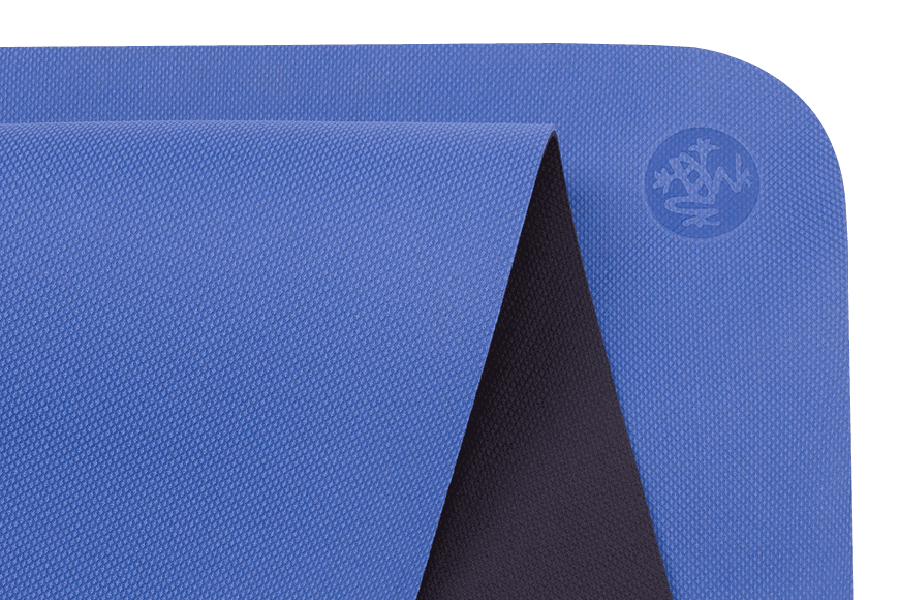
The Begin is Manduka’s entry mat: 5 mm of soft TPE, reversible, with a centre alignment stripe, at 2.5 pounds and $62. It is latex free and it comes in 10 colorways at last count.
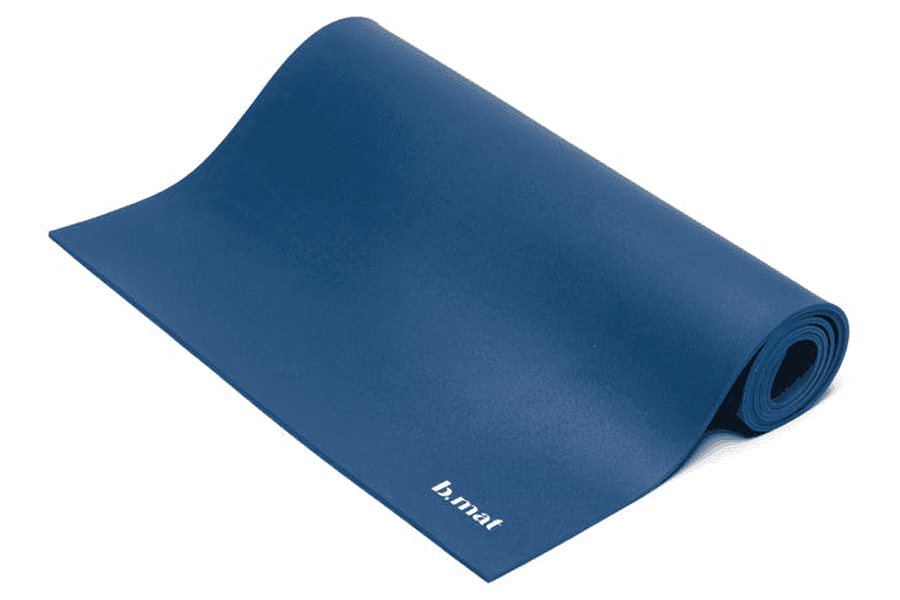
The B Mat Strong is 6 mm of dense rubber, 26″ wide, made in Spain, certified to OEKO-TEX Standard 100, at $144. It is the mat people move to when grip is the thing that keeps letting them down.
Grip: the reason to spend the $82
GearLab tested the 4 mm version of the same b, halfmoon rubber, rated it 9 out of 10 for grip and described it as among the grippiest mats it had used in wet or dry conditions, holding even with sweat pooled under a hand. There is no break-in and no towel required in a normal room.
The Begin grips well while your hands are dry. It is closed-cell TPE, so sweat sits on the surface with nowhere to go, and past a certain point your palms move. For gentle work in a cool room you may never get there. For a vigorous or heated practice you will, fairly quickly.
Six millimetres of rubber is steadier than five of TPE
This runs against what the numbers suggest. The B Mat Strong is the thicker mat and the more planted one, because dense rubber barely compresses under a standing foot. You get real cushion for knees without paying for it in wobble.
The Begin’s soft TPE gives more under a single foot, so balances feel slightly less settled on it despite being a millimetre thinner. It is the kinder surface to kneel on, which is a fair trade for a beginner and a nuisance later.
Three inches longer, two inches wider
The B Mat is 71″ × 26″ against the Begin’s 68″ × 24″. Sixty-eight inches is short for anyone near six feet, and 24 inches is the older narrow standard that puts a hand on the floor in a wide-legged stance.
b, halfmoon also makes an 85″ Strong Long if length is the issue, and a 4 mm B Mat Everyday at $118 with the same rubber and width in a lighter build. Manduka sells the Begin in one size.
Twice the weight
The Begin is 2.5 pounds and the B Mat Strong about 5. That is the difference between a mat you forget you are carrying and one you are aware of on a long walk.
Neither is a travel mat and both are reasonable studio carries. If weight is genuinely the deciding factor and you still want rubber, the B Mat Everyday drops to about 4.1 pounds while keeping the same surface and the same 26 inch width.
TPE, rubber and the latex question
TPE is a thermoplastic elastomer with no natural latex in it, made in Taiwan. That makes the Begin one of the safer options if you have an allergy, and it is worth knowing because most of the grippy mats people get recommended are natural rubber.
The B Mat is described as mostly natural rubber with some synthetic content, so it contains latex and is off the list for anyone with a genuine allergy. What it gains is the OEKO-TEX Standard 100 certificate, which speaks to what is not in the mat, and European manufacturing. Neither claim is a performance claim.
Dents against years
Soft TPE takes compression set. Over a year or two of regular practice the Begin develops marks where you kneel and loses some of its bounce, and Manduka gives it a 30 day return window and nothing after, since the lifetime guarantee belongs to the PRO line.
Dense rubber wears slowly and there is no coating to break down, so the B Mat should give you years of regular practice; b, halfmoon backs it for one. The thing that actually destroys rubber is sunlight, so store it rolled and in the shade rather than in a car window.
Price and where to buy
$62 against $144. Check the live Begin price, where individual Manduka colorways drop well below list. The B Mat Strong is sold direct and is not on Amazon, so it holds at $144 most of the year.
Buying the Begin first and the B Mat later is a normal and sensible path, and it costs you $62 to learn what you want. Buying the B Mat straight away makes sense if you already know you sweat or you have already slid off a borrowed studio mat.
Bottom line
Get the Begin if you are new, if you practice occasionally, if you need a latex-free mat, or if $62 is the number that makes this happen. The alignment stripe earns its place while you are learning and the cushioning is genuinely comfortable.
Get the B Mat Strong if you practice several times a week. It grips wet or dry with no break-in, 6 mm of dense rubber cushions without wobbling, 26 inches is the modern width, and the mat will still be doing its job in five years. It is twice the weight and more than twice the price, and for a regular practice it is worth both.
Manduka Begin
List price $62
B Mat Strong 6mm
List price $144
Frequently Asked Questions
- How much grippier is the B Mat?
- A lot, and specifically when you are damp. GearLab tested the 4 mm version of the same b, halfmoon rubber, rated it 9 out of 10 for grip and called it among the grippiest mats it had used in either wet or dry conditions, holding even with sweat pooled under a hand. The Begin's closed-cell TPE grips fine while you are dry and gives up fairly quickly once you are not.
- Is the Begin a bad mat?
- No, it is a well-made starter mat that does what it says. The alignment stripe is useful, the cushioning is genuinely comfortable, and at 2.5 pounds it carries better than almost any full-thickness mat. What it is not is a mat for a demanding sweaty practice, and Manduka does not sell it as one. Buying it and outgrowing it in two years is a reasonable outcome at $62.
- Is 6 mm too thick to balance on?
- Not on the B Mat, because the rubber is dense rather than squishy. Thickness only destabilises you when the material compresses under a foot, which is a problem with thick foam and not with thick rubber. The Begin's softer 5 mm actually moves more under a standing foot than the B Mat's 6 mm does, which is the opposite of what the numbers suggest.
- Which is safer with a latex allergy?
- The Begin. It is TPE, a thermoplastic elastomer with no natural latex in it. The B Mat is described as mostly natural rubber with some synthetic content, which means it contains latex and is not suitable for anyone with a genuine allergy. If you need real grip without latex, a polyurethane-topped mat is worth a look, though most of those have a rubber base too.
- How do you clean each one?
- The Begin is closed-cell, so a damp cloth and mild soap takes seconds and nothing soaks in. The B Mat is dense rubber and cleans the same way, with one extra rule: sun is what actually destroys rubber mats, so it has to dry flat and out of direct light rather than draped over a balcony rail. Neither tolerates harsh cleaners.
- Which lasts longer?
- The B Mat, by years. Dense rubber wears slowly and there is no coating to break down, and b, halfmoon backs it for a year. Soft TPE takes compression set, so the Begin gradually develops dents where you kneel and loses some of its cushioning; Manduka gives it a 30 day return window and nothing after. If you practice several times a week, that difference is most of what the extra $82 buys.
Related comparisons
- Manduka Begin vs IUGA Eco Friendly Non Slip PU
- b, halfmoon B Mat Strong 6mm vs Manduka PRO Terra 6mm
- Manduka PRO vs b, halfmoon B Mat Strong 6mm
- Manduka Begin vs Gaiam Performance Dry-Grip 5mm
- Manduka Begin vs Hugger Mugger Earth Elements 5mm
- Manduka Begin vs JadeYoga Level One
- Manduka PROlite Long & Wide vs b, halfmoon B Mat Strong 6mm
- Manduka GRP Adapt 2.0 Long vs b, halfmoon B Mat Strong 6mm
- Yoloha Unity Pro Cork vs b, halfmoon B Mat Strong 6mm