B Mat Strong vs B Mat Everyday: Which One Should You Buy?
b, halfmoon makes one mat surface and sells it in several thicknesses, so this decision comes down to how much rubber you want between you and the floor. The Everyday is the 4 mm version at $118 and the one most reviewers have actually tested. The Strong is the same mat at 6 mm for $144, with an extra pound of weight to carry.
As an Amazon Associate, we earn from qualifying purchases made through links on this page. How this works
The quick answer
Grip is identical, so ignore it. The Everyday is the more versatile mat: 4 mm is enough cushion for most practices, 4.1 pounds is genuinely portable, and it is the version GearLab reviewed and rated 78 out of 100, with a 9 out of 10 for grip. The Strong adds 2 mm of rubber for knees, elbows and hips, and costs $26 more.
Buy the Everyday unless you have a specific reason not to. Buy the Strong if you practice on hard floors, spend a lot of time kneeling, or already know that thin mats leave your knees sore. Both are the same rubber, so both need the same care and both wear the same way.
Get the B Mat Strong if...
- Your knees, elbows or hip bones complain on 4 mm mats
- You practice on concrete, tile or thin studio flooring
- The mat mostly stays in one room, so the extra pound does not matter
- You do a lot of kneeling, low lunges or floor-based work
Get the B Mat Everyday if...
- You want the same grip in the lighter, cheaper version
- You carry the mat to a studio and want to keep it under 5 pounds
- You prefer a firmer, more grounded feel in standing and balance poses
- You'd rather keep the $26
Side by side
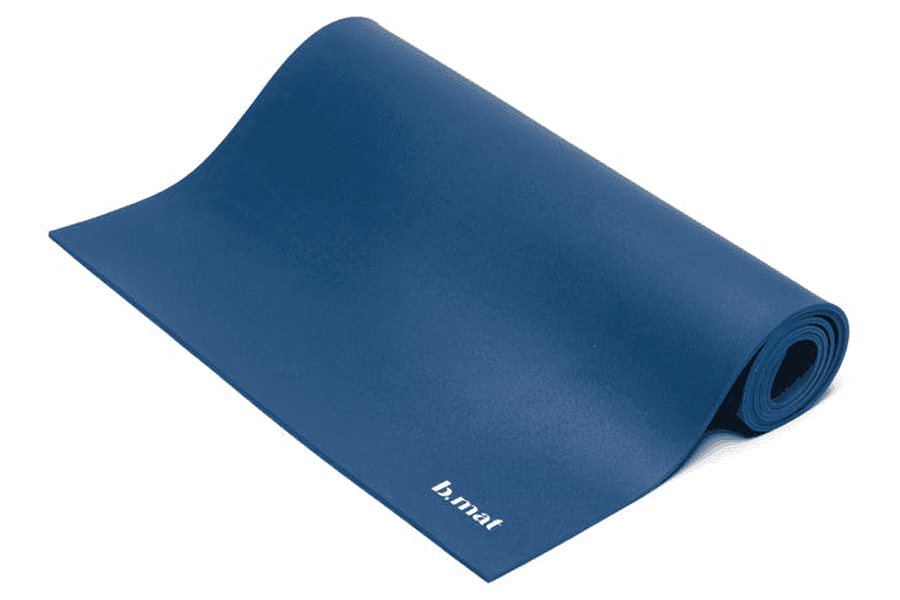
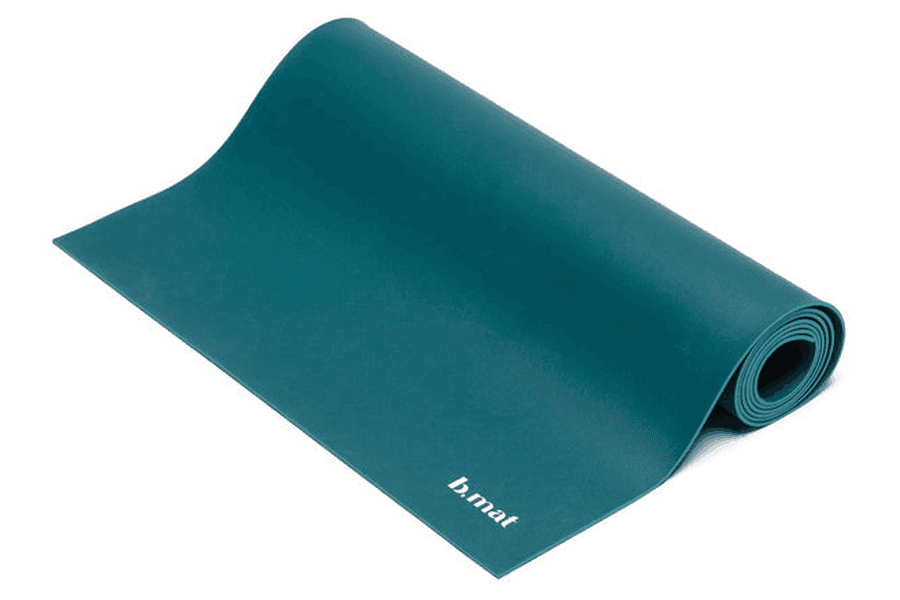
Price
The B Mat Everyday lists for $26 less.
$144
List price · check price at bhalfmoon.com
$118
List price · check price at bhalfmoon.com
Thickness
The B Mat Strong is 50% thicker.
6 mm0.23″
4 mm0.2″
Weight
The B Mat Everyday is 0.9 lbs lighter.
5 lbs2.27 kg
4.1 lbs1.86 kg
Size
Same length; same width.
Same on both
- 71″ × 26″, wider than a standard mat
- Rubber that is mostly natural with some synthetic
- Made in Spain, OEKO-TEX Standard 100 certified
- Grippy from the first class, no break-in
- One-year warranty, seven colorways
- Available in an 85″ long version
Full specs
Dimensions
Materials & build
Buying
- Strong Long85" × 26"
- Everyday Long85" × 26"
One surface, two thicknesses
b, halfmoon builds every mat in this line from the same rubber and sells it at different depths. The Everyday is 4 mm and $118. The Strong is 6 mm and $144. Same 71″ × 26″ footprint, same made-in-Spain rubber, same OEKO-TEX Standard 100 certification, same seven colorways, same one-year warranty.
So grip is not a factor here, and neither is durability or materials. You are choosing how much rubber sits between your knees and the floor, and whether an extra pound in the bag bothers you.
Cushion: 2 mm you feel in kneeling poses
Four millimeters of dense rubber is more cushion than the number suggests. GearLab tested the Everyday and rated it 8 out of 10 for comfort and support, describing the rubber as springy rather than thin, and said the difference from thicker mats in the lineup was barely noticeable. Their bone-compression test found it dipped slightly and rebounded quickly, which is the behavior you want under an elbow.
The Strong adds 2 mm on top of that. It matters in low lunges, kneeling sequences, tabletop work and anything where a hip or a knee bears down on a hard floor. It matters less if you practice on carpet or a wood floor with give, and it works slightly against you in standing balance, where a thinner mat puts you closer to the ground.
Weight: 4.1 pounds against 5
The Everyday weighs 4.1 pounds and the Strong weighs 5. GearLab called the Everyday portable, noting it rolls to about 3.5 to 4 inches across and runs two to four pounds lighter than most of the mats it beats on grip.
One pound is not dramatic, but it is roughly the difference between a mat you carry without thinking and one you notice on a long walk. If the mat lives in a studio bag most days, take the Everyday. If it lives in a spare room, take whichever thickness you prefer and ignore this section.
Grip: identical, and more than most people expect
Both mats use the same tacky rubber on both faces, so grip does not enter this decision. It is worth knowing what you are getting into either way. GearLab found no break-in period at all and rated the Everyday 9 out of 10 for grip, calling it one of the grippiest mats it had tested wet or dry, with traction that held through a hot class.
The same review is clear about the downside: the surface can be too grippy for practices built on sliding transitions. Testers found themselves stepping between poses rather than gliding, and dragging a foot across the mat is uncomfortable on bare skin. If you practice Ashtanga or fast vinyasa, that is worth weighing before you buy either thickness.
Sweat: neither mat drinks it
b, halfmoon lists both mats as highly absorbent, and that is not quite what happens in practice. GearLab found sweat that does not evaporate pools on the surface, and recommended toweling it off during a hot class. The useful part is that the traction survives anyway; a wet B Mat still holds where most mats give up.
Because nothing soaks in, cleaning stays simple on both: a wipe rather than a soak. Thickness changes nothing here.
Durability: the same two-year mat either way
b, halfmoon says its mats are designed to support your practice for two or more years when cared for and stored properly. The one-year warranty excludes sun damage, dirt, stains and normal wear, explicitly including the marks that show up where hands and feet land. GearLab rated the Everyday 6 out of 10 for materials, having found water staining during testing and owner reports of the top layer peeling in high-contact spots.
The extra 2 mm in the Strong does not buy you extra years, because wear happens at the surface. If lifespan is the thing you care about most, neither of these is the mat; a Manduka PRO costs the same as the Strong and routinely lasts a decade, at the cost of a break-in period and 2.5 extra pounds.
What owners say about each one
b, halfmoon publishes ratings on its own product pages, which are self-selected and should be read as such, but the pattern is still useful. The Strong sits at 4.9 out of 5 across 241 reviews and the Everyday at 4.8 across 168. What people praise differs in a way that matches the specs: cushioning and grip dominate the Strong’s reviews, while durability is far and away the most common theme in the Everyday’s.
The recurring complaints are the same on both, and they are the ones GearLab found too. Reviewers are split on the smell, which says more about how long people aired the mat out than about the rubber. Nobody praises either mat for staying clean. If you have read owner reviews of one and are wondering whether the other behaves differently, it does not.
Who each thickness suits
Take the Everyday if you practice standing sequences on a floor with some give, carry the mat regularly, or want to be closest to the ground for balance work. It is the default recommendation for a reason, and 4 mm of this particular rubber is not a thin mat in practice.
Take the Strong if kneeling is part of most sessions, if your practice happens on concrete, tile or a thin apartment floor, or if you already know that thin mats leave your knees aching afterward. It is also the better mat if you use it for anything beyond yoga, since floor work in a Pilates or stretching session puts more of your weight on smaller contact points.
Care: identical routines, and not optional
Wipe with plain water and a neutral soap, air dry flat, and store the mat rolled with the logo facing out, which b, halfmoon says prevents creasing and peeling. Keep it out of direct sunlight; UV exposure is one of the fastest ways to ruin a rubber mat and it voids the warranty. Leave the mat sealed in its packaging until you plan to use it, since air starts oxidizing the rubber.
The tacky surface picks up hair and lint from any floor it touches, so expect to wipe more often than you would with a slicker mat. Both thicknesses do this equally.
Sizes and colors
Both come in the same seven colorways and both offer an 85″ × 26″ long version: $132 for the Everyday Long and $154 for the Strong Long at last check. The standard 71 inch length already runs 3 inches past the 68 inch mats most brands sell, so the long version is aimed at practitioners around six feet and above.
b, halfmoon also sells the same surface at 2 mm as the Traveller, for folding into a suitcase, and a 10 mm foam mat called the Impact that is a different material entirely. Within this line, 4 mm and 6 mm are the two everyday choices.
Price: $26 for 2 mm
The Everyday lists at $118 and the Strong at $144. Both are sold direct from b, halfmoon, and buying direct is also what keeps the warranty valid. Third party listings for these mats are patchy, partly because the brand traded as B Yoga before rebranding.
Since the two mats share a lifespan, the $26 is not buying you anything over time. It buys cushion now, so decide based on your knees rather than on value.
Bottom line
Get the Everyday. It is the version reviewers have tested, it is lighter, it is cheaper, and 4 mm of this rubber is enough cushion for most practices. It is also the one people mean when they recommend a B Mat.
Get the Strong if you kneel a lot, practice on concrete or tile, or already know that thinner mats leave your knees sore afterward. The grip, the care routine and the lifespan are the same, so nothing else about the decision changes. If you want that grip in a mat built to last longer, look at the Lululemon The Mat, which costs the same as the Everyday and holds up for years longer.
B Mat Strong 6mm
List price $144
B Mat Everyday 4mm
List price $118
Frequently Asked Questions
- Is the B Mat Strong worth $26 more than the Everyday?
- Only if you need the cushion. The two mats share a surface, a size, a warranty and a lifespan, so the entire price gap buys 2 mm of extra rubber and about a pound of extra weight. If your knees bother you on thinner mats or you practice on a hard floor, that 2 mm is worth paying for. If you mostly do standing sequences on a wood or carpeted floor, the Everyday gives you the same grip for less money.
- Which one is better for hot yoga?
- Either, and the Everyday is the one with a track record. GearLab called the B Mat Everyday its favorite for hot yoga when it reviewed the mat, noting that traction held even with a puddle of sweat sitting on the surface. The rubber is identical on the Strong, so grip should behave the same way. Neither absorbs sweat, so you towel the surface off during class rather than letting it soak in.
- Do both come in a long version?
- Yes. b, halfmoon sells an 85 by 26 inch version of both mats for taller practitioners, at $132 for the Everyday Long and $154 for the Strong Long as of this writing. The standard 71 inch length already runs 3 inches longer than the 68 inch mats most brands treat as standard, so the long version is aimed at people around six feet and up.
- How long does a B Mat last?
- b, halfmoon says its mats are designed to support your practice for two or more years when cared for and stored properly. The warranty runs one year and excludes sun damage, staining, and normal wear such as the marks that develop where your hands and feet land. GearLab found the same limit from the other direction, flagging user reports of the top layer peeling in high-contact spots and rating the mat 6 out of 10 on materials. Neither thickness changes this.
- Do these mats smell?
- At first, yes. Rubber mats arrive with a strong smell and the B Mat is no exception; GearLab left theirs to air out for two days in a shaded spot and the odor was gone. b, halfmoon asks you to leave the mat sealed in its packaging until you are ready to use it, since early exposure to air starts oxidizing the rubber.
- How do you clean a B Mat without wrecking it?
- Wipe it with plain water and a neutral soap, air dry it flat, and store it rolled with the logo facing out. b, halfmoon warns that dirt, harsh cleaners and sun exposure all void the warranty, and that heavy sliding accelerates surface wear. The grip that makes these mats good also makes them magnets for hair and lint, so a regular wipe-down is not optional.
Related comparisons
- Yoga Design Lab Combo 3.5mm vs b, halfmoon B Mat Everyday 4mm
- b, halfmoon B Mat Everyday 4mm vs Manduka GRP Adapt Lite 2.1 4mm
- b, halfmoon B Mat Strong 6mm vs Manduka PRO Terra 6mm
- Manduka PROlite vs b, halfmoon B Mat Everyday 4mm
- Lululemon The Mat 5mm vs b, halfmoon B Mat Everyday 4mm
- Manduka PROlite Long vs b, halfmoon B Mat Everyday 4mm
- Manduka PRO vs b, halfmoon B Mat Strong 6mm
- b, halfmoon B Mat Everyday 4mm vs Manduka PRO Lite Terra 4.7mm
- b, halfmoon B Mat Everyday 4mm vs JadeYoga Harmony 2.0 68"