Manduka PROlite vs IUGA PU Mat: Which One Should You Buy?
One of these mats is designed to outlive your practice and the other is designed to be replaced. The Manduka PROlite is dense PVC with a lifetime guarantee, slick for its first few weeks and then dependable for a decade. The IUGA puts an absorbent polyurethane top over natural rubber, grips from the first class wet or dry, weighs a third as much, and wears out in a few years. Which one is right comes down to sweat and to how you like to buy things.
As an Amazon Associate, we earn from qualifying purchases made through links on this page. How this works
The quick answer
The IUGA is the better mat to practice on if you sweat at all. OutdoorGearLab ranked it 8th of 19 at 75 of 100 with a Best Value Upgrade award, found hands and feet held an excellent grip even on a soaked surface, and measured it at 2.1 pounds with a carry strap in the box. It's also longer and wider than the PROlite, at 72 by 26 inches against 71 by 24.
The PROlite's case is the long game. It's dense, latex-free PVC that stays firm under balance work, it's certified to OEKO-TEX Standard 100, and Manduka guarantees it for life, which in the fine print means about ten years of regular use. The catch is a slick break-in period of a few weeks and a closed surface that gives up once your palms are wet. Buy the PROlite if your practice is dry and you want to buy once; buy the IUGA if you sweat, carry your mat, or would rather spend $45 less.
Get the PROlite if...
- You want a mat that lasts a decade, with a written guarantee
- Your practice is dry, so wet grip isn't the deciding factor
- A latex allergy rules out rubber-based mats
- You'd rather buy once than replace a mat every few years
Get the IUGA if...
- You sweat, or practice heated: it grips wet from day one
- You carry your mat: 2.1 pounds against 4.6, strap included
- You want the bigger 72 by 26 inch surface
- You'd rather spend about $45 less
Side by side
Price
The IUGA lists for about $45 less.
$112
List price · check price at Amazon
$66.99
List price · check price at Amazon
Thickness
The IUGA is 6% thicker.
4.7 mm0.19″
5 mm0.2″
Weight
The IUGA is 2.5 lbs lighter.
4.6 lbs2.1 kg
2.1 lbs0.95 kg
Size
The IUGA is 1″ longer; the IUGA is 2″ wider.
Same on both
- About 5 mm thick, firm rather than squishy
- Both lie flat without curling
- Both sell through Amazon
- Damp cloth and mild soap; no machine washing
Full specs
Dimensions
Materials & build
Buying
One mat is built to last, the other to be replaced
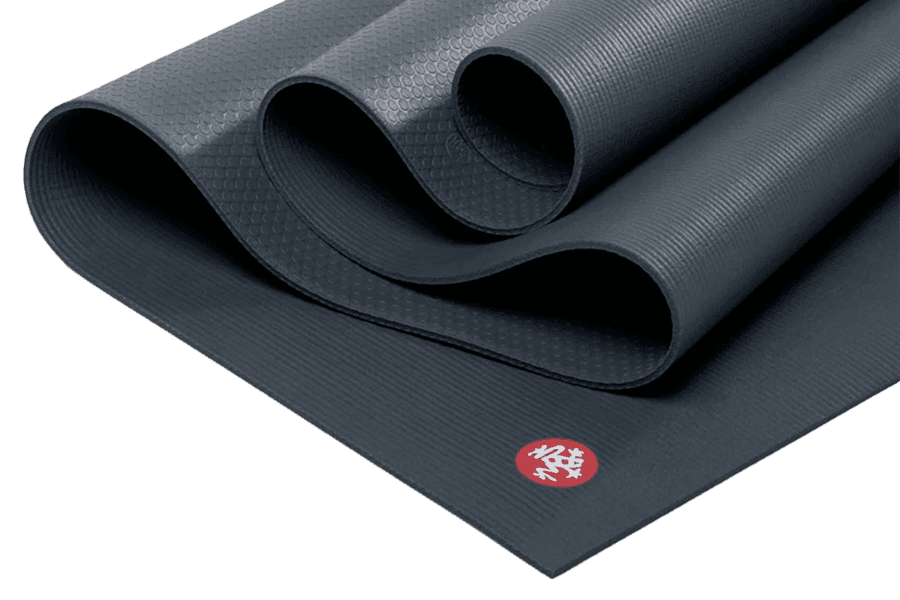
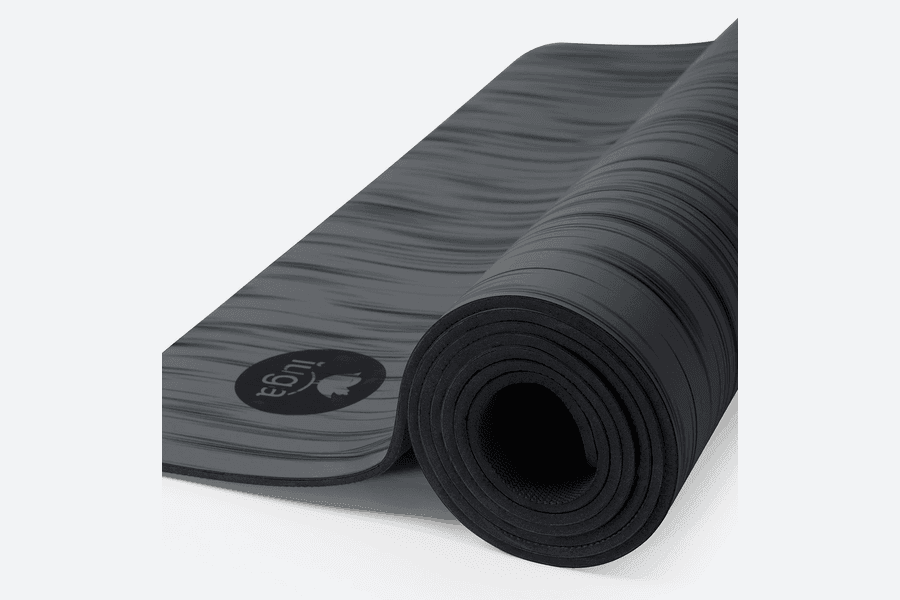
The Manduka PROlite is the light version of a studio standard: 4.7 mm of dense PVC, $112, certified to OEKO-TEX Standard 100, and covered by a lifetime guarantee. The IUGA is $66.99 of polyurethane over natural rubber, the construction premium sweat mats use, at 2.1 pounds with a carry strap in the box.
They are not really competing on the same axis. One asks you to break it in and then keeps its side of the bargain for a decade. The other works perfectly on day one and wears out in a few years. Where you land depends on how much you sweat and how far ahead you buy.
Grip: day one against year two
The IUGA grips immediately. OutdoorGearLab found excellent, zero slippage dry traction and, when testers saturated the surface with water, hands and feet still held. That performance is why it ranked eighth of 19 mats at 75 of 100 and took a Best Value Upgrade award. There is nothing to learn and nothing to wait for.
The PROlite starts slick. New Manduka PVC is famously slippery and takes a few weeks of regular practice to break in; Manduka has retired the salt-scrub ritual it used to recommend and now says the slickness resolves with use, which matches what owners report. Once broken in, its dry grip is genuinely good and keeps improving for years. What it never becomes is a wet-hands mat: the closed-cell surface leaves sweat sitting on top.
Feel underfoot
The PROlite is firm in the way Manduka mats are firm: dense enough that your hand presses in a millimeter and stops, with no wobble under a loaded foot. That density is why the line has the reputation it has for balance work, and it comes with less padding than the numbers imply, since dense material compresses less than soft foam of the same thickness.
The IUGA is a little softer and, at 2.1 pounds, noticeably lighter underfoot. GearLab found its cushion thick enough to protect knees on hard floors and firm enough to rise into tree pose without wobbling, which is a good result for a mat this light. Its one physical quirk follows from the weight: testers noticed it wrinkle slightly when rolling over the toes from up dog to down dog.
Size and weight
The IUGA is the bigger mat, 72″ × 26″ against the PROlite’s 71″ × 24″. The inch of length is trivial; the two inches of width are not, since that is what keeps hands on the mat in wide-legged poses and gives broad shoulders room in savasana.
Manduka’s answer is to sell you a larger size. The PROlite Long runs 79″ at $124 and the Long & Wide is 79″ × 30″ at $144, both of which cost more than the IUGA. On weight the IUGA wins outright at 2.1 pounds against 4.6, with a strap included.
Lifespan and what each guarantee is worth
This is the PROlite’s section. Dense PVC barely wears, and Manduka’s lifetime guarantee has real terms behind it: roughly ten years of regular use, one replacement, proof of purchase from an authorized seller, with Amazon qualifying when the mat is sold and shipped by Amazon. Daily practice on a PROlite is a rounding error.
The IUGA is a consumable. GearLab’s durability research found the absorbent top flaking or showing wear marks where hands and feet land after several years of rigorous use, and notes it degrades faster on abrasive surfaces like pavement or dirt. IUGA gives you 45 days to return it and nothing after. Plan on a few good years.
Run over a decade the arithmetic favors Manduka clearly: one $112 mat against three or four IUGAs. Run over the next twelve months, the IUGA is the better mat to be on if you sweat, and $45 stays in your pocket.
Materials, allergies, and care
The PROlite is PVC, which is the less romantic material story and the safer one for some people: no natural rubber anywhere, so it is the clear pick for a latex allergy, and it carries an OEKO-TEX Standard 100 certification. The IUGA sits on a natural rubber base, which can carry trace latex proteins.
Care is where the gap widens again. The PROlite wants a damp cloth and no prolonged sun, and otherwise tolerates careless ownership for years. The IUGA’s open-cell top absorbs sweat, so it needs a proper air-dry out of direct sunlight after heavy classes, and it arrives with a strong smell that takes a few days of airing to clear despite the odorless marketing on the box.
Price and where to buy
List prices are $112 and $66.99, and both sell on Amazon with street prices that drift by colorway, so check the current price of the PROlite at Amazon and the IUGA at Amazon before you decide. Buying the PROlite through Amazon keeps the guarantee valid only when it is sold and shipped by Amazon itself.
Bottom line
Get the IUGA if you sweat, if you carry your mat, or if you would rather not spend $112 on a hobby you are still learning. It grips wet, weighs almost nothing, is bigger in the dimension that counts, and independent testing rates it a legitimate value pick rather than a compromise.
Get the PROlite if your practice is dry and you would rather buy once. You are paying for density, a latex-free build, and a guarantee with real terms, and you are accepting a few slick weeks at the start. If sweat is your problem but Manduka is your brand, our PROlite vs Lululemon The Mat page runs the same trade at the premium end, and Gaiam Dry-Grip vs IUGA covers the cheaper alternative to this surface.
Manduka PROlite
List price $112
Frequently Asked Questions
- Which grips better?
- It depends entirely on moisture, and there's no ambiguity in either direction. The IUGA grips from the first class and keeps its hold when wet; GearLab saturated the surface with water and testers still found excellent traction, which is why it recommends the mat for sweaty practice. The PROlite is closed-cell PVC, so sweat sits on top, and a new one is slick even dry. After a few weeks of break-in the PROlite's dry grip is genuinely good and keeps improving for years, but it never becomes a wet-hands mat.
- Does the PROlite really need breaking in?
- Yes, and it's the most common complaint about Manduka's PVC mats. A new PROlite is slippery, and it takes a few weeks of regular practice before the surface grips properly. Manduka has retired the salt-scrub ritual it used to recommend and now says the slickness resolves with use. If you want grip on day one and don't want to manage a break-in period, that alone points at the IUGA.
- Is the lifetime guarantee worth $45?
- It depends how long you plan to practice. Manduka's lifetime guarantee means roughly ten years of regular use, one replacement, and proof of purchase from an authorized seller, with Amazon qualifying when the mat is sold and shipped by Amazon. Spread over a decade, the PROlite is the cheaper mat by a wide margin. The IUGA gives you 45 days to return it and nothing after, and GearLab's research points to flaking and wear marks after several years of hard use. For a daily practitioner the PROlite wins on cost per year; for someone still finding their footing, paying for a decade of coverage up front is optimistic.
- Which is better if you're taller or broader?
- The IUGA, without spending more. It's 72 by 26 inches against the PROlite's 71 by 24, so you get an inch of length and two inches of width, and that width is what most people notice: hands stay on the mat in wide-legged poses. Manduka's answer is to sell you a bigger size, with the PROlite Long at 79 inches for $124 and the Long & Wide at 79 by 30 for $144.
- Which is safer for a latex allergy?
- The PROlite. It's PVC with no natural rubber in it, certified to OEKO-TEX Standard 100, and it's the safe choice for an allergic practitioner. The IUGA sits on a natural rubber base, and natural rubber can carry trace latex proteins. No grip score changes that, and it's one of the clearest reasons to pick the more expensive mat here.
- How much care does each one need?
- The PROlite is close to care-free: wipe it with a damp cloth, keep it out of prolonged sun, and it tolerates careless ownership for years. The IUGA asks for more. Its open-cell top absorbs sweat, so it needs a full air-dry away from direct sunlight after heavy classes, and GearLab notes it degrades faster if you practice on abrasive surfaces like pavement. It also arrives with a strong smell that takes a few days of airing to clear.
Related comparisons
- Manduka PROlite vs JadeYoga Harmony 74"
- Manduka Begin vs IUGA Eco Friendly Non Slip PU
- Manduka X vs IUGA Eco Friendly Non Slip PU
- Manduka PROlite vs Lululemon The Mat 5mm
- Manduka PROlite vs JadeYoga Harmony 68"
- Gaiam Performance Dry-Grip 5mm vs IUGA Eco Friendly Non Slip PU
- Manduka PROlite vs b, halfmoon B Mat Everyday 4mm
- IUGA Eco Friendly Non Slip PU vs Hugger Mugger Earth Elements 5mm
- Manduka PROlite vs Suga SugaMat