Manduka PROlite vs Jade Harmony: Which One Should You Buy?
This is the evenest version of the old Manduka-versus-Jade argument. The PROlite and the Harmony are both about 3/16 of an inch thick, both under 5 pounds, and only $12 apart at list. With size and weight nearly neutralized, what's left is the material question in its purest form: closed-cell PVC that starts slick and lasts decades, or open-cell natural rubber that grips from the first class and wears like the natural material it is.
As an Amazon Associate, we earn from qualifying purchases made through links on this page. How this works
The quick answer
The PROlite is the long-haul pick: dense PVC that takes a few weeks to break in, then grips well dry and keeps improving for a decade or more, with Manduka's lifetime guarantee behind it. The Harmony is tacky from the first down dog, absorbs sweat instead of pooling it, and costs $12 less, but natural rubber softens with hard use, hates sunlight, and carries a 1 year warranty.
If you want one mat for the next ten years and your palms stay mostly dry, get the PROlite. If you want grip today, sweat even moderately, or prefer a natural material, get the Harmony and accept that it's a mat you'll eventually replace.
Get the PROlite if...
- You want a mat that's still going in year ten, with the guarantee to match
- You can wait out a few weeks of break-in slickness
- You have a latex allergy, since the Harmony is natural rubber
- You want 3 more inches of length and around 13 colors to pick from
Get the Harmony if...
- You want real grip on day one, no break-in
- Your hands sweat; open-cell rubber absorbs what PVC pools
- A renewable natural material matters to you
- You'd rather keep the $12 and replace the mat in a few years
Side by side
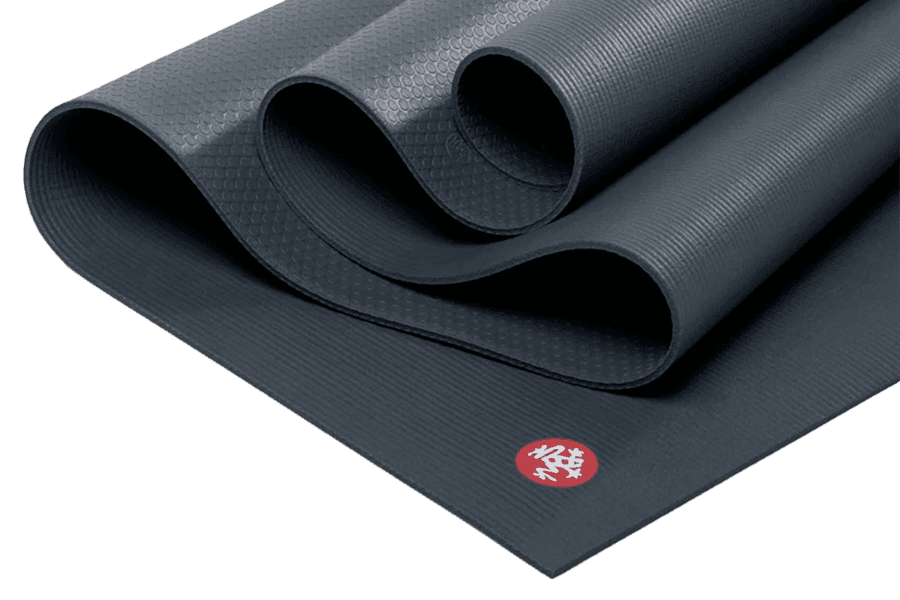
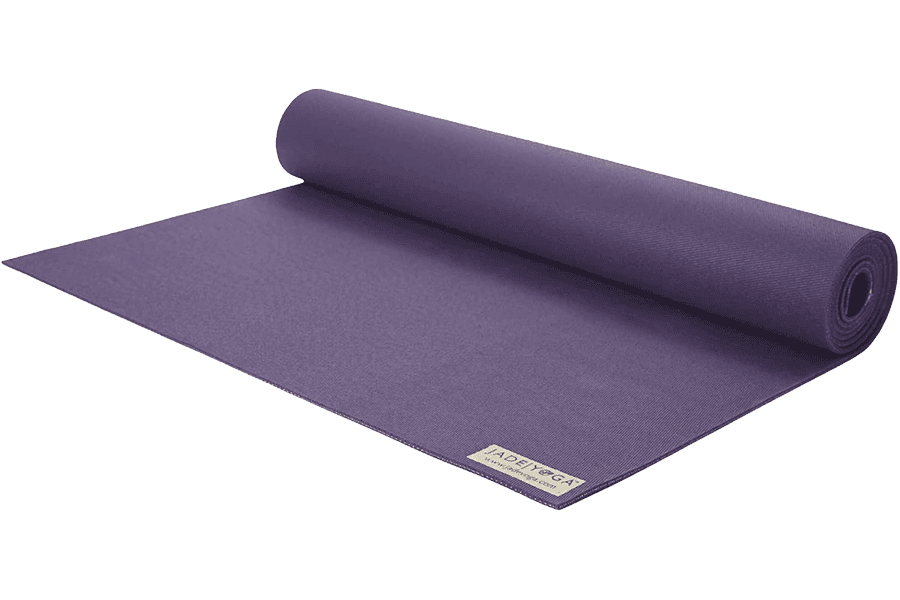
Price
The Harmony lists for about $12 less.
$112
List price · check price at Amazon
$99.95
List price · check price at Amazon
Thickness
The Harmony is 2% thicker.
4.7 mm0.19″
4.8 mm0.19″
Weight
The PROlite is 0.2 lbs lighter.
4.6 lbs2.1 kg
4.8 lbs2.2 kg
Size
The PROlite is 3″ longer; same width.
Same on both
- 24" wide
- About 3/16" thick
- Under 5 pounds
- Firm, stable feel rather than squishy
- Lies flat without curling
- Longer sizes available
Full specs
Dimensions
Materials & build
Buying
The fairest fight in the premium aisle
When people argue Manduka versus Jade, they usually mean the 7.5 pound PRO against the 4.8 pound Harmony, and half the argument ends up being about weight. This pairing removes that noise. The PROlite is Manduka’s light cut: 4.6 pounds, 4.7 mm thick, $112. The Harmony is 4.8 pounds, 4.8 mm thick, $99.95. Same weight class, same thickness, twelve dollars apart.
What’s left is the purest version of the material question. Closed-cell German PVC that starts slick, breaks in, and then refuses to wear out. Or open-cell American natural rubber that grips from the first class and ages the way natural materials do. Nearly every difference below traces back to that choice.
Grip now vs grip eventually
The Harmony’s case takes one down dog to make. The rubber is tacky straight out of the box, Jade advertises a Yoga Journal best-grip award on the product page, and owners back the reputation: dry or slightly damp, the surface just holds. Its open-cell construction also absorbs moisture, which Wirecutter credits for keeping traction through sweaty sessions.
The PROlite asks for patience first. New, the surface is genuinely slick, and the first weeks are its worst; Manduka’s current position is that the slickness resolves with regular use, having retired its old salt-scrub advice. Broken in, the dry grip is very good and keeps improving for years, but the closed-cell surface never learns to handle sweat. Wet palms slide, and heated classes mean a towel.
Two Harmony caveats keep this from being a rout. Truly dripping practices overwhelm even open-cell rubber, so hot yoga regulars end up with a towel either way. And the tackiness has a flip side: transitions that slide a foot forward can catch, and the rubber collects lint and pet hair enthusiastically.
Feel: two firm mats with different accents
On paper the cushioning is a tie, 4.7 mm against 4.8, and neither mat wobbles under balance work the way soft foam does. The difference is texture and temperament. The PROlite’s dense PVC reads firm verging on hard, with a smooth fabric-like finish; the Harmony’s rubber has a touch of spring and a grippier, more organic hand. Sensitive knees on concrete or tile get slightly better protection from the PROlite’s density, but at this thickness both are mats for practitioners who like firm ground, and cushion seekers should be shopping the 6 mm tier instead.
Where the $12 gap becomes years
This is the PROlite’s whole argument, and it’s a strong one. Its closed-cell PVC is the same construction GearLab keeps finding in service after five to twenty years, and Manduka backs it with the lifetime guarantee: roughly ten years of regular use in the fine print, one replacement per purchase, proof of purchase from an authorized seller, with Amazon qualifying when the mat is sold and shipped by Amazon itself.
The Harmony wears like the natural material it is. Heavy practice slowly softens and sheds the surface, sweat accelerates it, and hard-practicing owners tend to replace theirs every few years; babied and kept out of the sun, CNN Underscored puts the ceiling around ten. Jade’s 1 year warranty against defects, with sun damage and harsh cleaners excluded, states the expectation plainly.
The care rules differ just as much. Sunlight hardens natural rubber, so the Harmony can’t live in a car or work outdoors, and cleaning means a damp cloth or diluted vinegar, never alcohol or harsh products. The PROlite tolerates all of it: trunk, sunny room, forgotten corner, an occasional wipe-down and it carries on.
Materials, trees, and one allergy warning
If environmental footprint drives the decision, the Harmony reads better. Its rubber is tapped from trees, a renewable source with no PVC or synthetic rubber in the mat, and Jade plants a tree for every mat sold, past two million by its own count. The PROlite is PVC, which has no practical recycling path; Manduka’s counterargument is that one mat lasting fifteen years can beat a series of rubber mats each lasting five, and its OEKO-TEX Standard 100 certification covers harmful substances in manufacturing. Both arguments are honest; they just measure different things.
The health note is one-sided: Jade describes its mats as 99 percent latex free, which still means trace latex proteins. With a latex allergy, the PROlite is the only safe pick on this page.
Length, sizes, and colors
The PROlite is 71″ × 24″ and the Harmony is 68″ × 24″, so Manduka’s cut gives you 3 extra inches of length at the same width. That matters between about five foot eight and five foot eleven, where the Harmony runs out and the PROlite still covers you. Taller than that, both companies sell you length: the 74″ Harmony for $10 more, or the 79″ PROlite Long for $12 more.
Colors are close to a draw: around 13 PROlite colorways at last count against the Harmony’s dozen, both rotating with stock. The Harmony’s deck runs brighter on average, including its Jade Green signature; the PROlite adds the practical option of grommeted hanging editions.
Price and value
List prices are $112 for the PROlite and $99.95 for the Harmony. Street prices drift by colorway, so check the current price on both the PROlite and the Harmony before deciding.
Twelve dollars shouldn’t decide anything, so think in replacement cycles instead. A PROlite that runs a decade costs about eleven dollars a year of ownership; a Harmony replaced every four years costs roughly double that. Against that, the Harmony delivers better grip for every one of those years, with zero break-in tax at the start. Cheaper to own versus nicer to use is the actual trade.
Bottom line
Get the PROlite if you think in decades. It matches the Harmony pound for pound and millimeter for millimeter, then outlasts it by years, guaranteed on paper, and it never asks to be protected from the sun or the wrong cleaner. The cost is a few slick weeks up front and a surface that always needs a towel once palms get wet.
Get the Harmony if the first month matters more than the tenth year. The grip is immediate and stays better in sweat, the material story is greener, and at $99.95 it’s the cheaper way into a genuine studio-grade mat. Plenty of practitioners replace a Harmony every few years without regret and consider it the best money in yoga. Just keep it out of the sun, and skip it entirely if latex is a problem.
Manduka PROlite
List price $112
Jade Harmony
List price $99.95
Frequently Asked Questions
- Which is better for hot yoga, the PROlite or the Jade Harmony?
- The Harmony, clearly. Its open-cell rubber absorbs moisture, which Wirecutter credits for keeping traction in sweaty sessions, while the PROlite's closed-cell surface leaves sweat sitting on top where wet palms slide. The honest ceiling: if you drip heavily in a heated room, even the Harmony wants a towel, and a purpose-built hot yoga mat serves you better than either.
- Which lasts longer, the PROlite or the Harmony?
- The PROlite, and it isn't close. Its dense closed-cell PVC is the same construction GearLab keeps finding in service after five to twenty years, and Manduka's lifetime guarantee, roughly ten years of regular use with one replacement in the fine print, backs it. The Harmony's natural rubber softens and sheds with heavy practice; hard-practicing owners tend to replace theirs every few years, though gentle treatment and no sun exposure can stretch it toward ten.
- Is the Jade Harmony safe if I have a latex allergy?
- No. Jade describes its mats as 99 percent latex free, which means trace latex proteins can remain, and natural rubber is exactly the material latex allergies react to. Jade itself doesn't recommend its mats for people with latex allergies. The PROlite is PVC throughout, latex-free, and OEKO-TEX certified, so it's the safe pick here.
- Does the Jade Harmony smell like rubber?
- Out of the box, yes, a noticeable natural rubber smell that most owners say fades to faint within a few weeks of airing and use. It never disappears completely; noses sensitive to rubber will always find it up close. The PROlite has no meaningful odor reputation, which is one of the quiet benefits of its OEKO-TEX certified PVC.
- Can I leave the Jade Harmony in my car or practice outside on it?
- Don't. Sunlight and heat harden natural rubber and break down the surface, and Jade specifically excludes sun damage from its 1 year warranty, which tells you how predictable the failure is. A hot car does the same work faster. The PROlite doesn't care; closed-cell PVC tolerates a trunk, a sunny room, and general neglect, which is worth a lot if you're not a careful owner.
- What's the difference between the Jade Harmony and the Harmony 2.0?
- They're different mats, not a rebrand. The original Harmony compared here is made in the USA. The Harmony 2.0 is made in Spain, costs more, and carries the FSC and OEKO-TEX certifications plus the recent OutdoorGearLab award; reviews and accolades for one don't automatically apply to the other. If you're buying, confirm which version the listing actually is before you rely on a review.
Related comparisons
- Manduka PROlite vs JadeYoga Harmony 2.0 68"
- JadeYoga Harmony 68" vs Suga SugaMat
- Manduka PROlite vs JadeYoga Harmony 74"
- JadeYoga Harmony 68" vs Manduka PRO Lite Terra 4.7mm
- JadeYoga Harmony 68" vs Manduka eKO Lite
- Manduka PROlite vs Lululemon The Mat 5mm
- JadeYoga Harmony 68" vs Manduka GRP Adapt 1.0
- Manduka PROlite vs b, halfmoon B Mat Everyday 4mm
- JadeYoga Harmony 68" vs Manduka eKO Lite Long