Manduka PRO vs eKO Long: Which One Should You Buy?
An odd but common matchup: Manduka's standard-size PVC flagship against the long cut of its natural rubber eKO. The PRO is 71" of dense, slick-at-first, guaranteed-for-life mat at $144. The eKO Long is 79" of natural rubber that grips right away, at $124, with no warranty behind it. Both are 26" wide and too heavy to enjoy carrying. If you're tall, the eKO Long solves your problem for $20 less than the PRO; whether that's a bargain depends on how long you expect the rubber to last.
As an Amazon Associate, we earn from qualifying purchases made through links on this page. How this works
The quick answer
The PRO is thicker (6 mm vs 5), essentially immortal, and covered by Manduka's lifetime guarantee, but it's 71" long and starts out slippery. The eKO Long gives you 79" of length and real traction from the first practice for $20 less, but natural rubber wears faster, wants more care, and gets only a 30 day return window. It also comes in exactly one color.
If you're under six feet, get the PRO; the extra length is wasted and the PRO is the better mat for the long haul. If you're tall, the real choice is between the eKO Long at $124 and the 85" PRO Long at $164, and we'd pay the $40 for the mat Manduka stands behind.
Get the PRO if...
- You want a mat that lasts decades, with the guarantee to match
- You want the thicker, firmer 6 mm cushion
- 71" is plenty of length for your practice
- You're fine breaking in the surface for a few weeks
Get the eKO Long if...
- You're tall and 71" leaves your head or heels on the floor
- You want real traction on day one, no break-in
- A renewable material with recycled content matters to you
- You'd rather keep the $20 and don't need a warranty
Side by side
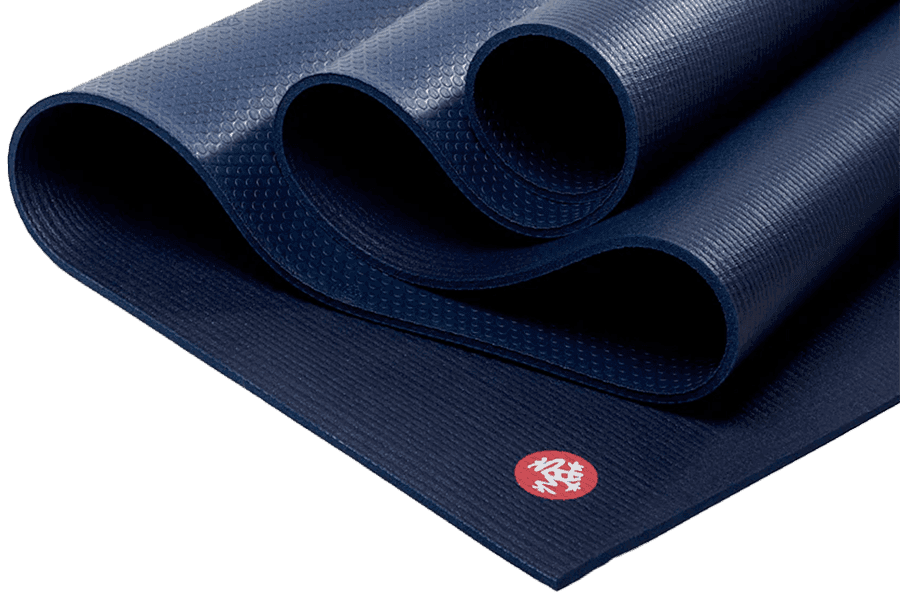
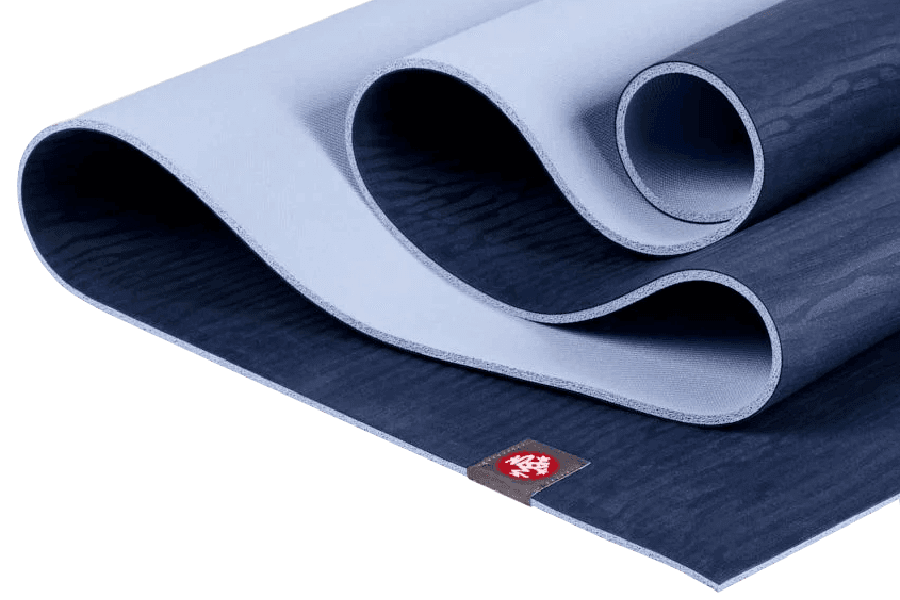
Price
The eKO Long lists for $20 less.
$144
List price · check price at Amazon
$124
List price · check price at Amazon
Thickness
The PRO is 20% thicker.
6 mm0.24″
5 mm0.2″
Weight
Identical weight.
8 lbs3.6 kg
8 lbs3.6 kg
Size
The eKO Long is 8″ longer; same width.
Same on both
- Made by Manduka
- Same roomy 26" width
- Closed-cell surface (sweat can't soak in)
- Heavy, stay-at-home weight class
- Lies flat without curling
Full specs
Dimensions
Materials & build
Buying
A standard mat against a long one
This pairing crosses two lines at once. The PRO is Manduka’s PVC flagship in its standard 71″ cut: dense, German-made, slick out of the box, and guaranteed for life. The eKO Long is the stretched 79″ version of Manduka’s natural rubber mat: grippy from the first practice, made in Taiwan with over 30% recycled content, and backed by nothing more than a 30 day return window.
So you’re weighing two things at the same time: PVC versus rubber, and standard versus long. Both mats are 26″ wide and heavy enough that you won’t enjoy carrying either. If the material question is what brought you here, our PRO vs eKO comparison covers the same-size fight. This page is for the person who’s also asking whether eight extra inches are worth having.
Length is the reason this page exists
The eKO Long is 79″ × 26″; the PRO is 71″ × 26″. Those eight inches matter more than they sound. At 71″, anyone around six feet tall ends up negotiating in Savasana: head on the mat or heels on the mat, pick one. At 79″ that negotiation goes away for everyone short of the seriously tall.
If you want length without giving up the PRO’s material, know that the 85″ PRO Long exists at $164. That’s the eKO Long’s real rival for tall practitioners: $40 more, six inches longer still, and covered by the guarantee. The standard PRO only wins this matchup if 71″ is genuinely enough for your body.
Grip: the eKO Long works on day one
The eKO Long’s textured rubber surface has real traction from the first practice. Nothing to condition, nothing to wait out, and the rubber feels warmer and softer under the hands than the PRO’s fabric-like top.
The PRO famously ships slick. The surface needs a few weeks of consistent practice before the grip shows up; Manduka used to recommend a salt scrub to hurry it along and now simply says the slickness resolves with use. It does, and a broken-in PRO grips well for years, but the early weeks annoy almost everyone.
Sweat is a wash. Both mats are closed-cell, so moisture beads on the surface instead of soaking in, and Manduka itself frames the eKO’s traction as reliable in dry conditions. Light sweat is fine on either; a dripping class wants a towel on both.
Cushioning: 6 mm vs 5, both firm
The PRO carries 6 mm of dense PVC, the eKO Long 5 mm of natural rubber foam with a gentle rebound. Neither is a soft mat. The PRO reads harder and more planted; the eKO has a touch more spring. On wood floors the difference is small. On concrete or tile, the PRO’s extra millimeter and density are noticeable in kneeling work, which is part of why OutdoorGearLab’s testers scored the PRO’s comfort at the top of their rankings.
Weight: both stay home
Eight pounds for the eKO Long, seven and a half for the PRO. The eKO Long is the heavier mat here, which surprises people who associate rubber with the lighter Jade mats. The mass buys you the same thing on both: they unroll flat, stay planted, and never bunch mid-flow. But if you carry your mat to class regularly, neither is the right buy; look at the 5 pound eKO Lite or the PROlite instead.
Durability and the warranty Manduka won’t extend
The PRO lasts decades. GearLab’s testers found instructors still practicing on PRO mats five to twenty years old, and Manduka’s lifetime guarantee, roughly ten years of regular use in the fine print with one replacement, formalizes it.
The eKO Long gets no warranty at all. Manduka’s guarantee page covers the PRO series only, and that exclusion is informative: natural rubber oxidizes, wears faster under vigorous daily practice, and degrades in sunlight. Owners of eKO mats report surface wear after a few years of hard use. The company that makes both materials wrote its warranty terms around exactly this difference.
Care splits the same way. The PRO tolerates a hot car and careless cleaning. The eKO Long wants shade and mild soap, because it’s a plant product and behaves like one.
The eco question
If the PRO has one honest weakness, it’s the material. PVC isn’t practically recyclable, and no service life fully erases that. The eKO Long answers with rubber tapped from trees and over 30% recycled content. The counterpoint is the one Manduka makes for the PRO: a mat that serves twenty years can beat a rotation of shorter-lived rubber mats on total footprint. Both arguments are fair; which persuades you depends on whether you judge a mat by what it’s made of or how often you replace it.
Sizes and colors: the eKO Long comes in one
Color is a real weakness on the eKO side of this page. The eKO Long ships in Midnight only at last count, a dark blue, take it or leave it. The standard 71″ eKO offers around five colorways, and the PRO around fourteen across its standard size, plus Long, Long & Wide, and Squared cuts for home studios. If you want choice, the PRO family simply has more of everything except day-one grip.
Price and value
List prices are $144 for the PRO and $124 for the eKO Long. Street prices drift by colorway and stock, so check the current price on both the PRO and the eKO Long before deciding.
Stretched over years, the math tilts hard toward the PRO. The $20 you save on the eKO Long buys a mat with a fraction of the PRO’s working life and no coverage when the surface wears. The eKO Long earns its price a different way: it’s the cheapest long mat Manduka makes, $40 under the PRO Long. If length is the requirement and the budget is firm, that’s a legitimate reason to pick it.
Bottom line
If you’re under six feet, this is a short conversation: get the PRO. The extra length would sit unused while you gave up the thicker cushion, the guarantee, and a decade or more of service life.
If you’re tall, the eKO Long is a genuinely good answer, just not the only one. It grips from day one, costs the least of any long Manduka, and fixes the height problem completely. We still think most tall buyers should find the extra $40 for the 85″ PRO Long and get the mat Manduka will stand behind. Choose the eKO Long when the rubber matters to you, or when $124 is the ceiling.
Manduka PRO
List price $144
Manduka eKO Long
List price $124
Frequently Asked Questions
- Is the Manduka eKO Long covered by the same lifetime guarantee as the PRO?
- No. Manduka's lifetime guarantee covers the PRO series only (PRO, PROlite, and PRO Travel). The eKO Long, like the rest of the eKO line, has no stated warranty; you get Manduka's standard 30 day return window and nothing after it. If the guarantee is a big part of why you're buying Manduka, only the PRO side of this comparison delivers it.
- How much longer is the eKO Long than the Manduka PRO?
- Eight inches: the eKO Long is 79" × 26" versus the PRO's 71" × 26". Both share the same generous 26" width. If you want that kind of length in the PRO's PVC instead, the 85" PRO Long exists at $164, which is $40 more than the eKO Long.
- Which grips better, the PRO or the eKO Long?
- Out of the box, the eKO Long. Its textured natural rubber surface has reliable traction from the first practice, while a new PRO is famously slick and needs a few weeks of regular use to break in. Once broken in the PRO grips well and keeps improving. Both are closed-cell mats that keep sweat on the surface, so heavy sweaters will want a towel on either one.
- Which lasts longer, the PRO or the eKO Long?
- The PRO, by a wide margin. Dense PVC barely wears, and PRO mats routinely serve a decade or more. The eKO's natural rubber is durable for rubber, but owners report surface wear after a few years of heavy use, sunlight degrades it, and Manduka doesn't warranty it. The warranty gap says a lot about how Manduka expects the two materials to age.
- What colors does the eKO Long come in?
- Just one at last count: Midnight, a dark blue. The standard 71" eKO offers around five colorways, and the PRO offers around fourteen. If color matters and you need the length, that's a genuine downside of the eKO Long.
- How heavy are the PRO and the eKO Long?
- The eKO Long weighs 8 pounds and the PRO weighs 7.5, so both live at the leave-it-at-home end of the scale. The upside of that mass is that both mats lie flat immediately and stay planted through practice. If you carry your mat to class regularly, look at the 5 pound eKO Lite or Manduka's PROlite instead.
Related comparisons
- Manduka eKO Long vs Lululemon The (Big) Mat 5mm
- Manduka eKO Long vs Hugger Mugger Para Rubber 5mm
- Manduka PRO vs Alo Warrior
- Manduka eKO Long vs Yoga Design Lab Infinity 5mm
- Manduka PRO vs b, halfmoon B Mat Strong 6mm
- Manduka PRO vs Yoloha Unity Pro Cork
- Lululemon The Mat 5mm vs Manduka eKO Long
- Manduka eKO Long vs Alo Warrior
- Manduka PRO vs JadeYoga Harmony XW