Manduka PRO vs Jade Travel: Which One Should You Buy?
The Manduka PRO is the mat you buy once and keep in one room. The Jade Travel is the mat you buy so you stop practicing on hotel carpet. At $79.95 it is not a throwaway second mat, and at 3.2 mm it keeps enough cushion to work as a real one, which is what separates it from thinner travel mats. The decision is less about which is better and more about whether you need one mat or two.
As an Amazon Associate, we earn from qualifying purchases made through links on this page. How this works
The quick answer
The PRO won OutdoorGearLab's yoga mat test outright at 91 of 100, with a perfect 10 for comfort and support, a perfect 10 for materials, and a lifetime guarantee behind it. Nothing the Jade Travel does competes with that at home. What the Travel does is fold. It is 3.2 mm of the same open-cell natural rubber Jade uses on the Harmony, about 3 pounds, made in the USA, and it packs flat rather than rolling. That thickness is roughly double Jade's thinner Voyager, which is the whole reason to pay $30 more for it.
Buy the PRO if this is your one mat. Buy the Travel if you already have a mat and you want something you can genuinely practice on when you land.
Get the PRO if...
- You want one mat for a decade with a lifetime guarantee attached
- You practice on hardwood, tile, or concrete and want full cushion
- You want the highest-scoring mat in GearLab's test, 91 of 100
- The mat is not going to travel much, so 7.5 pounds is fine
Get the Jade Travel if...
- You want a mat that folds flat into luggage, at about $64 less
- You want Jade's rubber grip without the weight of a studio mat
- You want more cushion than an ultra-thin travel mat gives you
- You'd use the 74 inch Long version if you're tall
Side by side
Price
The Travel lists for about $64 less.
$144
List price · check price at Amazon
$79.95
List price · check price at Amazon
Thickness
The PRO is 88% thicker.
6 mm0.24″
3.2 mm0.13″
Weight
The Travel is 4.5 lbs lighter.
7.5 lbs3.4 kg
3 lbs1.4 kg
Size
The PRO is 3″ longer; the PRO is 2″ wider.
Same on both
- Wipe-down care only, no machine washing
- Made in a country each brand names openly
- Sold on Amazon as well as direct from the brand
- Solid colorways rather than printed patterns
Full specs
Dimensions
Materials & build
Buying
This is really a question about owning one mat or two
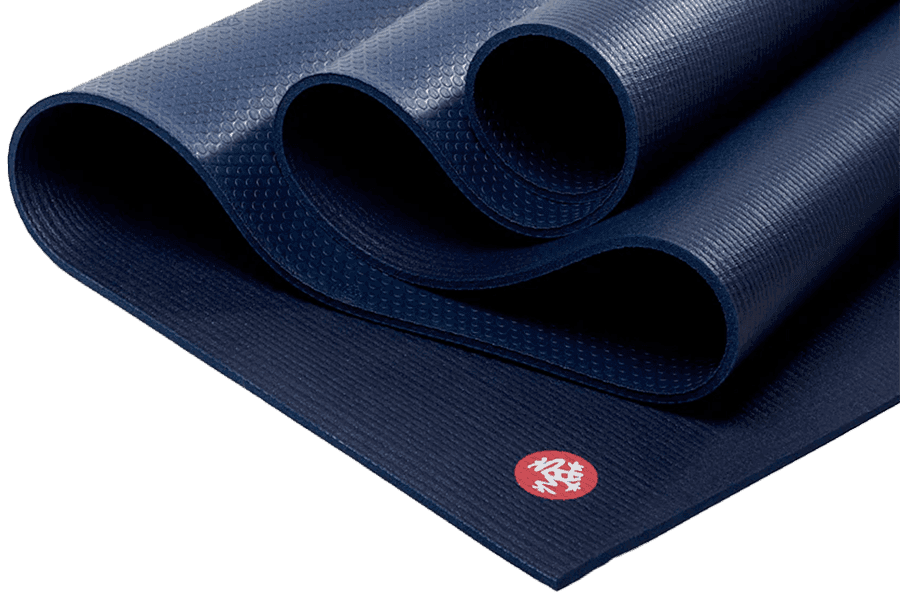
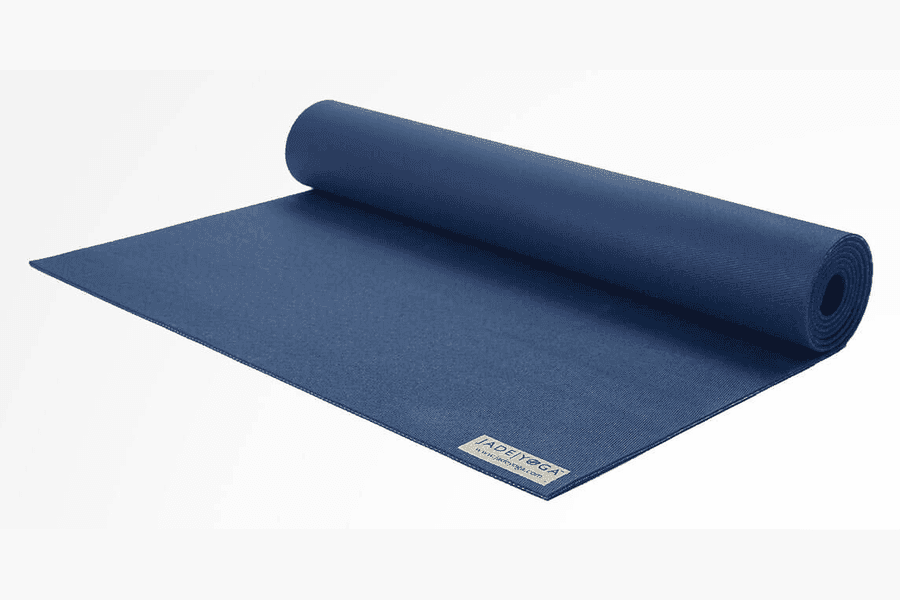
The Manduka PRO is 6 mm of dense closed-cell PVC, 7.5 pounds, made in Germany, sold at $144 with a lifetime guarantee. The Jade Travel is 3.2 mm of open-cell natural rubber, about 3 pounds, made in the USA, and $79.95. It folds flat rather than rolling.
What makes the Travel worth comparing to a full studio mat, rather than filing under luggage, is that it keeps enough thickness to practice on. Plenty of owners use it as their only mat. It is roughly double the thickness of Jade’s cheaper Voyager, and that is the difference between a mat you tolerate on a hard floor and one you do not.
Cushion: 6 mm of dense PVC against 3.2 mm of rubber
OutdoorGearLab scored the PRO 10 of 10 for comfort and support, one of only two perfect marks in a 19 mat test. Six millimeters of dense PVC keeps a kneecap off hardwood in a low lunge and stays supportive under a forearm plank. It is firm rather than plush, so it does not sink under you, and that firmness is why it works for people with unhappy knees.
The Travel has enough under you for standing work, flows, and most floor sequences on a wood floor. Where it runs out is long kneeling and elbow work on tile or concrete, where the gap to 6 mm is obvious within a minute. Jade positions it as thinner than the Harmony and thicker than the Voyager, which is an accurate way to place it: usable rather than generous.
One thing the numbers hide: density matters as much as thickness. The PRO’s PVC is unusually dense, so its 6 mm does not compress the way a soft foam mat of the same depth would. The Jade’s rubber is dense too, which is why 3.2 mm goes further than the figure suggests. Comparing either of these to a cheap 6 mm foam mat on thickness alone would give you the wrong answer.
Grip: two mechanisms, both good
The PRO grips through friction and surface area rather than tack, and it has a break-in period nobody warns you about. New owners often find the first few weeks slippery until the fabric-like finish opens up with use. Manduka used to recommend a salt scrub to speed that up and has since dropped the advice, saying it resolves on its own. Once it does, GearLab rated it 9 of 10 dry.
Jade’s rubber has no break-in at all. It is tacky the moment you unfold it, and GearLab rated the Harmony 2.0, which uses the same open-cell surface as the Travel, 9.5 of 10 dry and 7 wet. In practice you would not pick between these two on grip. The practical difference is the first month, where the Jade is immediately good and the PRO is not yet.
Packing and weight
The PRO weighs 7.5 pounds, which GearLab confirmed on its own scale, and rolls thick. It is heavy enough that most owners leave it where it lives, and no strap design changes what that feels like over a shoulder for fifteen minutes.
The Travel folds. That matters more than the 3 pound weight, because a folded mat lies flat inside a suitcase instead of eating a corner of it. The cost is creases along the fold lines over the years, which is true of every folding rubber mat and worth knowing before you buy one.
Worth adding that the PRO is not merely heavy, it is bulky. The roll is thick enough that it does not sit neatly in most mat bags designed for 4 mm mats, and it takes up real space in a closet. The Travel disappears in both senses, which is part of why people who own both end up reaching for it more often than they expected to.
Sweat, odor, and cleaning
These handle moisture in opposite ways. The PRO is closed-cell, so nothing soaks in: sweat sits on the surface, which is hygienic and easy to wipe but means puddles in a heated room. Most PRO owners in hot classes keep a towel on it. GearLab scored its care and cleaning 8 of 10 and its materials a perfect 10.
The Travel is open-cell and pulls moisture in, which helps grip and complicates everything else. It has to dry fully before it gets folded away or it will start to smell, and folding a damp rubber mat into a bag for a long flight is the worst version of that. Diluted mild soap on a cloth suits both. Neither goes in a washing machine, and harsh cleaners void Jade’s warranty.
Durability and what the warranties cover
The PRO is the longest-lived mat most people will own. Manduka’s lifetime guarantee reads better than its fine print, which works out to roughly ten years of regular use and one replacement, with proof of purchase from an authorized seller. Amazon counts only when the mat is sold and shipped by Amazon itself. Even discounted for that, it is far more coverage than anything else in the category.
Jade covers the Travel for one year and excludes sun damage and harsh cleaners, both of which genuinely degrade natural rubber. Thin rubber ages by losing tack slowly, creasing where it folds, and tearing at the edges if it snags. Jade also plants a tree for every mat it sells, more than two million so far, which is a program rather than a certification.
Sizes and colorways
The PRO is 71 by 26 inches and Manduka sells it in four more shapes: an 85 inch Long, a Long & Wide, and a 78 inch Squared, plus black and roughly a dozen more colorways.
The Travel is 68 by 24 inches with a 74 inch Long version at $93.75, in three colorways at last count. That 24 inch width is narrow, which is normal for travel mats and still worth noting if you find standard mats tight in a wide-legged stance.
Where the Travel sits against the Voyager
Most people shopping for a Jade travel mat are choosing between two, not one. The Voyager is 1.6 mm, about 1.5 pounds, and $30.00 cheaper. It folds smaller and is the better pure packing mat. What it cannot do is cushion anything: GearLab scored its comfort and support 2 of 10.
The Travel costs more and gives you a mat you can actually practice on when you land, on a hotel room floor, without a blanket under every kneel. If your trips involve real practice, that is money well spent. If the mat is going over carpet or a studio’s rental mats, the Voyager saves you cash and space, and our PRO vs Jade Voyager comparison covers that end of the range.
Price and where to buy
$144 against $79.95, about $64 apart. Both sell on Amazon as well as direct, and the PRO in particular moves around by colorway, so it is worth checking the current PRO price at Amazon and the current Jade Travel price at Amazon before paying list on either. Remember that the PRO’s guarantee holds only when the seller is Amazon itself.
$79.95 is expensive for a travel mat and that is a fair objection. What it buys is USA manufacturing, Jade’s rubber, and enough thickness to be a mat rather than a mat-shaped object. Cheaper folding mats are mostly thin foam that slides.
Bottom line
Buy the PRO if this is your one mat and it stays in one room. It took the top overall score in GearLab’s test at 91 of 100, it is the most comfortable mat there, and Manduka stands behind it longer than anyone stands behind anything else. The cost is weight, and you feel it every time you carry it.
Buy the Jade Travel if you fly often and want a mat you can genuinely practice on when you land, or if you have carpet at home and never needed 6 mm in the first place. It is one of the few travel mats that works as a primary mat. If you want the full-size Jade instead, our Harmony vs Travel comparison is the next thing to read.
Manduka PRO
List price $144
Jade Travel
List price $79.95
Frequently Asked Questions
- Can the Jade Travel replace a full mat like the PRO?
- Closer than most travel mats, but not quite. At 3.2 mm it has enough under you for standing work and most flows on a wood floor, and plenty of owners use it as a primary mat without complaint. Where it gives up ground is kneeling and forearm work on hard floors, where 6 mm of dense PVC is a meaningfully different experience. If you have carpet at home, the Travel can absolutely be your only mat. On tile or concrete, the PRO is doing a job the Travel only half does.
- How does the Jade Travel compare to the Jade Voyager?
- The Travel is twice as thick, 3.2 mm against 1.6, weighs about twice as much at 3 pounds, and costs $30 more. The Voyager folds smaller and is the better pure packing mat; the Travel is the better mat to practice on once it is unfolded. If you want a travel mat you can use on a hard floor without a blanket, the extra $30 is well spent. If the mat is going over carpet or a studio rental, the Voyager saves you money and space.
- Which is better for hot yoga?
- Neither is a hot yoga specialist. The PRO's closed-cell surface keeps sweat on top, which is hygienic but means most owners run a towel over it in a heated room. The Travel's open-cell rubber absorbs, which helps grip but leaves the mat damp and slower to dry, and folding a wet rubber mat into a bag is how it starts to smell. GearLab rated the PRO 7 of 10 for wet grip, well behind the 8.5 its hot yoga pick earned.
- Does the PRO's lifetime guarantee mean lifetime?
- It works out to roughly ten years of regular use and one replacement, with proof of purchase from an authorized seller. Amazon counts only when the mat is sold and shipped by Amazon itself. That is narrower than the word implies, but it is still far more coverage than anything else in the category, and the PRO lasts long enough that filing a claim is realistic. Jade covers the Travel for one year and excludes sun damage and harsh cleaners.
- Is the Jade Travel worth $79.95 for a second mat?
- It is expensive for a travel mat, and that is a fair objection. What you get is USA manufacturing, Jade's genuinely good rubber surface, and enough thickness to be usable rather than merely portable. Cheaper folding mats exist and most of them are thin foam that slides. If you travel a few times a year, the Voyager at $49.95 is the more sensible spend. If you travel constantly and practice wherever you land, the Travel earns it.
- How does the grip compare?
- Different mechanisms, both good. GearLab rated the PRO 9 of 10 dry, though new PRO owners often find the first few weeks slippery until the finish opens up with use. Manduka used to suggest a salt scrub for that and has since dropped the advice. Jade's rubber is tacky immediately with nothing to break in; GearLab rated the Harmony 2.0, which uses the same surface, 9.5 of 10 dry. In practice you would not choose between these two on grip.
Related comparisons
- Manduka PRO vs b, halfmoon B Mat Strong 6mm
- JadeYoga Travel 68" vs Manduka PRO Travel
- Manduka PRO vs Alo Warrior
- Manduka PRO vs Yoloha Unity Pro Cork
- Manduka PRO vs JadeYoga Harmony XW
- JadeYoga Travel 68" vs Hugger Mugger Earth Elements 5mm
- Manduka PRO vs Lululemon The (Big) Mat 5mm
- Manduka X vs JadeYoga Travel 68"
- JadeYoga Travel 68" vs Gaiam Performance Dry-Grip Long & Wide