Manduka eKO vs Retrospec Solana 1": Which One Should You Buy?
These two show up together in search results and belong to different product categories. The eKO is Manduka's natural rubber mat, second of 19 in GearLab's 2026 test at 87 out of 100. The Solana 1" is 25 mm of NBR foam sold on joint relief. The gap in thickness is five times, and the thick one is not the better yoga mat.
As an Amazon Associate, we earn from qualifying purchases made through links on this page. How this works
The quick answer
The eKO earned a perfect 10 for dry grip, the best in GearLab's field, plus 9 for comfort and support and 8 for materials. It is 7 pounds of closed-cell natural rubber at $114. The Solana 1" is soft foam with a ribbed surface and a carry strap for about $40, holding 4.5 stars across roughly 14,900 Amazon ratings.
For anything involving standing on one leg, the eKO is the mat and the inch of foam is a liability. For stretching, mat Pilates, rehab work or a practice spent on your knees and back, the Solana is more comfortable and costs $74 less.
Get the Manduka eKO if...
- You do standing poses, balances or vinyasa
- You want the grippiest dry surface GearLab tested
- You want a mat that stays planted on a slick floor
- You want natural rubber and 26 inches of width
Get the Retrospec Solana 1" if...
- You want maximum padding for knees, hips and spine
- Your sessions are floor-based rather than standing
- You want a strap included and 4 pounds to carry
- You'd rather keep about $74
Side by side
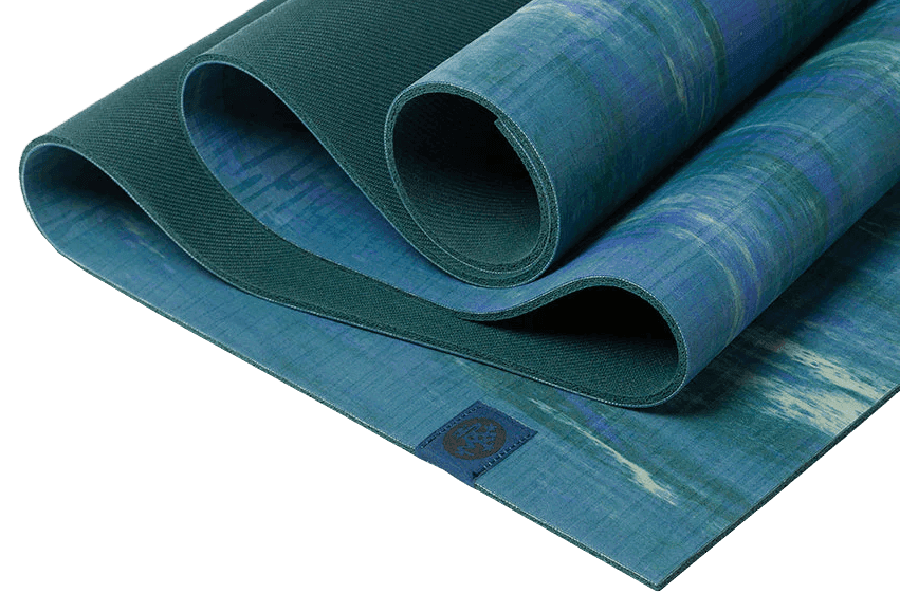
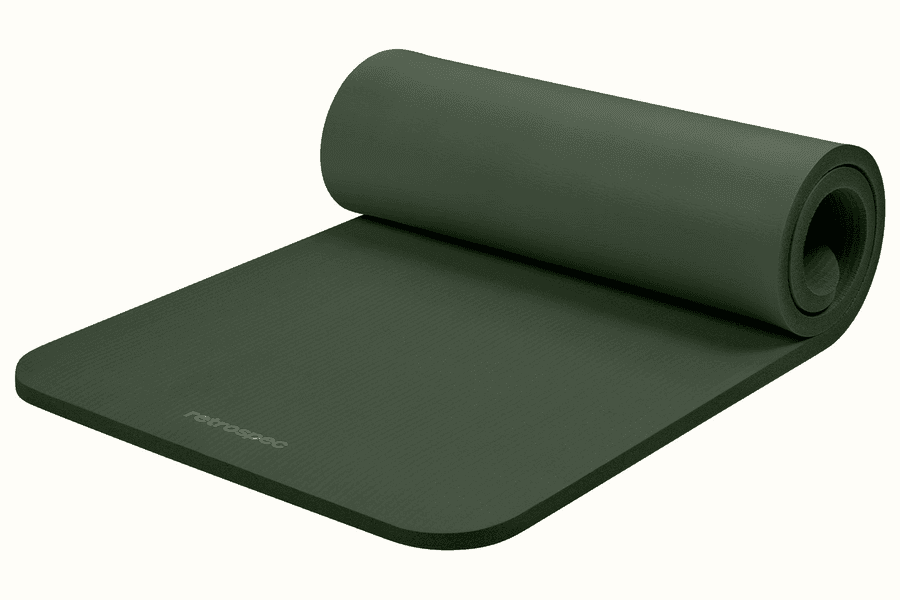
Price
The Solana 1" lists for about $74 less.
$114
List price · check price at Amazon
$39.99
List price · check price at Amazon
Thickness
The Solana 1" is 408% thicker.
5 mm0.2″
25.4 mm1″
Weight
The Solana 1" is 3 lbs lighter.
7 lbs3.2 kg
4 lbs1.81 kg
Size
The Solana 1" is 1″ longer; the eKO is 2″ wider.
Same on both
- About 72 inches of usable length
- Closed-cell, so nothing soaks in
- Both smell out of the wrapper and need airing
- Both are wipe-clean with mild soap
Full specs
Dimensions
Materials & build
A studio mat and a cushioning pad
A full inch of foam is five times the thickness of the eKO, and the two products are aimed at different sessions. The eKO is Manduka’s natural rubber mat and finished second of 19 in GearLab’s 2026 test at 87 out of 100, with the best dry grip in the field. The Solana 1″ is a floor pad that sells extremely well because it is comfortable and cheap.
Prices are $114 and about $39.99. Both are around 72 inches long, and that is where the resemblance stops.
What 25 mm does to a standing pose
Soft NBR that deep compresses more under your heel than under the ball of your foot, so the surface tilts as you shift and your ankle spends the pose keeping it level. Tree and half moon become harder for reasons that have nothing to do with your balance improving.
Retrospec’s own listing leads with stretching, mat Pilates and somatic movement rather than yoga flows, which is an accurate description of the job it does well. The eKO does not deflect at all, and GearLab’s 9 out of 10 for comfort and support reflects that.
Grip: a perfect dry score against a ribbed surface
GearLab measured the eKO at 10 out of 10 for dry grip, the top result among 19 mats, and 7 out of 10 wet. Natural rubber is tacky by nature and Manduka adds real texture to it. Closed-cell means sweat sits on the surface, which is why the wet number lands mid-pack rather than at the top.
The Solana relies on moulded ribs. They hold a dry bare foot on a hard floor reasonably well, but the foam itself moves before the surface does, so what you feel is squirming rather than sliding. Once your palms are damp it offers very little.
The Solana’s real strength
If a hard floor is the thing stopping you practicing, an inch of foam solves that outright and no yoga mat comes close. Rehab work, core work on your back, seated practice, long stretching sessions: the Solana is more comfortable for all of it and costs $74 less.
If standing poses are part of your session, the better answer is a firm mat plus a knee pad, because you cannot add stability back to foam. That combination usually costs less than the difference between these two mats.
Tapped rubber against nitrile foam
The eKO is natural rubber made in Taiwan, and the current version carries over 30% recycled content. GearLab rated its materials 8 out of 10. It is also not suitable for anyone with a latex allergy, which rules it out entirely for some people.
NBR is a synthetic nitrile rubber foam, the same material used in gym mats and camping pads. Light, cheap, extremely cushioned, and prone to permanent dents where weight sits. Retrospec lists the mat as free of latex, BPA, phthalates and heavy metals.
Weight, bulk and storage
Manduka specs the eKO at 7 pounds and GearLab measured 6.3. It rolls tight, so it stores easily even though it is heavy. The Solana is 4 pounds with a nylon strap, but an inch-thick mat rolls into a fat cylinder that does not tuck behind a door.
If the eKO’s weight is the sticking point, Manduka’s eKO Superlite takes the same rubber down to a packable travel mat, with all the cushioning that implies.
Both need airing, and one needs it longer
The eKO’s rubber smell is strong out of the wrapper and takes about a fortnight of unrolled airing to settle. It is the most common complaint about the mat, and the reason its Amazon rating sits around 4.1 stars across roughly 700 ratings despite testing near the top of the field.
Retrospec asks buyers to unroll the Solana and air it for a day or two, and warns against submerging it when cleaning. Neither mat should be left in direct sun; UV is hard on rubber and harder on foam.
Thin coverage on both sides
Manduka’s lifetime guarantee does not extend to the eKO line, which catches people out. The eKO gets a 30 day return window and nothing else. Retrospec covers manufacturing defects for six months, with 30 day returns on unused product.
If a long warranty matters to you, the Manduka mats that carry one are the PRO and PROlite, and our PRO vs eKO comparison covers that trade in detail.
Price and value
List prices are $114 and $39.99, a gap of about $74. The Solana holds 4.5 stars across roughly 14,900 Amazon ratings, which is worth taking seriously as long as you read what people bought it for: knee comfort, home workouts and stretching rather than yoga sequences.
Three Solanas cost roughly one eKO, and you would work through several of them in the years a well-kept rubber mat lasts. That arithmetic only matters if you are doing the kind of practice the eKO is built for. If you are not, the cheaper mat is not a compromise, it is the right product.
Bottom line
Buy the Manduka eKO if you do yoga. It has the best dry grip GearLab measured, holds still under a standing foot, and is built well enough to earn 8 out of 10 for materials. Check the current price on the eKO at Amazon before you order.
Buy the Retrospec Solana 1″ if you want padding and your session happens on the ground. If you want some of both, Retrospec’s half inch version is the sensible middle of its own range.
Manduka eKO
List price $114
Retrospec Solana 1"
List price $39.99
Frequently Asked Questions
- Why does an inch of foam make yoga harder?
- Soft foam compresses more under your heel than under the ball of your foot, so the surface tips as you shift weight and your ankle spends the pose keeping it level. That is not balance training, it is noise. Retrospec's own listing leads with stretching, mat Pilates and somatic work rather than yoga sequences, which is an accurate description of the job it does well.
- What makes the eKO grip so well?
- Natural rubber is tacky by nature, and Manduka gives the eKO a closed-cell surface with real texture. GearLab measured 10 out of 10 for dry grip, the top score in a field of 19, and 7 out of 10 wet. Closed-cell means it does not absorb sweat, so a genuinely hot room will still test it, but in a normal class it is about as secure as a mat gets.
- Is the eKO worth $114 over a $40 mat?
- For yoga, yes, because they are not doing the same job. The eKO is a studio-grade rubber mat that scored 87 out of 100 in an independent test; the Solana is an exercise pad with a yoga label. If what you need is padding, though, spending $114 on grip you will not use is the wrong trade and the Solana will serve you better.
- How heavy is the eKO really?
- Manduka specs it at 7 pounds and GearLab measured 6.3, which is heavy for a 5 mm mat and part of why it stays planted on a slick floor. The Solana is 4 pounds with a nylon strap, but an inch-thick mat rolls into a bulky cylinder that is awkward to carry and store however light it is. If weight is your issue, Manduka's eKO Lite and Superlite are the lighter versions of the same idea.
- Does either have a warranty?
- Not much. The eKO is not covered by Manduka's lifetime guarantee, which applies to the PRO and PROlite lines; it gets a 30 day return window. Retrospec warrants manufacturing defects for six months and takes returns within 30 days for unused product. Foam denting and rubber losing tack are wear, so neither is covered.
- Which is better for hot yoga?
- The eKO, with a caveat. Its 7 out of 10 wet grip beats anything foam can manage, but closed-cell rubber still leaves sweat on the surface, so a towel is sensible in a heated room. The Solana in a hot class is a slip hazard. For a proper hot yoga mat, look at absorbent-top designs instead.
Related comparisons
- Amazon Basics 1 Inch Extra Thick vs Retrospec Solana 1"
- Manduka eKO vs Lululemon The (Big) Mat 5mm
- Lululemon The Mat 5mm vs Manduka eKO
- JadeYoga Harmony 74" vs Manduka eKO
- Manduka eKO vs JadeYoga Harmony 2.0 68"
- Manduka eKO vs Suga SugaMat
- JadeYoga Harmony 68" vs Manduka eKO
- Manduka eKO vs Yoga Design Lab Combo 3.5mm
- Manduka eKO vs b, halfmoon B Mat Everyday 4mm