Manduka eKO vs Amazon Basics 1/2 Inch: Which One Should You Buy?
These two turn up on the same shortlist because both are sold as yoga mats, and that is where the similarity ends. The Manduka eKO placed second out of nineteen mats in OutdoorGearLab's test and took the only perfect dry grip score in the group. The Amazon Basics 1/2 Inch Extra Thick is half an inch of soft NBR foam for $22.48, which is a different product doing a different job.
As an Amazon Associate, we earn from qualifying purchases made through links on this page. How this works
The quick answer
For yoga, the eKO is not just better, it is a different category of thing. Dense natural rubber, 26 inches wide, 10 out of 10 for dry grip, and no break-in. The Amazon Basics is soft exercise foam: excellent under a knee or a spine during floor work, and unstable the moment you stand on one leg, because your foot sinks into it and keeps correcting.
Two real advantages for the cheap mat: it is 12.7 mm thick against 5, and it is 2.2 pounds against 7. If your practice is floor-based, or your knees are the whole problem, the $22.48 mat may genuinely serve you better than the $114 one.
Get the Manduka eKO if...
- You want the best dry grip in a mainstream mat
- You do standing poses and balances, not only floor work
- You want 26″ of width and dense support
- The mat mostly stays in one room
Get the Amazon Basics 1/2 Inch if...
- Knee and spine padding is the problem you are solving
- Your practice is mostly floor work, stretching, or pilates
- You carry it; 2.2 pounds against 7 is decisive
- You have a latex allergy; the eKO is tree rubber
Side by side
Price
The Amazon Basics lists for about $92 less.
$114
List price · check price at Amazon
$22.48
List price · check price at Amazon
Thickness
The Amazon Basics is 154% thicker.
5 mm0.2″
12.7 mm0.5″
Weight
The Amazon Basics is 4.8 lbs lighter.
7 lbs3.2 kg
2.2 lbs1 kg
Size
The Amazon Basics is 3″ longer; the eKO is 2″ wider.
Same on both
- Both are marketed as yoga mats
- Both are longer than the 68″ standard
- Wipe-clean care; neither goes in a washing machine
- Neither is a good surface once your hands are properly wet
Full specs
Dimensions
Materials & build
Both sold as yoga mats, built for different work
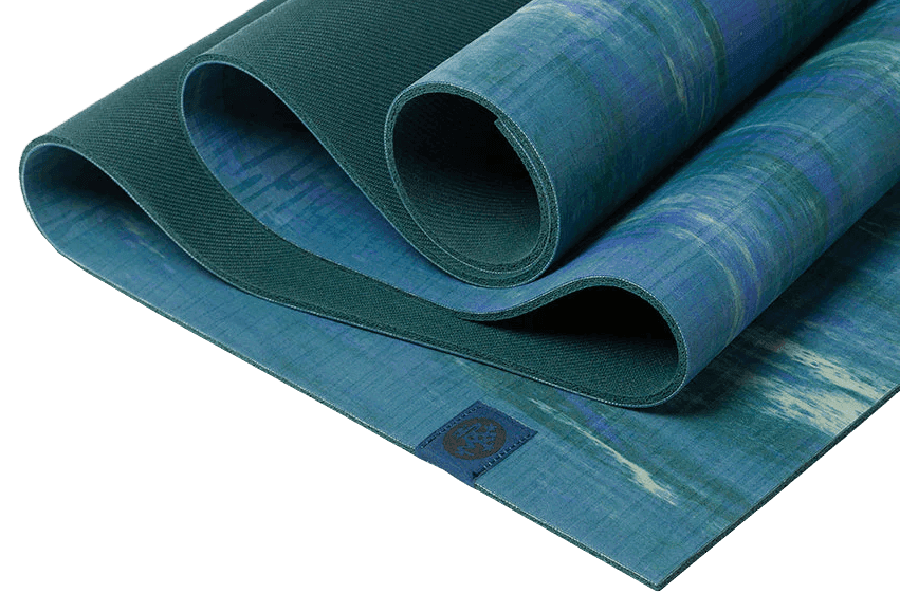
The Manduka eKO placed second out of nineteen mats in OutdoorGearLab’s test at 87 out of 100, and took the only perfect dry grip score in the group. It is 5 mm of dense natural rubber, 26 inches wide.
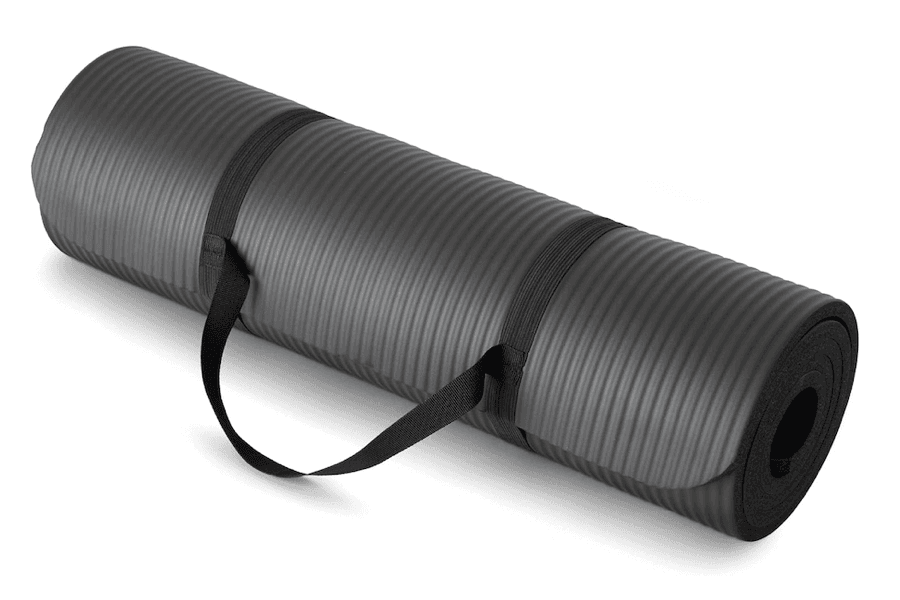
The Amazon Basics 1/2 Inch Extra Thick is 12.7 mm of soft NBR foam for $22.48. It is the sort of mat you find under someone doing core work or physio exercises, and it is sold with yoga in the name.
These are not two versions of the same product, and pretending otherwise is how people end up disappointed by whichever one they buy.
A perfect 10, against foam
GearLab rated the eKO 10 out of 10 for dry grip, the only mat in its nineteen mat test to take full marks, and 9 out of 10 for grip overall. No break-in, no slick factory finish. Unroll it and it holds.
The qualifier is moisture. The eKO is closed-cell, so sweat sits on the surface rather than soaking in, and GearLab put more slippery when wet in its cons. Superb in a normal room, merely adequate once you are dripping.
Textured foam has no real grip claim to make. It works dry through friction and slides once your palms are damp. The Amazon Basics was not in that test and it would not have troubled the top of it.
Half an inch is a lot, and it cuts both ways
12.7 mm against 5. Under a knee in a low lunge, or a spine during core work on a tile floor, that extra material is a genuine comfort and the eKO cannot match it at any price.
Stand on one leg and it works against you. Soft foam compresses unevenly underfoot, so your ankle keeps making small corrections and balances get harder than they should be. People often read that as their balance getting worse.
Dense rubber is the opposite trade: less padding, and a platform that stays exactly where you put your foot.
Seven pounds against 2.2
Manduka lists the eKO at 7 pounds and GearLab measured 6.3. Either way it is roughly three times the Amazon Basics, and weight is the main thing that kept the eKO off the top of that test.
Ten minutes on a shoulder is nothing. A twenty minute walk plus a train, four days a week, is a different proposition and it is why plenty of eKO owners end up with a second, lighter mat. Manduka’s own answer is the eKO Lite at 4 mm and 5 pounds.
If the mat lives in one room, none of this matters.
They split the size advantage
The Amazon Basics is longer at 74″ against 71″, which is unusual at this price and genuinely useful if you are tall.
The eKO is wider at 26″ against 24″. In practice the width is the one you notice more often, because it is what stops your hands hanging over the edge in a wide down dog or a side angle.
The warranty and the reality point opposite ways
Amazon Basics gives a one-year warranty. Manduka gives the eKO a 30 day return window and nothing else. On paper the $22.48 mat is better protected.
In use it is not close. Soft NBR foam at this price compresses where you load it and tears at the edges, especially if you drag it, typically within a year or two. Dense rubber runs for years. GearLab did note the eKO creases easily if you store it folded, so roll it and keep it out of hot cars and direct sun.
Tree rubber, synthetic foam, and allergies
The eKO is tapped natural rubber, which is the reason for the grip and also the reason a genuine latex allergy rules it out. The Amazon Basics is NBR foam, a synthetic nitrile, with no natural rubber in it.
If allergy is the constraint and you still want Manduka build quality, their PVC line is where to look: the PROlite is the closest equivalent and comes with a lifetime guarantee.
Both smell when new
The eKO arrives smelling powerfully of rubber, and it takes a week or two of use and open windows to settle. That is normal for natural rubber and catches out people who have only owned foam or PVC mats.
NBR foam has a chemical smell of its own when new that also clears. Whichever you buy, unroll it somewhere ventilated for a few days before its first session if you are sensitive to that sort of thing.
Prices and where to buy
Check the current eKO price at Amazon and the current Amazon Basics price. Manduka discounts retiring eKO colorways on its own site regularly, so it is worth comparing both before ordering.
The Amazon Basics is Amazon-only and also comes in a 1 inch version if padding is what you are after. The eKO comes in five colorways and a 79″ Long.
Bottom line
Buy the Amazon Basics if joint padding is the actual problem, if your practice is mostly on the floor, if you carry the mat, or if latex rules rubber out. Half an inch of foam solves something real and it costs $22.48.
Buy the Manduka eKO if you do standing work and want the best mainstream grip there is. It is heavy, it smells for a fortnight, and it has no warranty at all, and it is still one of the two or three best yoga surfaces you can buy. If you need both padding and grip, the honest answer is a thin grippy mat over a thick foam one.
Manduka eKO
List price $114
Amazon Basics 1/2 Inch Extra Thick
List price $22.48
Frequently Asked Questions
- Is the Amazon Basics actually a yoga mat?
- It is sold as one and it is really an exercise mat. Half an inch of soft NBR foam is what you want under a spine during core work or a knee during kneeling poses, and it is the wrong surface for standing balances, because a foot sinks in and then keeps making small corrections. Plenty of people practice on one happily; just know what you are buying.
- How much better is the eKO's grip?
- Measurably. OutdoorGearLab rated the eKO 10 out of 10 for dry grip, the only mat in a nineteen mat test to take full marks, and 9 out of 10 for grip overall. It also noted the eKO is more slippery when wet, so the advantage is with dry or lightly damp hands. Foam mats have no meaningful grip claim at all; the Amazon Basics was not in that test and its textured foam works dry and slides once damp.
- Seven pounds against 2.2. Does that matter?
- It is the main thing that kept the eKO off the top of GearLab's test, and it is the strongest argument for the cheap mat. Manduka lists 7 pounds and GearLab measured 6.3. Ten minutes on a shoulder is fine; a daily commute is not. If you carry your mat and still want rubber, Manduka's answer is the eKO Lite at 4 mm and 5 pounds.
- Which is bigger?
- They split it. The Amazon Basics is longer at 74″ against 71″, which is unusual for a budget mat and genuinely useful if you are tall. The eKO is wider at 26″ against 24″, which is what stops your hands hanging off the edge in a wide down dog. Neither is small.
- Which lasts longer, and what is covered?
- The eKO, comfortably, though the warranties say otherwise. Amazon Basics gives a one-year warranty; Manduka gives the eKO a 30 day return window and nothing else. In use, soft NBR foam compresses and tears at the edges within a year or two of regular use, while dense rubber runs for years. GearLab did note the eKO creases easily if stored folded, so roll it.
- Is either safe with a latex allergy?
- The Amazon Basics is the safer choice. It is NBR foam, a synthetic nitrile, with no natural rubber in it. The eKO is tapped tree rubber and a genuine latex allergy rules it out. If you want Manduka build quality without rubber, the PRO and PROlite are PVC and are the line to look at.
- Does the eKO smell?
- New ones do, of rubber, sometimes strongly for a week or two before fading with use and air. That is normal for natural rubber and not a fault. NBR foam has its own chemical smell when new that also clears. If smells are a real problem in a small space, unroll whichever you buy somewhere ventilated for a few days first.
Related comparisons
- Amazon Basics 1/2 Inch Extra Thick vs Retrospec Solana 1/2"
- Manduka eKO vs Lululemon The (Big) Mat 5mm
- Lululemon The Mat 5mm vs Manduka eKO
- JadeYoga Harmony 74" vs Manduka eKO
- Manduka eKO vs JadeYoga Harmony 2.0 68"
- Manduka eKO vs Suga SugaMat
- JadeYoga Harmony 68" vs Manduka eKO
- Manduka eKO vs Yoga Design Lab Combo 3.5mm
- Manduka eKO vs b, halfmoon B Mat Everyday 4mm