Manduka eKO vs Amazon Basics TPE: Which One Should You Buy?
Here's the surprise hiding in this price gap: on the one spec people assume premium mats win, these two tie. Both are closed-cell surfaces that grip well dry and lose their hold once palms sweat. What the eKO's extra $88 actually buys is everything else: dense natural rubber instead of light TPE foam, a 26" width instead of 24", a planted 7 pounds instead of a drifting 2, and years of service instead of a few.
As an Amazon Associate, we earn from qualifying purchases made through links on this page. How this works
The quick answer
The eKO justifies its price with material and build: warm, tacky rubber that feels like a studio mat because it is one, over 30% recycled content, and a surface that survives daily practice for years. The Amazon Basics answers with pragmatism: $26, 73.6" long against 71", a quarter of the weight, latex free, odorless, and completely adequate under a dry, developing practice.
Neither is the hot yoga answer, so buy on material and commitment. An established dry practice deserves the eKO. A new or occasional one runs happily on the Basics, and the $88 saved will still be there when you know what you actually want.
Get the eKO if...
- Your practice is established and worth real rubber
- You want the wider 26" surface and planted feel
- Recycled content and natural materials matter to you
- You'd rather buy once every several years
Get the Amazon Basics TPE if...
- You're new to yoga or practice occasionally
- You're tall on a budget: 73.6" for $26
- You have a latex allergy: TPE has none, rubber does
- You carry your mat: 2 pounds against 7
Side by side
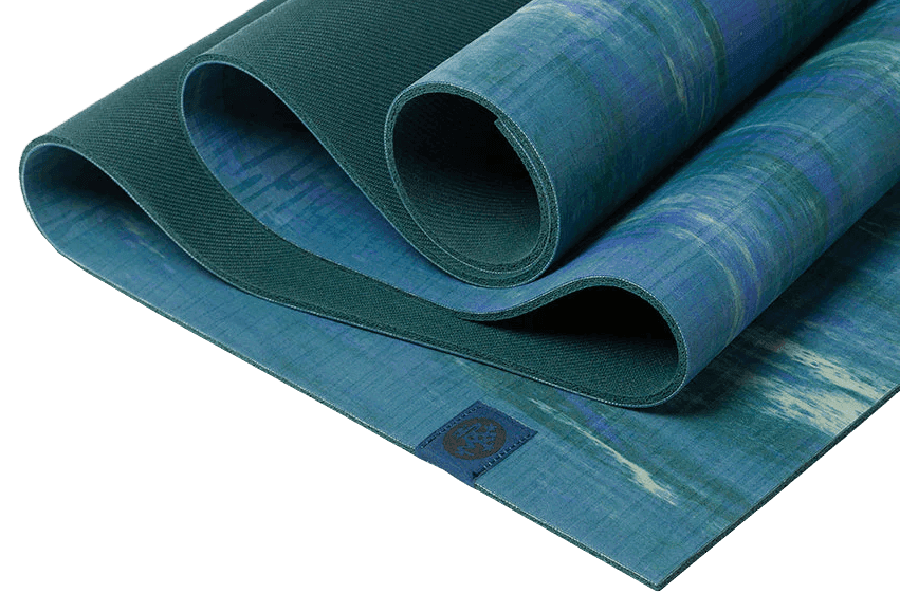
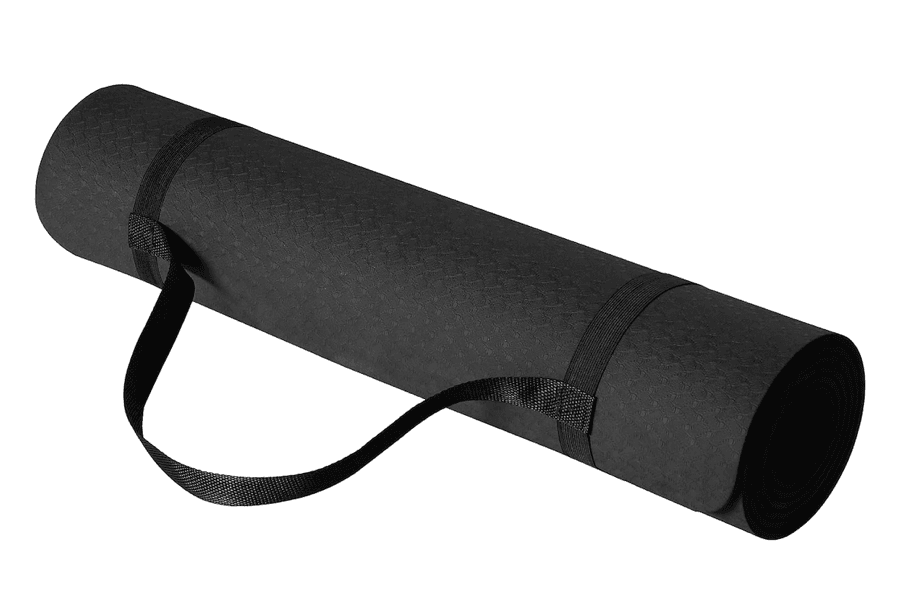
Price
The Amazon Basics lists for about $88 less.
$114
List price · check price at Amazon
$26.36
List price · check price at Amazon
Thickness
The Amazon Basics is 20% thicker.
5 mm0.2″
6 mm0.24″
Weight
The Amazon Basics is 5 lbs lighter.
7 lbs3.2 kg
2 lbs0.9 kg
Size
The Amazon Basics is 2.6″ longer; the eKO is 2″ wider.
Same on both
- Closed-cell surfaces: sweat stays on top
- Grip from the first practice in dry rooms
- Sold on Amazon at first-party prices
- Textured on both sides
Full specs
Dimensions
Materials & build
Buying
Material: rubber is the point of the eKO
The eKO is dense tapped tree rubber, and everything people pay for follows from that: a warm, rippled surface with genuine tack, 7 pounds that plant the mat like it was installed, and a build with over 30% recycled content in a process Manduka promotes as zero-waste. The Basics is 2 pounds of springy TPE foam, competent and characterless, with a coarse texture that holds dry feet and a tendency to shift on smooth floors during vigorous flows.
Neither material description is a criticism. They’re different answers to different budgets, and hands can tell them apart blindfolded on the first down dog.
Size: a genuine split decision
The eKO gives you width: 26″ against 24″, felt in every wide stance and side-lying pose. The Basics gives you length: 73.6″ against 71″, a real gift to tall buyers at this price. Tall practitioners with eKO money get both from the 79″ eKO Long at $124; tall practitioners without it are better fit by the cheap mat than by the standard eKO, which is not something premium brands like hearing.
Latex, smell, and the commute
The budget mat sweeps the practicality column. TPE carries no latex, while the eKO’s rubber is 99% latex free, which is Manduka’s way of conceding it isn’t, so allergic practitioners have exactly one option here. The Basics arrives odorless; the eKO announces itself for weeks. And 2 pounds against 7 makes the Basics the only one of these two anyone happily carries across town. The eKO’s weight repays you at home, where it lies flat and stays put, but it repays nobody on a shoulder strap.
Years: the multiple that closes the gap
Run the clocks and the price ratio shrinks. Budget TPE typically scuffs, compresses, or sheds texture within a few years of steady practice. The eKO runs longer under the same load, its known failure mode being surface flaking after years of hard use, and daily practitioners commonly replace two or three cheap TPE mats in one eKO’s lifetime. That turns $88 of sticker distance into something closer to $35 of real distance for a committed practice.
Paper coverage points backwards as usual in this tier: Amazon warranties its mat for a year, the eKO gets a 30 day return window, and the wear clocks matter more than either document.
Matching mat to practitioner
The Basics is the right buy for more people than premium brands admit: beginners, occasional practitioners, tall buyers on budgets, latex-allergic households, and anyone whose mat rides a bike rack daily. The eKO is the right buy for the practice that already exists: unheated, regular, rooted at home, held by someone who’ll notice the rubber every session and keep the mat long enough to amortize it. The mismatch cases are the expensive ones, in both directions.
Price and value
List prices are $114 for the eKO and about $26.36 for the Basics, which drifts with Amazon’s pricing; both sell first-party there. Check current prices on the eKO and the Amazon Basics TPE; eKO colorway sales are frequent and can trim the gap meaningfully.
Spend by commitment, not aspiration. A practice you hope to have someday is served fine by $26 while you build it; a practice you already protect on your calendar has earned the rubber. And a practice that sweats has earned neither of these, it’s earned an absorbent-top mat.
Bottom line
Get the eKO if your dry-room practice is established and the mat gets to live where you practice. The rubber feel, the width, the eco build, and the years are all real, and they compound daily for the person who shows up daily.
Get the Amazon Basics TPE if you’re earlier in the story: newer, lighter-committed, taller than your budget, or allergic to latex. It does the fundamental job with no catch beyond honest limits, and it leaves $88 in your pocket to spend once your practice tells you what it’s becoming.
Manduka eKO
List price $114
Amazon Basics 1/4 Inch Thick TPE
List price $26.36
Frequently Asked Questions
- Is the Manduka eKO worth $88 more than the Amazon Basics TPE?
- It depends on what you'd be paying for. The eKO's premium buys density, width, natural rubber feel, eco credentials, and a much longer service life. It does not buy better sweat handling; both mats are closed-cell, and both are towel mats in a heated room. Committed dry-room practitioners get their money's worth. Beginners mostly don't, yet.
- Do they really grip the same?
- Dry, they're closer than the prices suggest; both hold a practice from day one with no break-in. The eKO's rubber is the tackier, more confidence-inspiring surface, and its 7 pounds keeps the mat itself planted where the 2 pound Basics can shift on smooth floors. Wet, they fail together: sweat beads on both, and Manduka's own framing of the eKO's grip as reliable in dry conditions applies to the whole comparison.
- How different are the sizes?
- Each wins a direction. The Basics is longer at 73.6" against 71", a real gift to tall budget shoppers. The eKO is wider at 26" against 24", which shows up in wide stances and side-lying work every session. The eKO also offers a 79" Long version at $124; the Basics comes in one size.
- What's the durability difference?
- A multiple. eKO owners measure lifespan in years of daily practice, with surface flaking the known failure mode after hard use. Budget TPE typically scuffs, compresses, or sheds texture within a few years of regular practice, faster under heavy use. The warranty paperwork inverts the reality, as it often does at this tier: Amazon writes 1 year on the $26 mat, while the eKO gets only Manduka's 30 day return window.
- Which is better for a latex allergy or a shared space?
- The Amazon Basics on both counts. Its TPE contains no latex, while the eKO's natural rubber carries trace latex that rules it out for allergic practitioners. The Basics also arrives odorless, where the eKO ships with a rubber smell that takes weeks to fade, a real consideration in small apartments.
- What should hot yoga practitioners buy instead of either?
- An absorbent-top mat, which is a different construction entirely. Manduka's GRP Adapt 2.0 at $128 is the current OutdoorGearLab hot yoga pick, the discontinued GRP Adapt 1.0 runs $94 on Amazon while stock lasts, and Lululemon's The Mat at $118 held GearLab's heated-class testing. Sweat defeats everything on this page; it's the one problem neither of these mats was built to solve.
Related comparisons
- Amazon Basics 1/4 Inch Thick TPE vs Gruper TPE 6mm
- Amazon Basics 1/4 Inch Thick TPE vs Gaiam Premium 6mm
- Amazon Basics 1/4 Inch Thick TPE vs Gaiam Essentials 6mm
- Manduka eKO vs Lululemon The (Big) Mat 5mm
- Lululemon The Mat 5mm vs Manduka eKO
- Amazon Basics 1/4 Inch Thick TPE vs YogaAccessories Extra Thick Deluxe 1/4"
- JadeYoga Harmony 74" vs Manduka eKO
- Manduka eKO vs JadeYoga Harmony 2.0 68"
- Amazon Basics 1/4 Inch Thick TPE vs Gaiam Premium Reversible 6mm