Jade Voyager vs IUGA Eco Friendly PU: Which One Should You Buy?
Both of these are unusually light, which is why they end up compared. The Jade Voyager weighs about 1.5 pounds and the IUGA about 2.1, so there is barely half a pound between them. What that half pound buys is 3.4 extra millimeters of mat, and OutdoorGearLab tested both, which makes this one of the few travel-adjacent matchups with hard numbers on either side.
As an Amazon Associate, we earn from qualifying purchases made through links on this page. How this works
The quick answer
The IUGA is the better mat by almost every measure that is not packing size. GearLab rated it 8 of 10 for dry grip, 7 for wet, and 8 for comfort and support, placing it 8th of 19 overall at 75 of 100 with a Best Value Upgrade award. The Voyager grips slightly better, 9 dry and 7 wet, and that is the only column it wins: it scored 2 of 10 for comfort and finished 18th at 51 of 100. For roughly half a pound and $17 more, the IUGA gives you a mat you can kneel on.
Buy the IUGA unless the thing you actually need is a mat that folds flat. If it is, the Voyager is the only one of the two that does it.
Get the Jade Voyager if...
- You need a mat that folds flat into a carry-on rather than rolling
- You want the grippiest surface of the two, 9 of 10 dry
- You want natural rubber made in the USA with a tree planted for it
- You'd rather keep about $17, and you already own a full mat
Get the IUGA if...
- You want a mat with real cushion, rated 8 of 10 by GearLab
- You practice hot yoga and want a surface built for sweat
- You want the bigger footprint, 72 by 26 inches against 68 by 24
- You want a carry strap in the box for barely more weight
Side by side
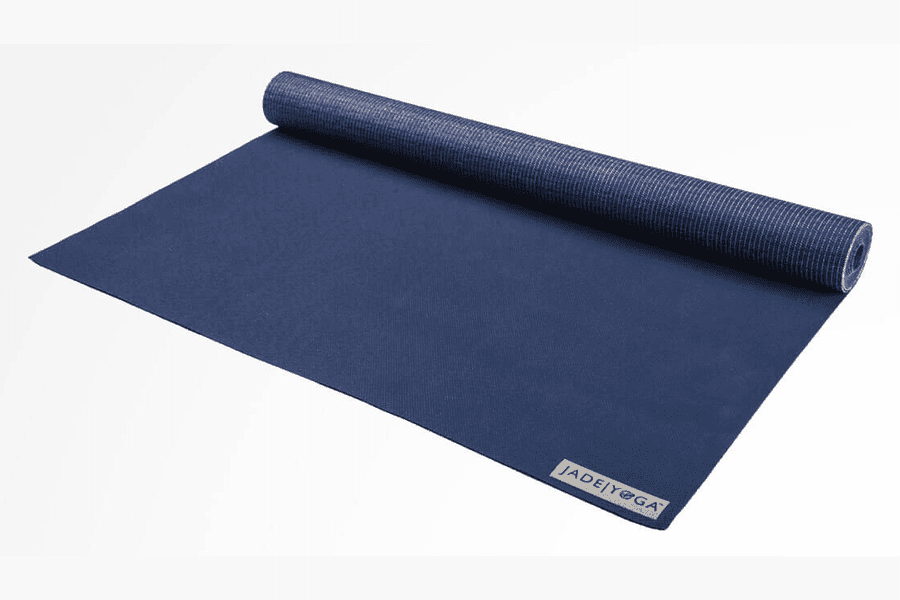
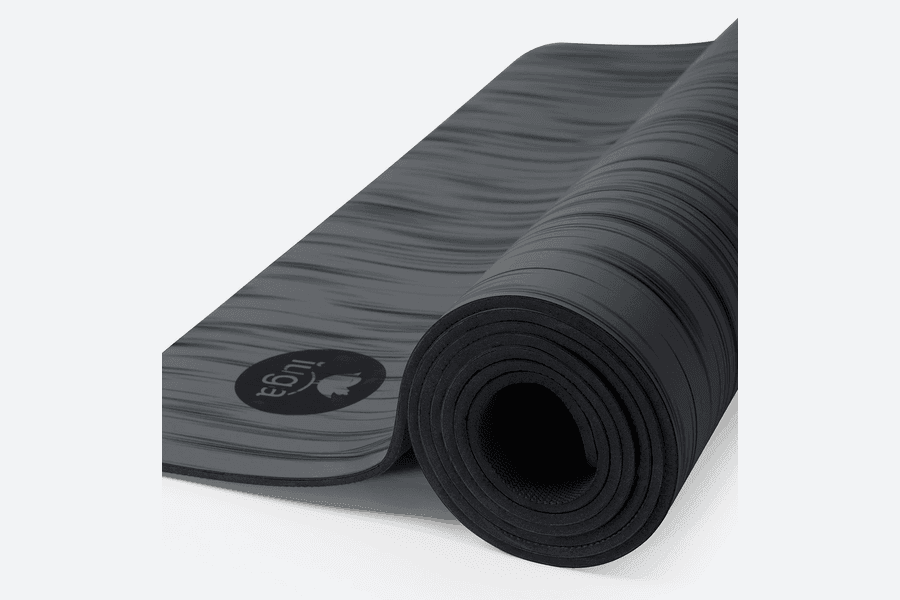
Price
The Voyager lists for about $17 less.
$49.95
List price · check price at jadeyoga.com
$66.99
List price · check price at Amazon
Thickness
The IUGA is 213% thicker.
1.6 mm0.06″
5 mm0.2″
Weight
The Voyager is 0.6 lbs lighter.
1.5 lbs0.68 kg
2.1 lbs0.95 kg
Size
The IUGA is 4″ longer; the IUGA is 2″ wider.
Same on both
- Natural rubber in the build, so neither suits a latex allergy
- Both weigh under 2.5 pounds
- Both absorb moisture and need to dry fully before being put away
- Grippy from the first session with no break-in
Full specs
Dimensions
Materials & build
Buying
Half a pound apart, and one of them is a full mat
These get compared because both are unusually light. The Jade Voyager lists at just over 1.5 pounds and the IUGA at 2.1. OutdoorGearLab weighed them at 1.8 and 2.1, so the real gap is about a third of a pound.
What that third of a pound buys is 3.4 extra millimeters of mat. The Voyager is 1.6 mm of natural rubber that folds flat. The IUGA is 5 mm of polyurethane over rubber that rolls. Both were in GearLab’s 19 mat test, which makes this unusually well documented for a comparison involving a travel mat.
What the testing actually found
The IUGA placed 8th of 19 at 75 of 100 and took GearLab’s Best Value Upgrade award: 8 of 10 for dry grip, 7 for wet, 8 for comfort and support, 8 for care and cleaning, and 7 for materials. That is a consistent mat with no weak column.
The Voyager placed 18th at 51 of 100, and the shape of its scorecard explains why. Grip was 9 dry and 7 wet, better than the IUGA on the dry number. Comfort and support was 2 of 10, and materials 4. It is not a bad mat. It is a mat with one outstanding column and one that barely registers.
It is worth understanding why the overall numbers diverge so much when the grip numbers are so close. GearLab weights comfort and support at 35 percent of the total, grip at 30, materials at 20, and ease of use at 15. A mat that scores 2 on the heaviest category cannot finish high no matter what else it does, which is precisely the Voyager’s situation.
Grip: the Voyager edges it dry, the IUGA holds up longer
Jade’s open-cell rubber is tacky the instant you unfold it, with nothing to break in. That is worth a point over the IUGA’s 8 of 10 dry, and it is why the Voyager keeps turning up in grip conversations well above its price.
Wet, they tie at 7, but the mechanisms age differently over a class. The Voyager holds moisture in the rubber, so past a certain point the surface itself is wet and the next drop has nowhere to go. The IUGA’s polyurethane keeps moving sweat down out of the contact area. Forty minutes into a warm class, that difference shows up even though the ratings match.
Cushion: 8 of 10 against 2 of 10
GearLab scored the IUGA 8 of 10 for comfort and support, which is strong for a 5 mm mat and better than several thicker ones in the same field. Its natural rubber base gives without collapsing, so kneeling and forearm work on a hard floor are unremarkable.
The Voyager scored 2. On hardwood or tile you feel the floor immediately and every pose with a bone against the ground wants a blanket underneath. On carpet, or laid over a studio’s rental mats, that stops mattering entirely, which is exactly the use case Jade built it for.
Size
The IUGA is 72 by 26 inches. The Voyager is 68 by 24. Four inches of length and two of width, and both differences land on the Voyager’s wrong side.
Travel mats are usually short and narrow, so this is not a criticism so much as a fact of the format. It does mean that if you already find standard mats tight, the Voyager will feel tighter still, and on an unfamiliar floor that is when you notice it most.
The IUGA also comes with an adjustable carry strap, which is not nothing at this price and removes the need to buy one. The Voyager does not need a strap, because it folds rather than rolls. Two different answers to the same problem, and both work.
Packing, the one column the Voyager owns
The Voyager folds rather than rolls, down to roughly the size of a yoga block, so it lies flat along the bottom of a suitcase. No rolled mat does that, regardless of weight, and this is the entire reason the mat exists.
The IUGA rolls into a normal mat roll and comes with an adjustable strap, which makes it easy to carry to a studio and awkward to put inside luggage. If your problem is a walk to class, the IUGA is fine. If your problem is a carry-on, only one of these solves it.
Sweat and hot yoga
IUGA sells its mat explicitly for hot yoga and the design backs that up: the polyurethane top is there to pull moisture off the surface. Combined with 5 mm of cushion for a long heated class, it is the obvious pick of the two for a hot room.
The Voyager absorbs too and its 7 of 10 wet rating is respectable, but 1.6 mm in a 105 degree room is uncomfortable and damp open-cell rubber folded into a bag will start to smell. Both mats need to dry fully before being put away; on the Voyager that is a trip-planning problem rather than a habit.
One workaround owners use for the Voyager on the road: hang it over a towel rail overnight rather than folding it damp, and pack it last. It dries quickly for a rubber mat precisely because there is so little of it. That does not fix the comfort gap, but it takes the odor risk off the table.
Durability and coverage
The Voyager is thin natural rubber. It loses tack slowly, creases permanently along its fold lines, and can tear at the edges if it snags. Jade’s one year warranty applies, with sun damage and harsh cleaners carved out, and a tree goes in the ground for every mat the brand sells.
The IUGA’s polyurethane top is the same material that scuffs and stains on mats costing three times as much, and surface wear is its usual complaint rather than the mat coming apart. IUGA gives 45 day returns and no warranty. Neither of these is a mat you plan to keep for a decade.
Price and where to buy
Call it $17 between them, $49.95 to $66.99. IUGA sells direct and through Amazon, where colorway pricing moves around, so check the current IUGA price at Amazon before paying list. Jade does not run an Amazon storefront for the Voyager, so it comes from jadeyoga.com or a yoga retailer at a price that rarely changes.
For $17 more the IUGA gives you a mat that outscored several $150 competitors, with a strap in the box. That is the better spend for anyone who is not specifically buying a folding mat.
Bottom line
Buy the IUGA unless you specifically need something that folds. It is bigger, far more comfortable, built for sweat, comes with a strap, and weighs only a third of a pound more. GearLab put it ahead of mats at twice the price and we would too.
Buy the Voyager if the actual problem is luggage and you already own a mat at home. Its dry grip beats the IUGA’s and it packs like nothing else, and those two things are worth $49.95 on their own. If you want the same rubber with real thickness, our Jade Level One vs Voyager comparison is the one to read.
Jade Voyager
List price $49.95
Frequently Asked Questions
- Is half a pound really the only weight difference?
- Close to it. GearLab measured the Voyager at 1.8 pounds and the IUGA at 2.1, exactly matching IUGA's own claim, so the real gap is about a third of a pound. That is the striking part of this comparison: the IUGA is one of the lightest full-thickness mats made, so it costs you almost nothing in weight to get 5 mm instead of 1.6. Where the Voyager still wins is bulk, because it folds flat and the IUGA rolls.
- Which is better for hot yoga?
- The IUGA, which is what it was designed for. Its polyurethane top pulls sweat down away from your hands and GearLab rated its wet grip 7 of 10. The Voyager's open-cell rubber also absorbs and scored the same 7, but a 1.6 mm mat is uncomfortable through a long heated class, and rubber that thin holds odor if it gets folded away damp. For a heated practice the IUGA is the obvious pick.
- Can the Voyager work as a primary mat?
- Only on carpet, or laid over a studio's rental mats. GearLab's 2 of 10 for comfort and support is an honest number: on hardwood or tile you feel the floor immediately, and kneeling poses need a blanket under the contact point. Jade built and markets it as a travel mat. Its bad reviews come almost entirely from people who bought it expecting it to replace a full mat.
- Which packs better?
- The Voyager, and it is not close on bulk even though the weights are similar. It folds rather than rolls, down to roughly the size of a yoga block, so it lies flat along the bottom of a suitcase. The IUGA rolls into a normal mat roll and comes with an adjustable strap, which makes it easy to carry to a studio but not easy to put inside luggage.
- Which lasts longer?
- Different weak spots, similar horizons. The Voyager is thin natural rubber: it loses tack slowly, creases permanently along its fold lines, and can tear at the edges. Jade covers it for one year and excludes sun damage and harsh cleaners. The IUGA's polyurethane top is the same material that scuffs and stains on much more expensive mats, and IUGA gives 45 day returns with no warranty. Neither is a mat you keep for a decade.
- Which is better value?
- The IUGA, for anyone who does not specifically need a folding mat. At $66.99 it is a mat GearLab ranked above several $150 competitors, with a strap included. The Voyager at $49.95 is fairly priced for what it is, but what it is happens to be a supplement to another mat. Comparing them on value only makes sense if you are choosing your single mat, and then it is not really a contest.
Related comparisons
- Manduka Begin vs IUGA Eco Friendly Non Slip PU
- Manduka eKO Superlite vs JadeYoga Voyager
- Manduka X vs IUGA Eco Friendly Non Slip PU
- Manduka eKO Superlite Long vs JadeYoga Voyager
- Gaiam Performance Dry-Grip 5mm vs IUGA Eco Friendly Non Slip PU
- IUGA Eco Friendly Non Slip PU vs Hugger Mugger Earth Elements 5mm
- JadeYoga Level One vs IUGA Eco Friendly Non Slip PU
- IUGA Eco Friendly Non Slip PU vs Gaiam Performance Dry-Grip Long & Wide
- 42 Birds The Robin vs IUGA Eco Friendly Non Slip PU