Gaiam Premium Reversible vs Gaiam Classic Print: Which One Should You Buy?
Gaiam makes both of these from the same latex-free PVC in the same 68 by 24 inch size, with the same lifetime guarantee. The Classic Print is 4 mm with one printed face at $24.98. The Premium Reversible is sold as 6 mm with a different print on each side at $39.98, and it is the one GearLab tested. You are deciding whether a second design and a little more foam are worth $15.
As an Amazon Associate, we earn from qualifying purchases made through links on this page. How this works
The quick answer
These are two takes on Gaiam's printed PVC mat. The Reversible gives you a pattern on both faces and 2 mm more foam, but GearLab still listed poor cushion among its flaws and gave it 54 points overall. The Classic Print is $15 cheaper, 1.2 pounds lighter and slightly steadier underfoot, with a similar surface that slips once you sweat.
Get the Classic Print unless you specifically want two designs to flip between. If more padding is the goal, skip both and buy the plain Gaiam Premium 6mm at $29.98, which scored 62 and won GearLab's Best First Yoga Mat title.
Get the Gaiam Premium Reversible if...
- You want a different pattern on each side to switch between
- You'd like a second practice surface for when one face wears
- You want a little more cushion than 4 mm
- You find a print on sale near the Classic Print's price
Get the Gaiam Classic Print if...
- One printed design is all you need
- You'd rather keep $15
- You carry your mat and want 2.1 pounds instead of 3.3
- Standing balance matters more to you than padding
Side by side
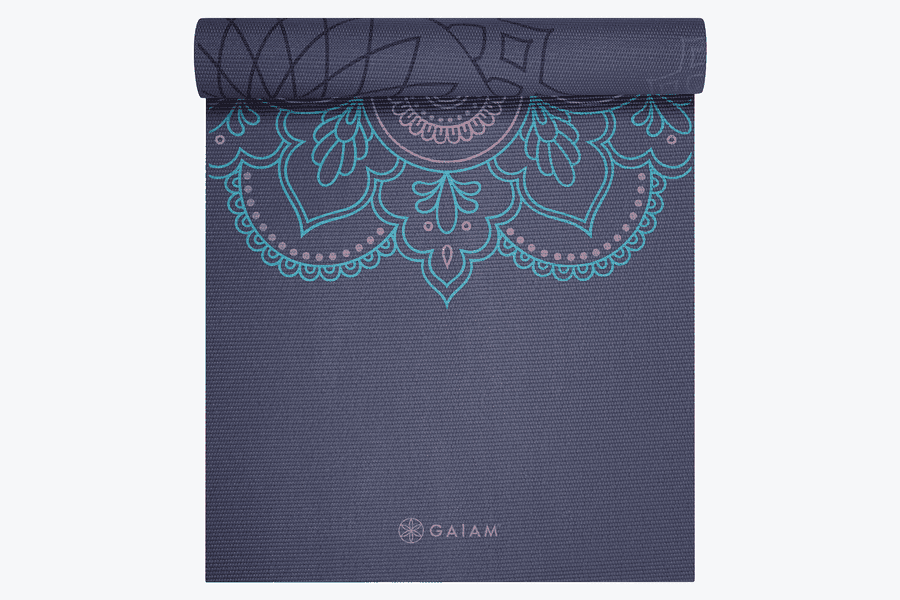
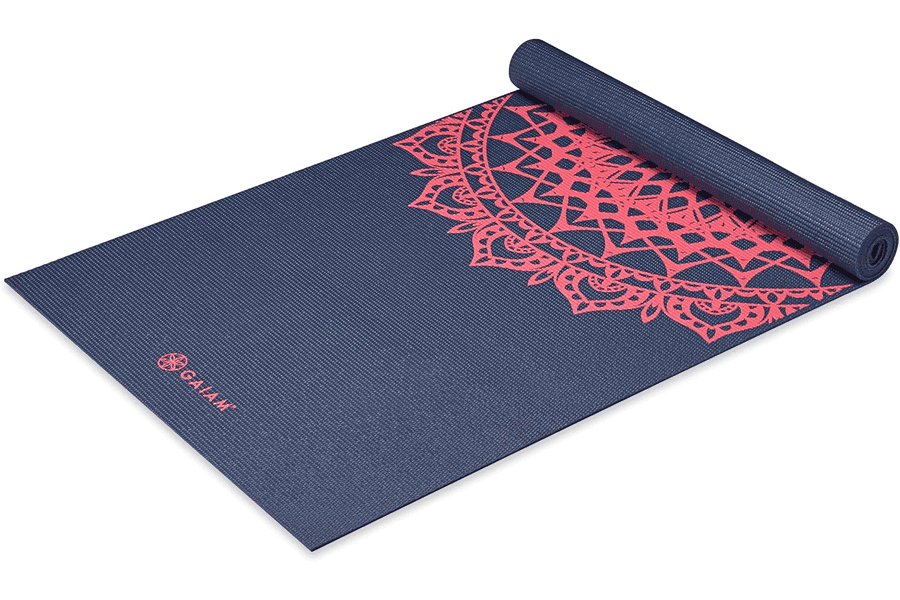
Price
The Classic Print lists for about $15 less.
$39.98
List price · check price at Amazon
$24.98
List price · check price at Amazon
Thickness
The Gaiam Reversible is 50% thicker.
6 mm0.24″
4 mm0.16″
Weight
The Classic Print is 1.2 lbs lighter.
3.3 lbs1.5 kg
2.1 lbs0.95 kg
Size
Same length; same width.
Same on both
- 68″ × 24″ footprint
- Latex-free PVC
- Gaiam lifetime guarantee
- Printed sticky surface
- Same airing-out and sun warnings from Gaiam
Full specs
Dimensions
Materials & build
Buying
Fifteen dollars for a second print
Gaiam makes both of these from latex-free PVC in the same 68″ × 24″ size, and both carry its lifetime guarantee. The Classic Print is 4 mm thick with one printed face at $24.98. The Premium Reversible is sold as 6 mm with a different print on each side at $39.98.
So the extra $15 pays for 2 mm more foam and a second design. The foam does less than you might hope, and the second print only matters if you will actually flip the mat. A third Gaiam sits between them on price, and it changes the answer for a lot of readers.
The Reversible scored 54 out of 100
GearLab included the Premium Reversible in its 19 mat roundup and ranked it 15th. Its best sub-score was a 7 for how easily it cleans. Comfort and support got a 6, grip a 5 both dry and wet, and materials a 5. The testers liked the patterns and the way it rolls out flat, and listed poor cushion, slipping when wet and prints that can stain clothing as its flaws.
The Classic Print wasn’t in the test, and we won’t hand it the Reversible’s numbers. The two share a material and a surface, so the grip results are the best guide available for both. The cushion result points the other way: if GearLab found the Reversible short on padding, the Classic Print has less foam still.
The extra foam on the Reversible
On paper the Reversible has half again as much foam, 6 mm against 4. Soft PVC compresses a long way under a knee, though, so the extra depth is used up quickly. GearLab still listed poor cushion among the Reversible’s flaws and gave it 6 for comfort, half a point under the plain Gaiam Premium 6mm, which Gaiam sells at the same stated thickness.
One oddity if you read GearLab’s spec table: it lists the Reversible at 5 mm rather than 6, without saying whether that figure was measured. We go by Gaiam’s 6 mm. Nobody has published a test of the Classic Print, so its 4 mm is Gaiam’s number too.
Either way, 2 mm of soft PVC is noticeable under a knee on tile, but it doesn’t turn a thin mat into a thick one. If extra cushion is the main reason you are looking at the Reversible, the plain Premium 6mm further down is the cheaper way to get it.
Kneeling and floor work on each
Both are soft PVC, so both compress under a kneecap and both reach the floor during long holds on hardwood. The Reversible just gets there a little later. For a gentle home practice on carpet or a rug, either will do. Over tile, both benefit from a blanket doubled up under the knees, the Classic Print more so.
The Reversible’s comfort score of 6 sits below the Gaiam Premium 6mm at 6.5 and well below the perfect 10s GearLab gave its most cushioned mats. If your joints are the priority, neither mat here is a strong answer.
Standing poses on soft PVC
Less foam underfoot means less to sink into, so the Classic Print moves less in a one-legged balance and your ankle does less correcting. The Reversible’s extra 2 mm adds a little give, not a lot.
Neither is a firm mat, and if balancing takes up most of your practice, a dense rubber mat does that job far better than any soft Gaiam. Between these two, the Classic Print has a slight edge for standing sequences.
One printed face or two
The Reversible does what the name says. Each side carries a different design, Gaiam lists about ten combinations at last count, and you can turn the mat over whenever you tire of one. Both faces are practice surfaces, so you also get a fresh top if one side gets scuffed.
The Classic Print has one printed top over a plain textured underside. Gaiam swaps those designs in and out, so the one you want could disappear from the lineup. If one pattern you like is all you need, it gets you there for $15 less.
About that clothing stain note from GearLab: it was recorded for the Reversible, but the Classic Print is also printed PVC, so we would assume the same risk until you know how your mat’s ink behaves. Dark clothes for the first few sessions are the easy precaution.
Grip: fine for a cool room, not for sweat
GearLab’s dry grip score of 5 for the Reversible was one of the lowest in the test, with only two mats scoring worse. The Classic Print uses a similar textured sticky finish, so expect similar behavior: enough traction for a beginner class with dry hands, not enough once you sweat.
PVC doesn’t absorb moisture, so sweat stays on the surface. If your practice runs warm, neither Gaiam will fix that, and our IUGA vs Classic Print comparison covers a sweat-absorbing polyurethane top for about $67.
Weight, smell and sun
The Classic Print weighs 2.1 pounds and the Reversible 3.3. Neither is heavy, but the Classic Print is the one to choose if the mat rides to class on your shoulder or goes in a suitcase. Gaiam’s own product pages don’t list a strap for either, though Amazon’s listing titles now mention one, so check the listing you order from.
Gaiam prints identical care notes for both. Expect a strong smell when you unwrap either one, and leave it spread out to air for two or three days before you use it. Spot clean with cold water and a mild soap, and store it away from windows, since Gaiam says long sun exposure fades these mats and leaves them brittle. The lifetime guarantee covers defects on both, not foam that packs down with use.
Price, the Premium in between and where to buy
Individual prints on both listings often sell below list, and a discounted Reversible design can close most of the gap. Check the Premium Reversible at Amazon and the Classic Print at Amazon before deciding.
Then look at the plain Gaiam Premium 6mm at $29.98. It is the same family of sticky PVC at the same stated 6 mm, and it scored 62 in the same test, eight points above the Reversible, winning the Best First Yoga Mat title. If you want more cushion and don’t need two prints, it beats both mats here. Our Premium vs Classic Print and Premium vs Premium Reversible pages go into the details.
Bottom line
Buy the Classic Print if you want a printed Gaiam and one design is enough. It is $15 cheaper, more than a pound lighter and a little steadier in standing poses, and 2 mm of soft PVC is not much cushion to give up.
Buy the Premium Reversible if you want two patterns to switch between, or a sale brings it near the Classic Print’s price. And if you mainly want a softer mat, skip both and get the plain Premium 6mm, the Gaiam that GearLab recommends to beginners.
Gaiam Premium Reversible 6mm
List price $39.98
Gaiam Classic Print 4mm
List price $24.98
Frequently Asked Questions
- How much thicker is the Premium Reversible?
- Gaiam sells it as 6 mm against 4 mm for the Classic Print, so on paper it has half again as much foam. Soft PVC compresses a long way under a knee, though, and GearLab still listed poor cushion as one of the Reversible's drawbacks. GearLab's spec table also lists the Reversible at 5 mm without saying whether that was measured, so we go by Gaiam's figures. If padding is the main goal, the plain Gaiam Premium 6mm is the better Gaiam.
- Did GearLab test the Gaiam Classic Print?
- No. GearLab's 19 mat roundup, updated in March 2026, includes the Gaiam Premium Reversible, which finished 15th with 54 points, and the Gaiam Premium 6mm, which earned 62 points and the Best First Yoga Mat title. There was no Classic Print in the lineup, so any lab scores you see attributed to it are borrowed from another Gaiam mat.
- Can you practice on both sides of the Premium Reversible?
- Yes. Each face has a different printed design and both are practice surfaces, so you can flip the mat for a change of look or to use a fresh side if one gets scuffed. The Classic Print has one printed top and a plain textured underside meant to face the floor.
- Do Gaiam printed mats stain clothes?
- They can. GearLab listed prints that can stain clothing as one of the Premium Reversible's drawbacks. The Classic Print is also printed PVC, so it is sensible to assume the same risk until you know how your mat behaves. Wearing dark clothes for the first few sessions is an easy precaution.
- Which one is better for bad knees?
- The Premium Reversible, slightly. It has 2 mm more foam, though GearLab's testers still listed poor cushion as a drawback. The 4 mm Classic Print reaches the floor sooner in kneeling poses. Neither is a strong choice for sensitive knees on a hard floor; within Gaiam's line, the plain Premium 6mm, which scored higher for comfort in the same test, is the better pick.
- Are Gaiam mats good for hot yoga?
- No. Neither mat's PVC absorbs sweat. GearLab gave the Premium Reversible a 5 for grip whether dry or wet and listed slippery when wet as a con, and the Classic Print uses a similar sticky finish. A towel on top helps, but for heated classes a mat with an absorbent polyurethane top or a natural rubber mat is the better choice.
Related comparisons
- Gaiam Premium Reversible 6mm vs Gruper TPE 6mm
- Amazon Basics 1/4 Inch Thick TPE vs Gaiam Premium Reversible 6mm
- Amazon Basics 1/4 Inch Thick TPE vs Gaiam Classic Print 4mm
- Gaiam Premium Reversible 6mm vs YogaAccessories Extra Thick Deluxe 1/4"
- Gruper TPE 6mm vs Gaiam Classic Print 4mm
- YogaAccessories Extra Thick Deluxe 1/4" vs Gaiam Classic Print 4mm
- Manduka Begin vs Gaiam Premium Reversible 6mm
- IUGA Eco Friendly Non Slip PU vs Gaiam Premium Reversible 6mm
- Manduka X vs Gaiam Premium Reversible 6mm