IUGA PU Mat vs Gaiam Classic Print: Which One Should You Buy?
The IUGA and the Gaiam Classic Print weigh exactly the same, 2.1 pounds, and have little else in common. The IUGA is a bigger, thicker polyurethane-over-rubber mat that GearLab ranked eighth of 19. The Classic Print is thin printed PVC at a little over a third of the price, and GearLab hasn't tested it. Grip with damp hands is the biggest difference.
As an Amazon Associate, we earn from qualifying purchases made through links on this page. How this works
The quick answer
The IUGA gives you about 15% more mat for the same weight, a sweat-absorbing polyurethane top that GearLab scored 8 dry and 7 wet, and cushion GearLab rated 8 out of 10 for comfort. It costs about $42 more, has no warranty and sits on natural rubber. The Classic Print is thin, latex-free PVC with a lifetime guarantee, fine with dry hands in a gentle class and slippery once you sweat.
If you practice regularly or your hands sweat, buy the IUGA. If you're just starting out, practice gently, need a latex-free mat or mostly want a print you like, the Classic Print is a sensible first mat at $24.98.
Get the IUGA PU Mat if...
- Your palms sweat and you want grip that holds when damp
- You're taller than about five foot eight or like a wide stance
- Kneeling on a thin mat bothers your knees
- You practice most weeks and can live without a warranty
Get the Gaiam Classic Print if...
- You're new to yoga and want to spend about $25
- You need a latex-free mat
- You want a printed design rather than a solid color
- You want a lifetime guarantee on a budget mat
Side by side
Price
The Classic Print lists for about $42 less.
$66.99
List price · check price at Amazon
$24.98
List price · check price at Amazon
Thickness
The IUGA is 25% thicker.
5 mm0.2″
4 mm0.16″
Weight
Identical weight.
2.1 lbs0.95 kg
2.1 lbs0.95 kg
Size
The IUGA is 4″ longer; the IUGA is 2″ wider.
Same on both
- Both weigh 2.1 pounds
- A strong smell out of the box that needs airing
- Hold fine with dry hands in a gentle class
- Clean with a damp cloth
Full specs
Dimensions
Materials & build
Buying
Both weigh 2.1 pounds
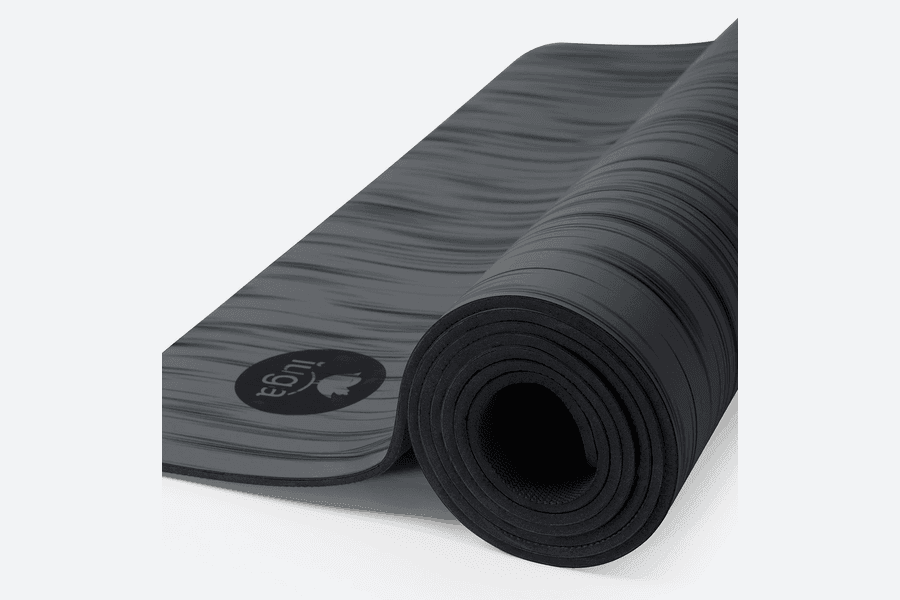
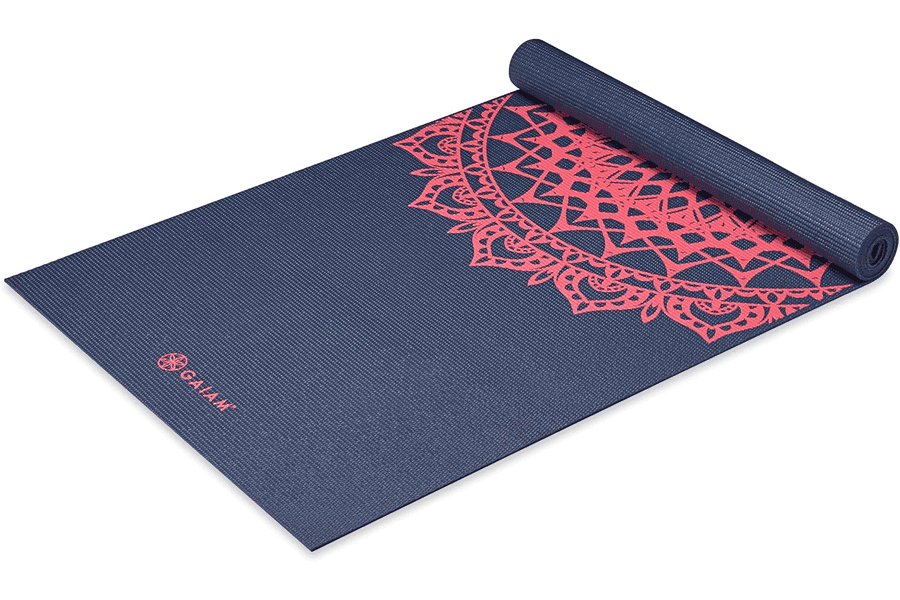
The IUGA and the Gaiam Classic Print weigh exactly the same, each coming in at 2.1 pounds. Past that, they have little in common. IUGA builds a 72″ × 26″ × 5 mm mat from polyurethane over natural rubber. Gaiam’s Classic Print is 68″ × 24″ × 4 mm of printed PVC.
List prices are $66.99 for the IUGA and $24.98 for the Classic Print, a gap of about $42, so the IUGA costs a bit over two and a half times as much. Two questions sort out whether that premium makes sense for you: how often you practice, and whether your palms sweat.
The same weight buys a lot more mat
For the same carrying weight, the IUGA adds four inches of length and two of width, about 15% more surface area. People taller than roughly five foot eight will find the Classic Print too short to lie on without something hanging off, and its 24 inch width gets tight in wide stances.
Neither is a chore to carry. GearLab singled the IUGA out as especially light for a standard-size mat, and it comes with an adjustable strap. The Classic Print matches it ounce for ounce, so what changes is how much mat you get to unroll.
Four millimeters is thin
Four millimeters has one advantage. Thin PVC gives less underfoot than the thicker foam of Gaiam’s 6 mm mats, so your standing foot stays level instead of sinking. The cost lands on your knees, which will feel a hard floor through it.
The IUGA is just one millimeter thicker, yet GearLab gave it 8 of 10 for comfort and support, saying it protects knees on hard floors without going soft in balance poses. If your knees already complain on your current mat, the Classic Print will not fix that. The IUGA might.
Damp hands are the dividing line
Sweat soaks into the IUGA’s PU surface rather than pooling on it, which is most of the reason to buy a polyurethane mat. GearLab rated it 8 of 10 dry and 7 wet and found it keeps its grip even when wet.
Gaiam says the Classic Print is textured for non-slip performance, and in a slow class with dry palms the texture works. PVC holds no moisture, though, so as soon as your hands get damp there is a film of sweat between skin and mat and traction falls away. If down dog makes you sweat, this is the section that matters.
What testing can and cannot tell you
GearLab tested the IUGA but not the Classic Print. In its March 2026 roundup the IUGA placed eighth out of 19 with a 75 and won Best Value Upgrade.
The closest Gaiam in that test is the Premium 6mm, a thicker mat with a similar sticky PVC surface. Use its results as a proxy only: 6 of 10 dry, 4 wet, 62 overall, and the Best First Yoga Mat award. Being 2 mm thicker and softer, the Premium tells you nothing about how comfortable the Classic Print is. Its wet grip score is the relevant part, since that reflects the surface.
Air out either one first
Gaiam warns that printed mats like this one give off a strong smell out of the wrapper, harmless by its account, and asks you to leave it open for two or three days first. IUGA’s listing says odorless; GearLab’s testers disagreed and put an initial strong smell in the cons column. Give the IUGA a few days of airing out too, somewhere with open windows.
Routine care is easy with either. Gaiam suggests cleaning spots with mild detergent and cold water on a damp cloth and letting the mat dry flat. GearLab found the IUGA quick to wipe clean but slow to dry, worth knowing if you tend to roll up right after a sweaty session.
Phthalates, latex and the SGS claim
Gaiam makes the Classic Print from latex-free PVC without the six most harmful phthalates, so it is the one to choose for a latex allergy. The IUGA’s underside is natural rubber, a possible allergy trigger even though you practice on the other side.
The eco-friendly and SGS certified labels on the IUGA come from IUGA itself. Neither brand says where its mat is manufactured. If you want to avoid PVC, the IUGA is the only one of the two that does.
Lifespan and who pays when it fails
GearLab’s cons for the IUGA include a short lifespan, and its review mentions durability concerns after a few years. PU tops also stain and show wear. IUGA offers no warranty. You get 45 days to send it back, and the return postage is yours to pay.
Gaiam backs the Classic Print with a lifetime guarantee. Read that as protection against a faulty mat; we would not expect it to cover a surface worn down by years of practice. Gaiam also cautions that too much sun can leave the mat faded and brittle. Natural rubber does not like UV either, so store both indoors.
Prices and listings
See today’s prices for the IUGA on Amazon and the Gaiam Classic Print on Amazon. There the Classic Print averages 4.5 stars over roughly 12,600 ratings and the IUGA 4.4 over roughly 2,900. Gaiam changes the Classic Print designs from time to time, so a pattern you see now may be gone later, while IUGA offers five colorways at last count.
For Gaiam prints on a thicker mat, our Premium Reversible vs Classic Print page covers that step, and IUGA vs Premium Reversible pits the IUGA against the printed Gaiam that GearLab actually tested.
Bottom line
Go with the IUGA if you practice most weeks, sweat through class, or need more than 68 inches of length. It gives you a bigger mat at the same weight, much better grip once your hands are damp and more knee protection, and it costs about $42 more with no warranty.
Go with the Gaiam Classic Print if you are just starting, keep things gentle, care about the print, or must avoid latex. It is thin and slippery once sweat arrives, but for $24.98 with a lifetime guarantee it makes a reasonable first mat.
Gaiam Classic Print 4mm
List price $24.98
Frequently Asked Questions
- Is the IUGA mat worth the extra money over the Gaiam Classic Print?
- If you sweat or practice regularly, yes. GearLab scored the IUGA 8 out of 10 for dry grip and 7 for wet and gave it its Best Value Upgrade award. GearLab hasn't tested the Classic Print, but the Gaiam Premium 6mm, which has a similar sticky PVC surface, scored 6 dry and 4 wet. The IUGA is also bigger at the same 2.1 pounds. It costs about $42 more and has no warranty, so for gentle, occasional practice the Classic Print is enough.
- Is the Gaiam Classic Print good for hot yoga?
- No. It's PVC, which doesn't absorb sweat, so grip drops once your hands get damp. GearLab hasn't tested the Classic Print; the closest Gaiam it did test, the Premium 6mm, scored 4 out of 10 for wet grip. The IUGA's polyurethane top absorbs sweat and GearLab found it stays grippy wet, though it's slow to dry, so let it air out after a sweaty class.
- Does the IUGA mat smell?
- IUGA markets it as odorless, but GearLab listed a strong smell at first among its cons, so plan on airing it out for a few days. Gaiam is upfront that its printed mats release a strong but harmless odor when unwrapped and asks you to unroll the Classic Print for two to three days before use.
- Is 4 mm thick enough for a yoga mat?
- For standing work it's fine, and thin PVC stays firmer underfoot than thicker soft foam. For kneeling on a hard floor, 4 mm is thin and you'll feel the floor. The IUGA is only 1 mm thicker, but GearLab rated its comfort and support 8 out of 10 and said it protects knees on hard floors.
- Which is better for a latex allergy, the IUGA or the Gaiam Classic Print?
- The Gaiam Classic Print. It's latex-free PVC made without the six most harmful phthalates. The IUGA has a natural rubber base, which can carry the proteins that trigger latex allergies, so it isn't a safe choice even though you practice on the polyurethane side.
- How long do the IUGA and Gaiam Classic Print last?
- GearLab lists a short lifespan among the IUGA's cons and mentions durability concerns after a few years, and IUGA offers no warranty, only a 45-day return window with return shipping paid by you. Gaiam covers the Classic Print with a lifetime guarantee, which we'd read as protection against defects rather than normal wear. Keep either out of direct sun; Gaiam warns the Classic Print may fade and become brittle.
Related comparisons
- Manduka Begin vs IUGA Eco Friendly Non Slip PU
- Manduka X vs IUGA Eco Friendly Non Slip PU
- Gaiam Performance Dry-Grip 5mm vs IUGA Eco Friendly Non Slip PU
- IUGA Eco Friendly Non Slip PU vs Hugger Mugger Earth Elements 5mm
- JadeYoga Level One vs IUGA Eco Friendly Non Slip PU
- Amazon Basics 1/4 Inch Thick TPE vs Gaiam Classic Print 4mm
- IUGA Eco Friendly Non Slip PU vs Gaiam Performance Dry-Grip Long & Wide
- Gruper TPE 6mm vs Gaiam Classic Print 4mm
- 42 Birds The Robin vs IUGA Eco Friendly Non Slip PU