Manduka Begin vs Gaiam Premium Reversible: Which One Should You Buy?
Two beginner mats, $22 apart, both 24 inches wide and both usable on either side. The Gaiam Premium Reversible is thicker, cheaper, printed on both faces, and covered for life. The Manduka Begin is thinner, lighter, and has a stripe down the middle to line yourself up against. On a spec sheet the cheaper mat looks like the better deal. On a floor it is more complicated.
As an Amazon Associate, we earn from qualifying purchases made through links on this page. How this works
The quick answer
The Gaiam wins on price, thickness, and looks. It is 6 mm to the Begin's 5, costs $22 less, comes in ten printed designs, and carries a lifetime guarantee. What it does not do is grip: OutdoorGearLab rated it 5 of 10 dry and 5 wet, near the bottom of their 19 mat lineup, and scored its comfort 6 of 10 despite the extra millimeter, because soft PVC foam compresses under a knee. The Begin is firmer TPE, nearly a pound lighter at 2.5 pounds, and has the alignment stripe, which is the best teaching feature on any mat at this price.
Buy the Gaiam if budget is the constraint and your practice is gentle. Buy the Begin if you want the alignment help and a firmer, lighter mat.
Get the Manduka Begin if...
- You want the center alignment stripe to check your positioning against
- You want the lighter mat, 2.5 pounds against 3.3
- You want firmer support rather than soft foam that bottoms out
- You want a surface that will not flake where your hands land
Get the Gaiam Reversible if...
- You want to spend about $22 less
- You want the extra millimeter, 6 mm against 5
- You want a printed design, with a different one on the back
- Gaiam's lifetime guarantee appeals to you more than 30 day returns
Side by side
Price
The Gaiam Reversible lists for about $22 less.
$62
List price · check price at Amazon
$39.98
List price · check price at Amazon
Thickness
The Gaiam Reversible is 20% thicker.
5 mm0.2″
6 mm0.24″
Weight
The Begin is 0.8 lbs lighter.
2.5 lbs1.1 kg
3.3 lbs1.5 kg
Size
Same length; same width.
Same on both
- Both are 68 by 24 inches, at the small end of standard
- Both are usable on either face
- Neither absorbs sweat; both wipe clean
- Neither is a hot yoga mat
Full specs
Dimensions
Materials & build
Buying
Two starter mats, $22 apart
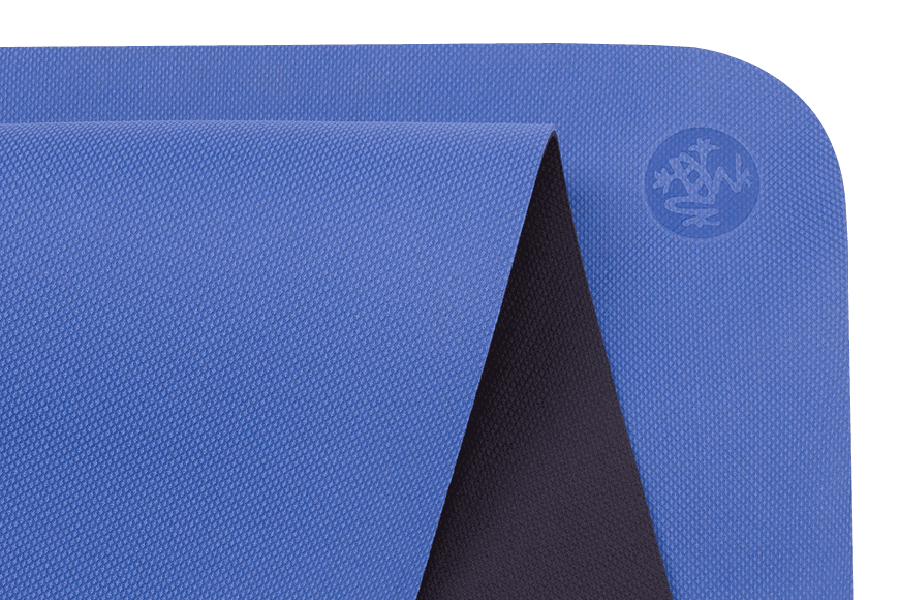
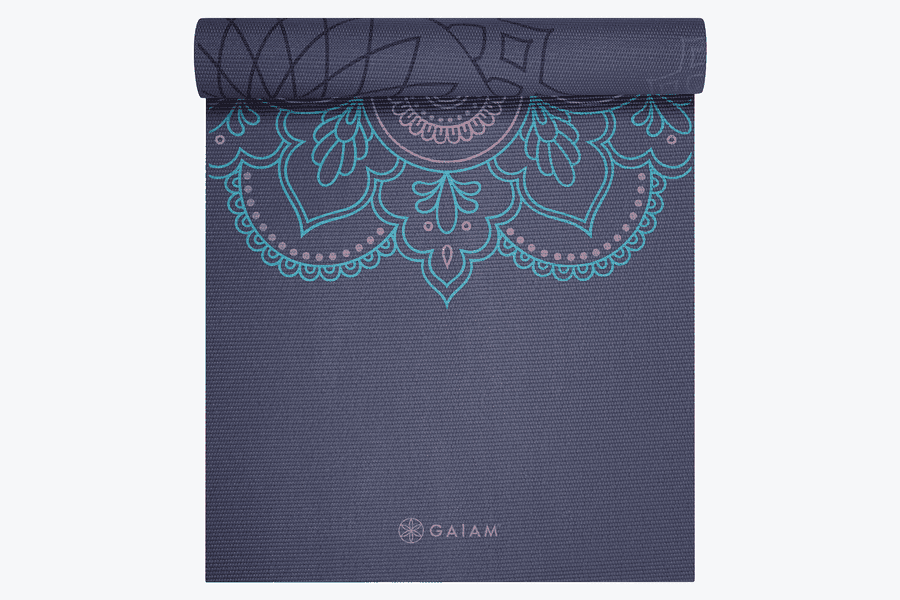
The Gaiam Premium Reversible is 6 mm of printed PVC at $39.98, with a different design on each face and a lifetime guarantee. The Manduka Begin is 5 mm of TPE at $62, with a stripe down the middle to line yourself up against and a 30 day return window.
Same 68 by 24 inch footprint, both usable on either side, both aimed squarely at people buying their first mat. On paper the cheaper one looks like more mat. Under a knee it usually is not.
Why 6 mm can feel thinner than 5
OutdoorGearLab scored the Gaiam Reversible 6 of 10 for comfort and support despite the extra millimeter, and put it 15th of 19 overall at 54 of 100. Soft PVC foam compresses under a concentrated load, so a kneecap or an elbow presses through to the floor even though the mat measures thicker than most of the field.
The Begin’s TPE is firmer and holds its shape better under a point load. Lying on the Gaiam feels more generous; kneeling on it does not. The easy way to check this yourself in the first week is to kneel on one knee and shift your weight forward. A dense mat keeps its thickness. A soft one collapses and you feel the floor.
Where the Gaiam does win is lying down. For restorative work, savasana, and stretching on your back, spread load across a whole body is exactly what soft foam handles well, and the extra millimeter helps. If most of your practice happens on your back rather than your knees, the ranking above flips.
Grip: neither is strong, one is genuinely weak
GearLab rated the Gaiam Reversible 5 of 10 dry and 5 wet, near the bottom of their lineup. The print is part of it: the reversible version has a smoother finish than the plain Gaiam Premium, which scored higher and took their Best First Yoga Mat award. If you want a cheap Gaiam and grip matters, the plain one is the better buy, and our Gaiam Premium vs Premium Reversible comparison goes through it.
The Begin was not in that test. Its soft-touch TPE holds a steady beginner practice with dry hands, and Manduka says plainly it does not grip like the brand’s premium mats. Both are closed-cell, so sweat sits on the surface on either one. Neither is a hot yoga mat, and the Gaiam is not close.
The stripe against the prints
The Begin’s center stripe is the best teaching feature on any mat at this price. Square your hands to it in down dog, your back heel to it in warrior poses, your spine to it lying down, and you get the symmetry check that otherwise takes a teacher watching you. New practitioners drift off center without knowing.
The Gaiam’s two printed faces are decorative, and that is a legitimate thing to want. Ten designs at last count, and they photograph well. The catch is that the print is also the wear surface, so the areas under hands and feet dull and thin first and the mat looks used before it stops working.
There is a practical wrinkle to a two-sided printed mat as well. Because both faces are meant to be practiced on, both pick up floor grit, so you end up wiping twice as much surface. The Begin has the same reversible design but a plain finish, which hides marks better and is quicker to clean.
Weight and carrying
The Begin is 2.5 pounds by Manduka’s own spec, genuinely light for a 5 mm mat and one of its better arguments. The Gaiam is 3.3 pounds, with GearLab measuring 3.2 on their scale.
Under a pound apart, so neither is a burden, but if you carry a mat to a class by foot or on transit you will notice which is which. Neither comes with a strap.
PVC foam against TPE
The Gaiam is latex-free PVC foam, the material most cheap mats are made of. GearLab scored its materials 5 of 10. It is soft, takes ink well, which is why the prints look good, and holds a dent where you stand.
The Begin is TPE made in Taiwan, closed-cell, and recyclable in principle in a way PVC largely is not. Manduka markets the Begin as its entry point rather than an eco mat, so this is a modest point rather than a decisive one. If natural materials matter to you, neither of these is the right shelf.
Neither brand states where its mat is made in the case of the Gaiam; Manduka names Taiwan for the Begin. That is a small transparency difference rather than a quality claim, but if sourcing matters to you it is one of the few places these two actually differ on paper.
What wears out first
The Gaiam’s failure mode is predictable: the printed top layer thins and flakes where hands and feet land, and the foam takes a permanent compression under the standing spots. Heavy practice gets you a year or two; light practice gets you longer.
The Begin holds up better. Its firmer TPE does not dent the same way and there is no full print layer to wear off, only the stripe, which does fade eventually. Neither mat is a long-term purchase, but at $62 against $39.98, replacing the Gaiam twice costs about what buying the Begin once does.
A lifetime guarantee against 30 days
Gaiam covers the Reversible for life and Manduka covers the Begin for 30 days, and on paper that is not a contest. In practice the guarantee is worth less than it reads: it addresses a mat that fails, not a print that wears thin, which is what actually happens. At $39.98 the mat is cheap enough that replacing it is easier than claiming anyway.
Worth clearing up a common assumption: Manduka’s famous lifetime guarantee belongs to the PRO line, not to everything the brand sells, and the Begin sits outside it. Buying a Manduka does not automatically buy the guarantee.
Price and where to buy
$62 against $39.98, about $22 apart, and both discount on Amazon by design or colorway. Check the current Begin price at Amazon and the current Gaiam Reversible price at Amazon before paying list on either. Manduka has been running the Black Begin colorway well below the others on its own site.
Choice is close: ten colorways on the Begin, ten printed designs on the Gaiam. They just point in different directions, one solid and functional, the other patterned.
Bottom line
Buy the Gaiam Reversible if $40 is the ceiling or you want a mat that looks good in a room and your practice is gentle. It is thick, soft, cheap, and covered for life, and for stretching or a class or two a week at home that is a real answer. Its grip is weak and the surface will show its age.
Buy the Begin if you can stretch to $62 and you want a mat that supports better, weighs less, and gives you the alignment stripe while you are learning. If you would rather have the cheap Gaiam with better grip, our Begin vs Gaiam Premium 6 mm comparison covers the plain version, which scored higher.

Manduka Begin
List price $62
Gaiam Premium Reversible 6mm
List price $39.98
Frequently Asked Questions
- Is the Gaiam's 6 mm actually more cushioned than the Begin's 5 mm?
- Not really, and this trips people up. GearLab scored the Gaiam Reversible 6 of 10 for comfort and support despite the extra millimeter, because soft PVC foam compresses under a concentrated load: a knee or an elbow presses through to the floor even though the mat measures thicker. The Begin's TPE is firmer and holds its shape better under a point load. For lying and stretching the Gaiam feels more generous. For kneeling it does not.
- How much better does the Begin grip?
- Better, though neither is a grip standout. GearLab rated the Gaiam Reversible 5 of 10 dry and 5 wet, and part of that is the print: the reversible version has a smoother finish than the plain Gaiam Premium, which scored higher and took their Best First Yoga Mat award. The Begin was not in that test; its soft-touch TPE holds a steady beginner practice fine with dry hands, and Manduka is upfront that it does not grip like the brand's premium mats.
- Does the alignment stripe matter?
- In your first year, quite a lot. Squaring your hands to it in down dog, your back heel to it in warrior, and your spine to it lying down gives you symmetry feedback that otherwise needs a teacher. New practitioners drift off-center without noticing it. The Gaiam's prints are decorative rather than functional, so there is nothing comparable. Note that the Begin's stripe is printed too, so heavy use will fade it over the years.
- Is Gaiam's lifetime guarantee worth anything?
- Less than the word suggests, but it is not nothing. Gaiam will replace a mat that fails, and at $39.98 the mat is cheap enough that a replacement is a real remedy. What it does not cover is what actually happens: the printed surface thinning and flaking where hands and feet land, which reads as normal use. Manduka gives the Begin 30 days and no more, since its lifetime guarantee applies to the PRO line rather than to everything the brand sells.
- Which one lasts longer?
- The Begin, in most hands. Its TPE is firmer and does not take a permanent dent where you stand the way soft PVC foam does, and there is no print layer to wear off, only a stripe. The Gaiam's failure mode is predictable: the top design thins where you practice and the foam compresses under the standing spots. Heavy practice gets you a year or two out of the Gaiam. At $22 less, replacing it is not a disaster.
- Which is the better first mat?
- The Begin, if you can stretch to $62 and you practice at home. The stripe genuinely helps, the firmer surface supports better, and it is lighter to carry. The Gaiam makes sense if $40 is the ceiling or if you want a mat that looks good in a room. If you want a cheap Gaiam with better grip, the plain Premium 6 mm scored higher than the Reversible and won GearLab's Best First Yoga Mat award.
Related comparisons
- Manduka Begin vs IUGA Eco Friendly Non Slip PU
- Gaiam Premium Reversible 6mm vs Gruper TPE 6mm
- Manduka Begin vs Gaiam Performance Dry-Grip 5mm
- Amazon Basics 1/4 Inch Thick TPE vs Gaiam Premium Reversible 6mm
- Manduka Begin vs Hugger Mugger Earth Elements 5mm
- Gaiam Premium Reversible 6mm vs YogaAccessories Extra Thick Deluxe 1/4"
- Manduka Begin vs JadeYoga Level One
- Manduka Begin vs Gaiam Performance Dry-Grip Long & Wide
- Manduka Begin vs 42 Birds The Robin