Gaiam Performance Dry-Grip vs B Mat Everyday 4mm: Which One Should You Buy?
The name on the Gaiam suggests it solves the sweat problem, and the test results say otherwise. The Performance Dry-Grip is a $69.98 PVC mat with a moisture-wicking topcoat, 68 by 24 inches. The B Mat Everyday is $118 of dense rubber, 71 by 26, and it is one of the grippiest surfaces anyone makes. The $48 between them mostly buys traction you can rely on.
As an Amazon Associate, we earn from qualifying purchases made through links on this page. How this works
The quick answer
The B Mat Everyday is the better mat and the gap is largest exactly where the Gaiam claims to be strong. GearLab tested the 4 mm B Mat, rated it 9 out of 10 for grip and called it among the grippiest it had used wet or dry, while the Dry-Grip scored 6.5 dry and 3.5 wet. The B Mat is also bigger, certified to OEKO-TEX Standard 100, and made in Spain.
The Dry-Grip is worth considering for a dry, unheated practice where the topcoat is enough and $48 matters. It is comfortable, it has a lifetime guarantee, and it is easy to live with. Buy it knowing the name overpromises: this is a mat for a cool room, not a sweaty one.
Get the Gaiam Dry-Grip if...
- You practice in a cool room and never really sweat
- You want a lifetime guarantee at under $70
- You have a latex allergy that rules rubber out
- You'd rather keep the $48
Get the B Mat Everyday if...
- Grip is the thing that keeps failing you
- You want 71 by 26 inches instead of 68 by 24
- You want rubber rather than PVC
- You want a mat with an OEKO-TEX certificate behind it
Side by side
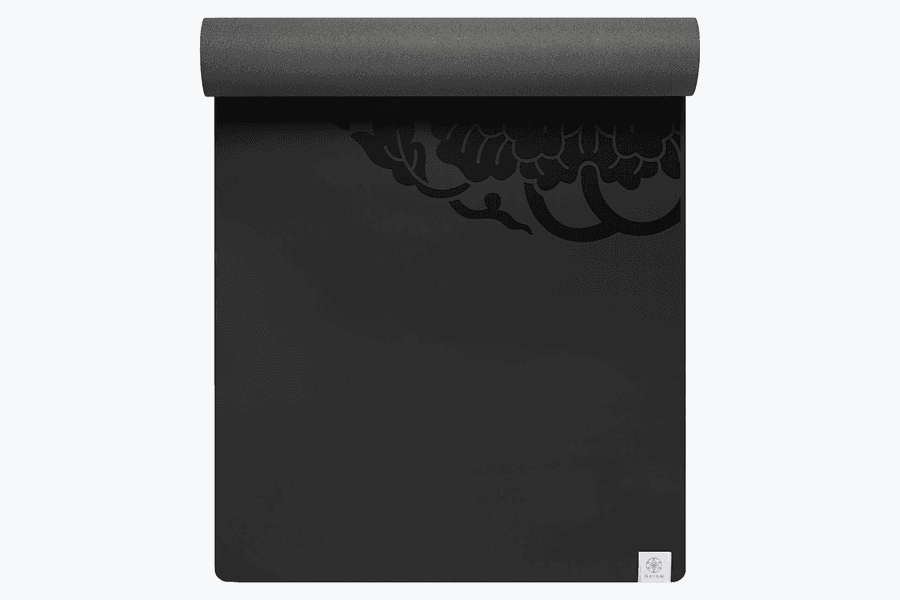
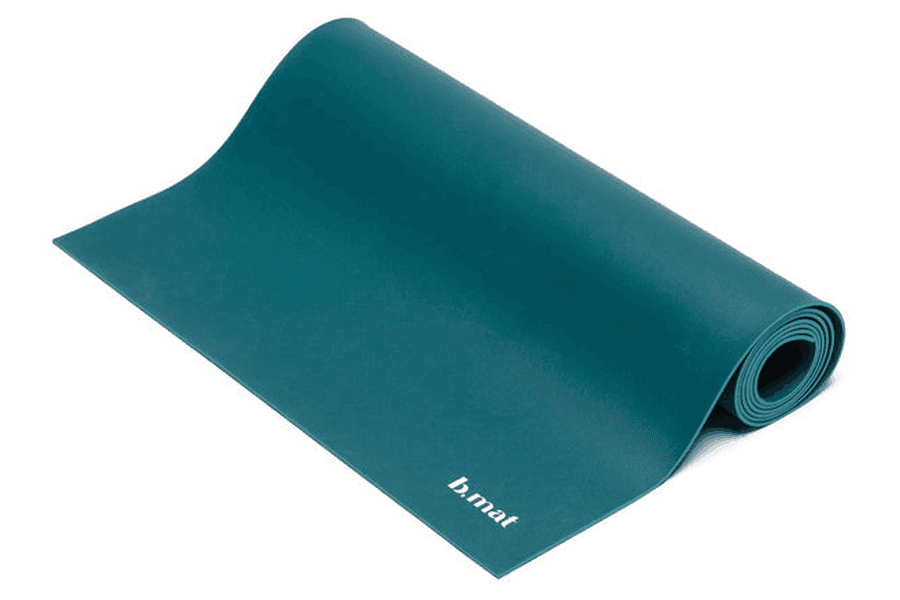
Price
The Dry-Grip lists for about $48 less.
$69.98
List price · check price at Amazon
$118
List price · check price at bhalfmoon.com
Thickness
The Dry-Grip is 25% thicker.
5 mm0.2″
4 mm0.2″
Weight
The B Mat Everyday is 0.2 lbs lighter.
4.25 lbs1.9 kg
4.1 lbs1.86 kg
Size
The B Mat Everyday is 3″ longer; the B Mat Everyday is 2″ wider.
Same on both
- Around 4 to 5 mm underfoot, firm rather than plush
- No break-in period on either
- Both wipe clean rather than absorbing sweat
- Both lie flat from the first unroll
Full specs
Dimensions
Materials & build
Buying
One of these is named after the thing it does worst
The Gaiam Performance Dry-Grip is a 5 mm PVC mat with a moisture-wicking topcoat, 68″ × 24″, at $69.98. The name promises a mat that handles sweat. OutdoorGearLab scored it 6.5 out of 10 for dry grip and 3.5 for wet, the second-lowest wet result among the 19 mats it tested.
The B Mat Everyday is 4 mm of dense rubber, 71″ × 26″, at $118. GearLab rated the same 4 mm B Mat 9 out of 10 for grip and called it among the grippiest mats it had used in either wet or dry conditions. That is the comparison in two numbers.
Grip: the gap is largest exactly where it matters
The Gaiam’s topcoat does wick a little moisture, and at the start of a warm class you notice it working. Once you are properly sweating it behaves like the topcoated PVC mat it is, and hands start to move. In a heated room a towel is not optional.
The B Mat grips from the first unroll and keeps gripping when the surface is wet, which is the single hardest thing for a mat to do. Sweat pools on top of the dense rubber and the rubber holds through it; GearLab reported traction surviving with a puddle under a hand. You towel the surface between rounds rather than washing moisture back out of the mat afterwards.
One caveat worth knowing: b, halfmoon’s rubber can be too grippy for styles built on sliding transitions, and GearLab’s testers found themselves stepping between poses rather than gliding.
The Gaiam is the softer mat
This is where the cheaper mat wins. Five millimetres of PVC has more give than four of dense rubber, and GearLab scored the Dry-Grip 8 out of 10 for comfort and support. On tile, kneeling work is noticeably easier on it.
The B Mat trades that softness for stability. It is firm, it does not compress under a standing foot, and standing poses feel more planted. If your knees are the limiting factor rather than your grip, that is a real point for the Gaiam. If you want both, b, halfmoon’s 6 mm B Mat Strong is the same rubber with more of it, at $144.
Three inches longer, two inches wider
The B Mat is 71″ × 26″ against the Gaiam’s 68″ × 24″. Sixty-eight inches is short for anyone near six feet, and 24 inches is narrow enough that a hand finds the floor in a wide stance.
Gaiam’s answer to both is the Dry-Grip Long & Wide at 78″ × 26″, which is worth knowing about if the surface suits you and the size does not.
A coating against a material
The difference in how these two are built explains most of what follows. The Gaiam’s grip comes from a topcoat applied to PVC foam. Coatings wear, and GearLab scored its materials 4 out of 10, among the lowest in its test. When the topcoat goes, the mat underneath is ordinary PVC.
The B Mat’s grip is the material itself, all the way through, so there is nothing to wear off. It is made in Spain from mostly natural rubber with some synthetic content and carries OEKO-TEX Standard 100 certification. It also means latex, so it is out with an allergy, where the Gaiam is PVC and latex free.
Weight and the spec sheet
Gaiam lists the Dry-Grip at 4.25 pounds, and GearLab weighed its sample at 5.4, which is a meaningful difference if you are buying on the number. The B Mat Everyday is about 4.1 pounds and GearLab described it as portable by the standards of mats it beats on grip, rolling to about 3.5 to 4 inches across.
In practice they are close enough that weight should not decide this. Both carry comfortably to a studio and neither is a travel mat.
Warranty against material
Gaiam advertises a lifetime guarantee on the Dry-Grip, which is unusual at $69.98 and worth having. It covers manufacturing defects rather than a topcoat that has worn smooth after two years of sweaty practice, which is the failure you should actually expect.
b, halfmoon gives one year. Dense rubber wears slowly and there is no coating to lose, so the material is doing the work the warranty is not. The thing that kills it is sunlight, so store it rolled and in the shade rather than in a car window.
Price and where to buy
$69.98 against $118. Check the live Dry-Grip price on Amazon, where Gaiam colors are discounted independently. The B Mat is sold direct and not on Amazon, so it stays at list.
The $48 gap buys traction you can rely on and a mat that will still grip in year four. If you never sweat, it buys you very little, and the Gaiam is a perfectly good mat for a cool room at a much better price.
Bottom line
Get the B Mat Everyday if grip is what keeps failing you. It is the better mat on the measure most people are actually shopping for, it is bigger in both directions, and the rubber holds up for years. Accept that it is firm and that it contains latex.
Get the Dry-Grip if your room is cool, your knees want the softer surface, or you need a latex-free mat under $70 with a lifetime guarantee behind it. It is a decent mat with an overpromising name, and buying it with clear eyes about the wet grip is the whole trick.
B Mat Everyday 4mm
List price $118
Frequently Asked Questions
- Does the Gaiam Dry-Grip actually work when you sweat?
- Less well than the name implies. OutdoorGearLab scored it 6.5 out of 10 for dry grip and 3.5 for wet, the second-lowest wet score in a 19-mat test. The topcoat wicks a little moisture away, which helps at the start of a warm class, but it is a topcoated PVC mat and it behaves like one once you are properly sweating. In a heated room, use a towel.
- Is the B Mat Everyday worth $118?
- If grip is why you are shopping, yes. The rubber holds from the first class with no break-in and keeps holding when the surface is wet, which is the single hardest thing for a mat to do. You also get 26 inches of width, OEKO-TEX Standard 100 certification and a year of coverage. Where it is beatable is cushion: 4 mm of dense rubber is firmer underfoot than the Gaiam's 5 mm of PVC.
- Which is more comfortable?
- The Gaiam, slightly. It is 5 mm against 4, and PVC has more give than dense rubber, which GearLab reflected by scoring the Dry-Grip 8 out of 10 for comfort and support. On tile, kneeling is easier on the Gaiam. The B Mat trades some of that softness for stability, so standing poses feel more planted on it.
- How much do they weigh?
- Gaiam lists the Dry-Grip at about 4.25 pounds, though GearLab weighed its sample at 5.4, which is worth knowing if you are buying on the spec sheet. The B Mat Everyday is about 4.1 pounds. In practice they are close enough that weight should not decide this, and both are easy enough to carry to a studio.
- Which lasts longer?
- The B Mat, most likely. Dense rubber resists the compression that eventually flattens PVC, and the surface does not depend on a coating that can wear through. The Dry-Grip's weak point is exactly that topcoat: GearLab scored its materials 4 out of 10, among the lowest in its test. Gaiam's lifetime guarantee is a real benefit here, but it covers defects rather than a worn surface.
- Is either latex free?
- The Gaiam is. It is PVC and Gaiam lists it as latex free, so it is the safe choice with an allergy. The B Mat is mostly natural rubber with some synthetic content, which means it contains latex. If you need real grip without latex, a polyurethane-topped mat is worth a look, though most of those have a rubber base too, so read the construction carefully.
Related comparisons
- Manduka X vs Gaiam Performance Dry-Grip 5mm
- Yoga Design Lab Combo 3.5mm vs b, halfmoon B Mat Everyday 4mm
- b, halfmoon B Mat Everyday 4mm vs Manduka GRP Adapt Lite 2.1 4mm
- JadeYoga Level One vs Gaiam Performance Dry-Grip 5mm
- Gaiam Performance Dry-Grip 5mm vs IUGA Eco Friendly Non Slip PU
- Manduka PROlite vs b, halfmoon B Mat Everyday 4mm
- Lululemon The Mat 5mm vs b, halfmoon B Mat Everyday 4mm
- Manduka PROlite Long vs b, halfmoon B Mat Everyday 4mm
- Manduka Begin vs Gaiam Performance Dry-Grip 5mm