Amazon Basics 1/2 Inch Extra Thick vs B Mat Strong 6mm: Which One Should You Buy?
Both of these are sold as thick mats, which is where the similarity stops. The Amazon Basics is half an inch of soft NBR foam for $22.48. The B Mat Strong is 6 mm of dense rubber for $144. The foam mat is twice as thick and far less stable, and that contradiction is the whole comparison.
As an Amazon Associate, we earn from qualifying purchases made through links on this page. How this works
The quick answer
For yoga, the B Mat Strong is the mat and the price gap is justified by what rubber does that foam cannot. It grips from the first class, wet or dry, it holds still under a standing foot, and 6 mm of dense rubber is enough to kneel on without turning your balance poses into a wobble. It is $121.52 more and it contains latex.
The Amazon Basics is not trying to be that mat, and judged as an exercise mat it is good value. Half an inch of foam is the friendliest surface here for knees, elbows and spine, it weighs 2.2 pounds, it is 74 inches long, and it costs less than one studio class. It slides when your palms are damp and it dents where you kneel.
Get the Amazon Basics if...
- Your floor work is stretching, core or physio rather than yoga
- Your knees need real padding more than you need stability
- You want 74 inches of length for $22.48
- You need a latex-free mat
Get the B Mat Strong if...
- You practice yoga and grip is what keeps failing
- You want to balance without the mat moving under you
- You want 26 inches of width
- You want a mat that lasts years rather than seasons
Side by side
Price
The Amazon Basics lists for about $122 less.
$22.48
List price · check price at Amazon
$144
List price · check price at bhalfmoon.com
Thickness
The Amazon Basics is 112% thicker.
12.7 mm0.5″
6 mm0.23″
Weight
The Amazon Basics is 2.8 lbs lighter.
2.2 lbs1 kg
5 lbs2.27 kg
Size
The Amazon Basics is 3″ longer; the B Mat Strong is 2″ wider.
Same on both
- Both are thicker than a standard 4 to 5 mm mat
- Both roll rather than fold
- Neither needs breaking in
- Both are comfortable for kneeling work
Full specs
Dimensions
Materials & build
Buying
Both sold as thick mats, and thickness means two things
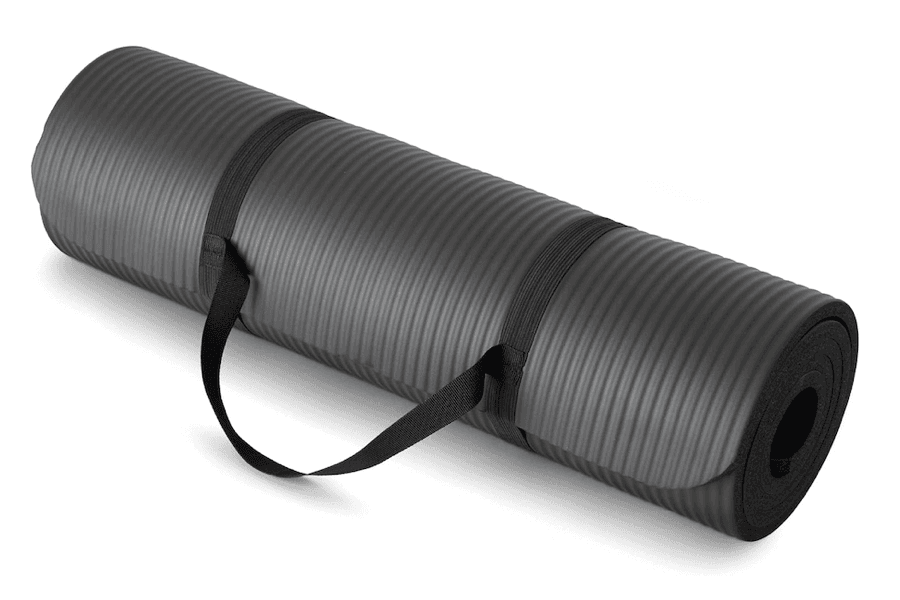
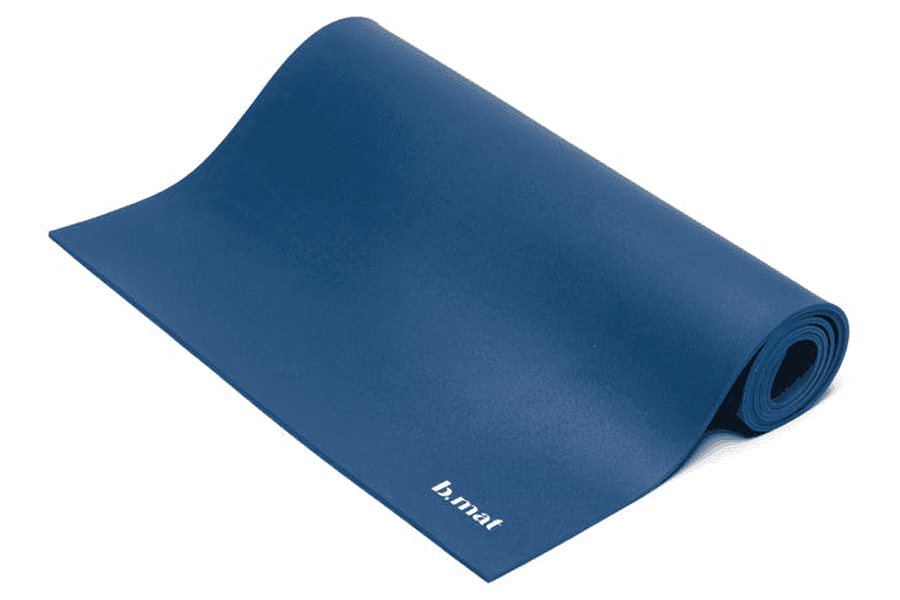
The Amazon Basics is half an inch of soft NBR foam, 74″ × 24″, at $22.48. The B Mat Strong is 6 mm of dense rubber, 71″ × 26″, at $144.
The foam mat is more than twice as thick and far less stable, and that contradiction is really the whole comparison. What a mat is made of decides how it behaves under you; how many millimetres it has only decides how much of that material there is.
Why the thinner mat holds you better
Push a foot into 12.7 mm of soft NBR foam and it compresses a long way, and unevenly. Standing balances turn into a small negotiation with the mat, and a deep lunge feels like it is settling underneath you. That is not a manufacturing flaw; it is what soft foam does.
Six millimetres of dense rubber barely compresses at all. The B Mat gives you a firm, predictable platform, so everything you do standing feels planted, and the extra 2 mm over a standard 4 mm mat is cushion you get without paying for it in wobble.
Grip is not close
GearLab tested the 4 mm version of the same b, halfmoon rubber, rated it 9 out of 10 for grip and called it among the grippiest mats it had used in wet or dry conditions, with traction surviving even with sweat pooled under a hand. It works from the first unroll with no break-in.
NBR foam is not sold on traction and does not deliver it. The Amazon Basics has a textured surface that is adequate while everything is dry and gets slick quickly once your palms are not. For a flowing practice, that means more sliding than you want; for hot yoga it is not a candidate.
Where the cheap mat genuinely wins
Half an inch of foam is lovely on a knee, an elbow or a spine. If your floor time is stretching, glute bridges, core work or a physio program, the Amazon Basics is more comfortable than most yoga mats at any price, and it is why the mat sells the way it does.
The B Mat Strong is the most cushioned mat in b, halfmoon’s range and it is still firm by comparison. On tile a long kneeling sequence is manageable rather than pleasant. A folded blanket closes that gap and keeps the stability everywhere else, which is what most people end up doing.
Length against width
The Amazon Basics is three inches longer at 74″, which is a genuine point in its favour if you are tall. The B Mat is two inches wider at 26″, which tends to be the more useful dimension unless you are properly tall, because 24 inches puts a hand on the floor in a wide stance.
If you want the b, halfmoon rubber in a lighter, cheaper build, the 4 mm B Mat Everyday keeps the same width and surface for $118. Amazon Basics also makes a 1-inch version if even more padding is the goal.
Years against seasons
NBR foam takes compression set. Knees and elbows leave permanent dents and the loft slowly disappears. Used a few times a week for stretching, a year or two is realistic. Amazon covers it for a year, which is more warranty on paper than a lot of expensive mats carry.
The B Mat should give you years of regular practice. Dense rubber wears slowly, carries OEKO-TEX Standard 100 certification and a one-year warranty, and what actually destroys it is sunlight rather than use. Store it rolled and in the shade and it holds up.
Nitrile foam and natural rubber
NBR is nitrile butadiene rubber, a synthetic closed-cell foam used in exercise mats because it is light, cheap and soft. It contains no natural latex, so the Amazon Basics is the safe pick with an allergy. It has a plastic smell out of the box that airs out over a week or so.
The B Mat is made in Spain from mostly natural rubber with some synthetic content, which does mean latex. It has the usual rubber smell for the first few weeks. Both sides of the mat are the same tacky surface, so either face practices.
Price and where to buy
$22.48 against $144, a gap of $121.52. Check the current Amazon Basics price, where the three colors are priced independently and the cheapest usually sits a little under list. The B Mat is sold direct and not on Amazon, so it holds its price.
Buying for the wrong activity is the expensive mistake here. A $22 mat you cannot balance on is poor value if you wanted to do yoga, and $144 of grippy rubber is poor value if what you needed was padding for floor exercises.
Bottom line
Get the B Mat Strong if you practice yoga and grip or stability is the problem. It holds from day one, wet or dry, it is 26 inches wide, and 6 mm of dense rubber is enough to kneel on without giving up a stable standing surface.
Get the Amazon Basics if your floor time is stretching, physio or general exercise, or if you want the most padding available for almost no money. It is genuinely good at that job, it is latex free, and at $22.48 nothing else in this comparison is close on price.
Amazon Basics 1/2 Inch Extra Thick
List price $22.48
B Mat Strong 6mm
List price $144
Frequently Asked Questions
- Isn't the Amazon Basics thicker, so shouldn't it be better?
- Thickness and support are different things. Half an inch of soft NBR foam compresses a long way under a single foot, so it feels plush when you kneel and unstable when you balance. Six millimetres of dense rubber barely compresses at all, so it cushions less but holds you where you put yourself. For yoga, the rubber is the better surface despite being half as thick.
- Can you do yoga on the Amazon Basics mat?
- Gentle yoga, yes. Anything on your back or knees is more comfortable than on a proper yoga mat. Standing poses are where it struggles, because the foam moves under your foot and the surface offers little grip once your hands are damp. If your practice is mostly restorative or you are following along with a stretching video, it does the job. For vinyasa or hot yoga it is the wrong mat.
- Is the B Mat Strong grippy enough for hot yoga?
- It is one of the best surfaces available for it. GearLab tested the 4 mm version of the same rubber, rated it 9 out of 10 for grip, and reported it holding even with sweat pooled under a hand. Because the rubber is dense rather than absorbent, sweat sits on top and you towel it between rounds instead of washing moisture out of the mat afterwards.
- How long does each mat last?
- The B Mat should give you years of regular practice and carries a one-year warranty; the thing that kills rubber mats is sun, not use, so store it out of a hot car. The Amazon Basics foam takes compression set, so elbows and knees leave permanent dents and the loft slowly disappears. A year or two of a few sessions a week is a realistic expectation at that price.
- What is NBR foam?
- Nitrile butadiene rubber, a synthetic closed-cell foam used in exercise mats because it is light, cheap and soft. It contains no natural latex, so it is safe with a latex allergy, unlike the B Mat. Its downsides are the ones you would expect from foam: low grip, poor compression recovery, and a plastic smell out of the box that fades over a week or two.
- Is there a middle option between these two?
- Plenty. If you want rubber grip for less, the Jade Level One is $66.50 and the b, halfmoon B Mat Everyday is $118 in a 4 mm build. If you want cushion for cheap but with a better surface, Gaiam's 6 mm mats sit around $22 to $30. The two mats on this page are close to opposite ends of the category, which is why the answer is usually one or the other rather than a close call.
Related comparisons
- Amazon Basics 1/2 Inch Extra Thick vs Retrospec Solana 1/2"
- b, halfmoon B Mat Strong 6mm vs Manduka PRO Terra 6mm
- Manduka PRO vs b, halfmoon B Mat Strong 6mm
- Manduka PROlite Long & Wide vs b, halfmoon B Mat Strong 6mm
- Manduka GRP Adapt 2.0 Long vs b, halfmoon B Mat Strong 6mm
- Yoloha Unity Pro Cork vs b, halfmoon B Mat Strong 6mm
- JadeYoga Harmony XW vs b, halfmoon B Mat Strong 6mm
- Manduka GRP Adapt 2.0 vs b, halfmoon B Mat Strong 6mm
- Alo Warrior vs b, halfmoon B Mat Strong 6mm