Manduka PROlite vs Gaiam Essentials: Which One Should You Buy?
Both mats are PVC and that is where the similarity ends. The PROlite is dense closed-cell PVC made in Germany and guaranteed for life; the Gaiam Essentials is soft foam you will probably replace in a couple of years. The surprise is how well the cheap mat holds the spec sheet: it is an inch longer, more than a millimeter thicker, and a pound lighter. What it cannot do is stay the same mat.
As an Amazon Associate, we earn from qualifying purchases made through links on this page. How this works
The quick answer
The PROlite is a decade-long purchase. Manduka calls it its number one studio mat and backs it with a lifetime guarantee whose fine print covers roughly ten years of regular use and one replacement. It is firm rather than plush, stable under a standing foot, OEKO-TEX certified, and it arrives slick: the closed-cell surface needs a few weeks of use before it grips properly, which catches a lot of new owners off guard.
The Essentials is softer on knees, longer, lighter, comes with a sling, and costs a fifth as much. Buy it if you are starting out or practicing once a week. Buy the PROlite if you are on a mat several times a week and want to stop buying mats.
Get the Manduka PROlite if...
- You practice several times a week and expect to keep going
- You want a firm surface that does not move under one foot
- You want a guarantee that actually covers the mat, not just defects
- You want other sizes, including a 79 inch Long and a Long and Wide
Get the Gaiam Essentials if...
- You are new, or practicing about once a week
- You want more padding under your knees
- You would rather not wait weeks for a mat to break in
- You want to spend about a fifth as much
Side by side
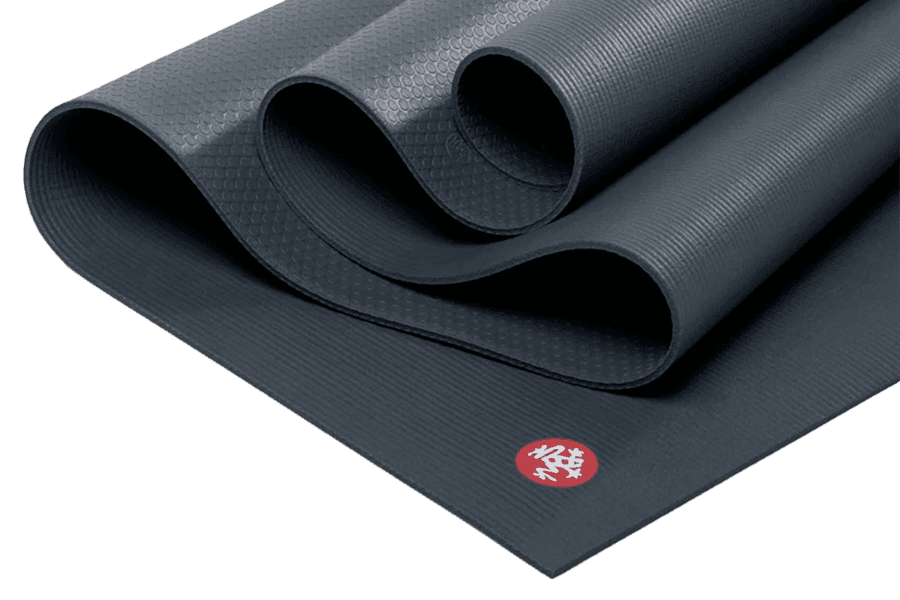
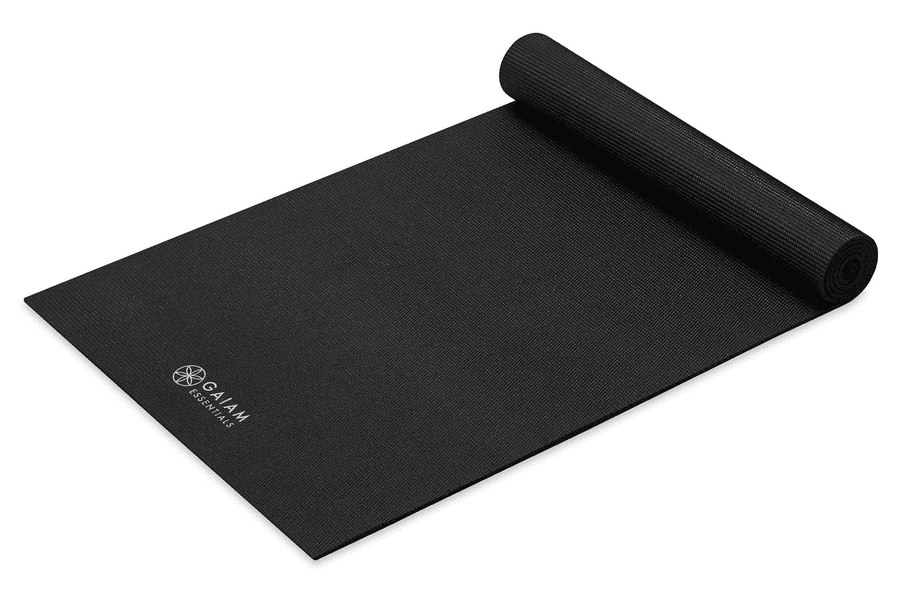
Price
The Gaiam Essentials lists for about $90 less.
$112
List price · check price at Amazon
$22.13
List price · check price at Amazon
Thickness
The Gaiam Essentials is 28% thicker.
4.7 mm0.19″
6 mm0.24″
Weight
The Gaiam Essentials is 1.1 lbs lighter.
4.6 lbs2.1 kg
3.5 lbs1.59 kg
Size
The Gaiam Essentials is 1″ longer; same width.
Same on both
- PVC, closed surface, so nothing soaks in
- 24 inches wide
- A wipe with a damp cloth is all the cleaning either needs
- Both go brittle if you leave them in the sun
- Both lose grip once your palms are wet
Full specs
Dimensions
Materials & build
Buying
A mat you keep against a mat you replace
The PROlite is $112 of dense closed-cell PVC made in Germany, and Manduka backs it for life. The Gaiam Essentials is about $22.13 of soft PVC foam, and you will probably buy another one in a couple of years. Same base material, completely different densities and completely different lifespans.
The interesting thing about this pair is how much the Gaiam holds its own on the spec sheet: it is an inch longer, more than a millimeter thicker, and a pound lighter. What it cannot do is stay the same mat after two years of practice.
What dense PVC feels like
Manduka calls the PROlite its number one studio mat and describes the cushioning as floor-like stability with joint support, which is an accurate if unglamorous description. At 4.7 mm it does not feel plush. It feels like a firm floor with a little give, and nothing about it moves when you put your weight on one foot.
The Essentials is 6 mm of foam that compresses and stays compressed for a beat when you press it. That is more comfortable on a knee and less certain under a standing leg. If your complaint is sore knees, the cheap mat is genuinely the better tool; if it is wobbling in tree pose, it is the cause.
Grip, and the PROlite break-in nobody warns you about
This is where a hundred and twelve dollar mat surprises people. The PROlite arrives slick. Its closed-cell surface has a fabric-like finish that does not grip properly until it has been used, and plenty of owners spend the first few weeks wondering what they bought. Manduka used to recommend a salt scrub and has retired that advice; the current position is that the slickness resolves with use, and in practice it does.
Once broken in, the PROlite holds dry hands well and still gives up when you sweat, because closed-cell PVC does not absorb anything. The Essentials is grippy enough dry from day one and worse when wet: GearLab rated the closely related Gaiam Premium 6mm, which uses the same textured surface, at 6 out of 10 dry and 4 wet. Neither of these is a hot yoga mat, and if that is your practice, spend the money on a mat built for sweat instead.
Size and weight
Both are 24 inches wide, which is the old standard and feels narrow if you have practiced on 26. The Gaiam is actually the longer mat, 72″ against 71″, and it is lighter at 3.5 pounds to 4.6, with a cinch sling in the box that the Manduka does not include.
The PROlite is the light one within its own family, which is the whole reason it exists next to the PRO. If you need more room, Manduka sells it as a 79 inch Long and a 79″ × 30″ Long and Wide, plus a 68 inch Short. The Essentials comes one way.
Ten years against two
This is what the money is for. Dense closed-cell PVC does not compress the way foam does, and PROlites in daily studio use routinely run for years without going soft. Manduka backs it with a lifetime guarantee, and the fine print is worth knowing: it covers roughly ten years of regular use, one replacement, and it needs proof of purchase from an authorized seller, with Amazon qualifying only when the mat is sold and shipped by Amazon rather than a third party.
The Essentials takes a set under your hands, knees and hips, and GearLab found the same foam in Gaiam’s Premium showing compression, scuffs and wear with regular use. Gaiam’s lifetime guarantee sounds identical and is not: it addresses manufacturing defects rather than a mat that has quietly gone flat. Both companies say lifetime; only one of them means the mat.
Cleaning, smell and certifications
Both are closed-surface PVC, so nothing soaks in and a damp cloth handles either. The PROlite carries an OEKO-TEX Standard 100 certification, which is documentation that the material has been tested for harmful substances; the Essentials has none, though Gaiam makes it free of latex and the six worst phthalates.
Both smell when new. Gaiam is direct about it, asking for two to three days of airing before the first session and publishing a guide on removing the odor. The PROlite has a milder version of the same problem that fades in about a week. Keep either mat out of the sun, which makes PVC brittle.
Who each one is actually for
The PROlite is for someone practicing several times a week who expects to keep practicing. Manduka calls it teacher recommended, and the reason teachers own them is that a studio mat gets used daily for years and the PROlite survives that. If your mat is going to be under you three hundred times a year, spreading $112 across a decade is not an extravagance.
The Essentials is for someone who is not there yet, or who wants a second mat for a guest room, or who mostly stretches. There is no shame in the cheap mat and no benefit in buying a mat for a practice you have not established. Buy it, use it, and let it tell you what you need next.
Price and where to buy
The PROlite lists at $112 for the standard 71 inch size and is on Amazon as well as manduka.com. If the guarantee matters to you, check the seller: Manduka honors Amazon purchases only when the mat is sold and shipped by Amazon itself.
The Essentials is about $22.13 on Amazon, drifting by colorway, and gaiam.com sells a 68″ × 24″ version at $19.98 without the sling. One PROlite costs about five Essentials, which is roughly the replacement math over a decade if the cheap mat is serving you well.
Bottom line
Buy the PROlite if you practice regularly and want to stop thinking about mats. It is firm, stable, made in Germany, certified, genuinely backed for a decade, and it is the mat you will find under half the teachers you take class from. Budget a few weeks for the surface to break in.
Buy the Gaiam Essentials if you are starting, stretching, or practicing once a week. It is longer, softer, lighter and costs a fifth as much, and its limits are sweat and standing balance. If you want the thicker, wider version of the Manduka argument, our PRO vs PROlite comparison covers the difference.
Manduka PROlite
List price $112
Gaiam Essentials 6mm
List price $22.13
Frequently Asked Questions
- Why is the PROlite slippery when it arrives?
- Because the closed-cell surface has a fabric-like finish that does not grip properly until it has been used. This catches out a lot of new owners who expect a $112 mat to work perfectly on day one. Manduka used to recommend a salt scrub to speed it up and has retired that advice; its current position is that the slickness resolves with normal use, and in practice it does over a few weeks.
- Is the lifetime guarantee real?
- Yes, with fine print worth knowing. It covers roughly ten years of regular use and one replacement, and it requires proof of purchase from an authorized seller. Amazon qualifies only when the mat is sold and shipped by Amazon itself rather than a third party seller. Gaiam's lifetime guarantee on the Essentials sounds identical but works differently: it addresses manufacturing defects rather than foam that has gradually gone flat.
- Which is more comfortable?
- The Gaiam, on the floor. It is 6 mm of soft foam against the PROlite's 4.7 mm of dense PVC, so kneeling and seated work are kinder on it. The PROlite is more comfortable in the other sense: it does not shift under a standing leg, so balance poses stop being a negotiation. Cushion and stability pull against each other and these two mats sit at opposite ends of it.
- Can you use either one for hot yoga?
- Not really. Both are closed-surface PVC, which means sweat sits on top with nowhere to go. The PROlite is grippier than the Gaiam once broken in and still gives up when your palms are wet. GearLab rated the closely related Gaiam Premium 6mm, which shares the Essentials surface, at 4 out of 10 for wet grip. For heated classes you want a polyurethane or natural rubber mat.
- Which one is actually bigger?
- The Gaiam, slightly. The Essentials listing we link is 72 by 24 inches and the PROlite is 71 by 24, and the Gaiam is also the lighter mat at 3.5 pounds against 4.6, with a cinch sling included. The PROlite's advantage is that it comes in other sizes: a 68 inch Short, a 79 inch Long, and a 79 by 30 inch Long and Wide.
- Is the PROlite worth five times the price?
- If you practice regularly, yes, on longevity alone. One PROlite costs about five Essentials, and a PROlite in daily studio use routinely runs for years without going soft while a soft foam mat takes a permanent set within a couple. If you practice once a week or you are not sure yoga will stick, the answer is no and the Essentials is doing the job.
Related comparisons
- YogaAccessories Extra Thick Deluxe 1/4" vs Gaiam Essentials 6mm
- Manduka PROlite vs JadeYoga Harmony 2.0 68"
- Manduka PROlite vs JadeYoga Harmony 74"
- Gruper TPE 6mm vs Gaiam Essentials 6mm
- Manduka PROlite vs Lululemon The Mat 5mm
- Amazon Basics 1/4 Inch Thick TPE vs Gaiam Essentials 6mm
- Manduka PROlite vs JadeYoga Harmony 68"
- Manduka PROlite vs b, halfmoon B Mat Everyday 4mm
- Manduka PROlite vs Suga SugaMat