Manduka GRP Adapt 2.0 vs IUGA PU Mat: Which One Should You Buy?
Both mats are polyurethane over natural rubber, both are 5 mm thick, both are 26 inches wide, and both are built around a top layer that soaks up sweat so the surface stays tacky. GearLab tested both and placed them third and eighth out of 19, giving the $128 GRP Adapt 2.0 its top pick for hot yoga and the $66.99 IUGA its best buy award. Sixty one dollars and seven points is the whole question.
As an Amazon Associate, we earn from qualifying purchases made through links on this page. How this works
The quick answer
The GRP Adapt 2.0 posted 9.5 out of 10 for dry grip and 8.5 wet, the best wet result in the field, and GearLab earned it by pouring a liter of water over the mat before running sun salutations. It scored 82 out of 100 overall and 8 of 10 on materials. The IUGA rated 8 dry and 7 wet at 75 out of 100, weighs 2.1 pounds against 5.5, includes a carry strap, and takes returns for 45 days.
Buy the IUGA if you practice a couple of times a week or carry your mat. GearLab's own recommendation was explicit about that, and it flagged durability concerns after a few years. Buy the GRP Adapt 2.0 if you are in a hot room several times a week and want the mat built to take it.
Get the GRP Adapt 2.0 if...
- You are in a heated room several times a week
- You want the best wet grip numbers published anywhere
- You want a mat built for daily use rather than occasional
- You want a 79 inch long version as an option
Get the IUGA if...
- You practice once or twice a week
- You carry your mat and want it to weigh 2.1 pounds
- You want a carry strap included and 45 days to return it
- You would rather keep the $61
Side by side
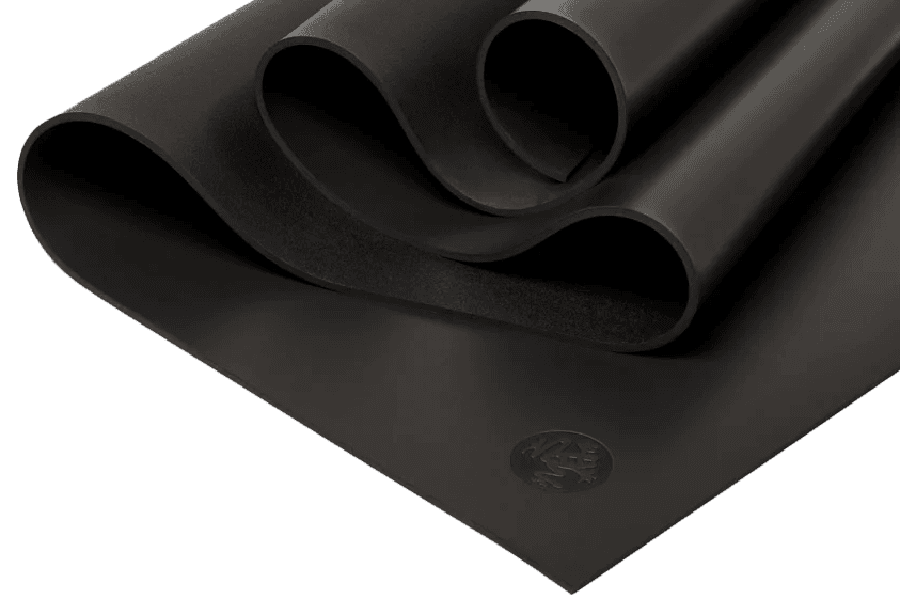
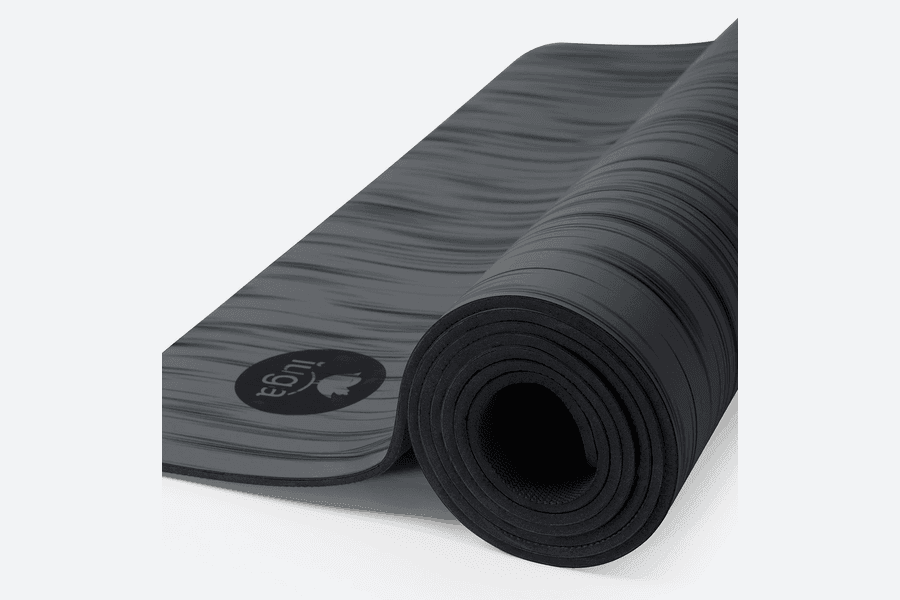
Price
The IUGA lists for about $61 less.
$128
List price · check price at manduka.com
$66.99
List price · check price at Amazon
Thickness
Identical thickness.
5 mm0.2″
5 mm0.2″
Weight
The IUGA is 3.7 lbs lighter.
5.8 lbs2.6 kg
2.1 lbs0.95 kg
Size
The IUGA is 1″ longer; same width.
Same on both
- 5 mm of polyurethane over natural rubber
- 26 inches wide
- A sweat-absorbing top that grips when wet
- No warranty, only a return window
- Built on natural rubber, so not latex safe
- Surfaces that wear at the hands and feet over time
Full specs
Dimensions
Materials & build
Buying
The same recipe, sixty one dollars apart
Both of these are polyurethane over natural rubber, both are 5 mm, both are 26 inches wide, and both are built around the same idea: a top layer that soaks up sweat so the surface stays tacky instead of turning into a slip hazard. The GRP Adapt 2.0 costs $128. The IUGA costs $66.99.
GearLab tested both and put them 3rd and 8th out of 19, with the GRP at 82 out of 100 and the IUGA at 75. It gave the GRP its top pick for hot yoga and the IUGA its best buy award. Seven points and sixty one dollars is the whole question here, and where you land depends almost entirely on how hard you plan to use the mat.
Grip: the GRP posted the best wet numbers in the field
GearLab scored the GRP Adapt 2.0 at 9.5 out of 10 dry and 8.5 wet. The wet figure is the highest of any mat in the lineup, and the testers earned it the hard way, pouring a liter of water over the surface and running sun salutations on it. Manduka’s Satin Grip top pulls moisture down through the mat rather than letting it sit, which is why it holds when a rubber mat would be sliding.
The IUGA rated 8 dry and 7 wet, which is genuinely good and better than plenty of mats twice its price. GearLab described its surface as non slip but less aggressive, softer against the skin than a grippier rubber mat. For a class where you sweat but do not soak the mat, that is enough. For a room at 105 degrees with the humidifier on, the GRP is a level above and it is the reason the award went where it did.
Two pounds against five and a half
The IUGA weighs 2.1 pounds, which GearLab confirmed on its own scale and called out repeatedly. For a full size mat that is close to remarkable; most rubber based mats this size run four to seven pounds. It also ships with an adjustable carry strap.
Manduka lists the GRP at 5.8 pounds and GearLab measured 5.5, with no strap in the box. That is a perfectly normal studio mat weight and it is more than twice the IUGA. If your mat rides a bike or walks to class, this line item outranks the grip scores.
Cushion and stability
Close, with a small edge to the Manduka: 8.5 out of 10 for comfort and support against 8.0. Both are firm rather than plush, which is the right call for a mat you stand on, and GearLab praised the IUGA’s cushion as thick enough to protect knees while staying stable through single leg balances.
Both have a caveat. GearLab listed less cushion on the knees among the GRP’s downsides, so if kneeling is what hurts, five millimeters of firm mat is not the fix. And the IUGA’s light build can wrinkle slightly in the middle if you are heavy on your feet, which the heavier GRP does not do.
Durability is where the gap opens
This is the real difference and it is worth more than seven points. GearLab flagged durability concerns after a few years on the IUGA and noted its more open surface degrades faster on abrasive ground like pavement or dirt. Its recommendation was explicit: an ideal upgrade for someone practicing once or twice a week, not every day.
The GRP scored 8 out of 10 on materials against the IUGA’s 7, and Manduka builds it in Spain with 20 percent recycled content. Polyurethane tops are a wear item on any mat in this category, so neither of these is a ten year purchase, but the Manduka is the one built for daily abuse. Neither carries a warranty; Manduka gives you 30 days to return, IUGA gives you 45.
Drying, watermarks and squeaks
The IUGA scored higher on care and cleaning, 8 out of 10 against 7, and GearLab found it wiped down easily even after practicing outdoors. Its listed downside is a long dry time, which follows from the same absorbency that makes it grip: a mat that takes moisture in takes a while to give it back. A sweaty daily practice will want two mats or a drying rack.
The GRP has two quirks GearLab named directly. Sweat leaves visible watermarks on the surface, and the mat can squeak occasionally underfoot. Neither affects how it performs and both annoy some people, so buy a dark colorway if marks would bother you. Both mats want water or a heavily diluted mild cleaner, never alcohol, vinegar, or oils.
Size, longer versions and colors
The IUGA is 72″ × 26″, an inch longer than the GRP’s 71″ × 26″, and GearLab counted those dimensions among its pros. At normal height either is plenty, and both give you the 26 inches of width that makes a wide down dog comfortable.
If you need more than 71 inches, only Manduka has an answer: the GRP Adapt 2.0 Long runs 79″ × 26″. Colors are limited on both, four Manduka colorways and five from IUGA at last count, and the darker ones hide sweat marks better on either mat.
Price, returns and where to buy
The IUGA sells on Amazon and through theiuga.com, discounts by colorway, and takes returns for 45 days, which takes most of the risk out of trying it. The GRP Adapt 2.0 is a direct purchase from manduka.com at $128; it is not sold on Amazon, so listings there are resold stock.
Two IUGAs cost less than one GRP Adapt 2.0, and if you replace the cheap mat every three years you would still be ahead at the six year mark. That arithmetic only holds if the IUGA is enough mat for how you practice, which is exactly what GearLab’s once or twice a week caveat is about.
Bottom line
Buy the IUGA if you practice a couple of times a week, carry your mat, or are not sure yet how much mat you need. It grips well wet, weighs two pounds, comes with a strap, and won a best buy award on exactly those terms. Accept a shorter lifespan and a slow dry time.
Buy the GRP Adapt 2.0 if you are in a hot room several times a week. Nothing tested grips better when the mat is wet, and it is built to take that treatment for years rather than seasons. If you want to see how it stacks up against the other serious hot yoga mat at this price, our GRP Adapt 2.0 vs B Mat Everyday comparison covers it.
Manduka GRP Adapt 2.0
List price $128
Frequently Asked Questions
- Is the GRP Adapt 2.0 worth twice the IUGA?
- It depends entirely on how often you practice. GearLab put the GRP third of 19 at 82 out of 100 and the IUGA eighth at 75, which is a real gap but not a chasm. The bigger difference is durability: GearLab flagged durability concerns on the IUGA after a few years and called it an ideal upgrade for someone practicing once or twice a week rather than every day. For a daily hot yoga habit, the Manduka is the safer purchase.
- Which grips better when you sweat?
- The GRP, by a clear margin. It scored 8.5 out of 10 for wet grip, the highest number in a 19 mat test, after testers poured a liter of water on it and kept practicing. The IUGA scored 7, which is genuinely good and better than plenty of mats twice its price, and GearLab described its surface as non slip but less aggressive and softer against the skin. For a room at 105 degrees, the Manduka is a level above.
- How can the IUGA weigh only 2.1 pounds?
- It is a thin polyurethane layer over a light rubber base, and GearLab confirmed 2.1 pounds on its own scale. Most rubber-based mats this size run four to seven pounds, and the GRP measured 5.5. The tradeoff is that the light build can wrinkle slightly in the middle if you are heavy on your feet, which the heavier Manduka does not do. The IUGA also ships with an adjustable carry strap; the GRP does not.
- Do these mats take long to dry?
- The IUGA does, and GearLab listed long dry time among its downsides. That follows from the same absorbency that makes it grip: a mat that takes moisture in takes a while to give it back. If you sweat heavily every day, plan on a drying rack or a second mat. The GRP dries faster but shows visible watermarks where sweat lands, which GearLab also named as a con.
- Which is more comfortable?
- Close, with a small edge to the Manduka. GearLab scored the GRP 8.5 out of 10 for comfort and support and the IUGA 8.0. Both are firm rather than plush, which is the right call for a mat you stand on, and GearLab praised the IUGA's cushion as thick enough to protect knees while staying stable through single leg balances. It also listed less cushion on the knees among the GRP's downsides, so if kneeling is what hurts, neither 5 mm mat is the fix.
- Where do you buy them?
- The IUGA sells on Amazon and through theiuga.com, discounts by colorway, and takes returns for 45 days, which removes most of the risk of trying it. The GRP Adapt 2.0 is a direct purchase from manduka.com at $128 and is not sold on Amazon, so listings there are resold stock with no coverage attached. Manduka does run seasonal sales on it.
Related comparisons
- Manduka Begin vs IUGA Eco Friendly Non Slip PU
- Manduka GRP Adapt 2.0 vs Lululemon The (Big) Mat 5mm
- Manduka X vs IUGA Eco Friendly Non Slip PU
- Lululemon The Mat 5mm vs Manduka GRP Adapt 2.0
- Gaiam Performance Dry-Grip 5mm vs IUGA Eco Friendly Non Slip PU
- IUGA Eco Friendly Non Slip PU vs Hugger Mugger Earth Elements 5mm
- JadeYoga Level One vs IUGA Eco Friendly Non Slip PU
- JadeYoga Harmony 74" vs Manduka GRP Adapt 2.0
- IUGA Eco Friendly Non Slip PU vs Gaiam Performance Dry-Grip Long & Wide