Manduka PRO vs eKO Lite: Which One Should You Buy?
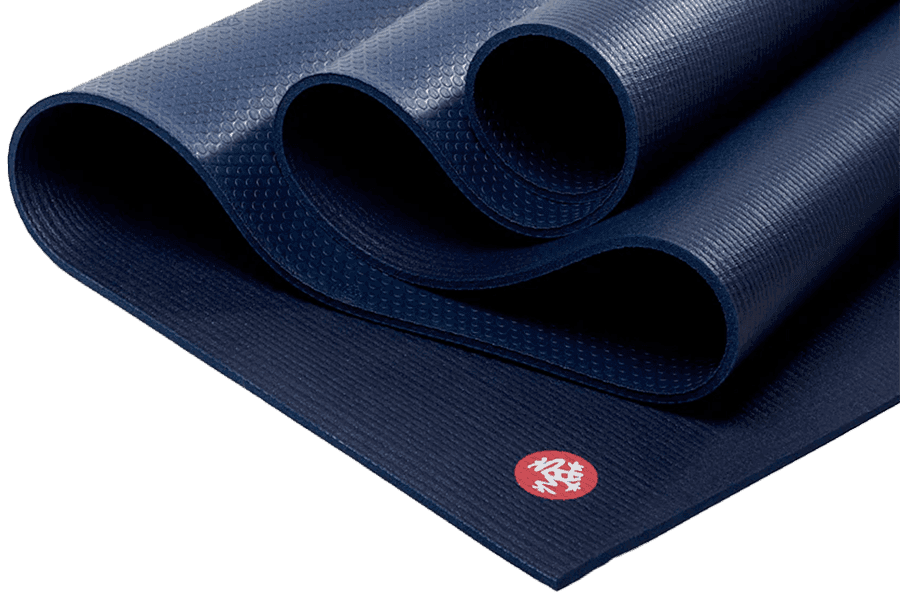
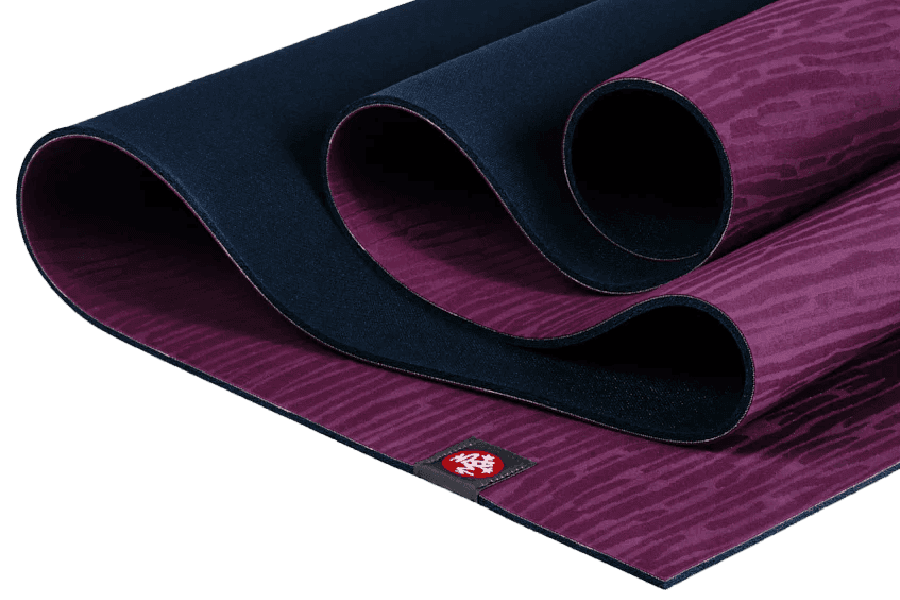
These are two very different mats from the same company. The PRO is the 7.5 pound PVC classic: thick, slick at first, guaranteed for life, and best left in one spot. The eKO Lite is the mat you actually carry: 5 pounds of natural rubber, 4 mm thin, grippy from the first practice, and $48 cheaper at $96. It's also 2 inches narrower and gets no warranty at all. Which one makes sense depends mostly on whether your mat travels.
As an Amazon Associate, we earn from qualifying purchases made through links on this page. How this works
The quick answer
The PRO wins on cushioning (6 mm vs 4), width (26" vs 24"), lifespan, and its lifetime guarantee. The eKO Lite wins on weight (5 lbs vs 7.5), day-one grip, price ($96 vs $144), and materials, if natural rubber matters to you.
If your mat lives in one spot and you kneel a lot, the PRO is worth the extra $48 and the break-in weeks. If you carry your mat to class, the eKO Lite is the one you'll be glad you bought. Just know the rubber won't last like PVC and Manduka won't replace it when it wears.
Get the PRO if...
- Your mat mostly stays in one place
- You want the thicker 6 mm cushion for knees and joints
- You want a mat that lasts decades, with the guarantee to match
- You like the wider 26" footprint
Get the eKO Lite if...
- You carry your mat to class and 7.5 pounds is a dealbreaker
- You want real traction on day one, no break-in
- A renewable material with recycled content matters to you
- You'd rather keep about $48
Side by side
Price
The eKO Lite lists for $48 less.
$144
List price · check price at Amazon
$96
List price · check price at Amazon
Thickness
The PRO is 50% thicker.
6 mm0.24″
4 mm0.16″
Weight
The eKO Lite is 2.5 lbs lighter.
7.5 lbs3.4 kg
5 lbs2.2 kg
Size
Same length; the PRO is 2″ wider.
Same on both
- Made by Manduka
- Same 71" length
- Closed-cell surface (sweat can't soak in)
- Firm, stable feel rather than squishy
- Lies flat without curling
Full specs
Dimensions
Materials & build
Buying
Two mats for two different lives
Start with an honest question: does your mat leave the house? The PRO is built on the assumption that it doesn’t. It’s 7.5 pounds of dense PVC that unrolls in one spot and stays there for a decade or two, guaranteed. The eKO Lite assumes the opposite: 5 pounds of natural rubber, 4 mm thin, made to roll up small and ride to class on your shoulder.
The price gap is the biggest of Manduka’s PRO-versus-eKO matchups: $144 for the PRO, $96 for the eKO Lite. That $48 buys thickness, width, and longevity, or it stays in your pocket and you get the lighter, grippier mat. Almost nobody is genuinely torn between these two once they answer the first question.
Weight: the eKO Lite is the one you carry
Five pounds versus seven and a half, and the roll is slimmer too, since the eKO Lite is 4 mm thick and 24″ wide to the PRO’s 6 mm and 26″. On a shoulder strap, on a bike, on a train, that difference is the entire comparison. The PRO’s weight isn’t a flaw exactly, it’s what makes the mat feel bolted to the floor, but nobody who commutes with a mat ever wished it were heavier.
Grip: day one versus week three
The eKO Lite grips from the first practice. Its surface is ribbed natural rubber, tackier and warmer-feeling than the PRO’s fabric-like finish, with nothing to break in and nothing to learn.
The PRO ships slick, and the first few weeks are the most complained-about stretch of PRO ownership. Manduka has retired its old salt-scrub advice and now says the film simply wears off with use, which matches what owners report. Once broken in, the PRO grips well and keeps improving.
On sweat, neither has an edge. Both are closed-cell, so moisture stays on top rather than absorbing, and Manduka hedges the eKO line’s traction as reliable in dry conditions. Hot yoga regulars will want a towel over either mat. If you want a surface that drinks sweat, that’s Jade territory, and our PRO vs Jade Harmony comparison is the better read.
Cushioning: your floor decides
The PRO’s 6 mm of dense PVC is the firmest, most protective cushion Manduka makes, and it’s the reason the mat tops comfort rankings like OutdoorGearLab’s. The eKO Lite’s 4 mm of rubber is firm with a slight spring, and on a wood floor or carpet most people find it perfectly comfortable.
Hard floors change the answer. On concrete or tile, kneeling poses will find the ground through 4 mm, and the PRO’s extra 2 mm of dense material earns its weight. If you have tender knees and unforgiving floors, that alone should decide this comparison.
The width difference nobody mentions
The PRO is 26″ wide; the eKO Lite is 24″. Two inches sounds trivial until you’ve spent time on a wide mat, where hands and knees stop drifting onto the floor in side work. It’s one of the PRO’s quiet advantages and part of why it feels so expansive in practice. Both mats are 71″ long, so height isn’t a factor here; tall practitioners should read our PRO vs eKO Lite Long comparison instead.
Durability and the warranty gap
The PRO is the longevity champion of the category. Dense PVC barely wears, GearLab found instructors’ PROs still serving after five to twenty years, and Manduka’s lifetime guarantee, about ten years of regular use in the fine print with one replacement, backs it up.
The eKO Lite gets a 30 day return window and nothing after it. Natural rubber oxidizes over time, wears faster under daily vigorous flows, and hates direct sun; owners report surface wear on eKO mats after a few years of hard use. Manduka sells both materials and warranties only one of them, which tells you what its own durability data says.
The eco story
The eKO Lite is the cleaner material by any static measure: rubber tapped from trees, over 30% recycled content, no PVC. The PRO’s counterargument is longevity, one mat for twenty years instead of several mats for seven each. Both cases are honest. If buying fewer petrochemical products is the point, get the eKO Lite and keep it out of the sun so it lasts. One related note: Manduka says the eKO line’s rubber is 99% latex free, which is not latex free, so allergy sufferers should stick with the PRO.
Sizes and colors
The eKO Lite comes in the standard 71″ × 24″ and a 79″ Long at $104, with around eight colorways at last count. The PRO family runs deeper: the standard 71″ × 26″, an 85″ Long, two oversized home-studio cuts, and around fourteen colorways. There’s also the full-thickness 5 mm eKO at $114 if you like the rubber but want more mat under you.
Price, value, and the PROlite question
List prices are $144 and $96. Street prices move with colorways, so check the current price on both the PRO and the eKO Lite before you buy.
One alternative belongs in this conversation. If the eKO Lite’s appeal is the weight rather than the rubber, Manduka’s PROlite splits the difference: 4.6 pounds of the PRO’s PVC, covered by the same lifetime guarantee, at $112. You take back the break-in period and give up the natural material, but you get a light mat that’s warrantied for the long haul. We’d steer most commuters there unless the rubber itself is the draw.
Bottom line
Get the PRO if your mat lives at home and you want to stop thinking about mats for a decade. It’s thicker, wider, and effectively permanent, and the slick first weeks are a toll you pay once.
Get the eKO Lite if you carry your mat and want grip without a break-in, and go in knowing the deal: it’s a mat for years, not decades, with no warranty behind it. At $96 that’s a fair trade. Just also price the PROlite before you commit, because a light mat with a lifetime guarantee is a hard argument to ignore.
Manduka PRO
List price $144
Frequently Asked Questions
- Is the Manduka eKO Lite covered by the lifetime guarantee?
- No. Manduka's lifetime guarantee covers the PRO series only (PRO, PROlite, and PRO Travel). The eKO Lite has no stated warranty beyond Manduka's standard 30 day return window. That gap says something: Manduka itself doesn't expect natural rubber to hold up the way PVC does.
- Is 4 mm enough cushioning for bad knees?
- It depends on your floor. The eKO Lite's 4 mm of natural rubber is firm and springy, and on a carpeted or wood floor most people find it comfortable. On concrete or tile, kneeling poses will find the floor through 4 mm, and the PRO's dense 6 mm is noticeably more forgiving. If knee comfort is your top priority, the PRO is the safer buy.
- Which grips better, the PRO or the eKO Lite?
- Out of the box, the eKO Lite. Its ribbed natural rubber surface has real traction from the first practice, while a new PRO is famously slick and takes a few weeks of regular use to break in. Once broken in, the PRO grips well and keeps improving for years. Both are closed-cell surfaces that keep sweat on top, so a dripping hot yoga class wants a towel on either mat.
- How much lighter is the eKO Lite than the PRO?
- Two and a half pounds: the eKO Lite weighs 5 pounds to the PRO's 7.5. It's also a slimmer roll because it's 4 mm thick and 24" wide versus the PRO's 6 mm and 26". If you walk, bike, or take transit to class, that difference is the whole comparison.
- How long does the eKO Lite last?
- Shorter than the PRO, and that's the honest trade. Natural rubber oxidizes over time, and owners report surface wear after a few years of frequent, vigorous practice; sunlight and harsh cleaners speed that up. The PRO's dense PVC shrugs off all of it and routinely serves a decade or more. Treat the eKO Lite as a mat you'll enjoy for years, not decades.
- Should I get the eKO Lite or the Manduka PROlite instead?
- If you want a lighter Manduka but the PRO's material and guarantee appeal to you, the PROlite is the middle path: 4.7 mm of the same PVC, 4.6 pounds, covered by the lifetime guarantee, at $112. You give up the eKO Lite's day-one grip and natural rubber, and you take on the same break-in period as the PRO. Sweat-prone or eco-minded buyers tend toward the eKO Lite; everyone else should look hard at the PROlite.
Related comparisons
- JadeYoga Harmony 68" vs Manduka eKO Lite
- Manduka eKO Lite vs Suga SugaMat
- Manduka PRO vs b, halfmoon B Mat Strong 6mm
- Manduka PRO vs Alo Warrior
- Manduka PRO vs Yoloha Unity Pro Cork
- Manduka eKO Lite vs Lululemon The Mat 3mm
- Manduka eKO Lite vs JadeYoga Harmony 2.0 68"
- Manduka PRO vs JadeYoga Harmony XW
- JadeYoga Harmony 74" vs Manduka eKO Lite