Manduka PRO vs Jade Level One: Which One Should You Buy?
This is a first-mat budget against a last-mat budget. The Jade Level One is the entry point to Jade's tacky natural rubber, thinner and cheaper than the Harmony but with the same day-one grip. The Manduka PRO costs more than twice as much, arrives slick, and then outlasts everything in this price bracket. Which one makes sense depends almost entirely on how established your practice is.
As an Amazon Associate, we earn from qualifying purchases made through links on this page. How this works
The quick answer
The Level One gives a beginner the thing they actually need: grip from the first class, at 4 mm and $66.50, made in the USA with a tree planted for every mat sold. The PRO gives a committed practitioner what they eventually want: 6 mm of dense PVC that stays flat and solid through a decade of daily use, once you get past a break-in that takes weeks at minimum.
If you are starting out or practice a few times a month, get the Level One and find out whether yoga sticks. If you already practice several times a week and plan to keep at it, the PRO costs less per year than anything on this page.
Get the Manduka PRO if...
- You practice regularly and want the last mat you'll buy for a long time
- You want 6 mm of dense cushion and a bigger 71″ × 26″ platform
- You have a latex allergy; the PRO is PVC and the Jade is natural rubber
- You'd rather break a mat in than replace one every couple of years
Get the Jade Level One if...
- You're new and $66.50 is the right size of bet on a new habit
- You want grip in your very first class, no break-in
- You want the lighter mat to carry at 4 pounds against 7.5
- A USA-made natural rubber mat with a tree planted for it appeals to you
Side by side
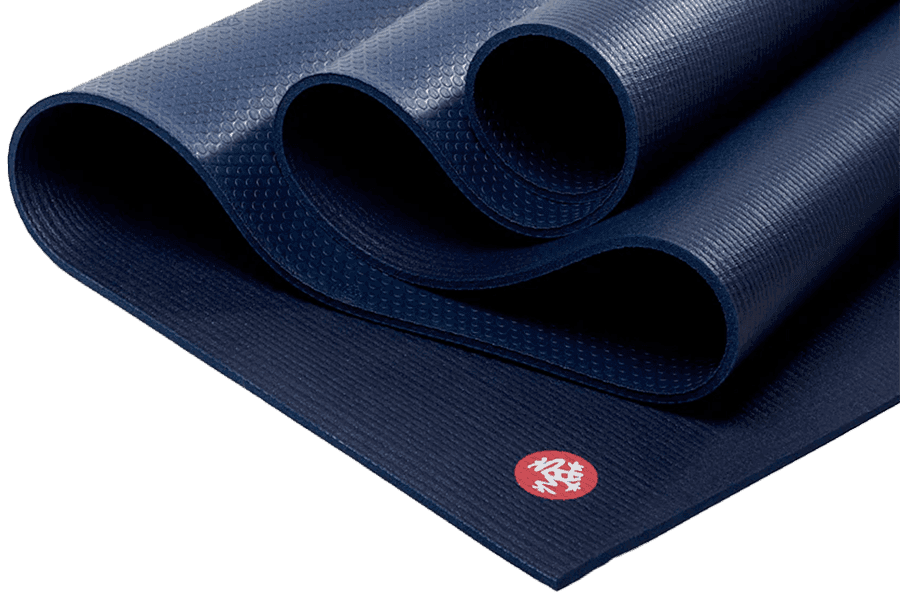
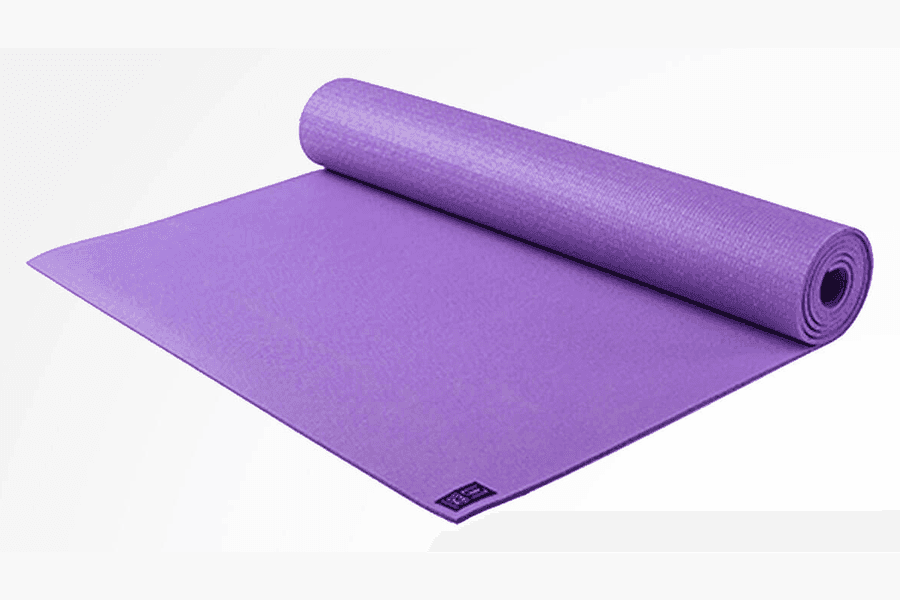
Price
The Level One lists for about $78 less.
$144
List price · check price at Amazon
$66.50
List price · check price at jadeyoga.com
Thickness
The PRO is 50% thicker.
6 mm0.24″
4 mm0.16″
Weight
The Level One is 3.5 lbs lighter.
7.5 lbs3.4 kg
4 lbs1.8 kg
Size
The PRO is 3″ longer; the PRO is 2″ wider.
Same on both
- Firm, stable feel rather than cheap-foam squish
- Textured bottoms that stay put on studio floors
- Neither is made in China
- Neither is a hot yoga specialist
Full specs
Dimensions
Materials & build
Buying
A first mat against a last mat
Jade named this mat honestly. The Level One is the entry point to the company’s tacky natural rubber: thinner than the flagship Harmony, two colors instead of a dozen, $66.50 instead of $99.95. The Manduka PRO sits at the other end of a yoga-mat lifetime, the $144 slab people buy after wearing out two or three mats like the Level One.
That framing does most of the deciding here. A beginner and a ten-year practitioner will read this page and correctly walk away with different mats.
Grip: the Level One works today, the PRO works eventually
The Level One grips the way Jade mats have gripped for decades. The open-cell natural rubber is tacky from the first class, holds damp palms by pulling moisture in, and needs no ritual to get there. For someone learning down dog, that matters more than any other spec on this page, because a beginner who slides usually assumes the problem is them.
The PRO makes you earn it. New PROs are slick enough that Manduka used to recommend a salt scrub; the company has since retired that advice and now says plainly that the slickness resolves with regular use. Owners report weeks to months. A broken-in PRO grips fine with dry hands, and GearLab named it Best for a Daily Practice in its March 2026 roundup on the strength of what it becomes. But nothing about that arc is beginner-friendly.
Cushion: 6 mm dense against 4 mm thin
The PRO is 6 mm of high-density PVC, firm rather than soft, and it protects knees and hips by refusing to compress all the way down. It is also a bigger platform: 71″ × 26″ against the Level One’s 68″ × 24″.
The Level One is 4 mm, the thinnest mat Jade sells short of its travel models, and it is built in a single pass with the reinforcing scrim on the bottom rather than sandwiched in the middle like the Harmony. On a wooden studio floor it feels fine; on concrete or tile, kneeling poses will tell you exactly how thin 4 mm is. Folding it double under the knees is the usual workaround.
Weight: the Level One is the one you carry
At 4 pounds the Level One hangs off a shoulder without complaint. The PRO weighs 7.5, and that number understates how it carries: dense PVC rolls into a stiff, heavy cylinder that makes a walking commute feel longer than it is.
If your mat lives at home or in a studio cubby, the weight buys you stability and is worth having. If it rides to class with you every time, it is a real cost, and Manduka’s own lighter answer is the PROlite.
Durability: this is what the $77.50 buys
The PRO’s dense PVC shrugs off years of daily practice, does not flake or tear, and does not mind sweat sitting on it. Manduka covers it with a lifetime guarantee whose fine print amounts to roughly ten years of regular use, one replacement, and proof of purchase from an authorized seller. Ten years is a realistic expectation, not marketing.
The Level One is natural rubber with a one-year warranty that excludes sun damage and harsh cleaners. Open-cell rubber absorbs sweat, which keeps it grippy and also ages it; heavy sweaters wear Jades faster, and sunlight degrades the rubber outright. Kept indoors and cleaned gently, a few years of regular practice is a fair expectation. That is normal for the material and the price, and it is not a decade.
Materials: rubber virtue against PVC pragmatism
The Level One is natural rubber tapped from trees, made in the USA, with no PVC or EVA in it, and Jade plants a tree for every mat sold, over two million so far. None of that is certified by a third party, but it is all concrete and checkable. The one hard caveat: Jade calls its mats 99% latex free, which is not latex free, so the Level One is out if you have a latex allergy.
The PRO is PVC, made in Germany, OEKO-TEX Standard 100 certified. PVC is the material eco-minded buyers avoid, and it is also why the mat lasts as long as it does, and why it is one of the few premium mats safe for a latex allergy. Both positions are coherent; they just serve different priorities.
The other Jade question: Level One or Harmony
If the Level One appeals to you, the $99.95 Harmony deserves a look before you decide. It is the same rubber grip with almost an extra millimeter of thickness, the scrim sandwiched in the middle of the mat rather than on the bottom, a dozen colorways, and longer sizes in the line. We compare them directly in Jade Harmony vs Level One.
Manduka runs the same play in reverse: its Begin is the $62 starter with none of the PRO’s break-in, aimed at exactly the buyer the Level One is aimed at.
Price and where to buy
The PRO lists at $144; check the current price at Amazon, keeping in mind the guarantee applies to Amazon orders only when sold and shipped by Amazon itself. The Level One lists at $66.50 and is sold direct from JadeYoga; it has no live Amazon listing worth pointing you to.
Per year of use the PRO is likely the cheaper mat, one $144 purchase that runs a decade against a $66.50 mat replaced every few years. But that arithmetic only pays off if you keep practicing, which is precisely what a beginner does not know yet.
Bottom line
Get the Jade Level One if you are starting out, practice a few times a month, or want day-one grip without spending three figures. It is a genuinely good mat, not a compromise, and if yoga sticks you will know exactly what to upgrade to and why.
Get the Manduka PRO if you already practice several times a week, keep your mat in one place, and want to stop thinking about mats for a decade. Sit out the break-in, buy from an authorized seller, and it is the last time this decision comes up for a long while.
Manduka PRO
List price $144
Jade Level One
List price $66.50
Frequently Asked Questions
- Is the Jade Level One good enough to learn on?
- Yes, and grip is the reason. A beginner slipping in down dog usually blames themselves rather than the mat, and the Level One removes that variable from the first class. It is the same tacky natural rubber Jade is known for, just 4 mm thick and built in a single pass with the reinforcing scrim on the bottom of the mat rather than sandwiched in the middle like the Harmony. For learning the basics several times a week, it is plenty of mat.
- Is the Manduka PRO overkill for a beginner?
- Usually. It is a superb mat once broken in, but a new PRO is slick, and a beginner fighting a slippery surface while learning balance poses is having a worse time for no good reason. Add that $144 is a lot to stake on a habit you have not formed yet, and the PRO makes more sense as the mat you upgrade to once you know you practice enough to wear out cheaper ones.
- Can I use either mat with a latex allergy?
- Only the PRO. It is PVC with no natural rubber, which makes it one of the safest premium mats for a latex allergy. Jade describes its mats as 99% latex free, and the company itself notes that is not the same as latex free; the Level One is natural rubber and should be avoided if latex is a problem for you.
- How is the Level One different from the Jade Harmony?
- The Harmony is Jade's flagship: 4.8 mm thick against the Level One's 4, built with the reinforcing scrim in the middle of the mat rather than on the bottom, offered in around a dozen colors against the Level One's two, and priced at $99.95 against $66.50. The grip is the same rubber. The Level One exists so you can get that grip at a beginner price; the Harmony is the one to pick if you want a bit more cushion and expect to practice for years.
- How long will each mat last?
- The PRO is the durability purchase: dense PVC that commonly runs a decade of regular practice, backed by a lifetime guarantee whose fine print works out to roughly ten years, one replacement, and proof of purchase from an authorized seller. The Level One is natural rubber with a one-year warranty that excludes sun damage and harsh cleaners; treated well and kept out of the sun, a few years of regular use is a fair expectation, and heavy sweat shortens that.
- Which is better for hot yoga?
- Neither is the right tool. The Level One's open-cell rubber keeps gripping when damp but drinks in sweat, which means aggressive cleaning and faster wear if you're in hot rooms often. The PRO's closed-cell surface keeps sweat out of the mat but gets slick under wet palms, which is why hot yoga practitioners cover it with a towel. For regular hot practice, a polyurethane-topped mat is the better direction.
Related comparisons
- JadeYoga Level One vs Gaiam Performance Dry-Grip 5mm
- Manduka PRO vs b, halfmoon B Mat Strong 6mm
- Manduka PRO vs Alo Warrior
- Manduka PRO vs Yoloha Unity Pro Cork
- Manduka X vs JadeYoga Level One
- JadeYoga Level One vs IUGA Eco Friendly Non Slip PU
- Manduka PRO vs JadeYoga Harmony XW
- Manduka Begin vs JadeYoga Level One
- JadeYoga Level One vs Gaiam Performance Dry-Grip Long & Wide