Manduka PRO Long & Wide vs Amazon Basics 1 Inch: Which One Should You Buy?
A full inch of cushioning for about $38 sounds like it should end the argument with a $288 Manduka. It does not, because an inch of soft NBR foam is not four times better than 6 mm of dense PVC; it is a different product with a different job. The Amazon Basics 1 Inch is a plush floor pad for stretching, core work, and knees on hard ground. The PRO Long & Wide is 79" × 52" of firm surface for a standing yoga practice at home.
As an Amazon Associate, we earn from qualifying purchases made through links on this page. How this works
The quick answer
For anything done on your back, the Amazon Basics is more comfortable than any yoga mat, including this one. For anything done on your feet, an inch of soft foam is unstable, and no amount of cushioning fixes that. The PRO Long & Wide is dense enough to stand on, wide enough for two people to stretch side by side, and guaranteed for a decade of use.
Buy the Basics as a padded exercise mat and expect a year or two out of it. Buy the PRO Long & Wide if you practice yoga, have the floor for it, and want the mat to be there in ten years. Buying either one to do the other one's job is the only real mistake available here.
Get the PRO Long & Wide if...
- You do standing poses and need a stable surface
- You want a wide practice area at home
- You want cushion that supports joints instead of swallowing them
- You want to buy a mat once
Get the Amazon Basics if...
- You want maximum padding for floor and rehab work
- Your knees, hips, or spine need help on a hard floor
- You want it light and cheap, with a carry strap included
- Standing balance poses are not part of your routine
Side by side
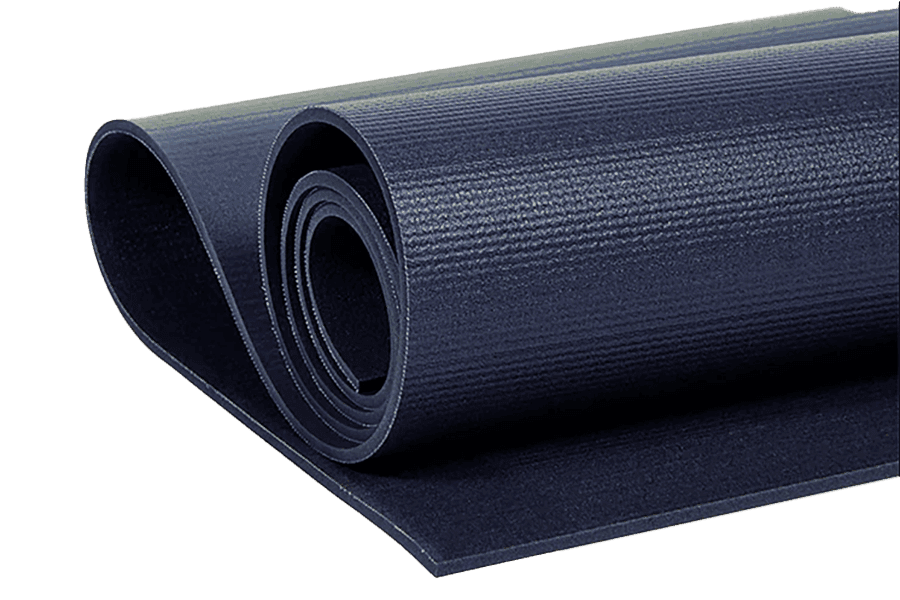
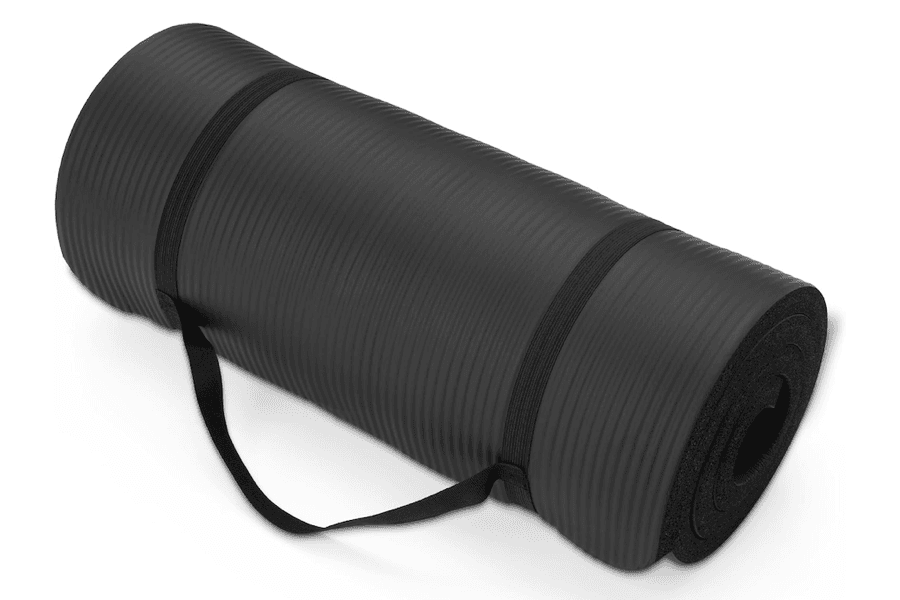
Price
The Amazon Basics lists for about $250 less.
$288
List price · check price at Amazon
$38.40
List price · check price at Amazon
Thickness
The Amazon Basics is 323% thicker.
6 mm0.24″
25.4 mm1″
Weight
The Amazon Basics is 17.4 lbs lighter.
22 lbs10 kg
4.6 lbs2.1 kg
Size
The Long & Wide is 5″ longer; the Long & Wide is 28″ wider.
Same on both
- Textured surfaces that wipe clean
- Both lie flat out of the box
- Neither absorbs sweat
Full specs
Dimensions
Materials & build
A floor pad and a floor
A full inch of cushioning for about $38 looks like it should settle any argument with a $288 Manduka. It does not, because the Amazon Basics 1 Inch is not a thicker yoga mat. It is soft NBR foam sold as a padded exercise surface, and it behaves like one.
The PRO Long & Wide is 79″ × 52″ of dense PVC that stays completely still under you, guaranteed for life, meant to be unrolled once in a room you have set aside for practice. Both are good at what they are for. Almost nobody needs both, and plenty of people buy the wrong one.
You cannot balance on an inch of soft foam
This is the whole argument, so it goes first. An inch of soft foam shifts under your feet as you load it. Lunges feel unsteady, single leg poses turn into an ankle exercise, and Tree pose is a joke. GearLab’s testers said of a comparable 1 inch foam mat that its extreme cushioning does not provide a stable surface for balancing, which matches the physics: the taller the soft stack, the more it moves.
The Long & Wide does not move at all. That is what dense PVC is for, and it is why studios have defaulted to the PRO construction for decades. If your practice includes standing sequences, the foam mat is not a cheaper option; it is a different product that will frustrate you.
Where the inch of foam actually earns its money
Lying down. Core work, stretching, physical therapy routines, anything where your spine, hips, or elbows are pressed into a hard floor for a while. The Basics is more comfortable there than the Manduka, and more comfortable than any yoga mat, because comfort lying still is precisely what soft loft delivers.
Owners buy it for exactly that: a knee-friendly surface on concrete, a pad for rehab exercises, something to soften a garage or a basement. Judged as that, it is a good product at about $38, and no amount of Manduka engineering competes with an inch of squish for lying on.
Thicker is not automatically better for knees
This is the claim that sells thick foam, and it is only half true. Soft foam feels wonderful under a knee for the first second and then bottoms out, letting the knee press through to whatever is below. Dense foam holds. The PRO’s 6 mm compresses barely at all, which is why the PRO construction wins comfort tests against mats four times its thickness and why OutdoorGearLab scored it perfectly for comfort and support.
Put simply: if you are kneeling and holding a pose, you want density. If you are kneeling on concrete to scrub a floor, you want the inch of foam. Yoga is mostly the first thing.
Size: 1,776 square inches against 4,108
The Basics is 74″ × 24″. That is longer than most yoga mats, so anyone up to about six feet lies flat on it, and it rolls up into a fat bundle with a carry strap at 4.6 pounds.
The Long & Wide is 79″ × 52″, more than twice the area, and 22 pounds. It needs a permanent cleared space about 6 feet 7 inches by 4 feet 4 inches. One of these lives in a closet; the other one moves into a room. Tape out the footprint before you buy, because that, more than the $288, is what people regret.
The half inch version is the better foam mat
The same Amazon listing sells this mat at half the thickness for about $16 less, and that is the version outlets like CNN Underscored and Forbes have actually tested and liked as a budget comfort pick. Going from half an inch to a full inch buys more plushness and more wobble, and it makes the roll fatter without fixing anything.
If a foam pad is genuinely what you want, start there; our PRO Long & Wide vs Amazon Basics 1/2 Inch comparison covers it. The full inch earns its place for bony joints on very hard floors and for routines done entirely on the ground.
Durability and smell
Amazon’s own review summary for the Basics line admits durability opinions are mixed, with some owners reporting rips and slippery surfaces. Soft foam also loses loft with use regardless of luck, and a mat whose entire value is loft loses value as the loft goes. The 1 year warranty is a fair signal of the design life. Amazon also recommends airing the mat out for 48 hours to let the new-product odor dissipate, which is unusually straight packaging copy.
The Long & Wide barely wears. GearLab’s testers keep finding instructors’ PRO mats still in service after five to twenty years, and Manduka’s lifetime guarantee (roughly ten years of regular use, one replacement, proof of purchase from an authorized seller) exists because the company can afford it. What it does have is a break-in period: the surface is slick for the first few weeks and then comes good.
Price and value
List prices are $288 for the Long & Wide and about $38 for the Amazon Basics 1 Inch. Amazon pricing moves, so check the current price on the PRO Long & Wide and the Amazon Basics 1 inch mat.
Both are fair value inside their own category. The mistake is the crossover: buying an inch of foam to do standing yoga on, or paying $288 for a surface you are only ever going to lie down on. If you want a real yoga mat on a budget, a firm 4 to 6 mm mat in the $25 to $50 range beats more foam every time.
Bottom line
Buy the Amazon Basics 1 Inch if your routine happens on the ground and your floor is hard. It is the most comfortable thing here to lie on, it weighs 4.6 pounds, it comes with a strap, and it costs about $38. Expect a year or two, and buy the half inch version instead if you ever plan to stand on it.
Buy the PRO Long & Wide if you practice yoga at home and want room to move. It is dense, still, wide enough for two people, and guaranteed for a decade of use. It also costs $250 more and takes over a room, so buy it because you have the practice and the space, not because it is the better mat on paper.
Amazon Basics 1 Inch Extra Thick
List price $38.40
Frequently Asked Questions
- Can you do yoga on a 1 inch thick mat?
- Floor yoga, yes. Standing yoga, not well. An inch of soft foam shifts under your feet as you load it, so lunges feel unsteady and balance poses are close to impossible. GearLab's testers said of a comparable 1 inch foam mat that its extreme cushioning does not provide a stable surface for balancing, which matches the physics: the taller the soft stack, the more it moves.
- Is the 1/2 inch version a better buy?
- For most people, yes. The half inch Amazon Basics is the one outlets like CNN Underscored and Forbes have actually tested and liked as a budget comfort pick, it costs about $16 less, and it rolls up smaller. Going to a full inch buys more plushness and more wobble. The 1 inch earns its place mainly for bony joints on very hard floors and physical therapy routines done lying down.
- How much cushioning does the PRO Long & Wide actually give you?
- 6 mm, but of a material that barely compresses. Dense PVC holds its shape under a knee or a planted palm instead of bottoming out, which is why the PRO construction earned a perfect comfort and support score from OutdoorGearLab despite being a quarter the thickness of this foam mat. It is firm, not soft, and that is the point.
- How do they compare on size?
- The Basics is 74" × 24", or 1,776 square inches, which is longer than most yoga mats but still a single narrow strip. The PRO Long & Wide is 79" × 52", or 4,108 square inches, and needs a cleared area of roughly 6 feet 7 inches by 4 feet 4 inches. One of these fits in a closet. The other one moves in.
- Does the Amazon Basics mat smell?
- Amazon's own listing recommends airing it out for 48 hours to let the new-product odor dissipate, which is unusually straight packaging copy. It fades. The PRO Long & Wide has very little smell out of the box; what it has instead is a slick surface that takes a few weeks of practice to break in.
- Which lasts longer?
- The PRO, by a lot. Amazon's own review summary for the Basics line is candid that durability opinions are mixed, with some owners reporting tears and slippery surfaces, and soft foam loses loft with use regardless. It carries a 1 year warranty. The PRO Long & Wide carries Manduka's lifetime guarantee, which the fine print defines as roughly ten years of regular use with one replacement, and dense PVC routinely goes the distance.
Related comparisons
- Amazon Basics 1 Inch Extra Thick vs Retrospec Solana 1"
- Manduka PRO Long & Wide vs JadeYoga Fusion XW
- Amazon Basics 1 Inch Extra Thick vs Retrospec Solana 1/2"
- Manduka PRO Long & Wide vs Liforme XL 4.2mm
- Amazon Basics 1 Inch Extra Thick vs Gaiam Essentials Fitness Mat 10mm
- Manduka PRO Long & Wide vs JadeYoga Fusion 74"
- Amazon Basics 1 Inch Extra Thick vs Gaiam Premium Reversible 6mm
- Manduka PRO Long & Wide vs Öko Living Herbal Yoga Mat 5mm
- Amazon Basics 1 Inch Extra Thick vs Gaiam Premium 6mm