Manduka eKO vs Retrospec Solana 1/2": Which One Should You Buy?
The eKO is Manduka's natural rubber mat and the second-highest scoring mat in GearLab's 2026 test, with the best dry grip result of the whole field. The Solana 1/2" is soft NBR foam, three pounds lighter and about $89 cheaper. One of these is a grip mat and one is a cushion, and you almost certainly only need one of those things.
As an Amazon Associate, we earn from qualifying purchases made through links on this page. How this works
The quick answer
GearLab scored the eKO 87 out of 100, second of 19 mats, with a perfect 10 for dry grip, 9 for comfort and support and 8 for materials. It is 7 pounds of closed-cell natural rubber made in Taiwan, and the current version carries over 30% recycled content. The Solana 1/2" is 12.7 mm of NBR foam with a ribbed surface and a nylon strap, about $25, and 4.4 stars from roughly 9,200 Amazon buyers.
For yoga, the eKO is the better mat by a distance and the grip is not close. The Solana wins if your knees are the reason you are shopping, if your session is mostly on the floor, or if you want a light mat you will not mind replacing.
Get the Manduka eKO if...
- You want the best dry grip GearLab measured in 2026
- You do standing poses and want a surface that holds still
- You want natural rubber rather than petroleum foam
- You want 26 inches of width instead of 24
Get the Retrospec Solana 1/2" if...
- Your knees or hips need padding on a hard floor
- You mostly stretch, do Pilates or floor workouts
- You want 3 pounds to carry rather than 7
- You'd rather keep about $89
Side by side
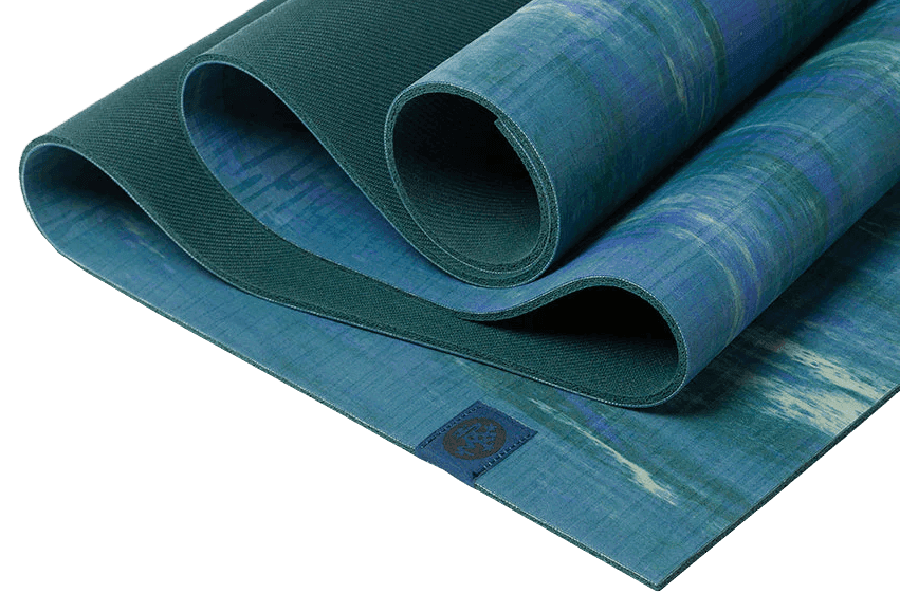
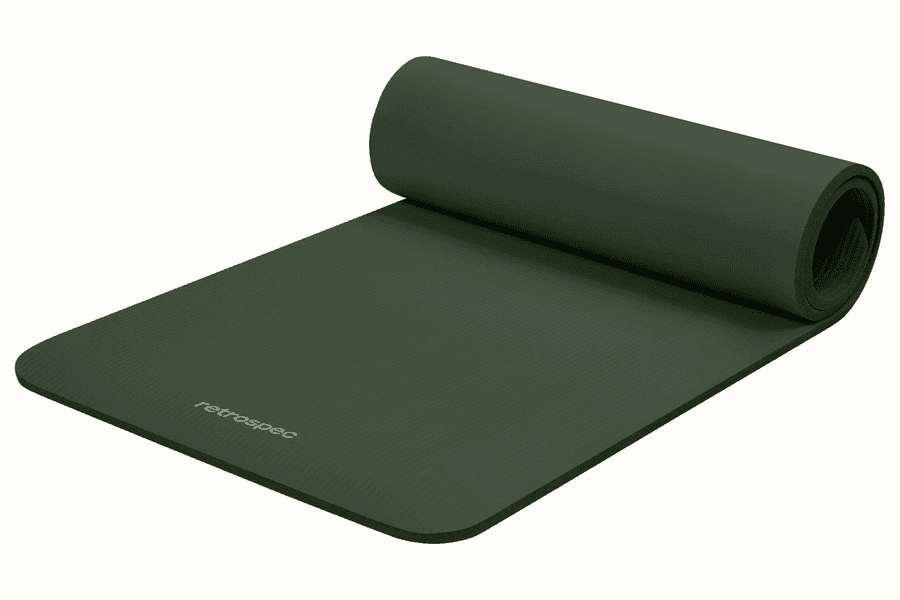
Price
The Solana 1/2" lists for about $89 less.
$114
List price · check price at Amazon
$24.99
List price · check price at Amazon
Thickness
The Solana 1/2" is 154% thicker.
5 mm0.2″
12.7 mm0.5″
Weight
The Solana 1/2" is 4 lbs lighter.
7 lbs3.2 kg
3 lbs1.36 kg
Size
The Solana 1/2" is 1″ longer; the eKO is 2″ wider.
Same on both
- Closed-cell, so sweat sits on the surface
- Around 71 to 72 inches long
- Both arrive with a smell that needs airing out
- Neither should be left in direct sun
Full specs
Dimensions
Materials & build
The grippiest mat in the test against half an inch of foam
GearLab handed the eKO a perfect 10 for dry grip in its 2026 test, the best result of the 19 mats it measured, and placed it second overall at 87 out of 100. It is 7 pounds of closed-cell natural rubber for $114.
The Solana 1/2″ takes the opposite approach: 12.7 mm of soft NBR foam, 3 pounds, about $24.99, and 4.4 stars from roughly 9,200 Amazon buyers. One of these is a grip problem solved and one is a joint problem solved.
How a closed-cell mat wins on grip
Natural rubber is tacky by nature. Manduka gives the eKO a textured closed-cell surface, so it grips through friction rather than by absorbing sweat the way an open-cell mat does. In a normal room that is as secure as a mat gets, which is what the perfect dry score reflects.
The limit shows up when you are genuinely dripping. Sweat has nowhere to go on a closed-cell surface, and GearLab’s 7 out of 10 wet puts the eKO mid-pack. The Solana’s ribbed foam has no answer at all once your palms are damp, which is normal for the material.
Standing on rubber against standing on foam
The eKO is dense and does not deflect, and it is heavy enough that it does not creep on a wood floor mid-flow. GearLab rated it 9 out of 10 for comfort and support, a measure of how well the surface holds you rather than how soft it feels.
At 12.7 mm the Solana compresses unevenly under one foot, so balance holds involve managing the mat as well as yourself. Retrospec calls this the steadier of its two Solanas, which is true relative to the 1″ version rather than relative to a yoga mat.
Where the foam wins outright
Kneeling. Half an inch of soft NBR is far kinder on a kneecap than 5 mm of dense rubber, and on tile or hardwood the difference is obvious in low lunges, table top and anything seated.
A folded blanket on the eKO gets you most of that padding exactly where you need it, without softening the parts of the mat you stand on. That is the route most people with sore knees end up taking, and it costs nothing.
The eKO smells, and it is the mat’s best-known flaw
Natural rubber comes out of the wrapper smelling strongly, and the eKO is no exception. It takes a couple of weeks of unrolled airing to settle, and some owners never entirely stop noticing it. The mat’s Amazon rating sits around 4.1 stars across roughly 700 ratings, modest for a mat that tests this well, and odor turns up repeatedly in the reviews.
The Solana has its own version of this. Retrospec tells buyers the NBR foam may release a harmless odor and asks them to air it for a day or two. That one fades faster.
Seven pounds against three
Manduka specs the eKO at 7 pounds and GearLab measured 6.3, which is heavy for a 5 mm mat. That mass is part of why it stays planted, and it is a genuine consideration on a walk to a studio.
The Solana is 3 pounds with a nylon strap included. If the eKO’s weight is what puts you off, Manduka’s own eKO Lite and eKO Superlite are the lighter versions of the same idea.
Neither one is well covered
This surprises people: Manduka’s lifetime guarantee applies to the PRO and PROlite lines, not the eKO. The eKO comes with a 30 day return window and nothing beyond it. It is a well-made mat, GearLab rated its materials 8 out of 10, but the paperwork does not back it the way a PRO’s does.
Retrospec warrants manufacturing defects for six months and takes returns within 30 days for unused product. Foam denting and rubber losing tack are both wear, so neither is covered by either policy.
The latex note
The eKO is natural rubber, so anyone with a latex allergy should avoid it. That is not a technicality and it rules the mat out regardless of how well it scores.
NBR is nitrile butadiene rubber, a synthetic foam, and Retrospec lists the Solana as free of latex, BPA, phthalates and heavy metals. If allergy is a factor, the cheap mat wins this outright.
Price and value
List prices are $114 and $24.99. Check the current price on the eKO at Amazon and the Solana at Amazon before deciding.
The eKO is not the cheapest way to get good grip, and it is one of the best. If $114 is more than you want to spend on rubber, our eKO vs Gaiam Premium comparison covers the budget end of the same question.
Bottom line
Buy the Manduka eKO if you want traction. It took the best dry grip score in GearLab’s 2026 field and finished second overall, and the things it asks of you are weight, a rubber smell for a fortnight, and no warranty.
Buy the Retrospec Solana 1/2″ if your knees are the reason you are shopping and your session is mostly on the ground. It is comfortable, light and cheap, and it is honest about being an exercise mat first.
Manduka eKO
List price $114
Retrospec Solana 1/2"
List price $24.99
Frequently Asked Questions
- How can a closed-cell mat have the best grip in the test?
- GearLab gave the eKO a perfect 10 for dry grip, the top score in its 2026 field of 19, and 7 out of 10 wet. Natural rubber is tacky by nature, so it grips through surface friction rather than by absorbing moisture the way an open-cell mat does. That means excellent traction in a normal room and a limit once you are genuinely dripping, which is where the wet score lands it mid-pack.
- Is 5 mm enough cushion?
- For standing and flowing, comfortably. GearLab rated the eKO 9 out of 10 for comfort and support, which measures how well the surface holds you rather than how soft it is. For kneeling on tile it is firm, and half an inch of Solana foam is much kinder. A folded blanket under a knee is the cheap fix and it keeps the eKO's footing.
- Does the eKO smell?
- Yes, and it is the most common complaint about the mat. Natural rubber has a strong smell out of the wrapper that takes a couple of weeks of airing to settle, and some people never fully stop noticing it. Its Amazon rating sits at about 4.1 stars across roughly 700 ratings, which is lower than you might expect for a mat that tests this well, and odor is a recurring theme. The Solana's NBR foam smells too; Retrospec asks you to air it for a day or two.
- Does the eKO have a warranty?
- No, and this surprises people who assume Manduka's lifetime guarantee covers everything. That guarantee applies to the PRO and PROlite lines, not the eKO, which comes with a 30 day return window and nothing more. Retrospec offers six months against manufacturing defects plus 30 day returns. Neither covers normal wear.
- Is the eKO safe with a latex allergy?
- No. It is natural rubber, so anyone with a latex allergy should avoid it. The Solana's NBR is a synthetic nitrile rubber foam, and Retrospec lists the mat as free of latex, BPA, phthalates and heavy metals, which makes it the safer option in that case.
- How long does each one last?
- The eKO's rubber gradually loses tack over years and is degraded fast by sunlight, but it is a dense, well-made mat and GearLab rated its materials 8 out of 10. The Solana's foam takes permanent dents where knees, elbows and heels land, usually inside a year of steady use, and the edges tear before the middle fails.
Related comparisons
- Amazon Basics 1/2 Inch Extra Thick vs Retrospec Solana 1/2"
- Manduka eKO vs Lululemon The (Big) Mat 5mm
- Lululemon The Mat 5mm vs Manduka eKO
- JadeYoga Harmony 74" vs Manduka eKO
- Manduka eKO vs JadeYoga Harmony 2.0 68"
- Manduka eKO vs Suga SugaMat
- Retrospec Solana 1/2" vs Gaiam Essentials Fitness Mat 10mm
- JadeYoga Harmony 68" vs Manduka eKO
- Manduka eKO vs Yoga Design Lab Combo 3.5mm