Manduka eKO vs Gaiam Performance Dry-Grip Long & Wide: Which One Should You Buy?
Both of these were measured by GearLab in 2026 and the results are a long way apart: 87 out of 100 for the eKO, second of 19, against 62 for the Dry-Grip construction. Gaiam's answer is size and price, 78 by 26 inches for $74.98 against the eKO's 71 by 26 for $114. If you are tall, that changes the calculation.
As an Amazon Associate, we earn from qualifying purchases made through links on this page. How this works
The quick answer
The eKO is closed-cell natural rubber with the best dry grip GearLab measured in its 2026 field, a perfect 10, plus 9 for comfort and support and 8 for materials. The Gaiam covers more floor for less money and uses a topcoat meant to wick moisture, which GearLab scored 3.5 out of 10 wet, second worst of 19, against Gaiam's claim that the mat is ideal for hot yoga.
Take the Gaiam if 78 inches solves a real problem, because a mat you do not fit on is worse than a mat that grips less. Otherwise the eKO is the better mat and the extra $39 buys traction, density and materials that hold up.
Get the Manduka eKO if...
- You want the grippiest dry surface in GearLab's 2026 test
- You want natural rubber rather than coated PVC foam
- You want a heavy mat that never shifts on a slick floor
- 71 inches of length is enough for you
Get the Gaiam Dry-Grip Long & Wide if...
- You're tall and need 78 inches rather than 71
- You want the biggest mat available under $80
- You want a lifetime guarantee on paper
- You'd rather keep about $39
Side by side
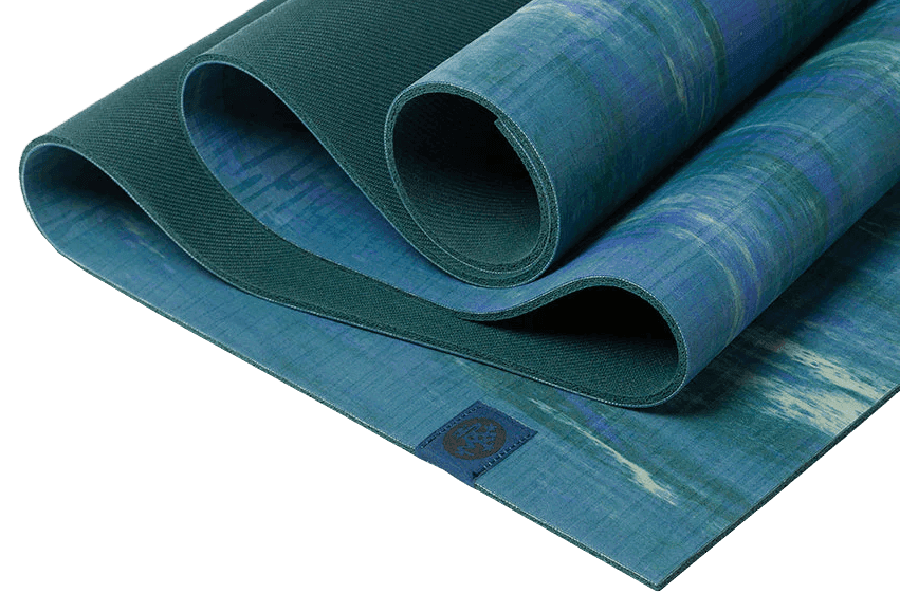
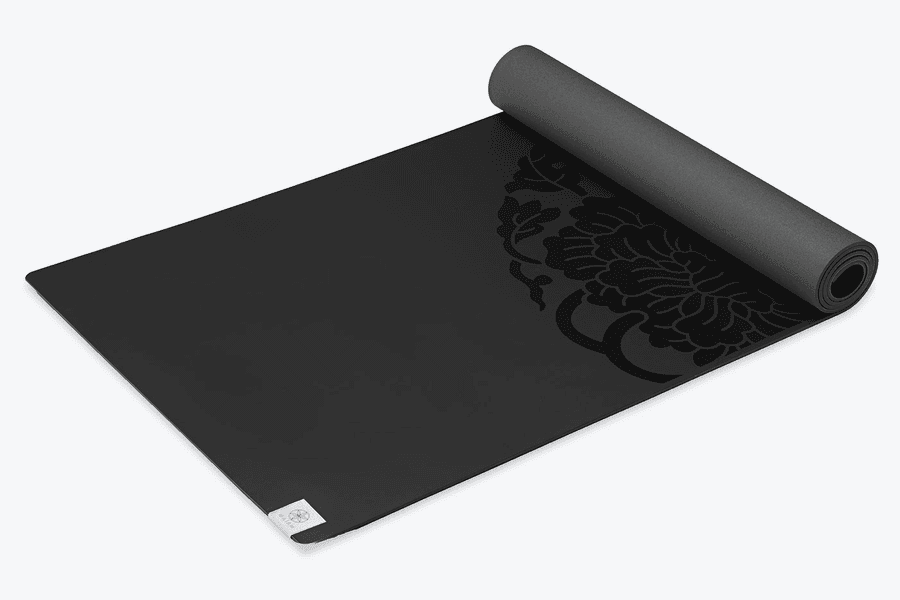
Price
The Dry-Grip L&W lists for about $39 less.
$114
List price · check price at Amazon
$74.98
List price · check price at Amazon
Thickness
Identical thickness.
5 mm0.2″
5 mm0.2″
Weight
The Dry-Grip L&W is 2 lbs lighter.
7 lbs3.2 kg
5 lbs2.27 kg
Size
The Dry-Grip L&W is 7″ longer; same width.
Same on both
- 26 inches wide
- 5 mm thick
- Both were tested by GearLab in its 2026 round-up
- Both need airing out before the first session
Full specs
Dimensions
Materials & build
Second of nineteen against a mid-table finish
GearLab scored the eKO 87 out of 100 in its 2026 test, second overall, with the best dry grip of the whole field. It scored the Dry-Grip construction 62. Both are 5 mm, both are 26 inches wide, and one costs $114 while the other costs $74.98.
Gaiam’s counter-argument is floor space. The Long & Wide cut runs 78″ against the eKO’s 71″, and for a tall person that is not a detail.
Grip: rubber against a topcoat
The eKO grips through the material itself. Natural rubber is tacky, Manduka texturises it, and GearLab measured 10 out of 10 dry, the top score in a field of 19, with 7 wet. Closed-cell construction is why the wet number is not higher; sweat has nowhere to go.
The Gaiam grips through a coating applied to PVC foam. GearLab measured the standard Dry-Grip at 6.5 dry and 3.5 wet, second worst in the field for wet grip, against Gaiam’s listing describing the mat as ideal for hot yoga. That description is the company’s own, not a test result.
Seven inches of length for less money
At 71 inches the eKO is a standard length mat, which means anyone over about six foot ends up with heels or head on the floor in savasana. The Gaiam’s 78 inches fixes that and costs $39 less while doing it.
Manduka’s own answer is the eKO Long at 79″ × 26″, which is longer than the Gaiam and about $10 more than the standard eKO. If length is your issue and you want the rubber, that is the cleaner solution.
Materials: 8 out of 10 against 4
This is the widest gap in the sub-scores. The eKO is dense natural rubber made in Taiwan with over 30% recycled content in the current version. It is a well-built object and it feels like one.
A dry-grip topcoat is a thin layer bonded to PVC foam. It thins out where hands and feet keep landing, and once it goes you are left with a plain PVC mat. That is what a 4 out of 10 describes, and it is the honest limit on a mat that covers this much floor for $75.
Feel: firm rubber against softer coated foam
GearLab rated the eKO 9 out of 10 for comfort and support and the standard Dry-Grip 8, so this is closer than the overall scores suggest. The eKO is denser and does not deflect; the Gaiam has more give, which is kinder when you kneel and less certain when you stand on one leg.
The eKO is also the heavier mat at 7 pounds against 5, and it never creeps on a polished floor because of it.
Both need airing, and neither likes the sun
The eKO’s natural rubber smell is strong out of the wrapper and takes about two weeks of unrolled airing to settle. It is the mat’s most common complaint, and it keeps its Amazon rating around 4.1 stars across roughly 700 ratings despite the test results.
Gaiam asks you to unroll the mat and air it for two to three days before your first session, and publishes a guide about removing the new-mat smell. It also warns that extended sun exposure makes the mat fade and turn brittle. Sun degrades natural rubber too, so neither belongs on a balcony.
A lifetime guarantee against nothing at all
On paper Gaiam wins outright. Its lifetime guarantee covers manufacturing defects, which is not the same as a topcoat wearing thin or foam compressing, and those are the two ways this mat actually ends.
Manduka’s lifetime guarantee does not extend to the eKO line at all; the eKO comes with a 30 day return window. If the warranty is what you care about, our PRO vs eKO comparison covers the Manduka mat that carries one.
One of these is rubber-free on purpose
The eKO is natural rubber, so it is off the table for anyone with a latex allergy. Gaiam mentions the Dry-Grip’s rubber-free construction specifically for people with latex sensitivities, which is a legitimate reason to choose it over a better-scoring mat.
If you need to avoid rubber but want better grip than a topcoat offers, the polyurethane-topped mats are the other route, though most of them still use a rubber base layer.
Price and value
List prices are $114 and $74.98. Check the current price on the eKO at Amazon and the Gaiam Dry-Grip at Amazon, where the listing carries several sizes and you need to select the 78 by 26 inch version rather than the standard 68 by 24.
The Gaiam is the value pick and the tall person’s pick. The eKO is the better mat by every measure that involves your hands staying put.
Bottom line
Buy the Gaiam Performance Dry-Grip Long & Wide if you are tall or shopping on a budget. It covers more floor than anything else near $75, and its weakness is a wet grip score you may never test if you practice in a cool room.
Buy the Manduka eKO if grip is the reason you are here. It is the grippiest dry mat GearLab measured and second overall in the test, and the trade-offs are weight, a rubber smell for a fortnight, and a 30 day return window instead of a warranty.
Manduka eKO
List price $114
Frequently Asked Questions
- How far apart is the grip, really?
- Further than the marketing suggests. GearLab measured the eKO at 10 out of 10 dry and 7 wet, the best dry score in a field of 19. The standard Gaiam Dry-Grip, the same construction in a smaller cut, came in at 6.5 dry and 3.5 wet, second from the bottom for wet grip. Gaiam's listing still describes the mat as ideal for hot yoga, which is the company's copy rather than a test result.
- How much difference do the extra inches make?
- For anyone over about six foot, quite a lot. On a 71 inch mat your heels or head end up on the floor in savasana and your back foot hangs off the end in a long lunge. The Gaiam's 78 by 26 fixes both for less money. Manduka's answer is the eKO Long at 79 by 26 inches, which costs about $10 more than the standard eKO.
- Which one lasts longer?
- The eKO. GearLab rated its materials 8 out of 10 against the Dry-Grip's 4. A dry-grip topcoat is a thin layer bonded to PVC, and it thins out where hands and feet land; once it goes you have a plain PVC mat. The eKO's rubber loses tack gradually and is killed quickly by sunlight, but the mat itself is dense and well made.
- What about the two warranties?
- On paper Gaiam wins, and in practice it is murkier. Gaiam's lifetime guarantee covers manufacturing defects, not a topcoat wearing thin or foam compressing, which is how the mat actually ends. Manduka's lifetime guarantee does not cover the eKO line at all; the eKO gets a 30 day return window. Neither is a reason to pick one over the other.
- Does either one smell?
- Both, differently. The eKO's natural rubber smell is strong out of the wrapper and takes a couple of weeks to settle, and it is the most common complaint about the mat. Gaiam asks you to unroll its mat and air it for two to three days before the first session, and publishes a guide about removing the smell, which tells you how often it comes up.
- Is the eKO safe with a latex allergy?
- No. Natural rubber means anyone with a latex allergy should avoid it. Gaiam makes a point of the Dry-Grip's rubber-free construction for exactly this reason, so if allergy is a factor the choice is settled regardless of the test scores.
Related comparisons
- Manduka X vs Gaiam Performance Dry-Grip Long & Wide
- Manduka eKO vs Lululemon The (Big) Mat 5mm
- Lululemon The Mat 5mm vs Manduka eKO
- JadeYoga Harmony 74" vs Manduka eKO
- Manduka eKO vs JadeYoga Harmony 2.0 68"
- Hugger Mugger Earth Elements 5mm vs Gaiam Performance Dry-Grip Long & Wide
- Manduka GRP Adapt 1.0 vs Gaiam Performance Dry-Grip Long & Wide
- Suga SugaMat vs Gaiam Performance Dry-Grip Long & Wide
- JadeYoga Level One vs Gaiam Performance Dry-Grip Long & Wide