Manduka eKO vs Gaiam Classic Print: Which One Should You Buy?
The Manduka eKO is the second-highest scoring mat in OutdoorGearLab's 19 mat test and the only one that earned a perfect 10 for dry grip. The Gaiam Classic Print costs $24.98, weighs a third as much, and is the mat most people already own. This is a comparison between a very good mat with one real drawback and a cheap mat with several.
As an Amazon Associate, we earn from qualifying purchases made through links on this page. How this works
The quick answer
On the floor the eKO is the better mat by a distance. Natural rubber, 5 mm, 26 inches wide, and grip that GearLab scored a straight 10 out of 10 dry, with no break-in and no slickness to work through. It placed second overall out of 19 mats and lost points mainly for weight.
That weight is the catch, and it is a big one: 7 pounds against the Gaiam's 2.1. If your mat lives in one room, the eKO is an easy recommendation. If it goes on a shoulder to a studio three times a week, try carrying one before you commit, and consider the eKO Lite instead.
Get the Manduka eKO if...
- You want the best dry grip in a mainstream mat
- The mat mostly stays in one place
- You want 26″ of width and 5 mm of dense rubber
- You want natural rubber rather than PVC
Get the Gaiam Classic Print if...
- You carry your mat and 2.1 pounds matters
- You have a latex allergy; the eKO is natural rubber
- You want to spend $24.98 rather than $114
- You want a mat you can leave in a hot car without worrying
Side by side
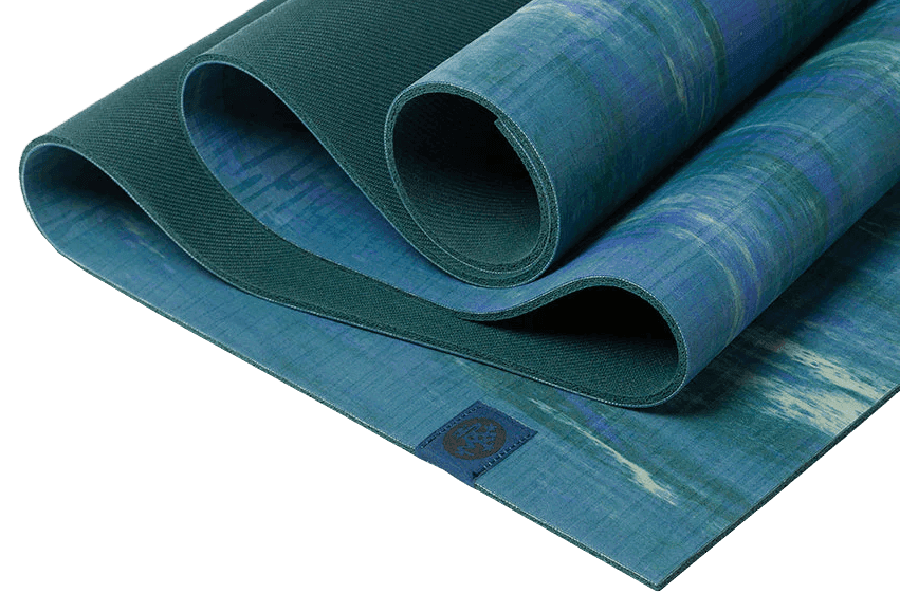
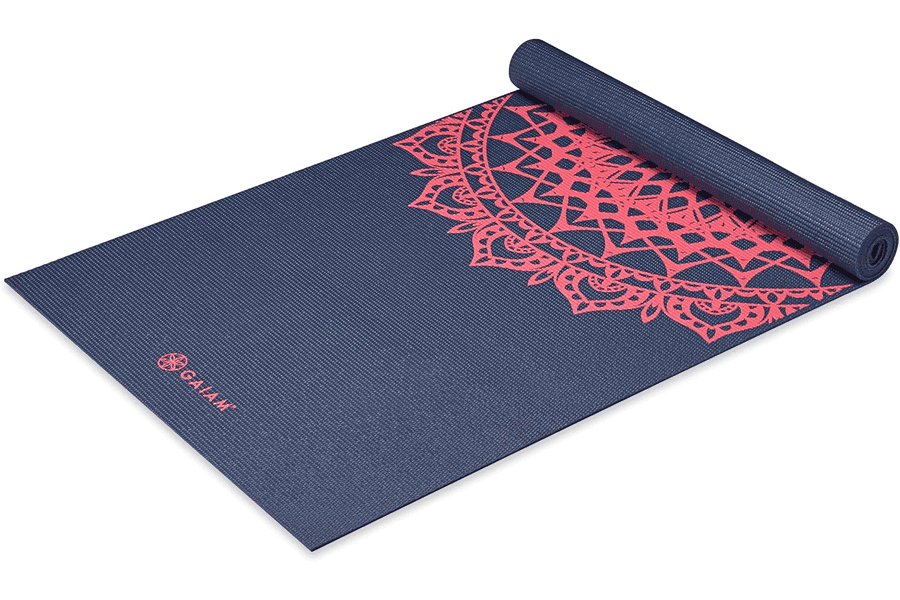
Price
The Classic Print lists for about $89 less.
$114
List price · check price at Amazon
$24.98
List price · check price at Amazon
Thickness
The eKO is 25% thicker.
5 mm0.2″
4 mm0.16″
Weight
The Classic Print is 4.9 lbs lighter.
7 lbs3.2 kg
2.1 lbs0.95 kg
Size
The eKO is 3″ longer; the eKO is 2″ wider.
Same on both
- Grippy with dry hands from the first session, no break-in
- Both lose traction once your palms are genuinely wet
- Wipe-clean only; neither goes in a washing machine
- Both come in a handful of colors or prints
Full specs
Dimensions
Materials & build
Buying
A top-rated mat against the one most people already own
The Manduka eKO placed second out of nineteen mats in OutdoorGearLab’s test, at 87 out of 100, behind only the Manduka PRO. It is 5 mm of natural rubber, 26 inches wide, and it earned the only perfect dry grip score in the group.
The Gaiam Classic Print is a $24.98 printed PVC mat that weighs 2.1 pounds and has been most people’s first yoga mat for two decades.
The eKO is a much better mat and it has one problem the Gaiam does not: it weighs 7 pounds.
A 10 out of 10 for dry grip, and what that means
GearLab rated the eKO 10 out of 10 for dry grip, the only mat in the test to take full marks, and 9 out of 10 for grip overall. No break in period, no slick factory finish to wear through. Unroll it and it holds.
The qualifier is moisture. The eKO is closed-cell, so sweat sits on the surface rather than soaking in, and GearLab put more slippery when wet in its cons. It is superb in a normal room and merely fine once you are dripping.
The Gaiam’s sticky PVC is decent dry and poor damp, which is the same shape of behavior at a much lower level. If grip is why you are reading this, the gap is not subtle.
Seven pounds is the catch
Manduka lists the eKO at 7 pounds and GearLab measured 6.3. Either way it is more than three times the Gaiam’s 2.1, and weight is the main thing that kept the eKO off the top of that test.
Ten minutes on a shoulder is fine. A twenty minute walk plus a subway ride, four days a week, is a different experience, and it is the reason plenty of eKO owners end up with a second lighter mat.
Manduka’s own answer is the eKO Lite, which is 4 mm and 5 pounds and gives up a little cushion for a mat you will actually bring with you. If your mat never leaves one room, ignore this section entirely.
Cushion, width, and how they feel underfoot
The eKO is 5 mm of dense rubber and 26 inches wide; the Gaiam is 4 mm and 24. GearLab scored the eKO 9 out of 10 for comfort and support and called it good on hard and soft ground alike.
The extra two inches of width is easy to underrate until you have it and your hands stop hanging off the edge in a wide down dog. The extra millimeter of dense rubber is worth more than a millimeter of foam, because it does not compress away over the first year.
The rubber smell, and how long it lasts
A new eKO smells of rubber, sometimes strongly, and it can take a week or two of use and fresh air to fade. This surprises people who have only owned PVC mats. It is normal for natural rubber and it is not a fault, but it is real, and in a small apartment it is worth unrolling the mat somewhere ventilated for a few days first.
The Gaiam has a mild plastic smell that clears within a couple of days. If smells are a genuine problem for you, that is a point in the cheap mat’s favor and one of the few it has here.
Care, storage, and how long each survives
The eKO outlasts the Gaiam by years, which is not what the coverage suggests: Manduka gives the eKO a 30 day return window and no warranty at all, while Gaiam advertises a lifetime guarantee on the Classic Print. The warranty terms line up poorly with how the materials actually wear.
Rubber does need a bit of respect. Keep the eKO out of direct sun and hot cars, which degrade it, and roll it rather than folding it, since GearLab noted it creases easily. The Gaiam tolerates all of this and simply flattens under your hands and heels instead, which is the thing that ends its life.
Latex, PVC, and which one you can actually use
The eKO is tapped tree rubber, so a genuine latex allergy rules it out completely. The Gaiam Classic Print is latex-free PVC and is the safe option.
If that is you and you still want Manduka build quality, the answer is their PVC line rather than their rubber one. The PROlite is the closest equivalent, with a lifetime guarantee and no rubber anywhere in it.
Price and where to buy
List is $114 against $24.98, and both move. Check the current eKO price at Amazon and the current Classic Print price at Amazon. Manduka discounts retiring colorways on its own site regularly, so it is worth checking both before you buy.
The eKO also comes in a 79″ Long for taller practitioners. The Classic Print is sold in one size.
Bottom line
Buy the Gaiam Classic Print if you are new and finding out whether this sticks, if you carry your mat every day, or if latex is a problem. It grips well enough for a gentle practice and it costs almost nothing.
Buy the Manduka eKO if the mat mostly stays put and you want one of the best surfaces available in a mainstream mat. The grip is the upgrade you notice on day one, the width is the one you notice in month two, and the weight is the thing to think hard about before you order.
Manduka eKO
List price $114
Gaiam Classic Print 4mm
List price $24.98
Frequently Asked Questions
- How much better is the eKO's grip?
- Measurably better. OutdoorGearLab rated the eKO 10 out of 10 for dry grip, the only mat in its 19 mat test to score full marks, and 9 out of 10 for grip overall. It also noted the mat is more slippery when wet, so the advantage is with dry or lightly damp hands rather than in a heated room. The Classic Print's sticky PVC is fine dry and gives up quickly once you sweat.
- Is the eKO too heavy to carry?
- For a lot of people, yes. It is 7 pounds by Manduka's figure and GearLab measured 6.3, against 2.1 for the Gaiam, and weight is the main thing that kept the eKO off the top of that test. Ten minutes on a shoulder is fine; a daily walk and a subway ride is not. Manduka's own answer is the eKO Lite at 4 mm and 5 pounds, which trades a little cushion for a mat you will actually bring.
- Does the eKO smell?
- New ones do, of rubber, and it can be strong for the first week or two before fading with use and air. That is normal for natural rubber and not a defect. The Gaiam has a mild plastic smell that clears in a couple of days. If you are sensitive to smells in a small space, unroll the eKO somewhere ventilated for a few days before its first session.
- Which lasts longer?
- The eKO, though neither brand's coverage says so. Manduka gives the eKO a 30 day return window and no warranty at all, while Gaiam advertises a lifetime guarantee on the Classic Print. In use the dense rubber outlasts the foam by years, and GearLab did note that the eKO creases easily if you store it folded rather than rolled. Roll it, keep it out of the sun, and it will see out several Gaiams.
- Can I use the eKO for hot yoga?
- With a towel. Closed-cell rubber does not absorb sweat, so moisture sits on the surface and traction drops as the room heats up, which is exactly what GearLab's more slippery when wet note describes. Plenty of people practice hot yoga on an eKO with a towel over it and are happy. If you want a mat that handles sweat unaided, the answer is an absorbent polyurethane top rather than either of these.
- Is the eKO safe with a latex allergy?
- No. It is natural tree rubber, so a genuine latex allergy rules it out. The Gaiam Classic Print is latex-free PVC and is the safe choice here. Manduka's PVC mats, the PRO and PROlite, are the alternative if you want the build quality without the rubber.
- Which one should a beginner buy?
- Start with the Gaiam unless you are already sure. It grips well enough for a gentle practice, costs $24.98, and tells you within a few months whether you want a real mat. If the answer is yes, the eKO's surface is one of the more noticeable upgrades you can make, and it will still be there.
Related comparisons
- Manduka eKO vs Lululemon The (Big) Mat 5mm
- Lululemon The Mat 5mm vs Manduka eKO
- JadeYoga Harmony 74" vs Manduka eKO
- Manduka eKO vs JadeYoga Harmony 2.0 68"
- Amazon Basics 1/4 Inch Thick TPE vs Gaiam Classic Print 4mm
- Gruper TPE 6mm vs Gaiam Classic Print 4mm
- Manduka eKO vs Suga SugaMat
- JadeYoga Harmony 68" vs Manduka eKO
- Manduka eKO vs Yoga Design Lab Combo 3.5mm