Manduka eKO vs Amazon Basics 1 Inch Extra Thick: Which One Should You Buy?
One of these is a yoga mat and the other is an exercise pad that gets sold as one. The eKO is 5 mm of natural rubber that GearLab rated best in its field for dry grip. The Amazon Basics is a full inch of NBR foam with 70,000 ratings behind it. If you are choosing between them, the useful thing to sort out is what you are actually going to do on the floor.
As an Amazon Associate, we earn from qualifying purchases made through links on this page. How this works
The quick answer
GearLab scored the eKO 87 out of 100 with a perfect 10 for dry grip, the highest of the 19 mats it tested. The Amazon Basics has not been through that test and would not do well in it: an inch of soft foam compresses unevenly under one foot, which is the opposite of what a standing balance pose needs. What it does well is protect knees, elbows and spine during floor work, and it costs $76 less.
Get the eKO if yoga is the practice and you want a surface that holds still under your hands. Get the Amazon Basics if the mat is for stretching, physio, core work, or anything you do lying down, where an inch of padding is genuinely better than 5 mm of rubber.
Get the Manduka eKO if...
- You practice standing yoga and need a stable floor
- Your hands slide on foam mats
- You want natural rubber rather than synthetic foam
- You want a mat that still looks right in a studio
Get the Amazon Basics 1 Inch if...
- Your knees or spine need real padding
- Most of what you do happens lying or kneeling down
- You want to spend $38 rather than $114
- You want a carrying strap included
Side by side
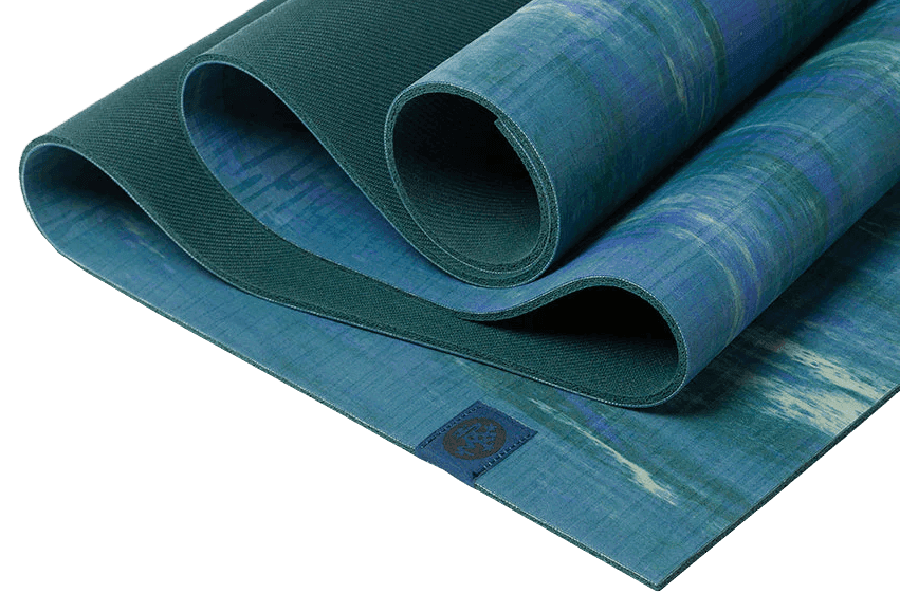
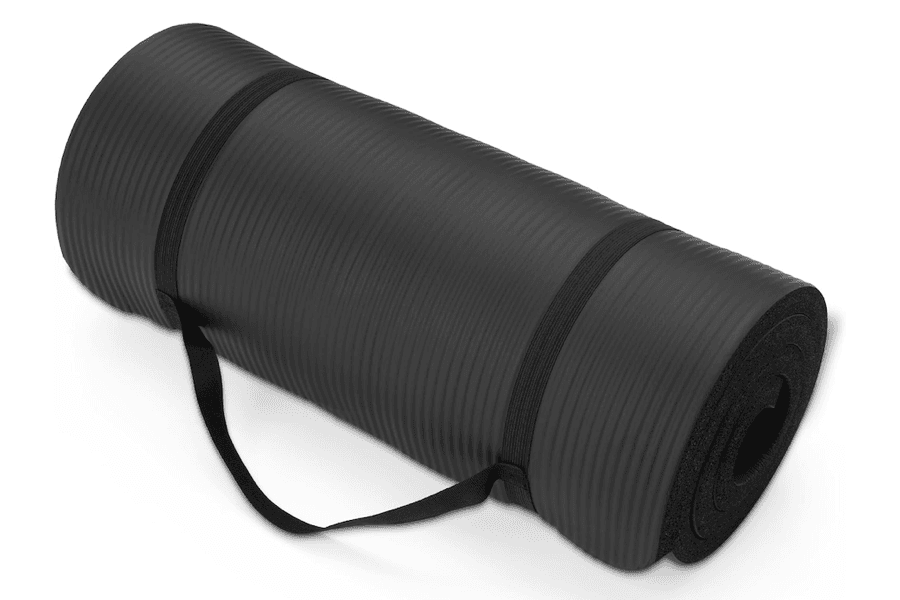
Price
The Amazon Basics lists for about $76 less.
$114
List price · check price at Amazon
$38.40
List price · check price at Amazon
Thickness
The Amazon Basics is 408% thicker.
5 mm0.2″
25.4 mm1″
Weight
The Amazon Basics is 2.4 lbs lighter.
7 lbs3.2 kg
4.6 lbs2.1 kg
Size
The Amazon Basics is 3″ longer; the eKO is 2″ wider.
Same on both
- Closed surfaces, so sweat sits on top of both
- Roughly 71 to 74 inches long
- Both degrade if you leave them in the sun
- Neither is machine washable
Full specs
Dimensions
Materials & build
A yoga mat and an exercise pad
The eKO is 5 mm of natural rubber that GearLab scored 87 out of 100, with the best dry grip of the 19 mats it tested in 2026. The Amazon Basics is a full inch of NBR foam with more than 70,000 ratings behind it. Both get sold as yoga mats and only one of them behaves like one.
That is not a knock on the cheap one. An inch of foam is genuinely better than 5 mm of rubber for a lot of floor work. It is just worth knowing which product you are buying before you spend either $38.40 or $114.
An inch of foam is unstable to stand on
Soft foam compresses unevenly under one foot. In tree pose or warrior three your ankle ends up correcting for the surface as much as holding the shape, which makes balance work harder than it needs to be for no benefit.
The eKO’s dense rubber does not deflect. That firmness is why every serious yoga mat sits between 4 and 6 mm rather than going thicker, and it is the single clearest reason not to buy an inch of foam for a standing practice.
Where the inch actually pays off
Kneeling, lying down, rolling on your spine, holding a plank on your elbows on a hard floor. For any of that, 25.4 mm of foam is a real improvement over the eKO, and no amount of rubber density substitutes for it.
If your practice is restorative, or if the mat is mostly for stretching and physio homework, the Amazon Basics is the better product and the cheaper one. It also includes a carrying strap, which the eKO does not.
Grip: the gap is enormous
GearLab measured the eKO at 10 out of 10 dry and 7 wet. Nobody has tested the Amazon Basics, and the result would not be close. NBR foam relies on texture, which stops helping the moment your palms are damp, and the mat’s softness lets your hands slide the pad around underneath you.
Grip is also the thing beginners complain about most, and it is what usually prompts the second mat purchase. If your hands slide in downward dog now, an inch of foam will not fix it.
Size, weight, and storage
The Amazon Basics is 74″ × 24″. The eKO is 71″ × 26″, so the cheap mat is three inches longer and two narrower. On the scale the foam wins at 4.6 pounds against 7.
Rolled, that reverses. An inch of foam does not compress, so the Amazon Basics is a thick log that will not fit a normal mat bag or a studio cubby. The eKO rolls tight and heavy. Neither is a mat you enjoy carrying, for opposite reasons.
How long each one lasts
NBR foam compresses and does not spring back, so the Amazon Basics is at its plushest the day it arrives and thinner wherever you kneel by the second year. It carries a one year warranty, which covers defects rather than that gradual flattening.
Rubber wears far more slowly. The eKO is not covered by Manduka’s lifetime guarantee, which applies only to the PRO and PROlite lines, so it gets 30 day returns. Even so, expect several years from it against one or two from the foam.
Both of them smell out of the box
The eKO smells of natural rubber, strongly, for the first weeks. It is the most common complaint owners raise and the reason the mat holds 4.1 stars across roughly 694 Amazon ratings despite its GearLab score. Unrolling it in a ventilated room speeds the fade.
The Amazon Basics arrives with a chemical foam smell of its own, which also passes. Neither odor is a defect. If a smell in a small flat is a dealbreaker, air whichever one you buy for a few days before the first session.
Price and the middle ground
Check current prices for the eKO and the Amazon Basics; both move, and the Amazon Basics in particular is often cheaper than its $38.40 list.
There is a sensible middle here that most people should take. The half inch Amazon Basics is the same mat at half the thickness and much more usable for yoga. A 6 mm PVC or TPE mat in the $25 to $70 range gives you far more grip than the foam and most of the cushioning people actually want.
Bottom line
Buy the eKO if yoga is the practice. It grips better than anything else GearLab tested when dry, it holds still under a standing foot, and it will last years rather than seasons. The cost is $76, 7 pounds, and a few weeks of rubber smell.
Buy the Amazon Basics if the mat is for stretching, physio, core work or anything else you do on your knees and back. It is better at that job than the eKO is, it costs a third as much, and there is no sense buying a $114 rubber mat to do sit-ups on.
Manduka eKO
List price $114
Amazon Basics 1 Inch Extra Thick
List price $38.40
Frequently Asked Questions
- Can I do yoga on a 1 inch mat?
- You can, and standing poses will be harder than they need to be. An inch of soft foam sinks under one foot and lets your ankle spend the pose correcting for it, so tree pose and warrior three become balance drills against the mat rather than with it. For floor-based practice, restorative work, or gentle stretching, the thickness is a genuine advantage.
- Is the eKO worth $76 more?
- For a yoga practice, yes, and it is not close. GearLab's 10 out of 10 dry grip score is the highest in a field of 19, and grip is the thing beginners complain about most. For anything other than yoga the answer flips, because you would be wearing out a $114 rubber mat doing sit-ups when a $38 foam pad does that job better.
- How long does the Amazon Basics last?
- A year or two of regular use before the foam takes a permanent set, longer if it is only occasional. NBR foam compresses and does not spring back, so the mat you buy is the plushest it will ever be. It carries a one year warranty, which is more than the eKO's 30 day return window, though the failure mode it covers is defects rather than flattening.
- Does the eKO smell?
- Yes, strongly, for the first weeks. It is the most common complaint owners raise, and it is why the mat carries 4.1 stars across roughly 694 Amazon ratings despite GearLab's 87 out of 100. Air it out unrolled in a ventilated room. The foam mat has its own chemical smell out of the packaging, which also fades.
- Which is easier to carry?
- The Amazon Basics, at 4.6 pounds against the eKO's 7, and it comes with a strap. It is also much bulkier rolled, since an inch of foam does not compress, so it is easier on the shoulder and worse in a locker. The eKO is dense and rolls tight, but 7 pounds is a lot of mat to walk anywhere with.
- Is there a middle option?
- Yes, and it is usually the right one. A 5 or 6 mm rubber or PVC mat around $30 to $70 gives you far more grip than the foam and most of the cushioning people actually need. The Amazon Basics half inch version is the same mat at half the thickness, which is a much more usable yoga surface than the full inch.
Related comparisons
- Amazon Basics 1 Inch Extra Thick vs Retrospec Solana 1"
- Manduka eKO vs Lululemon The (Big) Mat 5mm
- Lululemon The Mat 5mm vs Manduka eKO
- JadeYoga Harmony 74" vs Manduka eKO
- Manduka eKO vs JadeYoga Harmony 2.0 68"
- Manduka eKO vs Suga SugaMat
- JadeYoga Harmony 68" vs Manduka eKO
- Manduka eKO vs Yoga Design Lab Combo 3.5mm
- Manduka eKO vs b, halfmoon B Mat Everyday 4mm