Manduka eKO Lite vs eKO Superlite: Which One Should You Buy?
Manduka gave both of these mats names that promise lightness, and they deliver it in incompatible ways. The eKO Lite is a daily mat trimmed to commuting weight: 4 mm of rubber, 5 pounds, $96. The Superlite is travel gear: 1.5 mm and 2.2 pounds, foldable into a carry-on, $54. Same textured rubber surface on both. What sits under the surface, and whether your knees ever meet a hard floor through it, is the whole decision.
As an Amazon Associate, we earn from qualifying purchases made through links on this page. How this works
The quick answer
The eKO Lite is the lightest Manduka rubber mat that still works as your only mat: 4 mm cushions kneeling work on wood floors, 5 pounds carries to class daily, and the 71" x 24" footprint practices like any full mat. The Superlite gives up that self-sufficiency on purpose. At 1.5 mm it's a grip layer for floors that provide their own cushioning: carpet, grass, hotel room floors, or a rental mat underneath. In exchange it folds to laptop size, weighs almost nothing, and costs $42 less.
If you're choosing one mat for regular practice, get the eKO Lite. Get the Superlite as a travel or layering mat alongside whatever you practice on at home; as an only mat on hard floors, it will disappoint you.
Get the eKO Lite if...
- This will be your only or primary mat
- You practice on wood, tile, or other hard floors
- You want a real mat that still commutes at 5 pounds
- You kneel: 4 mm is modest, but 1.5 mm is nothing
Get the Superlite if...
- It's for travel: it folds flat into a carry-on
- You're layering it over rental or studio mats
- Your practice floor is carpet or grass
- You'd rather keep $42
Side by side
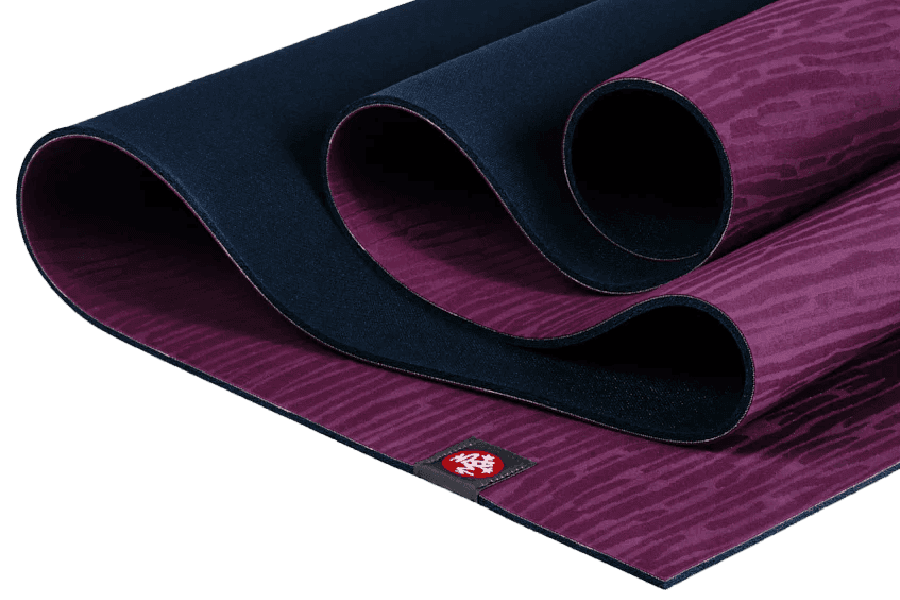
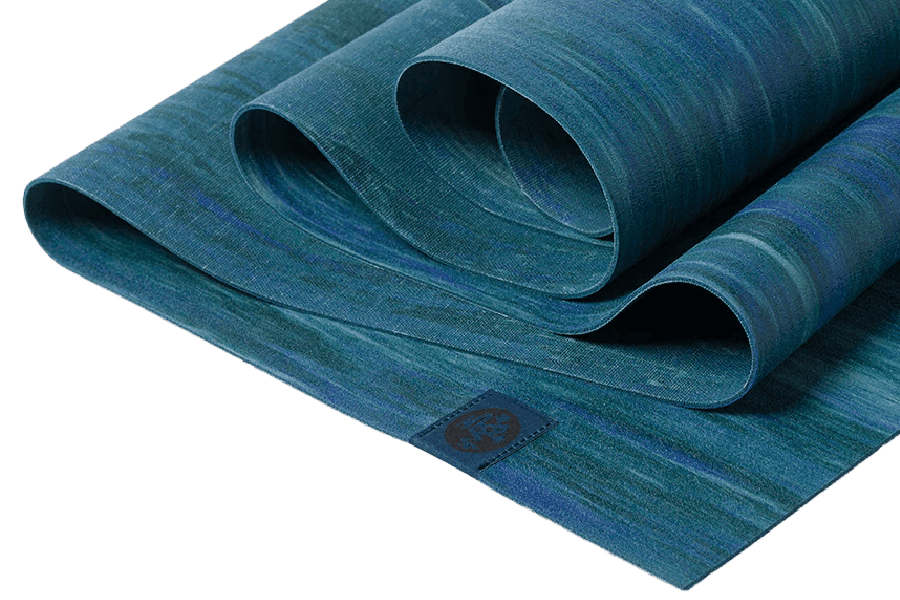
Price
The Superlite lists for $42 less.
$96
List price · check price at Amazon
$54
List price · check price at Amazon
Thickness
The eKO Lite is 167% thicker.
4 mm0.16″
1.5 mm0.06″
Weight
The Superlite is 2.8 lbs lighter.
5 lbs2.2 kg
2.2 lbs1 kg
Size
Same length; same width.
Same on both
- Same textured natural rubber surface and grip
- Closed-cell: sweat stays on top
- Grip from the first practice, no break-in
- No warranty beyond 30 day returns
- Not for latex allergies
- 79" Long versions available
Full specs
Dimensions
Materials & build
Lite and Superlite are not points on one scale
The names suggest a dial being turned, but these are two different kinds of light. The eKO Lite is a daily mat that lost weight: 4 mm of rubber at 5 pounds, everything a primary mat does, just easier to carry than the 7 pound full eKO. The Superlite is a different species: 1.5 mm and 2.2 pounds, a foldable rubber skin whose natural habitat is a suitcase.
Both wear the same textured closed-cell rubber, so grip and care are settled ties. The decision is structural: does this mat need to be your practice surface, or does it ride along to borrowed ones?
What 4 mm does that 1.5 mm can’t
The Lite’s 4 mm is modest by daily-mat standards, a step below the 5 mm norm, but it’s a working layer: kneeling lunges, seated folds, and low hip work on a wood floor all happen with rubber genuinely between you and the boards. On tile or concrete it starts feeling thin, which is where the thicker eKO takes over in this family.
The Superlite’s 1.5 mm isn’t a smaller amount of the same thing; it’s the absence of the thing. Knees meet the floor through it, and OutdoorGearLab’s testers found ultra-thin travel mats grippy but without protection for your bones, declining to recommend any as a solo daily mat. Over carpet, grass, or a rental mat, none of that matters, because the ground underneath is doing the cushioning. That’s the Superlite’s design brief in one sentence.
Two definitions of portable
The Lite is portable the way a good commuter mat is portable: a 5 pound roll that rides a shoulder strap to class every day without complaint. The Superlite is portable the way clothing is: folded flat to roughly laptop size, 2.2 pounds, inside the carry-on rather than strapped outside it. Airport security, hotel rooms, retreats, a drawer at the office: places a rolled mat is a burden are exactly where the Superlite disappears.
If your travel is a weekly drive to a studio, the Lite’s portability is plenty. If it involves boarding passes, no rolled mat competes with a folded one.
Same skin, different anchoring
Hand to rubber, these two are indistinguishable: the same rippled eKO texture, tacky from the first practice, no break-in. The difference appears under the mat. Five pounds of Lite settles onto a smooth floor and stays; the 2.2 pound Superlite can shift or wrinkle mid-flow on slick surfaces, a behavior GearLab’s testers flagged, and it wants carpet or another mat underneath to feel fully planted.
Both are closed-cell, so sweat pools on top and heated classes want a towel on either. Hot-yoga-first buyers should be reading about the GRP Adapt 2.0 instead of anything in the eKO family.
Durability and care: family traits
One care sheet covers both: damp cloth cleaning, no harsh products, no direct sun, no hot cars, and a rubber smell that fades over the first weeks. Both are 99% latex free, which is Manduka’s way of saying not latex free, so neither suits an allergy. Neither carries a warranty beyond the 30 day return window.
Wear runs surprisingly even. The Lite’s 4 mm has less material than the full eKO and shares the family’s surface-flaking pattern after hard years. The Superlite’s single dense layer has no loft to lose and holds up better than 1.5 mm suggests, though rough floors abrade it. Traveling owners of both report years of service; neither is the weak link in this comparison.
Sizes, colors, and the odd color gap
Both run 71″ × 24″ with 79″ Long versions: the Lite Long at $104 and the Superlite Long at $58. Color is where the catalog gets strange: the $54 travel mat comes in around 19 colorways, the widest range Manduka sells, while the $96 Lite gets 8. If palette is part of the purchase, the cheap one is the fun one.
Price and value
List prices are $96 for the eKO Lite and $54 for the Superlite. Check current prices on the eKO Lite and the Superlite at Amazon; Manduka discounts colorways on both regularly.
The $42 gap is honest pricing for the difference between a complete mat and a specialized layer. The mistake worth warning against is treating the Superlite as the budget version of the Lite: on a hard floor that $42 saving costs you your knees, and the eventual second mat erases it. As a pair, though, they’re complementary enough that $150 covers home, commute, and travel with nothing wasted.
Bottom line
Get the eKO Lite if one mat has to do everything. It’s the lightest Manduka rubber that still cushions a daily practice, it commutes well, and it never asks the floor underneath for help.
Get the Superlite for the jobs it was built for: flights, retreats, rental-mat hygiene, carpet practice. In those roles it’s excellent and cheap; as an only mat on hard floors it’s the wrong tool at any price. Buyers torn because they genuinely do both should notice the pair costs less than one premium flagship, and stop being torn.
Frequently Asked Questions
- Can the eKO Superlite replace the eKO Lite as a daily mat?
- Only if your floor is soft. On carpet or grass the Superlite works daily, because the ground does the cushioning. On wood, tile, or concrete, 1.5 mm leaves knees and tailbones effectively on the floor, and OutdoorGearLab's testers declined to recommend ultra-thin travel mats as anyone's solo mat for exactly that reason. The Lite's 4 mm is the minimum honest daily thickness in this family.
- How different are 4 mm and 1.5 mm in practice?
- It's the difference between a thin mat and a surface. The Lite compresses but keeps a layer of rubber between you and the floor through kneeling lunges and seated work. The Superlite is a skin: superb traction, no protection. Hands never notice the gap; knees notice it in the first minute of a kneeling sequence on hardwood.
- Which is easier to carry?
- Both are genuinely portable, differently. The Lite rolls like a normal mat and weighs 5 pounds, an easy shoulder carry to class. The Superlite folds flat to roughly laptop size at 2.2 pounds and disappears into a backpack or carry-on, no strap needed. For a daily studio commute either works; for an airplane, only the Superlite makes sense.
- Do they grip the same?
- The surfaces are the same textured closed-cell rubber, tacky from day one, so hand-feel is identical. The mats behave differently: the Lite's 5 pounds anchors it to the floor, while the Superlite is light enough to shift or wrinkle on smooth floors during dynamic flows, a behavior GearLab flagged on slick surfaces. Layered over another mat or carpet, the Superlite stays put. Neither absorbs sweat; heated rooms want a towel on both.
- What sizes and colors are available?
- Both are 71" x 24" with 79" Long versions, the Lite Long at $104 and the Superlite Long at $58. Color is the Superlite's surprise win: around 19 colorways at last count, the widest range Manduka makes, against the Lite's 8. Both sell through Manduka's first-party Amazon listings with regular colorway markdowns.
- Is buying both overkill?
- Not really, and plenty of Manduka loyalists do exactly that: a Lite for daily practice and a Superlite for trips and rentals, $150 total at list for a setup with no gaps. The two don't overlap in role, which is the test that matters. What we'd avoid is buying the Superlite alone to save $42 and then practicing on tile through it.
Related comparisons
- Manduka eKO Superlite vs JadeYoga Voyager
- JadeYoga Harmony 68" vs Manduka eKO Lite
- Manduka eKO Lite vs Suga SugaMat
- Manduka eKO Lite vs Lululemon The Mat 3mm
- Manduka eKO Lite vs JadeYoga Harmony 2.0 68"
- JadeYoga Harmony 74" vs Manduka eKO Lite
- Manduka eKO Lite vs Yoga Design Lab Combo 3.5mm
- Manduka eKO Lite vs b, halfmoon B Mat Everyday 4mm
- Manduka eKO Lite vs Yoga Design Lab Infinity 3mm