Manduka eKO Lite vs Gaiam Classic Print: Which One Should You Buy?
Classic Print owners complain about two things most: hands slipping and a mat that feels too thin. The eKO Lite is natural rubber at the same 4 mm thickness and 24 inch width, so it answers the first complaint and not the second. It also weighs more than twice as much and costs about $71 more.
As an Amazon Associate, we earn from qualifying purchases made through links on this page. How this works
The quick answer
At the same thickness and width, the extra $71 buys rubber grip and three more inches of length, not cushion. By owners' accounts the eKO Lite holds dry hands better, but it weighs 5 pounds, contains latex, has no warranty and can't be returned once used. The Classic Print is light, latex-free and carries a lifetime guarantee, and many of its owners find it slippery and thin.
If your hands slide on the Classic Print in normal, unheated classes and latex isn't a concern, get the eKO Lite. If you're new, carry your mat, need latex-free, or your real complaint is sore knees, keep the Gaiam and look at a thicker mat for your knees.
Get the eKO Lite if...
- Your hands slide on printed PVC in unheated classes
- You want to move from PVC to natural rubber
- You need more than 68 inches of length
- You can live with 5 pounds and a rubber smell at first
Get the Gaiam Classic Print if...
- You're new and would rather spend about $25
- You need a latex-free mat
- You carry your mat and want it around 2 pounds
- You want a printed design and a lifetime guarantee
Side by side
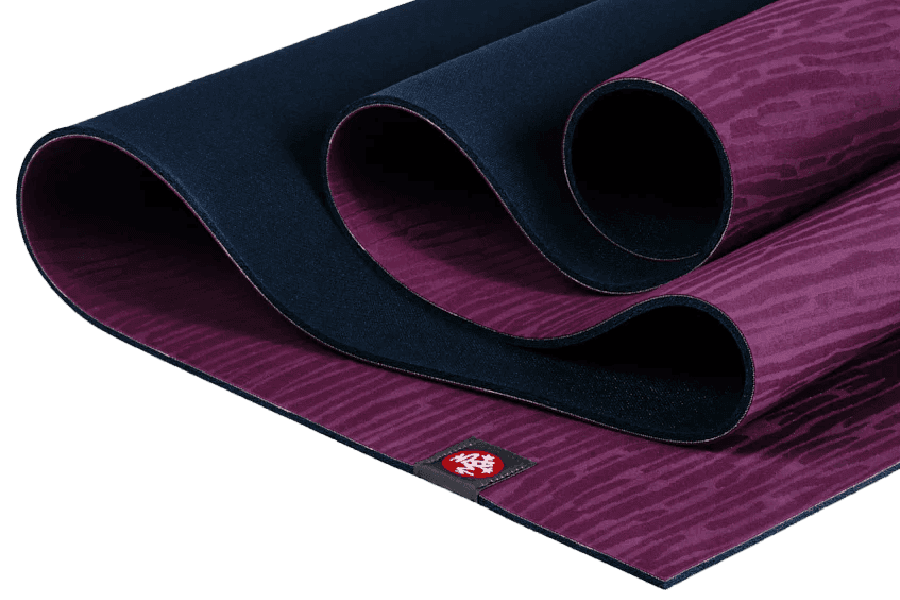
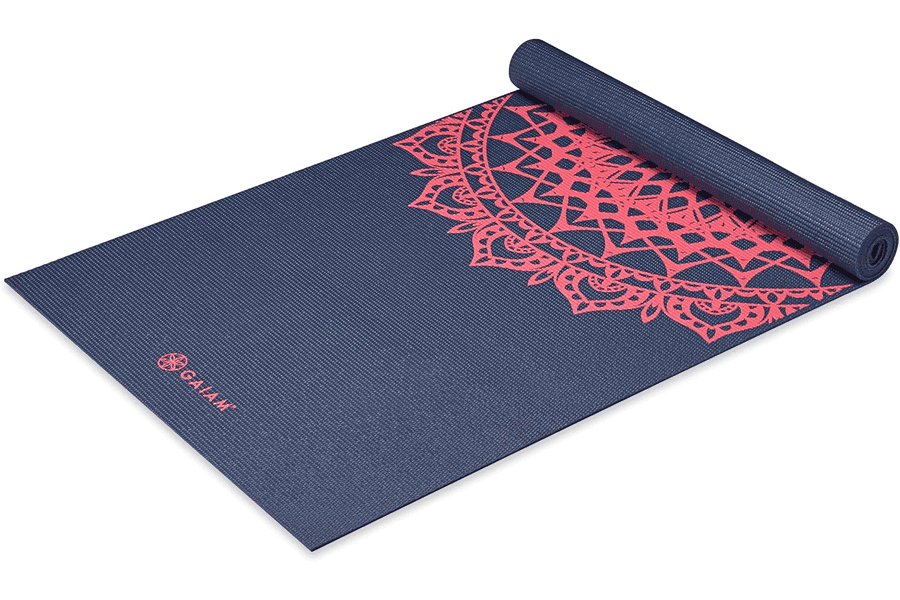
Price
The Classic Print lists for about $71 less.
$96
List price · check price at Amazon
$24.98
List price · check price at Amazon
Thickness
Identical thickness.
4 mm0.16″
4 mm0.16″
Weight
The Classic Print is 2.9 lbs lighter.
5 lbs2.2 kg
2.1 lbs0.95 kg
Size
The eKO Lite is 3″ longer; same width.
Same on both
- 4 mm thick
- 24 inches wide
- A closed surface that doesn't absorb sweat
- A strong smell when new
- Sun can make it fade and turn brittle
- Not tested by GearLab
Full specs
Dimensions
Materials & build
Buying
What Classic Print owners complain about
The Gaiam Classic Print is the $24.98 printed mat a lot of people start on: 4 mm of PVC, 68″ × 24″, with 4.5 stars across about 12,600 Amazon ratings. Amazon’s summary of those reviews has two sore spots. Grip mentions lean negative, 350 of 614, and thickness leans further: 410 of 594 mentions call it too thin.
The Manduka eKO Lite is $96 of natural rubber at the same 4 mm and the same 24″ width. It answers the first complaint and does very little for the second. GearLab hasn’t tested either mat, so this page works from brand specs and owner reviews.
Grip in a normal room
Gaiam says the Classic Print is textured for non-slip performance, and with dry hands in a slow class that’s fair. PVC absorbs nothing, though, so once a palm is damp it sits on a thin film of sweat, which is where the slipping complaints come from.
The eKO Lite’s textured rubber is sold on dry-condition traction, and 24 of the 30 grip mentions in its Amazon summary are positive. The full 5 mm eKO that GearLab did test scored 10 for dry grip, tied for best of 19. That tells you about the family, not this thinner mat.
Neither surface is made for sweat. Manduka warns in its care notes that the closed-cell eKO Lite can feel slick for heavy sweaters, and it suggests a towel. If damp hands are your problem, our GRP Adapt 2.0 vs Classic Print page covers GearLab’s top pick for wet grip.
Same 4 mm, so knees get little relief
If the Classic Print feels thin under your knees, the eKO Lite won’t change that much, because it’s the same thickness. Manduka describes the rubber as soft and responsive, and 10 of 11 cushioning mentions in the Amazon summary agree, but that sample is tiny and the thickness mentions there are mixed.
Joint comfort needs more material. GearLab’s buying guide points people who struggle with joint pain toward mats of 6 mm and up, where most yoga mats sit at 3 to 5. Within Manduka’s rubber line the modest step up is the 5 mm eKO, which our eKO vs Classic Print page covers.
Weight and length
The Classic Print weighs 2.1 pounds. The eKO Lite is 5, which is light only next to Manduka’s thicker eKO. If the mat rides on your shoulder, the Gaiam weighs almost three pounds less.
Length goes the other way. The eKO Lite is 71″ against the Gaiam’s 68″, and Manduka also makes a 79″ eKO Lite Long for $104. The Classic Print comes in one size, so a tall practitioner lying flat will run off the end.
Air either one out before the first class
Gaiam warns that printed mats release a very strong but harmless odor when first unwrapped, and wants the mat unrolled and aired for two to three days. Owners notice: the smell draws 282 negative mentions in Amazon’s summary against 86 positive.
The eKO Lite smells too, of rubber rather than vinyl. Its Amazon summary calls the smell unpleasant, and 10 of its 11 odor mentions are negative. Unroll either one in a room with a window open and give it a few days before you decide it’s a problem.
Both brands give the same sun warning
Gaiam says the Classic Print may fade and become brittle and unusable if it sits in the sun for long, and suggests keeping it in a mat bag. Manduka says nearly the same of the eKO Lite: its rubber is sensitive to UV and may fade or turn brittle, and white marks on the surface mean it’s oxidizing. Keep both away from sunny windows and hot cars.
Day to day, Gaiam asks for a spot clean with a damp cloth, cold water and mild detergent, then drying flat. Manduka’s version is its rubber cleaner or a damp cloth, then laying the mat flat or hanging it until dry before rolling, and never soaking it.
Latex decides it for some buyers
The Classic Print is latex-free PVC made without the six most harmful phthalates, per Gaiam. Manduka’s mat is natural tree rubber, more than 30% of it recycled, made in Taiwan, and Manduka advises against it for anyone with a latex sensitivity.
If leaving PVC behind is part of why you’re upgrading, the eKO Lite does that. If someone at home has a latex allergy, it’s off the table and the Gaiam is the one to buy.
Guarantees, returns and wear
The Classic Print carries a Gaiam lifetime guarantee, but Gaiam doesn’t publish the terms, and we’d take it to mean defects rather than wear. Gaiam’s own 30-day returns cover unopened, unused gaiam.com orders. Manduka offers no warranty on the eKO Lite and accepts returns within 30 days on unused mats only.
Durability is mostly positive in the Classic Print’s summary, 210 mentions to 96, with some owners reporting the plastic peeling off. The eKO Lite’s far smaller summary is mixed, with reports of it falling apart or getting dirty too easily. GearLab’s general observation is that rubber wears out sooner than PVC, though its example of long-lived PVC is the dense Manduka PRO, not a thin printed mat.
Prints, colors and price
Gaiam rotates the Classic Print’s printed designs over time. Gaiam’s own page doesn’t list a strap, though the Amazon listing title now mentions one. The eKO Lite comes in 8 colorways at last count.
List prices are $24.98 and $96, a gap of $71.02. Check the Classic Print at Amazon and the eKO Lite at Amazon, since both move around by print or colorway.
Bottom line
Buy the Classic Print if you’re new, practice gently in a cool room, carry your mat, or need it latex-free. It does the basic job for $24.98, and a lifetime guarantee comes with it.
The eKO Lite makes sense if your hands start sliding on printed PVC well before the class gets sweaty. It is longer and, by owners’ accounts, grippier with dry hands, but it won’t fix thin-mat knees, it weighs more than twice as much, and it can’t go back once used. For a cheaper step into rubber, see our eKO Lite vs Jade Level One page.
Gaiam Classic Print 4mm
List price $24.98
Frequently Asked Questions
- Is the eKO Lite thicker than the Gaiam Classic Print?
- No. Both are 4 mm thick and 24 inches wide, and the eKO Lite is three inches longer at 71 inches. If the Classic Print feels too thin under your knees, the eKO Lite won't fix that. Manduka's 5 mm eKO, or a mat of 6 mm or more, is the step up for joint comfort.
- Is the eKO Lite worth $71 more than the Classic Print?
- If grip is what bothers you, it can be. Grip is one of the most praised points in the eKO Lite's Amazon review summary, while 350 of 614 grip mentions for the Classic Print are negative. You also get natural rubber and three more inches of length. You don't get more cushion, a lighter mat or any warranty.
- Are either of these good for hot yoga?
- No. Both surfaces are closed, so sweat sits on top. Manduka's care notes say the eKO Lite may feel slick if you're prone to sweat and recommend a towel, and the Classic Print's PVC absorbs nothing. For heated classes, the best wet-grip mat in GearLab's test was the Manduka GRP Adapt 2.0.
- Which is better for a latex allergy?
- The Gaiam Classic Print. It's latex-free PVC made without the six most harmful phthalates. The eKO Lite is natural tree rubber, and Manduka says it isn't recommended for people with latex sensitivities.
- Do these mats smell when new?
- Both do. Gaiam says printed mats release a very strong but harmless odor when first unwrapped and asks you to air the mat for two to three days. The eKO Lite smells of natural rubber, and odor is the main complaint in its Amazon review summary. Unroll either one in a ventilated room for a few days before your first class.
- Which one lasts longer?
- Nobody has tested either for wear. Gaiam offers a lifetime guarantee but doesn't publish the terms, and some Classic Print owners report the plastic peeling off. The eKO Lite has no warranty, and its small pool of reviews is mixed on durability. Both brands say long sun exposure makes the mat fade and turn brittle, so store either one out of direct light.
Related comparisons
- JadeYoga Harmony 68" vs Manduka eKO Lite
- Manduka eKO Lite vs Suga SugaMat
- Manduka eKO Lite vs Lululemon The Mat 3mm
- Amazon Basics 1/4 Inch Thick TPE vs Gaiam Classic Print 4mm
- Manduka eKO Lite vs JadeYoga Harmony 2.0 68"
- JadeYoga Harmony 74" vs Manduka eKO Lite
- Gruper TPE 6mm vs Gaiam Classic Print 4mm
- Manduka eKO Lite vs Yoga Design Lab Combo 3.5mm
- Manduka eKO Lite vs b, halfmoon B Mat Everyday 4mm