Manduka eKO Lite vs Amazon Basics 1/4 Inch TPE: Which One Should You Buy?
The Manduka eKO Lite costs almost four times what the Amazon Basics 1/4 Inch TPE does, and the cheap mat arrives thicker, longer, lighter, and with the only written warranty of the two. That makes this a genuinely awkward comparison for the premium mat, and we'll be straight about where the extra $70 does and doesn't go.
As an Amazon Associate, we earn from qualifying purchases made through links on this page. How this works
The quick answer
On the spec sheet the TPE wins nearly everything: 6 mm against 4, 73.6 inches against 71, 2 pounds against 5, and a 1 year warranty against a 30 day return window. What it can't match is material and lifespan. The eKO Lite is tree rubber with over 30% recycled content, it's tackier dry, it stays planted in standing poses, and it lasts years rather than a year or two.
If you're new or unsure yoga will stick, buy the TPE and upgrade later from knowledge. If you already practice several times a week and want a surface you enjoy touching, the eKO Lite is worth the money. Neither of them grips when you sweat.
Get the eKO Lite if...
- You practice regularly and want a mat that lasts years
- You want a natural rubber surface rather than foam
- Standing balances are a big part of your practice
- Recycled content and a renewable material matter to you
Get the Amazon Basics TPE if...
- You're new and not yet sure how much you'll practice
- You want more cushion under your knees
- You're tall enough to want the extra 2.6 inches of length
- A latex allergy rules natural rubber out
Side by side
Price
The Amazon Basics lists for about $70 less.
$96
List price · check price at Amazon
$26.36
List price · check price at Amazon
Thickness
The Amazon Basics is 50% thicker.
4 mm0.16″
6 mm0.24″
Weight
The Amazon Basics is 3 lbs lighter.
5 lbs2.2 kg
2 lbs0.9 kg
Size
The Amazon Basics is 2.6″ longer; same width.
Same on both
- Closed-cell surface that sweat sits on top of
- Grippy dry, slippery once wet
- 24" width
- No break-in period
- Wipe-down cleaning
- No third-party certification
Full specs
Dimensions
Materials & build
Buying
What $70 more actually buys
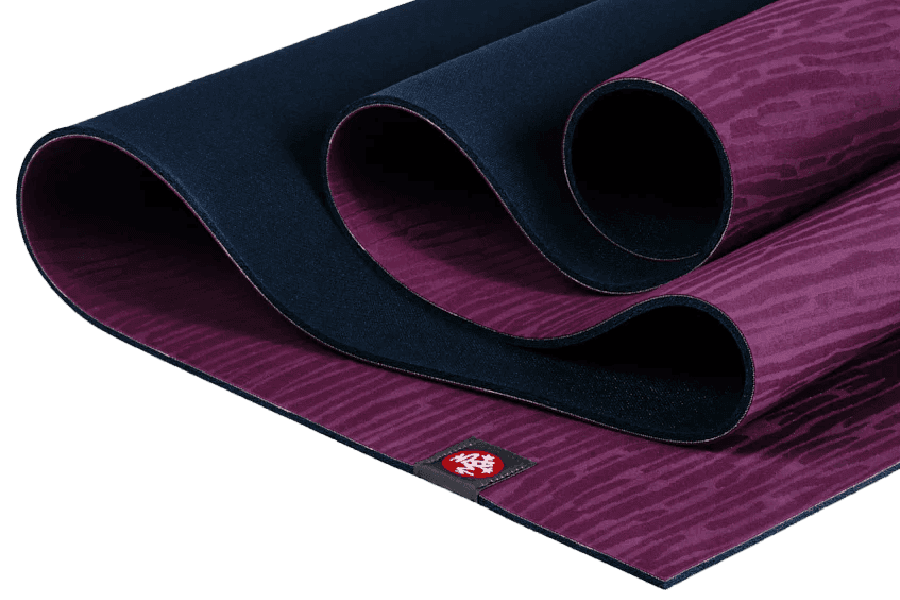
The Manduka eKO Lite is $96 of natural rubber. The Amazon Basics 1/4 Inch Thick TPE is $26.36 of closed-cell foam. That is close to a four times price gap, and the cheap mat arrives with the thicker cut, the longer cut, the lighter carry, and the only written warranty of the two.
So the case for the Manduka cannot rest on the spec sheet, and we are not going to pretend it does. It rests on material, feel, and how each surface ages, which are harder to put in a table and are still what most people end up caring about.
Grip: both are fine dry, both quit wet
Start with the part that is a tie, because it saves you money if it is your only question. Both mats are closed-cell, meaning nothing passes into the surface. Both grip well with dry hands from the first practice, with no break-in ritual on either. And both let sweat pool exactly where your palms land, at which point traction goes and does not come back until you towel off.
The eKO Lite’s textured rubber is the slightly better dry surface, tackier and more secure in a long hold, where the TPE grips through plain friction on a pressed texture. It is a real difference and a small one. Manduka itself only claims the eKO line is reliable in dry conditions, and that is the correct claim for both of these mats.
If you practice heated, neither mat solves your problem. A grippy towel over the TPE is the cheap fix, and an absorbent surface like the GRP Adapt 2.0 is the real one.
Feel: dense rubber against springy foam
Unroll them side by side and the difference is immediate. The eKO Lite is dense and quiet. It lies flat, stays where you put it, and has the warm slightly grabby character that rubber mats are bought for. It also picks up lint and pet hair, which is the same property seen from the other side.
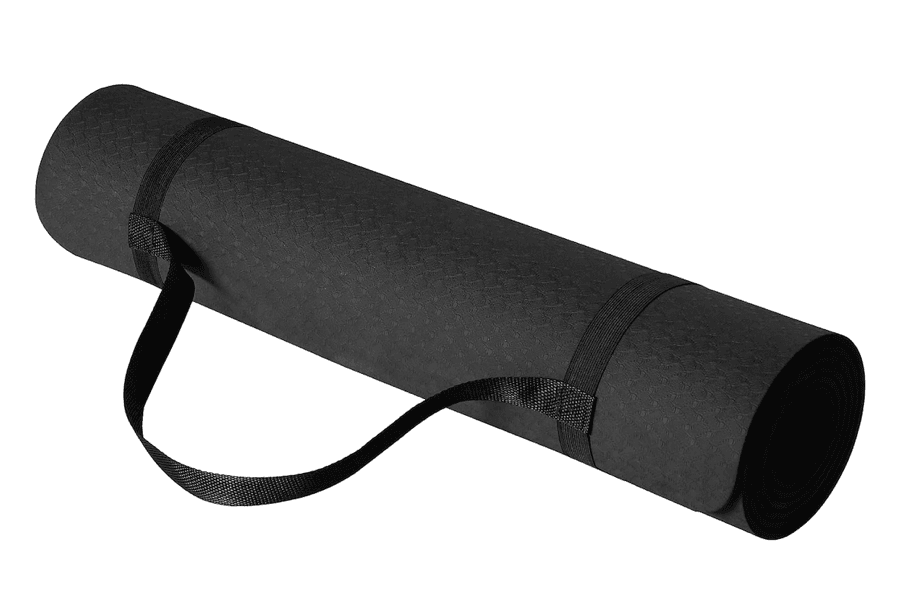
The TPE is light and springy, closer to a gym mat in character. At 2 pounds it slides on a slick floor more readily and it has a faint bounce underfoot that some people like and some find floaty in a long balance. It sheds lint and wipes clean instantly.
None of that is a defect on either side, but it is the clearest thing $70 buys, and it is worth being honest that it is a preference, not a performance gap.
Cushion: 6 mm of TPE against 4 mm of rubber
The cheap mat has half again as much material, 6 mm against 4, and in kneeling and seated work you feel it. Low lunges and long hip openers on a hard floor are noticeably kinder on the TPE. The eKO Lite’s 4 mm of dense rubber runs out sooner, and on tile or concrete your kneecaps find the floor.
Standing work flips it. Dense rubber gives your foot something that does not move, so balances feel planted, while springy foam compresses unevenly under the ball of a foot and asks your ankle to keep correcting. Neither mat is bad at either job. If your practice spends its time on the floor, the TPE has the edge; if it spends its time on one leg, the Manduka does.
Size and weight: the cheap mat wins both
The TPE measures 73.6″ long against the eKO Lite’s 71″, with both at 24″ wide, so a tall practitioner is better served by the $26 mat. It also weighs 2 pounds to the Manduka’s 5, which is the difference between a mat you forget you are carrying and one you notice on a long walk.
The eKO Lite’s answer for length is the 79″ eKO Lite Long at $104, which out-measures the TPE but widens the price gap. The Amazon Basics TPE comes in one size only.
How long each one lasts
This is where the Manduka starts earning its money back. Natural rubber is a resilient surface; it softens and sheds slowly over years of hard practice, and kept out of sun and hot cars an eKO Lite stays usable for a long time. Its ceiling is set by care rather than by the material giving up.
TPE has a shorter clock. It dents where knees land, the texture polishes smooth under hands and feet, and once the edges start fraying they keep going. A year or two of steady practice is a fair expectation, longer if the mat only comes out twice a week.
The paperwork does not follow the materials. Amazon Basics gives a 1 year warranty; Manduka gives the eKO Lite a 30 day return window and nothing after, since the lifetime guarantee is reserved for the PRO series. Even so, replacing $26 mats every eighteen months costs more over a decade than one $96 mat that survives it.
Materials, smell, and latex
The eKO Lite is tapped tree rubber built in Taiwan with over 30% recycled content, which is a genuinely good environmental story for a mat at this price. The TPE is a synthetic elastomer with no stated origin and no certification; it is generally considered a cleaner plastic than PVC and it is still a plastic.
Both smell out of the packaging. The rubber smell on a new eKO Lite is stronger and more distinctive, and it fades over the first couple of weeks of airing and use. The TPE’s is milder and clears faster.
The allergy note decides it for some people: tree rubber carries latex, so a latex-allergic practitioner should not buy the eKO Lite. TPE is the safe default, and at $26 it is a cheap way to stay out of trouble.
Price and value
List prices are $96 and about $26.36. Check the current price on the eKO Lite and the Amazon Basics TPE; Manduka runs hard colorway markdowns often enough that the gap is worth checking rather than assuming.
For someone who is not yet sure yoga will stick, the TPE is the right purchase and it is not close. It does the actual job, and if the habit takes, you will upgrade knowing what you want instead of guessing. For someone already practicing three or four times a week, the eKO Lite is the better thing to own, and spread over the years it lasts, the difference works out to a few dollars a month.
Bottom line
Buy the Amazon Basics TPE if you are new, if you need cushion under your knees, if you are tall, or if latex is a medical issue. It is a competent yoga mat sold for the price of a class, and the only thing it really lacks is longevity.
Buy the eKO Lite if you practice regularly and want a surface made of something that grew rather than something extruded. It grips a little better dry, it stays planted in standing work, it lasts considerably longer, and it feels like a nicer object every time you unroll it. Just do not expect it to fix a sweaty practice, because on that front it is no better than the $26 mat.
Amazon Basics 1/4 Inch Thick TPE
List price $26.36
Frequently Asked Questions
- Is the Manduka eKO Lite worth four times the price?
- It depends entirely on how much you practice. For someone on the mat three or four times a week, yes: the rubber feels better, grips slightly better dry, stays planted under a standing foot, and lasts several years where the TPE lasts one or two. Spread over that time the difference works out to a few dollars a month. For someone practicing occasionally, no. The TPE does the actual job, and replacing it once is still cheaper than the Manduka.
- Which one is better for a beginner?
- The Amazon Basics TPE, for most people. It's thicker, which helps with kneeling while you're still building up to longer holds, it's longer, it's light enough to carry anywhere, and at about $26 it doesn't punish you for discovering yoga isn't for you. The main thing you give up is longevity and the feel of a natural surface, and neither of those is what makes or breaks a first six months.
- Does the eKO Lite grip better than the TPE?
- Slightly, and only when dry. The eKO Lite's textured rubber is tackier and more secure in a long hold, where the TPE grips through friction on a pressed texture. Once sweat arrives they fail together, because both are closed-cell and neither absorbs anything. Manduka only claims the eKO line is reliable in dry conditions, and that's the honest claim for both of these mats.
- Which one is better for balance poses?
- The eKO Lite. Dense rubber gives your foot something that doesn't move, so tree and warrior three feel steady. TPE is springy and compresses a little unevenly under the ball of a foot, which some people never notice and others find floaty in a long balance. The trade runs the other way on the floor: the TPE's extra 2 mm is kinder to knees and hips in kneeling and seated work.
- Is the Manduka eKO Lite safe with a latex allergy?
- No. It is natural tree rubber, which carries latex. TPE is a synthetic elastomer with no latex in it, so the Amazon Basics is the safe default here, and at about $26 it is a cheap way to avoid the problem entirely.
- How long does an Amazon Basics TPE mat last?
- A year or two of steady practice is fair, longer if it only comes out twice a week. TPE dents where knees land, the texture polishes smooth under hands and feet, and once the edges start fraying they keep going. It carries a 1 year warranty against defects, which is more paperwork than the eKO Lite gets, but a warranty doesn't cover ordinary wear on either mat.
Related comparisons
- Amazon Basics 1/4 Inch Thick TPE vs Gruper TPE 6mm
- Amazon Basics 1/4 Inch Thick TPE vs Gaiam Premium 6mm
- JadeYoga Harmony 68" vs Manduka eKO Lite
- Manduka eKO Lite vs Suga SugaMat
- Amazon Basics 1/4 Inch Thick TPE vs Gaiam Essentials 6mm
- Amazon Basics 1/4 Inch Thick TPE vs YogaAccessories Extra Thick Deluxe 1/4"
- Manduka eKO Lite vs Lululemon The Mat 3mm
- Amazon Basics 1/4 Inch Thick TPE vs Gaiam Premium Reversible 6mm
- Amazon Basics 1/4 Inch Thick TPE vs Gaiam Classic Print 4mm