Lululemon The Mat vs Gaiam Premium: Which One Should You Buy?
This is the two ends of the mainstream yoga mat market in one comparison. The Gaiam Premium is the mat stacked by the register at every big-box store, and Lululemon's The Mat is what people upgrade to when the first one stops keeping up. OutdoorGearLab gave both an award in the same 19-mat test, which tells you something: they're good at different jobs, and $88 separates them.
As an Amazon Associate, we earn from qualifying purchases made through links on this page. How this works
The quick answer
The Mat placed 4th of 19 at 81 of 100 and took Best Mat for Mixed Fitness Routines, with a perfect 10 for comfort and support. Its top absorbs moisture as it lands, giving it one of the best wet grips in the lineup; testers said they'd confidently carry it into a room heated to 90 or 105 degrees. The Gaiam placed 11th at 62 and took Best First Yoga Mat, which is exactly the right description. Its 6 mm of soft foam is kind to knees in gentle practice, and testers found the same softness goes squishy in balance poses like tree and headstand, with dry grip rated 6 of 10 and wet grip 4.
If you sweat, practice heated, or already know yoga is part of your week, The Mat is worth its price and then some. If you're starting out or practice casually on your living room floor, the Gaiam does that job well for $29.98, and you'll know within a year whether you need more.
Get The Mat if...
- You sweat, or practice heated: this is the grip you're paying for
- You want a firm, stable base for balance poses
- You want the bigger 71 by 26 inch surface
- You practice often enough to use a serious mat
Get the Gaiam if...
- You're new and don't want to spend $118 to find out if yoga sticks
- Your practice is gentle, seated, or floor-based, where thick foam is a feature
- A latex allergy rules out rubber-based mats
- You'd rather keep about $88
Side by side
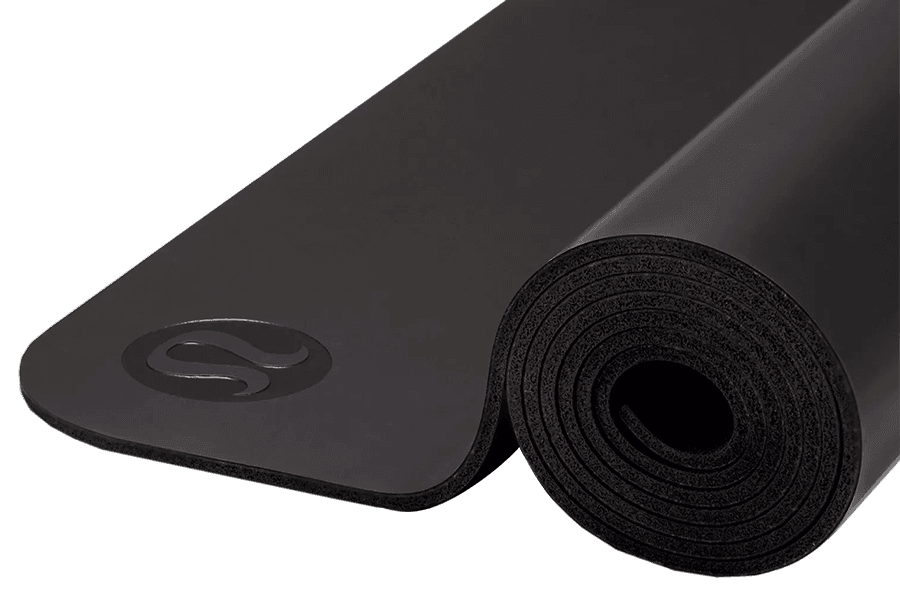
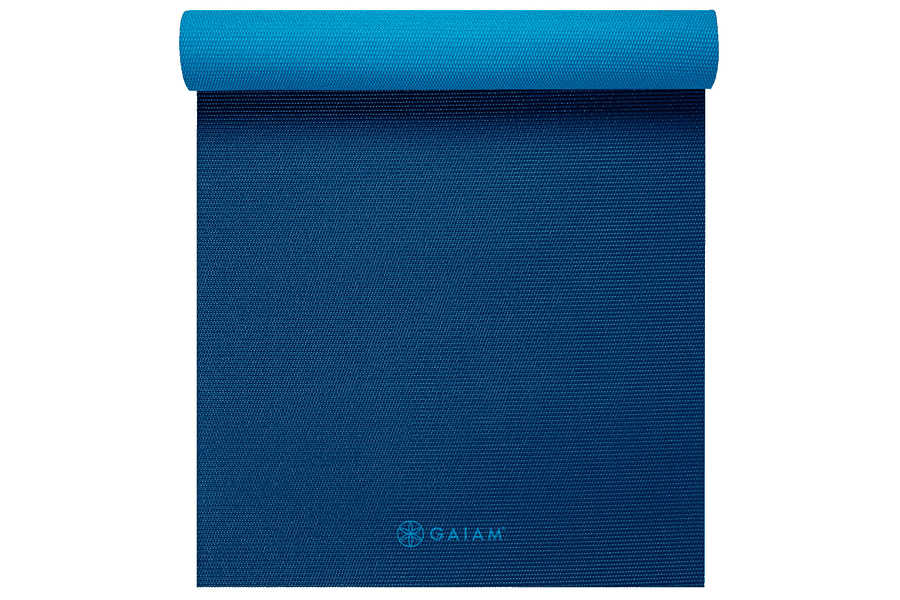
Price
The Gaiam Premium lists for about $88 less.
$118
List price · check price at lululemon.com
$29.98
List price · check price at Amazon
Thickness
The Gaiam Premium is 20% thicker.
5 mm0.2″
6 mm0.24″
Weight
The Gaiam Premium is 1.9 lbs lighter.
5.2 lbs2.4 kg
3.3 lbs1.5 kg
Size
The Mat is 3″ longer; the Mat is 2″ wider.
Same on both
- Both are around 5 to 6 mm thick
- Both are sold in solid colors and prints
- Both need a damp cloth rather than a washing machine
- Both arrive with a smell that fades over a few days
Full specs
Dimensions
Materials & build
Buying
Both ends of the same market
Almost everyone shopping for a yoga mat ends up looking at one of these two. The Gaiam Premium is the mat at Target, the one that costs $29.98 and comes in a stack of prints. The Mat is what Lululemon sells for $118 and what a lot of people buy second, once they know the habit is real.
OutdoorGearLab gave both of them an award in the same 19-mat test, which is the most useful fact on this page. The Mat took Best Mat for Mixed Fitness Routines at 81 of 100, fourth overall. The Gaiam took Best First Yoga Mat at 62, eleventh. Neither is a bad product. They are built for people at different points in the same hobby.
Sweat is what the $88 buys
The Mat’s top layer absorbs moisture as it lands, and that single property drives its reputation. GearLab called it one of the best wet grips in the lineup and said its testers would confidently take it into a room heated to 90 or 105 degrees. There is no break-in and no ritual: it grips from the first class, damp or dry.
The Gaiam is closed-surface PVC, so sweat has nowhere to go. Its dry grip rated 6 of 10 and its wet grip 4, and one tester described the foam turning slippery as moisture built up, enough to lose confidence in a wide-legged forward fold or even warrior two. For a dry, gentle class the textured sticky finish is perfectly adequate. For anything heated it is the wrong tool, and no amount of price difference changes that.
Cushion and stability run in opposite directions
The Gaiam is the softer mat, and that is a genuine feature for part of the market. At 6 mm it has more padding than The Mat’s 5, and GearLab’s testers praised the cushion during kneeling poses, seated stretches, and long floor holds. If your mat time is mostly horizontal, this is the more comfortable surface of the two.
Stand on one leg and the softness turns into the problem. The same testers found the cushion goes squishy and gives up stability in balance poses like tree and in headstands. The Mat earned a perfect 10 for comfort and support by doing both jobs at once: a rubber base that stays planted under a foot, with enough give that knees do not complain. That combination is most of the gap in the scores.
Size and weight
The Mat is bigger in both directions: 71″ × 26″ against the Gaiam’s 68″ × 24″. Two inches of width is what people notice day to day, since it keeps hands on the mat in wide-legged poses, and the extra length matters if you are over about five foot eight. Lululemon also sells an 84″ Big Mat if you need more; the Gaiam Premium comes one way.
The Gaiam is the lighter one at 3.3 pounds against 5.2, though neither is a burden. Neither includes a strap, so if the mat commutes you are buying one or carrying it under an arm.
How each one wears out
Both are wear items rather than heirlooms. GearLab puts The Mat’s realistic life at 4 to 6 years, with the absorbent top slowly trading grip for stains; staining is its most common complaint, and darker colors age better. It also needs an occasional deep clean rather than a quick wipe.
The Gaiam wears by compression. Testers found the areas where hands and feet land already showed slight indentations, and listed compression over time and moderate durability among its weaknesses. Under daily practice expect it to be noticeably flatter within a couple of years; a few sessions a month and it can last far longer.
The written coverage runs backwards from the prices. Gaiam offers a lifetime guarantee on a $29.98 mat, while Lululemon’s Quality Promise names no term at all. Both cover manufacturing defects rather than the normal wear that actually retires a mat, so treat them as tiebreakers.
Materials, allergies, and cleaning
This is the one category the Gaiam wins outright. It is latex-free PVC marketed as free of six common phthalates, which makes it the only safe option here for anyone with a latex allergy. The Mat is built on FSC-certified natural rubber, and GearLab lists latex content among its drawbacks. No grip score outweighs an allergy.
Care differs more than you would expect at these prices. Gaiam’s own instructions ask you to unroll the mat and air it for two to three days before the first practice to clear the new-mat smell. The Mat wants a damp cloth after sweaty sessions and dislikes prolonged sun like every rubber-based mat. Neither goes in a washing machine.
Who each one is actually for
The Gaiam is a first mat, and a good one. Buy it when you are not sure yoga will stick, when class is a weekly experiment, or when the mat mostly supports stretching and floor work at home. At $29.98 the risk of being wrong is close to nothing, and if you outgrow it you have lost less than the price of two classes.
The Mat is for a practice that already exists, especially a sweaty one. If you are on a mat several times a week, the grip and the stability show up in every session. Between the two extremes sits a useful middle: our The Mat vs IUGA page covers the $67 mat that runs the same absorbent-top construction for a lot less money.
Price and where to buy
List prices are $118 and $29.98. The Gaiam sells through Amazon and most big-box stores, and its street price drifts below list depending on colorway, so you can often do better than list and can squeeze one in person first. The Mat sells only through lululemon.com and Lululemon stores; Amazon listings for it are third-party resellers marking it up without the Quality Promise behind them.
Over time the comparison is closer than $88 suggests. A Gaiam replaced every couple of years under daily practice costs more than one mat that runs four to six, and it performs worse the whole time. Practice twice a month and that reverses completely: the Gaiam may never wear out, and everything The Mat does well would go unused.
Bottom line
Buy the Gaiam Premium if you are starting out, practice gently, or want cushion for floor work at a price that needs no justifying. Its limits are honest ones: wobbly under one-legged poses, slick once your palms are damp, and destined to flatten under heavy use. GearLab named it the best first mat in a 19-mat test for good reason.
Buy The Mat if you sweat, practice heated, or simply practice a lot. It is the better mat in every category except price, allergy safety, and written warranty. If $118 is more than you want to spend but sweat is still your problem, the IUGA above is the cheaper route to the same surface, and our PRO vs Gaiam Premium page covers the other end of this upgrade path.
Lululemon The Mat 5mm
List price $118
Gaiam Premium 6mm
List price $29.98
Frequently Asked Questions
- Is Lululemon's The Mat worth four times the Gaiam?
- For sweaty practice, yes, and it isn't close. The Mat's polyurethane top absorbs moisture as it lands, which is why GearLab rated its wet grip among the best in a 19-mat test and its testers were happy taking it into classes run at 90 to 105 degrees. The Gaiam's foam surface does the opposite: one tester noted it becomes slippery as moisture builds, enough to lose confidence in a wide-legged forward fold. For dry, gentle practice, most of what the extra $88 buys sits unused.
- Is the Gaiam Premium good enough for a real yoga practice?
- For a beginner or a casual practice, yes. GearLab named it Best First Yoga Mat and praised the 6 mm cushion for stretch classes, slower flows, and long kneeling sequences. The limits are worth knowing before you buy: the softness gives under one-legged poses like tree, the grip fades as your hands get damp, and the foam shows compression where hands and feet land. Plenty of people practice happily on one for years; plenty of others outgrow it in six months.
- Which is better for hot yoga?
- The Mat, easily. It's built for it, with an absorbent top over a natural rubber base, and testing backs that up. The Gaiam is closed-surface PVC, so sweat sits on top with nowhere to go and its wet grip rated 4 of 10. If you're set on the cheaper mat for heated classes, budget for a yoga towel over the top of it; that is the standard workaround.
- Which one lasts longer?
- The Mat, though neither is a decade mat. GearLab pegs The Mat's realistic life at 4 to 6 years as the absorbent top slowly trades grip for stains, and it notes The Mat stains easily and needs occasional deep cleans. The Gaiam's soft foam compresses with use, which GearLab lists among its weaknesses. Oddly, the cheap mat carries the longer written coverage: Gaiam offers a lifetime guarantee while Lululemon's Quality Promise names no term. Both cover defects rather than normal wear.
- Does either mat work for a latex allergy?
- Only the Gaiam. It's latex-free PVC, marketed as free of six common phthalates. The Mat is built on FSC-certified natural rubber, and GearLab lists latex content among its drawbacks, so it's the wrong mat for an allergic practitioner regardless of how well it grips. That's one of the few categories where the $29.98 mat wins outright.
- Where do you buy each one?
- The Mat sells only through lululemon.com and Lululemon stores; Amazon listings for it are third-party resellers marking it up without the Quality Promise behind them. The Gaiam is everywhere: Amazon, Target, and most sporting goods stores, which also means you can squeeze one in person before buying. Gaiam's street price drifts below list by colorway, so it's often cheaper than $29.98.
Related comparisons
- Gaiam Premium 6mm vs Gruper TPE 6mm
- Manduka PROlite Long vs Lululemon The Mat 5mm
- JadeYoga Harmony 74" vs Lululemon The Mat 5mm
- Amazon Basics 1/4 Inch Thick TPE vs Gaiam Premium 6mm
- Gaiam Premium 6mm vs YogaAccessories Extra Thick Deluxe 1/4"
- Manduka PROlite vs Lululemon The Mat 5mm
- Lululemon The Mat 5mm vs Manduka GRP Adapt 2.0
- Lululemon The Mat 5mm vs Manduka eKO
- Lululemon The Mat 5mm vs b, halfmoon B Mat Everyday 4mm