Jade Harmony vs Yoloha Unity Pro: Which One Should You Buy?
Two natural-material mats made in the USA, $60 apart, and they disagree about how grip should work. The Harmony's open-cell rubber is tacky the moment you unroll it. The Yoloha's cork surface is moderate when dry and improves once there's moisture on it, which is why Yoloha and GearLab both suggest spritzing it with water before class. Everything else, from weight to warranty to whether you can take the mat outside, follows from that one difference in material.
As an Amazon Associate, we earn from qualifying purchases made through links on this page. How this works
The quick answer
The Harmony grips from the first minute: tacky open-cell rubber that Wirecutter credits with absorbing moisture and holding traction in sweaty sessions, at 4.8 pounds and $99.95, with a 1 year warranty behind it. The Yoloha is bigger, firmer, and 7 pounds, and its cork needs moisture to do its best work. GearLab called it moderately grippy wet or dry, recommended spritzing water where your hands land, and noted that water doesn't absorb into cork, so a towel still comes out when sweat pools. It finished 10th of 19 mats in that test, and Yoloha offers 30 day returns rather than a warranty.
For most people the Harmony is the better buy: cheaper, lighter, grippier out of the box, and actually covered for a year. Take the Yoloha if you want cork specifically, if you practice outdoors or on uneven ground where its extra-firm base helps, or if you need a mat longer than 74 inches.
Get the Harmony if...
- You want grip that works the second you unroll the mat
- You carry your mat: 4.8 pounds against 7
- You want a year of warranty coverage rather than a return window
- You'd rather spend about $60 less
Get the Yoloha if...
- You want cork: naturally antimicrobial and slow to hold odors
- You practice outside, where Jade says its rubber shouldn't go
- You want a firm, stable base rather than a springy one
- You need a bigger mat, up to 84 by 30 inches
Side by side
Price
The Harmony lists for about $59 less.
$99.95
List price · check price at Amazon
$159
List price · check price at yolohayoga.com
Thickness
The Unity Pro is 25% thicker.
4.8 mm0.19″
6 mm0.24″
Weight
The Harmony is 2.2 lbs lighter.
4.8 lbs2.2 kg
7 lbs3.2 kg
Size
The Unity Pro is 4″ longer; the Unity Pro is 2″ wider.
Same on both
- Both are made in the USA by small manufacturers
- Both contain natural rubber, so trace latex is a caution
- Both are firm underfoot rather than plush
- Neither survives a hot car or a sunny patio
- Wipe-clean care with gentle cleaners only
Full specs
Dimensions
Materials & build
Buying
Rubber and cork want different things from you
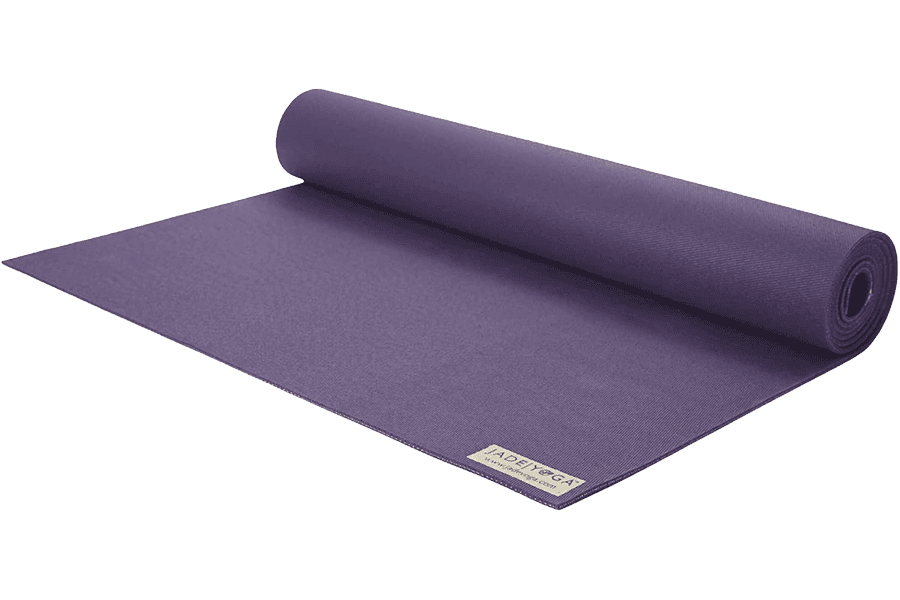
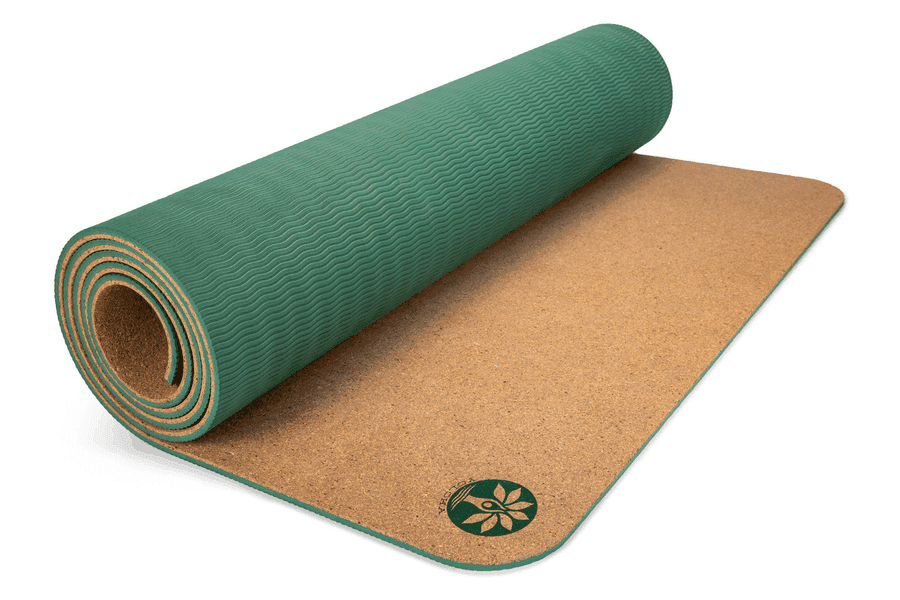
Both of these are made in the USA by companies that care loudly about materials, and both cost real money: $99.95 for the Jade Harmony, $159 for the Yoloha Unity Pro. That is where the agreement ends. The Harmony is open-cell natural rubber, tacky the moment you unroll it. The Yoloha is a cork and rubber top over a plant foam base, and cork grips best when there’s moisture on it.
That one property drives the rest. It’s why Yoloha suggests spritzing the mat with water before class, why the Harmony asks nothing of you on day one, and why the two mats end up in different rooms. If you’ve never practiced on cork, this is the page to read before spending $159 on it.
Grip: immediate versus earned
The Harmony is one of the most reliably grippy mats sold. Jade’s open-cell rubber absorbs light moisture instead of letting it sit on top, which is the quality Wirecutter credited when it praised the mat for holding traction in sweaty situations, and Jade advertises a Yoga Journal best-grip award for 2024. There is no warm-up period and no ritual.
The Yoloha needs a little help. OutdoorGearLab found it moderately grippy wet or dry and recommends spritzing water where your hands land at the start of practice to build traction, which matches Yoloha’s own advice. Once moisture is present the grip does improve. What cork doesn’t do is absorb: water stays on the surface, so GearLab’s testers kept a towel nearby once sweat began to pool, and listed slickness when wet among the mat’s drawbacks. It scored 7 of 10 for grip against a Liforme at 8 and a Manduka eKO at 9.
Rubber has a ceiling too. Soak a Harmony properly and it gets slippery like everything else. But across the wide middle of normal practice, the Harmony needs less managing than the cork.
Cushion: firm, and firmer
The Yoloha is thicker on paper, 6 mm against the Harmony’s 3/16 of an inch, which works out to about 4.8 mm. It doesn’t feel like a plusher mat. GearLab described the Unity Pro as extra-firm and rated it 7 of 10 for comfort and support, calling it one of the most stable bases it tested for practicing on uneven outdoor ground. Stability is the point, not softness.
The Harmony is firm with the gentle rebound rubber is loved for, and it lands in much the same place: fine for standing work, unremarkable under a kneeling lunge on a hard floor. If joints are your issue, neither of these is the answer. Jade’s 8 mm Fusion is the obvious fix on the Jade side, though it costs $15.95 more than the Yoloha.
Size and weight
The Yoloha is the bigger mat: 72″ × 26″ against the Harmony’s 68″ × 24″. Four inches of length and two of width is the difference between a standard cut and a roomy one, and Yoloha goes further still with 80″ and 84″ × 30″ versions. Nothing in Jade’s Harmony line is that wide except the 80″ × 28″ XW.
Weight runs the other way and it isn’t subtle: 7 pounds against 4.8. GearLab lists heft among the Yoloha’s downsides, and a mat that heavy tends to become a mat that stays home. If yours rides to a studio several times a week, two and a half pounds is worth more than two inches of width. Taller Jade buyers can add length cheaply with the 74″ Harmony at $109.95 and still carry less than the Yoloha.
Practicing outside: only one of these can
This is the cleanest reason to buy the Yoloha. Jade states plainly that its natural rubber mats are not intended for outdoor use and should not be exposed to sunlight, and sun damage is excluded from the warranty. That rules out deck sessions, park classes, and anything on a bright patio.
The Yoloha was one of GearLab’s favorites for exactly that, with its extra-firm build giving a stable platform on ground that isn’t level. The one caveat is indoors: testers found the underside tread grips most floors but can slide a little on very smooth surfaces like hardwood.
Wear, care, and what’s actually covered
Rubber softens and develops track lines where hands and feet rub the same paths into the surface. That’s normal for the material and it eventually retires every rubber mat, the Harmony included. Cork ages differently: it’s naturally antimicrobial, resists holding odor between cleanings, and doesn’t develop the same wear rails, though GearLab gave the Yoloha its lowest sub-score, 5 of 10, for care and cleaning, since nothing soaks in and everything has to be wiped off.
Coverage favors the cheaper mat. Jade warrants the Harmony for 1 year against defects and premature wear, excluding sun damage and harsh cleaners. Yoloha gives you 30 days to return the mat and nothing after that. Neither company is promising a decade, and both mats want the same treatment: no hot cars, no direct sun, gentle cleaners only.
Both eco stories hold up
Jade taps rubber from trees, manufactures in the United States, and plants a tree for every mat sold through Trees for the Future, past two million so far. Yoloha builds in the USA from cork, natural rubber, and a plant-based foam, and says the Unity Pro is 83% USDA-certified renewable materials. Neither claim is greenwashing, and there’s no winner here worth arguing about.
One health note applies to both. Jade says its mats are 99% latex free but may contain trace latex proteins and doesn’t recommend them for latex allergies. The Yoloha blends natural rubber into its cork top, so the same caution applies. Anyone with a genuine latex allergy should be looking at PVC or TPE instead.
Sizes, colors, and price
The Harmony comes in 68″ × 24″ at $99.95 in 12 colorways at last count, a 74″ version at $109.95, and the 80″ × 28″ XW at $149.95. The Yoloha comes in natural cork in three sizes: 72″ × 26″ at $159, 80″ × 26″ at $179, and 84″ × 30″ at $219. Cork looks like cork, so pattern choice mostly isn’t a Yoloha feature.
Check the current price of the Harmony at Amazon; the Yoloha sells through yolohayoga.com rather than Amazon, which also means no third-party discounting.
Bottom line
The Harmony is the better default. It grips from the first minute with no spritz bottle involved, it weighs two and a half pounds less, it comes with a year of coverage instead of a return window, and it costs about $60 less. For an indoor practice, in a studio or a living room, it does more of what most people want a mat to do.
Buy the Yoloha for reasons the Harmony can’t answer: you want to practice outdoors, you want a mat up to 84″ × 30″, you want a firm grounded platform rather than a springy one, or you simply want cork. Go in knowing the routine it asks for, a little water before class and a towel when you sweat hard, and it’s a mat you’ll enjoy. If you’re weighing cork against the other premium sweat mats, our Liforme vs Yoloha page runs that matchup.
Jade Harmony
List price $99.95
Yoloha Unity Pro Cork
List price $159
Frequently Asked Questions
- Which mat grips better?
- It depends on when you ask. Out of the box and through a normal practice, the Harmony: open-cell rubber is tacky immediately, absorbs light moisture, and Wirecutter praised it for holding traction in sweaty situations. The Yoloha needs help getting started. GearLab found the cork moderately grippy wet or dry and recommends spritzing water on it before practice to build traction, which is also what Yoloha suggests. Cork does improve as moisture arrives, but water sits on the surface rather than soaking in, so heavy sweat still calls for a towel.
- Is cork better than rubber for hot yoga?
- Not on this evidence. Cork's grip does wake up with a little moisture, but GearLab's testers kept a towel handy on the Yoloha once sweat started pooling, because the surface doesn't absorb it. Open-cell rubber like the Harmony's does absorb moisture, which is what makes it hold in damp practice, though it gets overwhelmed in a genuinely dripping class too. If heated classes are your normal practice, neither of these is the specialist choice; GearLab's hot yoga award went to the Manduka GRP Adapt 2.0.
- How much cushion does each one give you?
- Less than the numbers suggest, in both cases. The Harmony is 3/16 of an inch, about 4.8 mm, firm with the gentle spring natural rubber is known for. The Yoloha is 6 mm but extra-firm, and GearLab described it as one of the most stable bases it tested for practicing outside. Neither is a knee pillow. If kneeling work on a hard floor is what hurts, Jade's 8 mm Fusion is the answer on the Jade side.
- Which lasts longer, and what's actually covered?
- Jade covers the Harmony for 1 year against defects and premature wear, with sun damage and harsh cleaners specifically excluded. Yoloha gives you 30 days to return the mat and nothing after that. Rubber wears by softening and developing track lines where your hands and feet land, which is normal for the material; cork is naturally antimicrobial and resists odor between cleanings, which helps it age well as long as you keep it away from heat. On paper the cheaper mat has the better coverage.
- Can I use either mat outdoors?
- Only the Yoloha, and this is the clearest reason to buy one. Jade states plainly that its natural rubber mats are not intended for outdoor use and should not be exposed to sunlight, and sun damage voids the warranty. The Yoloha's extra-firm build was one of GearLab's favorites for practicing on uneven outdoor ground, though its underside tread can slide a little on very smooth floors like hardwood.
- Is this the same Harmony that reviewers keep testing?
- Check before you trust a review. This page covers the original Harmony, made in the USA, 68 by 24 inches, 3/16 of an inch thick, at $99.95. Jade also sells the Harmony 2.0, a different mat made in Spain and listed at $110, and that's the one that earned GearLab's Eco-friendly Dry Grip Powerhouse award at 78 of 100. The two share a name and a material, not a factory or a spec sheet.
Related comparisons
- JadeYoga Harmony 68" vs Suga SugaMat
- JadeYoga Harmony 68" vs Manduka eKO Lite
- Manduka PROlite vs JadeYoga Harmony 68"
- JadeYoga Harmony 68" vs Manduka GRP Adapt 1.0
- JadeYoga Harmony 68" vs Manduka eKO Lite Long
- Manduka PRO vs Yoloha Unity Pro Cork
- Manduka PRO Long vs Yoloha Unity Pro Cork
- JadeYoga Harmony 68" vs Lululemon The Mat 5mm
- JadeYoga Harmony XW vs Yoloha Unity Pro Cork