Gaiam Performance Dry-Grip vs Manduka PRO Travel: Which One Should You Buy?
Two PVC mats at almost the same price, both carrying lifetime coverage, and they could hardly be less alike to practice on. The Dry-Grip is 5 mm with a moisture-wicking topcoat, built to be a comfortable everyday mat. The PRO Travel is 2 mm of the dense German PVC from the PRO, built to fold into a suitcase. Four dollars apart, and the decision is entirely about where the mat lives.
As an Amazon Associate, we earn from qualifying purchases made through links on this page. How this works
The quick answer
For a home or studio mat, the Dry-Grip is the better buy. Five millimetres of PVC is comfortable enough that GearLab scored it 8 out of 10 for comfort and support, it grips from the first unroll, and Gaiam's lifetime guarantee costs you nothing extra. Its weakness is sweat: GearLab measured 6.5 dry and 3.5 wet, the second-lowest wet result in its 19-mat test.
The PRO Travel is the better object and the more specialised one. It folds flat, weighs 2.9 pounds, is OEKO-TEX Standard 100 certified, and carries the PRO series lifetime guarantee, which on a $74 mat is remarkable. It ships slick and takes a few weeks to come good, and at 2 mm a hard floor comes straight through.
Get the Gaiam Dry-Grip if...
- This is the mat you practice on at home
- You want 5 mm of cushion rather than 2
- You want grip that works from the first class
- You'd rather keep the $4 and get more mat for it
Get the Manduka PRO Travel if...
- You need a mat that folds flat into luggage
- You practice on carpet or on top of a studio mat
- You want German manufacturing and an OEKO-TEX certificate
- You want a mat that is still good in ten years
Side by side
Price
The Dry-Grip lists for about $4 less.
$69.98
List price · check price at Amazon
$74
List price · check price at Amazon
Thickness
The Dry-Grip is 150% thicker.
5 mm0.2″
2 mm0.08″
Weight
The PRO Travel is 1.4 lbs lighter.
4.25 lbs1.9 kg
2.9 lbs1.3 kg
Size
The PRO Travel is 3″ longer; same width.
Same on both
- PVC, so both are latex free
- Closed-cell: sweat sits on the surface rather than soaking in
- Lifetime coverage of some kind on both
- 24 inches wide
- Wipe clean in seconds
Full specs
Dimensions
Materials & build
Buying
Two PVC mats four dollars apart
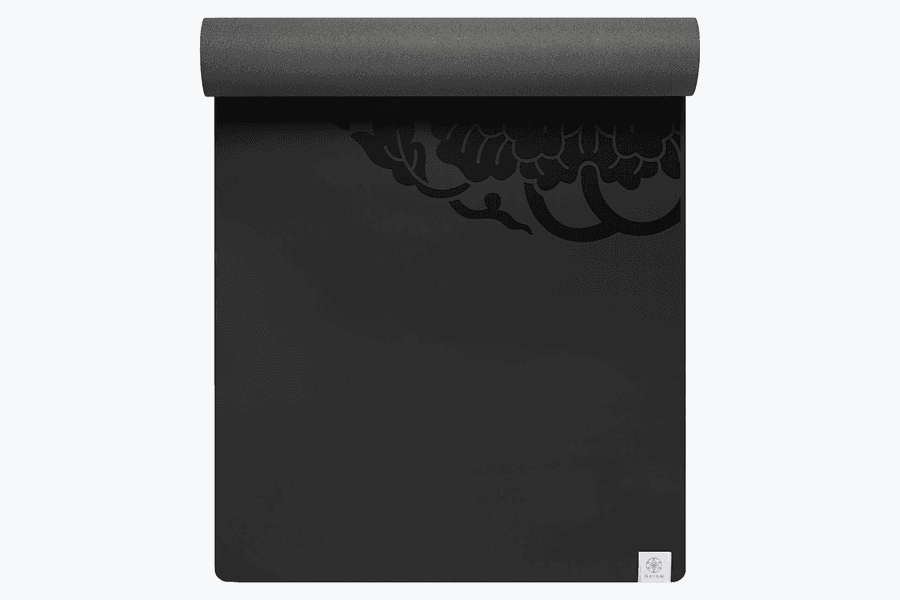
The Gaiam Performance Dry-Grip is 5 mm of PVC with a moisture-wicking topcoat, 68″ × 24″, at $69.98, with Gaiam’s lifetime guarantee.
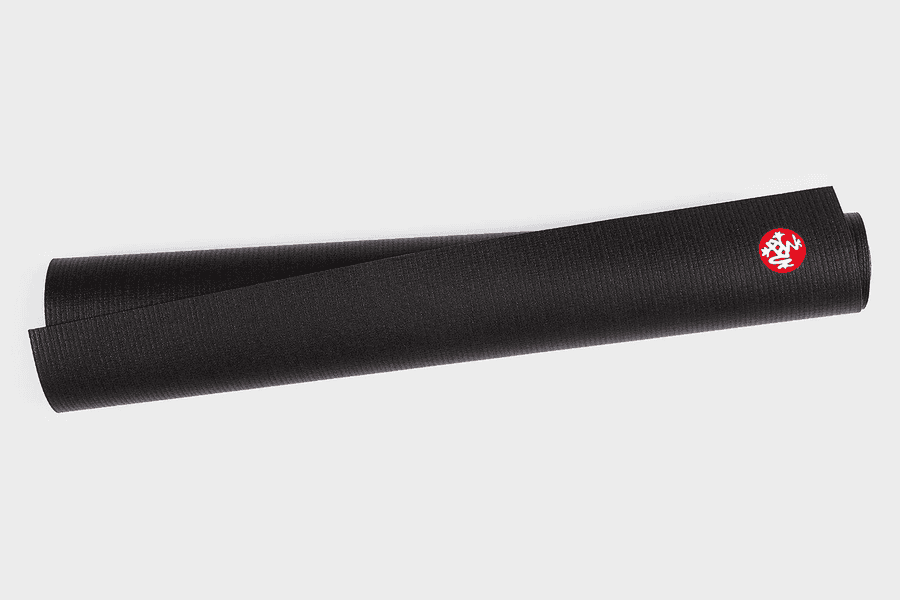
The PRO Travel is 2 mm of the dense German PVC that goes into the PRO, built to fold flat, at $74, with the PRO series lifetime guarantee. Same material family, same price bracket, and about as different to practice on as two PVC mats can be.
Five millimetres against two
The Dry-Grip has more than twice the material and GearLab scored it 8 out of 10 for comfort and support. For a mat you kneel on several times a week at home, that is the number that matters most, and it is the Gaiam’s strongest card.
The PRO Travel has no give at all. It is stable, so balances and inversions are fine, and on tile or hardwood the floor arrives straight through it. Over carpet or on top of a studio mat it is comfortable enough. It was designed to pack, not to be kind to joints.
One works tonight, one works in a month
The Dry-Grip’s topcoat works from the first unroll, which is worth something if you want to buy a mat and use it at the evening class. GearLab scored it 6.5 out of 10 for dry grip, which is fair: solid in a cool room.
The PRO Travel ships slick. Manduka has retired the salt-scrub advice it used to give and now says the slickness resolves with regular use, which is accurate and takes a few weeks of practice. Once it does, the surface is dependable and improves for years. Buy one the night before a trip and you will travel with a mat that has not come good yet.
Neither handles sweat, and one is named as if it does
Both are closed-cell PVC, so moisture pools on the surface with nowhere to go. GearLab measured the Dry-Grip at 3.5 out of 10 for wet grip, the second-lowest result among the nineteen mats in its test, which is a striking number given what is printed on the label. The topcoat helps early in a warm class and stops helping once you are genuinely sweating.
In a heated room, use a towel over either. If hot yoga is your main practice, an absorbent-topped or open-cell rubber mat is the category you want; our PRO against the GRP Adapt 2.0 covers what Manduka builds for that job.
Only one of them folds
The PRO Travel folds like a heavy towel and packs inside a suitcase. At 2.9 pounds it is the lightest mat Manduka makes, and it is the whole reason the mat exists. Fold marks show early and flatten out once you have practised on it a few times.
The Dry-Grip rolls. Gaiam lists it at 4.25 pounds, though GearLab weighed a sample at 5.4, which is worth knowing if you are buying on the spec sheet. It is an ordinary mat to carry and it does not go in luggage.
Two lifetime guarantees that are not the same
Manduka’s is the more specific. Its fine print works out to roughly ten years of regular use, one replacement per purchase, and proof of purchase from an authorized seller, which on Amazon means sold and shipped by Amazon itself rather than a marketplace seller. On a $74 mat that is unusual.
Gaiam advertises a lifetime guarantee too, and in practice it covers manufacturing defects rather than a topcoat that has worn smooth after a couple of years. That distinction matters here, because the topcoat is exactly what fails on this mat.
A coating against a material
The Dry-Grip’s grip lives on the surface, and coatings wear: GearLab scored its materials 4 out of 10, among the lowest in its test. The foam underneath is ordinary PVC, so when the topcoat goes the mat does not come back.
The PRO Travel’s surface is the material itself, dense PVC made in Germany and certified to OEKO-TEX Standard 100. It barely wears, it does not care about a hot car, and it is the sort of mat people still practice on a decade later. That is most of what you are buying at 2 mm.
Price and value
$69.98 against $74. Check the current Dry-Grip, where each of its three colors carries its own price, and the PRO Travel, which has a 79″ Long version at $84.
At four dollars apart, price is not the decision. The question is whether you are buying the mat you practice on or the mat you pack, because neither of these does both.
Bottom line
Get the Dry-Grip if this is the mat you practice on at home. Five millimetres is comfortable, it grips from day one, it is latex free, and the lifetime guarantee costs nothing extra. Be realistic about the name: it is a mat for a cool room.
Get the PRO Travel if you need something that folds into luggage. It is the better built object of the two, covered for a decade, German made and OEKO-TEX certified. Break it in at home first, and do not make it the mat you kneel on at home afterwards.
Frequently Asked Questions
- Does the PRO Travel need breaking in and the Dry-Grip not?
- That is the situation. The PRO Travel uses the PRO surface, which ships slick, and Manduka's current position is that the slickness resolves with regular use rather than with the salt scrub it used to recommend. It takes a few weeks of practice. The Dry-Grip's topcoat works from the first unroll. If you want a mat you can buy today and use tonight, that is a real point for the Gaiam.
- Are both lifetime guarantees the same thing?
- No. Manduka's is the more specific and the more useful: its fine print works out to roughly ten years of regular use, one replacement per purchase, and proof of purchase from an authorized seller, which on Amazon means sold and shipped by Amazon itself. Gaiam advertises a lifetime guarantee too, and in practice it covers manufacturing defects rather than a topcoat that has worn smooth, which is the failure you should expect.
- Which is better for hot yoga?
- Neither, and the Gaiam's name is misleading here. GearLab scored the Dry-Grip 3.5 out of 10 for wet grip, second-lowest in a 19-mat test, despite what is written on the label. Both mats are closed-cell PVC, so sweat pools on the surface with nowhere to go. In a heated room use a towel over either, or look at an absorbent-topped or open-cell rubber mat instead.
- Is 2 mm usable as a daily mat?
- Over carpet, yes. On tile or hardwood, not really. At 2 mm there is no give at all, so kneeling work gets uncomfortable fast, though the mat is perfectly stable for balances and inversions. The Dry-Grip gives you more than twice the material and is the better daily surface by some distance. The PRO Travel was designed to pack, not to be kind.
- Which one lasts longer?
- The Manduka. Dense PVC barely wears, it does not care about a hot car, and the surface is the material rather than a coating, so there is nothing to lose. The Dry-Grip's topcoat is its weak point, and GearLab scored its materials 4 out of 10, among the lowest in its test. Both should give you years; only one of them should still feel the same in year eight.
- Do either of these work with a latex allergy?
- Both do. They are PVC, with no natural latex in either, and the PRO Travel adds OEKO-TEX Standard 100 certification on top. That is worth knowing because most of the grippy mats people get steered towards are natural rubber, which contains latex and is off the list entirely if you have a genuine allergy.
Related comparisons
- Manduka X vs Gaiam Performance Dry-Grip 5mm
- JadeYoga Level One vs Gaiam Performance Dry-Grip 5mm
- Gaiam Performance Dry-Grip 5mm vs IUGA Eco Friendly Non Slip PU
- JadeYoga Travel 68" vs Manduka PRO Travel
- Manduka Begin vs Gaiam Performance Dry-Grip 5mm
- Gaiam Performance Dry-Grip 5mm vs Hugger Mugger Earth Elements 5mm
- Manduka GRP Adapt 1.0 vs Gaiam Performance Dry-Grip 5mm
- Gaiam Performance Dry-Grip 5mm vs Suga SugaMat
- JadeYoga Level One vs Manduka PRO Travel