Manduka PROlite vs Retrospec Solana 1": Which One Should You Buy?
One of these is five times thicker than the other, and the thick one is not the better yoga mat. The Solana 1" is a cushioning pad for floor work that gets marketed alongside yoga mats; the PROlite is Manduka's studio mat in a carryable cut. Deciding between them is really a question about what you do in a session.
As an Amazon Associate, we earn from qualifying purchases made through links on this page. How this works
The quick answer
The PROlite is 4.7 mm of dense closed-cell PVC at 4.6 pounds, made in Germany, OEKO-TEX certified, and covered by Manduka's lifetime guarantee. The Solana 1" is 25 mm of soft NBR foam with a ribbed surface and a carry strap for about $40, holding 4.5 stars across roughly 14,900 Amazon ratings.
If you flow, balance, or spend time standing, the PROlite is the mat and the inch of foam is actively unhelpful. If your practice is gentle, restorative or floor-based, or if you are using the mat for physio and stretching rather than yoga, the Solana is more comfortable and costs $72 less.
Get the Manduka PROlite if...
- You do standing poses, balances or vinyasa
- You want a firm surface that does not shift underfoot
- You want a mat you can carry that still lasts years
- You want Manduka's lifetime guarantee behind it
Get the Retrospec Solana 1" if...
- You want maximum padding for knees, hips and spine
- Your sessions are stretching, Pilates or physio work
- You want a strap included and 4 pounds to carry
- You'd rather keep about $72
Side by side
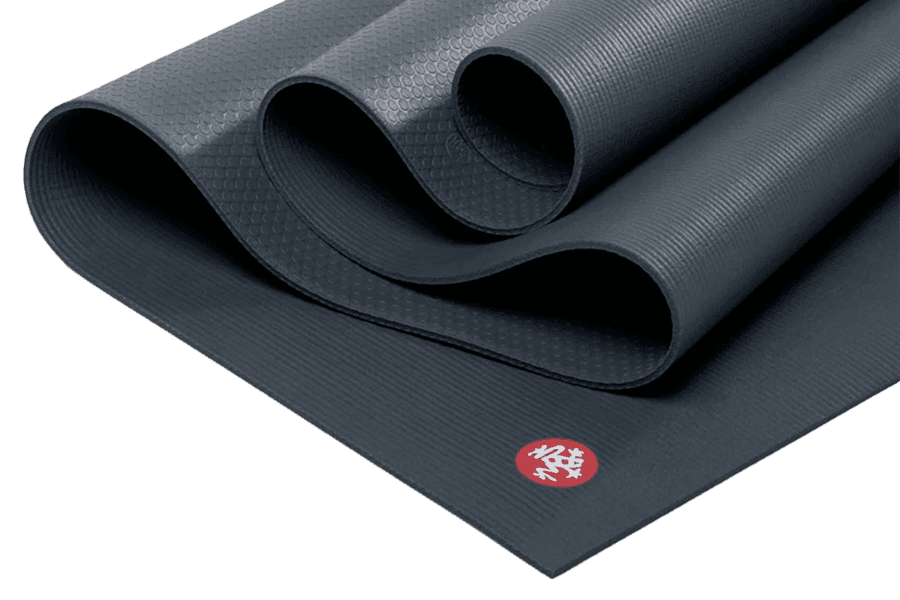
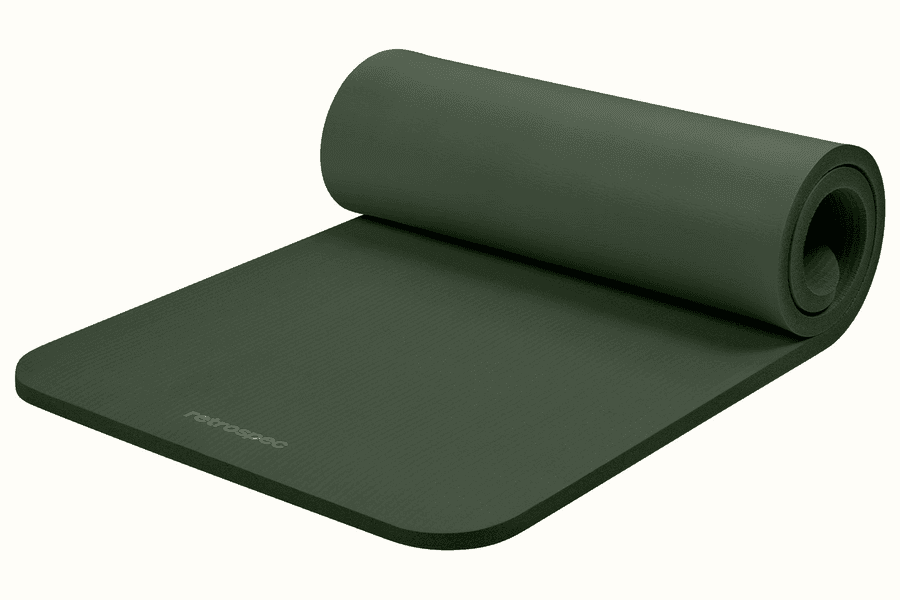
Price
The Solana 1" lists for about $72 less.
$112
List price · check price at Amazon
$39.99
List price · check price at Amazon
Thickness
The Solana 1" is 440% thicker.
4.7 mm0.19″
25.4 mm1″
Weight
The Solana 1" is 0.6 lbs lighter.
4.6 lbs2.1 kg
4 lbs1.81 kg
Size
The Solana 1" is 1″ longer; same width.
Same on both
- About 72 inches long and 24 inches wide
- Closed-cell, so sweat stays on the surface
- Both come with or take a standard carry strap
- Both want to stay out of direct sun
Full specs
Dimensions
Materials & build
Buying
A yoga mat and a floor pad
The Solana 1″ is five times thicker than a PROlite and about a third of the price. Those two facts sound like an argument for the cheap mat until you notice that the thickness is the problem rather than the selling point. An inch of soft NBR foam is a cushioning pad for floor exercise, and Retrospec’s own copy says as much.
The PROlite is Manduka’s studio mat in the cut people actually carry: 4.7 mm of dense PVC at 4.6 pounds, made in Germany, for $112.
Why an inch of foam undermines standing work
Soft foam that deep compresses differently under your heel than under the ball of your foot, so the surface tips as you shift, and your ankle spends the pose managing the mat. Balance holds get harder for reasons that have nothing to do with your balance improving.
The PROlite does not deflect. That is what people mean when they call Manduka mats stable, and it is why the same material scored a perfect 10 for comfort and support when GearLab tested the PRO in 2026. Firmness reads as support once you are standing on one leg.
What the Solana is genuinely good at
Kneeling, lying, rolling and anything where a hard floor is the enemy. For physio exercises, core work on your back, seated practice or general stretching, an inch of foam is a real comfort and no yoga mat comes close. Retrospec leads its listing with mat Pilates, somatic stretching and floor workouts, which is an accurate account of the job.
The PROlite in those same shapes is firm. Not punishing, but firm. A folded blanket under a knee costs nothing and solves most of it without softening the whole mat.
Dense PVC against NBR foam
Manduka’s PVC is unusually dense, closed-cell, made in a German facility and certified to OEKO-TEX Standard 100. It is heavy for its thickness on purpose, and it is close to indestructible; GearLab found testers still using the same PRO after 20 years.
NBR is nitrile butadiene rubber foam, the material in gym mats and camping pads. Light, cheap, extremely cushioned, and it dents permanently where weight sits. It also comes out of the wrapper smelling strongly, which is why Retrospec asks you to air it for a day or two.
Grip: neither is the answer to sweaty hands
Both are closed-cell, so sweat has nowhere to go. The PROlite adds a wrinkle: it is genuinely slick for the first few weeks out of the box, and Manduka now says regular use resolves that rather than a salt scrub. Once broken in it grips well dry and moderately when damp.
The Solana’s ribs hold a dry foot and lose the argument the moment your palms are wet. If a heated room is your normal practice, look at natural rubber or an absorbent top instead, such as the mats we cover in our PROlite vs GRP Adapt 2.0 comparison.
Carrying and storage
The Solana is 4 pounds and ships with a nylon strap, but an inch-thick mat rolls into a fat cylinder that is awkward to carry and awkward to store, however light it is. It does not tuck behind a door the way a thin mat does.
The PROlite is 4.6 pounds and rolls tight, which is the whole reason it exists alongside the 7.5 pound PRO. For a mat that travels to a studio a few times a week, that matters more than the raw weight number suggests.
Ten years against six months
Manduka’s lifetime guarantee amounts in the fine print to roughly ten years of regular use, one replacement, and proof of purchase from an authorized seller. Amazon purchases qualify only when the mat is sold and shipped by Amazon itself, so check the listing before ordering.
Retrospec puts yoga mats in the general category of its warranty policy: six months against manufacturing defects, with a 30 day return window for unused product. Foam denting is wear rather than a defect, so it is not covered.
Sizes
The PROlite comes in a 68″ Short, this 71″ standard, a 79″ Long and a 79″ × 30″ Long & Wide, which is the widest mat Manduka makes outside its studio sizes. Step up to the PRO for 6 mm and 26 inches across, at 7.5 pounds.
Retrospec offers the Solana only at 72″ × 24″, in one inch and half inch. If you like the foam but want to stand on it occasionally, the half inch is the version to buy.
Price and value
List prices are $112 and $39.99. Check the current price on the PROlite and the Solana 1″ at Amazon, where the Solana holds 4.5 stars across roughly 14,900 ratings.
Read those reviews and most of the enthusiasm is about knee comfort and home workouts rather than yoga. As a $40 exercise pad it is excellent value. As a $40 yoga mat it is the wrong product, and the half inch version is the one to look at instead.
Bottom line
Buy the Manduka PROlite if you practice yoga. It is firm, stable, carryable and built to last a decade, and its only real flaw is the slick surface it arrives with.
Buy the Retrospec Solana 1″ if your joints need serious padding and your session happens on the ground. If you want both cushion and some stability, the half inch Solana is the compromise, or a 6 mm yoga mat with a knee pad.
Manduka PROlite
List price $112
Retrospec Solana 1"
List price $39.99
Frequently Asked Questions
- Can you do yoga on an inch of foam?
- You can, and it is harder than it should be. On 25 mm of soft NBR your standing foot sinks unevenly, so your ankle spends the pose stabilising the mat instead of you, and poses like tree and half moon get wobbly for reasons that have nothing to do with your balance. Retrospec's own copy leads with stretching, mat Pilates and somatic work, which is an accurate description of the job.
- Is the PROlite just a thinner PRO?
- Broadly, yes. Same closed-cell PVC, same German factory, same OEKO-TEX certification and the same lifetime guarantee, at 4.7 mm instead of 6 and 24 inches wide instead of 26. It weighs 4.6 pounds against the PRO's 7.5, which is why so many people carrying a mat to class end up on the PROlite. The firmness is very similar; you notice the missing width more than the missing millimetre.
- Which one handles sweat better?
- Neither is good, and the PROlite is the less bad of the two. Both are closed-cell, so sweat sits on top rather than being absorbed. The PROlite is also slick when new until it breaks in with use. The Solana's ribbed foam is unpredictable once damp. For a heated room, look at natural rubber or an absorbent-top mat, or put a towel over whatever you buy.
- How long will each last?
- The PROlite is built on the same PVC that has kept PROs in service for decades, and Manduka's lifetime guarantee works out to roughly ten years of regular use with one replacement and proof of purchase from an authorized seller. Retrospec warrants defects for six months and takes returns for 30 days. Soft NBR foam takes permanent dents where your weight lands, usually within the first year of steady use.
- Is there a Retrospec mat that suits yoga better?
- The half inch Solana, at about $25. It is the same foam and the same 72 by 24 footprint with less give, and Retrospec markets it as the more stable of the pair. It is still soft compared with a real yoga mat, but it is a much more sensible choice than the full inch if any part of your session involves standing up.
- Does the PROlite come in other sizes?
- Yes: a 68 inch Short, a 79 inch Long, and a 79 by 30 inch Long & Wide. If you want more thickness and width in the same construction, the standard PRO is 6 mm and 26 inches wide at $144. The Solana only comes as 72 by 24 in half inch and one inch.
Related comparisons
- Manduka PROlite vs JadeYoga Harmony 2.0 68"
- Amazon Basics 1 Inch Extra Thick vs Retrospec Solana 1"
- Manduka PROlite vs JadeYoga Harmony 74"
- Manduka PROlite vs Lululemon The Mat 5mm
- Manduka PROlite vs JadeYoga Harmony 68"
- Manduka PROlite vs b, halfmoon B Mat Everyday 4mm
- Manduka PROlite vs Suga SugaMat
- Manduka PROlite vs Yoga Design Lab Combo 3.5mm
- Manduka PROlite vs Lululemon The (Big) Mat 5mm