Manduka PROlite vs eKO Lite: Which One Should You Buy?
These are Manduka's two commuter mats, and they share everything except what they're made of. Both are 71" × 24" and light enough to carry daily. The PROlite is 4.7 mm of dense PVC that starts slick, lasts decades, and carries the lifetime guarantee. The eKO Lite is 4 mm of natural rubber that grips immediately, costs $16 less, and comes with no warranty at all. Identical footprint, opposite materials; that's the whole decision.
As an Amazon Associate, we earn from qualifying purchases made through links on this page. How this works
The quick answer
The PROlite is the long-haul pick: denser cushioning, a surface that improves for years, and the guarantee to back it. Its cost is the break-in, a few weeks of slickness before the grip arrives. The eKO Lite is $16 cheaper and pleasant from the first class, with rubber's warm, tacky feel, but its 4 mm of softer material gives less under the knees, wears faster, and is covered by nothing past 30 days.
For a mat you plan to practice on for years, the PROlite is the better $112. Get the eKO Lite if immediate grip or the natural material matters more to you than longevity, and go in expecting to replace it eventually.
Get the PROlite if...
- You want a mat that lasts decades, with the guarantee to match
- You want the denser, more protective 4.7 mm cushion
- You want zero care rules: sun, hot cars, any cleaner
- You can wait out a few slick weeks up front
Get the eKO Lite if...
- You want real grip on day one, no break-in
- You'd rather keep the $16
- You prefer natural rubber over PVC
- You're fine replacing the mat every few years
Side by side
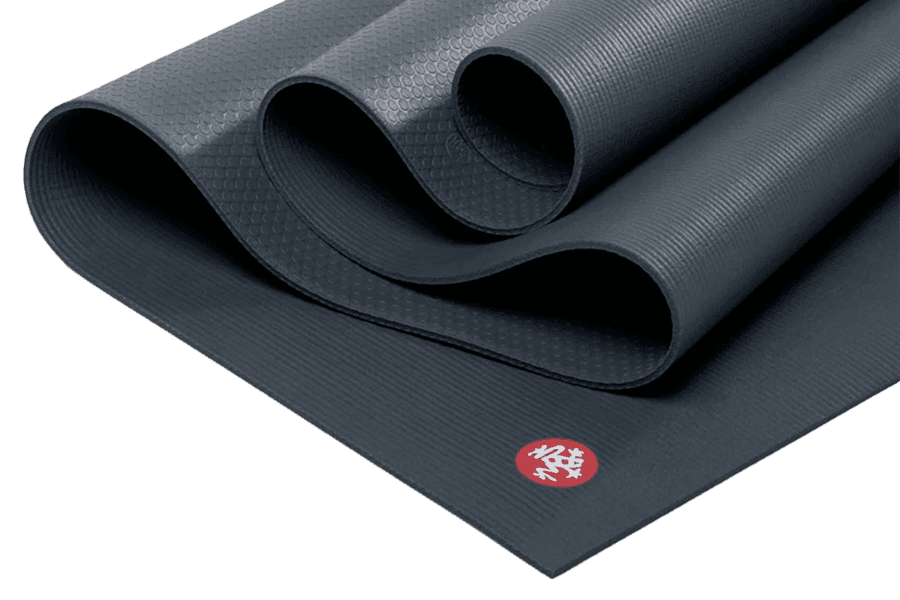
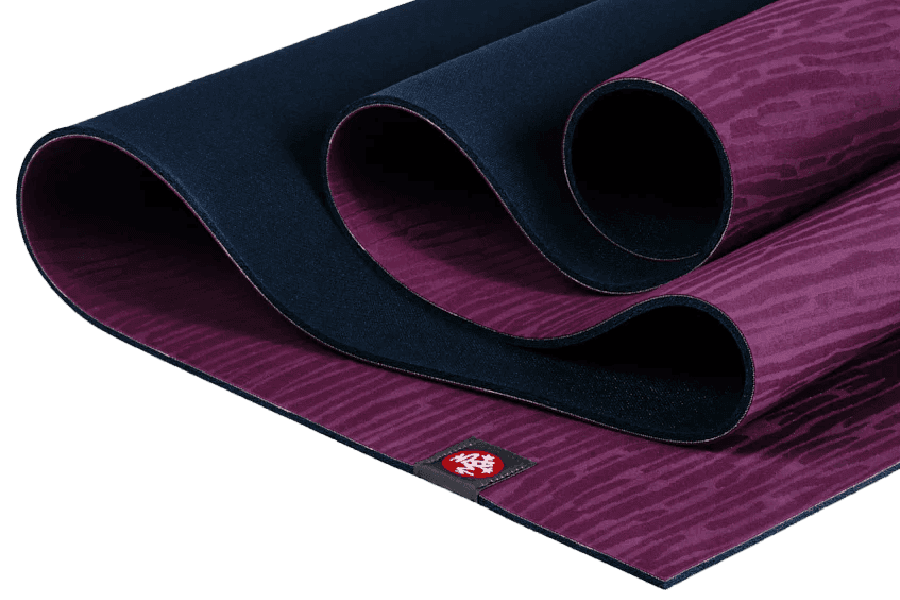
Price
The eKO Lite lists for $16 less.
$112
List price · check price at Amazon
$96
List price · check price at Amazon
Thickness
The PROlite is 18% thicker.
4.7 mm0.19″
4 mm0.16″
Weight
The PROlite is 0.4 lbs lighter.
4.6 lbs2.1 kg
5 lbs2.2 kg
Size
Same length; same width.
Same on both
- Same 71" × 24" footprint
- Made by Manduka
- Closed-cell surface (sweat can't soak in)
- Light enough to carry to class
- Lies flat without curling
Full specs
Dimensions
Materials & build
Buying
Same footprint, different chemistry
Manduka makes exactly two mats for people who carry their practice around town, and these are them. Both measure 71″ × 24″. Both roll light enough for a daily commute. From there they split at the molecular level: the PROlite is 4.7 mm of dense German PVC at $112, the eKO Lite is 4 mm of Taiwanese natural rubber at $96.
Because the sizes cancel out, this comparison is about texture, lifespan, and sixteen dollars. It’s the cleanest look at what Manduka’s two materials are like to own, without weight or footprint muddying the picture.
Grip: instant versus earned
The eKO Lite’s case starts strong: unroll it and it grips. The rippled rubber surface is tacky under dry palms from the first class, and it feels warmer and more organic than PVC ever will. For a first serious mat, that immediacy counts for a lot.
The PROlite starts as the worst version of itself. New, the surface is slick enough to annoy; Manduka used to suggest a sea-salt scrub and now just says use wears it in, which matches owner experience at a few weeks of steady practice. The payoff for waiting is a dry grip that gets better every year the mat ages.
On sweat, the two tie, and not in a good way. Closed-cell surfaces keep moisture on top, so once palms are wet both mats get slippery and a towel becomes standard equipment. Hot yoga regulars should read our PROlite vs Jade Harmony comparison instead; open-cell rubber is the tool for that job.
Cushioning: 0.7 mm on paper, more in practice
The spec gap looks trivial, 4.7 mm against 4, but the materials widen it. The PROlite’s PVC is dense, so kneeling weight sits on top of it; the eKO Lite’s rubber is softer and compresses further under the same knee, leaving less between you and the floor. On a wood studio floor either is fine. On tile or concrete, the PROlite is noticeably the more protective mat, and neither is generous enough for chronically sore knees; that buyer should step up to a 5 to 6 mm mat like the eKO or the PRO.
Balance work flips the coin. The eKO Lite’s slight give makes standing poses feel marginally softer underfoot, while the PROlite offers the more stable platform. Both are firm mats by the standards of the foam sold at big-box stores.
Weight and carry: a near tie
Four tenths of a pound separate them, 4.6 for the PROlite against 5 for the eKO Lite, and both roll to the same slim 24″ cylinder. Nobody will pick a winner on the walk to class. That’s worth pausing on, because it makes this pair unusual: in most PVC-versus-rubber matchups the rubber mat is drastically heavier, and here Manduka has genuinely built the same size mat twice. Cross weight off the list and move on.
Durability is where the $16 comes back
The PROlite belongs to the PRO series, which means it gets Manduka’s lifetime guarantee: roughly 10 years of regular use in the fine print, one replacement, proof of purchase from an authorized seller (Amazon counts when sold and shipped by Amazon). The material backs the promise; this closed-cell PVC construction routinely shows up in GearLab reporting at five to twenty years old and still serviceable.
The eKO Lite gets a 30 day return window, full stop. Rubber wears with use, and 4 mm gives it less to wear through than the standard eKO’s 5; daily practitioners commonly report visible surface wear within a few years. It also carries rubber’s care sheet: no direct sun, no harsh cleaners, no hot cars. The PROlite has no care sheet worth mentioning.
Materials and conscience
The eKO Lite is the pick if the material is the point. Tapped rubber is renewable, the current eKO line is built with over 30% recycled content, and it sidesteps PVC, which has no real recycling path. The PROlite’s answer is OEKO-TEX Standard 100 certification and sheer lifespan; a mat replaced once a decade generates less waste than one replaced every three years, whatever it’s made of. Both positions are defensible. Pick the one that matches how you actually treat your gear.
Sizes and colors
The PROlite family is the deeper bench: 68″ Short, this 71″ standard, the 79″ Long, and a 79″ × 30″ Long & Wide, with around 13 colorways at last count, including grommeted hanging editions. The eKO Lite comes in this size and a 79″ × 24″ Long, with about 8 colors on the standard cut. Solid selection on both sides; the PROlite just offers more directions to grow.
Price and value
List prices sit at $112 and $96. Colorway sales move both around, so check the current price on the PROlite and the eKO Lite before deciding; the gap sometimes shrinks to nothing.
At list, the $16 premium buys the guarantee, the denser cushion, and years of extra surface life. Spread over a decade, one $112 PROlite comes out well ahead of replacing a $96 rubber mat every three or four years. The eKO Lite’s counteroffer is cheaper entry and a better first month, which is a fair pitch to anyone still finding out whether the habit sticks.
Bottom line
The PROlite is the better buy for an established practice. Same size, same carryability, more protection under the knees, and a lifespan measured in decades with Manduka’s name on the promise. Sit out the slick first weeks and it’s the last commuter mat you’ll shop for in a long time.
The eKO Lite earns its place with people who want rubber underfoot and grip without a waiting period, or who’d rather spend $96 finding out if yoga sticks than $112 assuming it will. It’s the friendlier mat on day one and the more disposable one by year three. Know which trade you’re making and neither purchase disappoints.
Manduka PROlite
List price $112
Frequently Asked Questions
- What's the difference between the eKO and the eKO Lite?
- Size and heft. The standard eKO is 5 mm thick, 26" wide, and 7 pounds; the eKO Lite trims that to 4 mm, 24", and 5 pounds, and costs $18 less at $96. Same natural rubber, same closed-cell surface, same grip. The Lite is the one to carry to class; the standard eKO is the one to leave on the floor at home.
- Which grips better, the PROlite or the eKO Lite?
- For the first month, the eKO Lite, easily. Its rubber surface is tacky from the first practice, while a new PROlite is slick until regular use breaks it in; Manduka's current advice is simply to keep practicing. From then on the PROlite's dry grip is very good and keeps improving. Both are closed-cell, so a sweaty class wants a towel on either mat.
- Does the eKO Lite have a warranty?
- No. Manduka's lifetime guarantee covers the PRO series only, so the PROlite qualifies and the eKO Lite doesn't. eKO Lite buyers get the standard 30 day return window. That gap is worth weighing at these prices: the $16 you save buys a mat its own maker won't promise anything about after the first month.
- Is 4 mm enough cushioning for sensitive knees?
- It's the thin end of comfortable. The eKO Lite's 4 mm of rubber has some give, but kneeling poses on concrete or tile come through, and the PROlite's 4.7 mm of denser PVC protects noticeably better despite the small number gap. If your knees complain regularly, both of these are compromises; a 5 to 6 mm mat like the eKO or the PRO is the safer bet.
- Which is better for hot yoga, the PROlite or the eKO Lite?
- Neither is the right tool for serious sweat. Both are closed-cell surfaces, so moisture stays on top; the eKO Lite stays grippier a little longer as things get damp, but a dripping class defeats both, and a towel fixes both. If hot yoga is your main practice, an open-cell rubber mat like the Jade Harmony handles sweat better than either.
- Which is the better value over time?
- The PROlite, unless the eKO Lite's day-one feel wins you over. Spread over a decade of use, the PROlite's $112 works out cheaper than replacing a $96 rubber mat every three or four years, and the guarantee covers early failures. The eKO Lite's value case is upfront: less money, no break-in, and a material you may simply prefer.
Related comparisons
- Manduka PROlite vs JadeYoga Harmony 2.0 68"
- Manduka PROlite vs JadeYoga Harmony 74"
- JadeYoga Harmony 68" vs Manduka eKO Lite
- Manduka PROlite vs Lululemon The Mat 5mm
- Manduka eKO Lite vs Suga SugaMat
- Manduka PROlite vs JadeYoga Harmony 68"
- Manduka PROlite vs b, halfmoon B Mat Everyday 4mm
- Manduka PROlite vs Suga SugaMat
- Manduka eKO Lite vs Lululemon The Mat 3mm