Manduka PROlite vs Jade Fusion: Which One Should You Buy?
Both of these are firm, serious mats, and they spend their build budgets on opposite things. The Manduka PROlite spends its on being light and lasting: 4.6 pounds of dense closed-cell PVC with a lifetime guarantee. The Jade Fusion spends its on cushion: 8 mm of springy open-cell rubber, Jade's thickest mat, with the best-tested grip in the business. The Fusion costs $63 more, weighs almost twice as much, and is 3 inches shorter, so this comes down to what your joints and your commute actually need.
As an Amazon Associate, we earn from qualifying purchases made through links on this page. How this works
The quick answer
The PROlite is the practical pick: lighter by 3.4 pounds, cheaper by $63, longer by 3 inches, indifferent to sun and neglect, and built to outlast several Fusions with Manduka's guarantee behind it. Its costs are a slick break-in month and a surface that pools sweat. The Fusion is the comfort pick: 8 mm of cushioned natural rubber that OutdoorGearLab rated best-in-test for traction and perfect for comfort, wonderful under sensitive knees, with a 1 year warranty, real care rules, and no interest in leaving the house at 8 pounds.
Get the PROlite if your mat commutes or you're buying for the decade. Get the Fusion if bone-on-floor pain is the problem you're solving; nothing mainstream cushions a knee better, and that's worth its premium to the right buyer.
Get the PROlite if...
- Your mat rides to class, and 4.6 pounds beats 8
- You want one mat for ten years, guaranteed on paper
- You're between five foot eight and five foot eleven, where the Fusion's 68" runs short
- You'd rather keep $63, or latex is a concern
Get the Fusion if...
- Kneeling and floor work hurt on thinner mats
- Your practice leans restorative, yin, or Pilates
- You want tested-best grip from the first class
- The mat lives at home, away from sunlight
Side by side
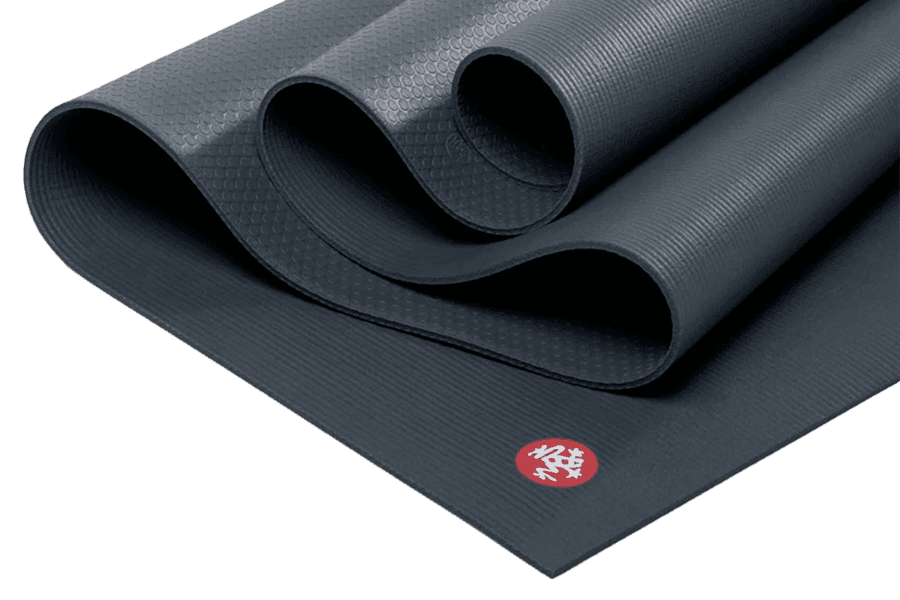
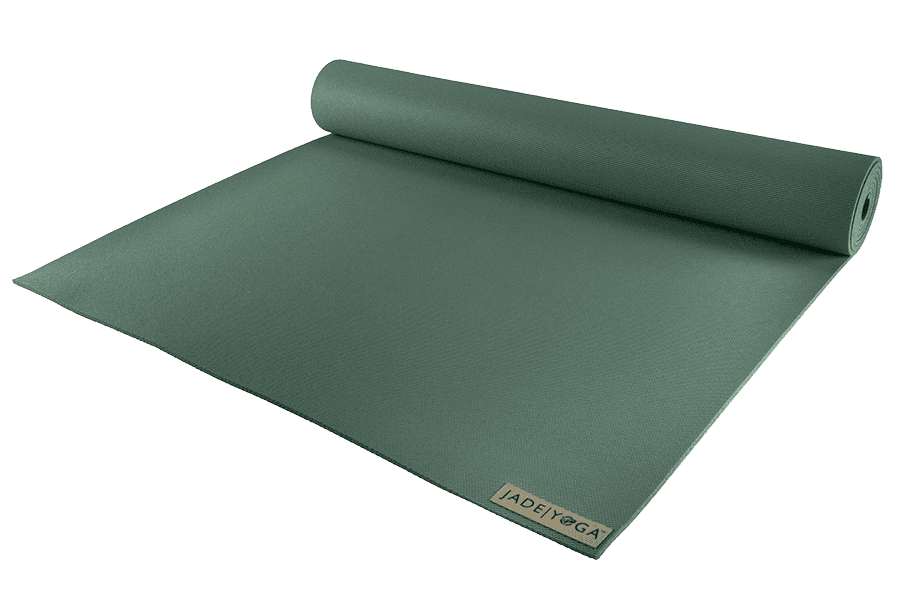
Price
The PROlite lists for about $63 less.
$112
List price · check price at Amazon
$174.95
List price · check price at Amazon
Thickness
The Fusion is 70% thicker.
4.7 mm0.19″
8 mm0.31″
Weight
The PROlite is 3.4 lbs lighter.
4.6 lbs2.1 kg
8 lbs3.6 kg
Size
The PROlite is 3″ longer; same width.
Same on both
- 24" wide
- Firm enough for balance poses
- Lies flat without curling
Full specs
Dimensions
Materials & build
Buying
A light classic against Jade’s thick specialist
These two took the same firm-mat philosophy in opposite directions. Manduka built the PROlite by thinning its dense PVC down to a carryable 4.6 pounds without losing the stability or the lifetime guarantee. Jade built the Fusion by pouring on more of its natural rubber, 8 mm of it, until the result cushions like nothing else mainstream, at 8 pounds and $174.95.
The $63 price gap runs the direction you might not expect: the rubber mat with the 1 year warranty costs more than the PVC mat guaranteed for a decade, and the pricier mat is also 3 inches shorter. None of that is a scandal; it just means the Fusion only makes sense when its cushioning is the exact thing you came shopping for.
Cushioning: the Fusion’s reason to exist
The Fusion carries 8 mm of open-cell rubber with real spring to it, and the results are hard to argue with: OutdoorGearLab scored it perfect for comfort and noted it smooths out uneven floors, and Yoga Journal has named it a best thick mat. For kneeling lunges, hip openers, long yin holds, and Pilates floor work, it’s the best mainstream surface we know of. Sensitive joints feel the difference on the first practice.
The PROlite’s 4.7 mm of dense PVC supports rather than cushions: it barely compresses, which keeps knees off the floor better than the number suggests and makes balance poses rock steady. But there is no spring in it, and practitioners who hurt on thin mats will still hurt on this one. If that sentence describes you, this comparison is already over in the Fusion’s favor.
Grip: tested best vs broken in
OutdoorGearLab called the Fusion’s traction the best of any mat it tested, wet or dry, and it works from the first class with nothing to break in. Light sweat soaks into the open-cell surface instead of pooling under your palms. The PROlite starts from the back of the pack: slick out of the box, a few weeks of regular practice before the grip arrives, and a closed-cell surface that pools sweat forever after. Broken in and dry, it grips well and keeps improving with age, which is a fine second place.
The Fusion’s asterisk is drying. GearLab found a soaked Fusion can take 2 to 3 days to dry fully, and sunning it dry isn’t an option because sunlight damages the rubber. An occasionally sweaty practice absorbs into that schedule fine; a hot practice several times a week does not, and a towel over either mat is the honest answer there.
One of these is a commuter, and it isn’t close
The PROlite weighs 4.6 pounds and was designed to be the Manduka you actually carry: standard roll, fits every bag and cubby, indifferent to a hot trunk or a sunny corner. The Fusion weighs 8 pounds, rolls into a fat cylinder that GearLab scored 3 out of 10 for portability, and its rubber can’t wait in a car or work outdoors. If your mat’s week includes commutes, the Fusion isn’t really a candidate, whatever your knees say.
The expensive mat is the short one
Worth pausing on: the standard Fusion is 68″ × 24″, 3 inches shorter than the PROlite at the same width. Between about five foot eight and five foot eleven, the PROlite covers you in savasana and the Fusion doesn’t. Jade’s fix is the Fusion 74″ at $199.95; Manduka’s taller option is the 79″ PROlite Long at $124. Going long costs $12 on the Manduka side and $25 on Jade’s, from very different starting points.
Ten guaranteed years vs a mat with rules
The PROlite’s closed-cell PVC barely wears; GearLab keeps finding the construction in service after five to twenty years, and Manduka’s lifetime guarantee makes the claim contractual: roughly ten years of regular use, one replacement per purchase, proof of purchase from an authorized seller, Amazon included when sold and shipped by Amazon. Care is an occasional wipe.
The Fusion is natural rubber, and owning one means accepting its rules: no sun, no car storage, no harsh cleaners, damp cloth or diluted vinegar only, real drying time after sweaty sessions. Follow them and the mat serves for years; heavy daily use still softens and sheds the surface eventually, and Jade’s 1 year warranty, sun damage excluded, prices the expectation. GearLab scored its ease of care 4 out of 10, mostly for the drying.
Materials, trees, and the latex line
The Fusion has the better material story if that drives your buying: tapped-tree rubber, no PVC or synthetic rubber in the mat, made in the USA, and a tree planted per mat sold, a Jade program past two million trees. The PROlite is PVC with no practical recycling path; its answers are OEKO-TEX Standard 100 certification and the argument that one fifteen-year mat out-greens a parade of five-year ones. The hard line is allergy: Jade mats are 99 percent latex free, not latex free, so latex-sensitive practitioners should take the PROlite and skip the debate.
Price and value
List prices are $112 for the PROlite and $174.95 for the Fusion; Jade raised Fusion prices within the last couple of years, so ignore older reviews quoting $150 or less. Check current prices on the PROlite and the Fusion before deciding.
Per year of ownership the PROlite wins from both ends, cheaper up front and lasting several times longer. The Fusion’s value lives entirely in the practice experience: the cushion and the grip, every session, starting today. For a body that needs them, that beats any cost-per-year arithmetic; for a body that doesn’t, the $63 buys weight and rules.
Bottom line
Get the PROlite as the default. It’s cheaper, longer, less than 60 percent of the Fusion’s weight, immune to neglect, and the only mat here you’ll plausibly never replace. Its slick first month is a real annoyance that ends.
Get the Fusion for your joints, and only for your joints. If kneeling on a standard mat hurts, nothing mainstream fixes that better than 8 mm of springy rubber with the best-tested grip in the category, and the price, weight, and care rules are what that fix costs. Keep it home, keep it out of the sun, and it will earn its keep every practice.
Manduka PROlite
List price $112
Jade Fusion
List price $174.95
Frequently Asked Questions
- Is the Jade Fusion worth $63 more than the PROlite?
- Only if cushioning is the reason you're shopping. The Fusion's 8 mm of springy rubber is the best mainstream answer to knee and hip pain on hard floors, and OutdoorGearLab gave it a perfect comfort score. If your joints are fine on a standard mat, the money buys weight you'll carry and care rules you'll follow, while the cheaper PROlite lasts years longer and covers more of your body at 71 inches to the Fusion's 68.
- Isn't the thicker Fusion automatically better for bad knees?
- For kneeling and floor work, genuinely yes; 8 mm of firm, springy rubber protects bone-on-floor contact better than 4.7 mm of anything, and that's the Fusion's core audience. The gap narrows in standing and balance work, where the PROlite's dense PVC is just as stable. If your pain shows up in low lunges and hip openers, the Fusion earns its price; if it shows up nowhere, it won't.
- Which mat grips better?
- The Fusion, by testing and by a wide margin at the start. OutdoorGearLab called its traction the best of any mat they tested, wet or dry, with no break-in period. The PROlite ships slick and needs a few weeks of regular practice before its grip arrives; broken in and dry it holds well, but its closed-cell surface pools sweat where the Fusion absorbs it. The Fusion's catch: once soaked, it can take 2 to 3 days to fully dry.
- Can either mat commute to a studio?
- The PROlite is built for exactly that: 4.6 pounds, standard roll, no rules about car trunks or sunny windows. The Fusion is not; it weighs 8 pounds, rolls into a fat cylinder that GearLab scored 3 out of 10 for portability, and its natural rubber can't sit in a hot car or direct sun without damage. Treat the Fusion as a home mat and this pairing sorts itself quickly.
- Which lasts longer?
- The PROlite, by years. Its closed-cell PVC is the construction GearLab keeps finding in service after five to twenty years, and Manduka's lifetime guarantee, roughly ten years of regular use with one replacement in the fine print, stands behind it. The Fusion's rubber softens and sheds under heavy use, sweat accelerates it, and Jade's warranty runs 1 year with sun damage excluded. On the more expensive mat, that's the trade to go in knowing.
- What if I'm sensitive to latex or want the greener mat?
- Those pull in opposite directions here. The Fusion is tapped-tree natural rubber with no PVC in the mat, made in the USA, and Jade plants a tree per mat sold, past two million; that's the stronger material story. But Jade mats are 99 percent latex free, not latex free, so a latex allergy rules the Fusion out. The PROlite is latex-free PVC with OEKO-TEX Standard 100 certification, and its durability is its own environmental argument.
Related comparisons
- Manduka PROlite vs JadeYoga Harmony 2.0 68"
- Manduka PROlite vs JadeYoga Harmony 74"
- Manduka PROlite vs Lululemon The Mat 5mm
- Manduka PROlite vs JadeYoga Harmony 68"
- Manduka PROlite vs b, halfmoon B Mat Everyday 4mm
- Manduka PROlite vs Suga SugaMat
- Manduka PROlite vs Yoga Design Lab Combo 3.5mm
- Manduka PROlite vs Lululemon The (Big) Mat 5mm
- Manduka PROlite vs Lululemon The Mat 3mm